World Briefing Hot Take
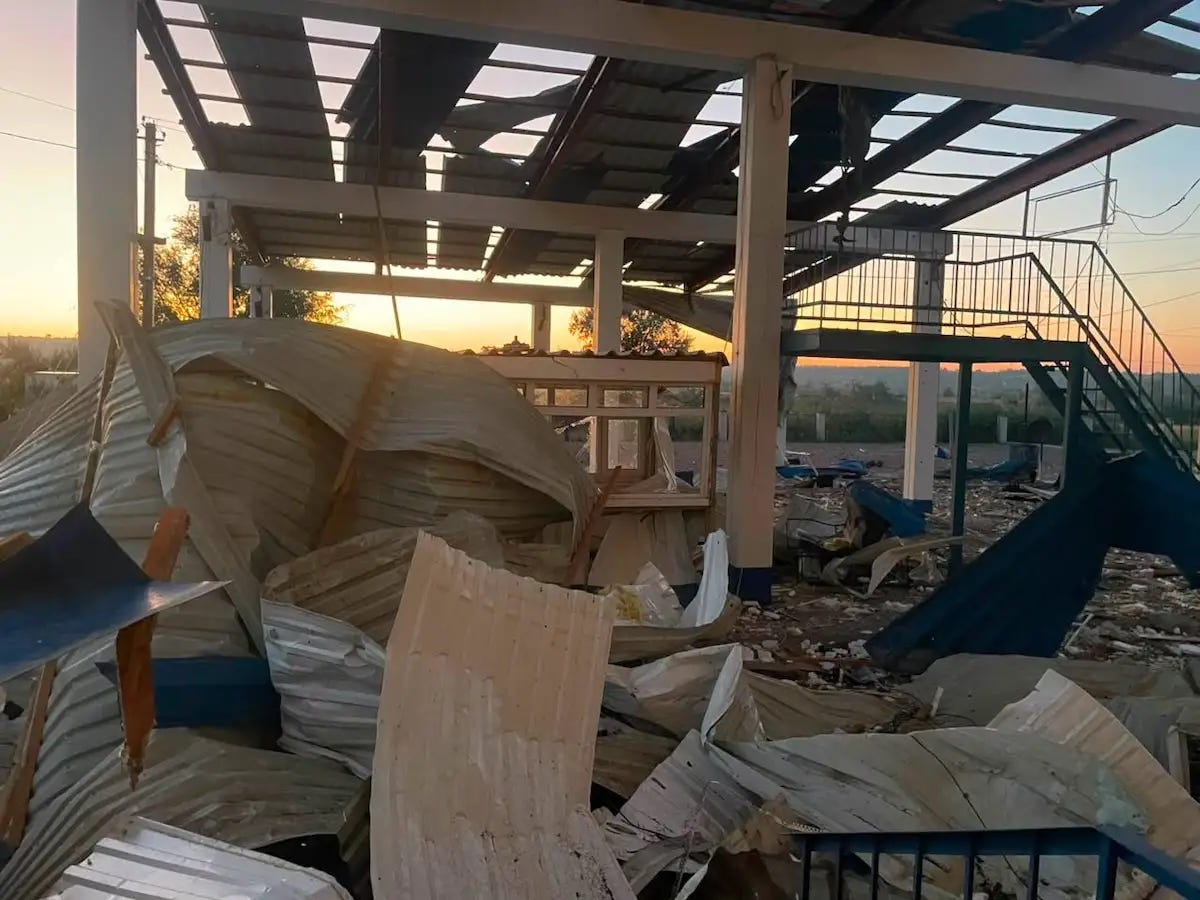
Russia has now hit Ukraine’s border crossings with Moldova on two consecutive nights. The point isn’t the damage. It’s the pattern that’s forming (read my recent Atlantic Council analysis).
The Tabaky checkpoint in Odesa region was struck overnight; traffic has been suspended and diverted to other crossings, with Chișinău “informed.” It came less than 24 hours after Russian forces targeted Reni–Giurgiulești during the large-scale attack on Kyiv. The night before, strikes in southern Odesa Oblast burned truck cargo and cut power to 13,000 customers.
Both crossings sit in Budzhak — the sliver of Odesa oblast wedged between Moldova and Romania that holds Reni, Izmail and Kiliya. When the Black Sea was blockaded, the Danube ports were the workaround. Moscow has evidently noticed, and is now working on the workaround.
A word on precision, because the temptation is to write “severed.” I put it more starkly a few weeks ago; the picture since has been subtler and worse. After Thursday’s strike the Border Guard Service said the checkpoint stayed operational with no casualties, and had only paused while the threat was active. Nothing has been cut. What’s been added is friction: longer queues, diverted freight, higher insurance, drivers and owners who think twice. That is cheaper for Russia than closure and harder for Ukraine to dramatise. It is also, over a season, more corrosive.
Three weeks ago I crossed out of Odesa oblast into Moldova, the overland route that eventually feeds into Romania. The lorry traffic was heavy, and that was a quiet day. Nobody was shooting at it then.
The spillover is no longer incidental. A Russian drone came down in Romania’s Tulcea county, and Romanian F-16s were scrambled to destroy an explosive-laden naval drone near an offshore gas project. Foreign Minister Sybiha called the border strikes “not isolated cases,” framing them as a test of NATO and partner resolve.
He’s right, and the test is being run at the one point on the map where Ukraine, Moldova, Romania and the Alliance all touch. Watch that seam.
News Briefs
Romania’s president blamed Moscow after F-16s downed an explosive-laden maritime drone near a major offshore gas field on Thursday, hours after a separate drone crashed inside Romanian territory — Euronews
The U.S. Treasury Secretary, Scott Bessent, said Washington will impose “the toughest sanctions in history” on Tehran and suggested plans to turn up the economic pressure mean major US military attacks on Iran are unlikely to resume soon. “It is a one-two punch. We have the blockade [on Iranian ports], and we are going to have the toughest sanctions in history,” Bessent told US network CNBC on August 20. “It is going to work in Iran and we are going to collapse this regime.” Bessent’s comments came a day after President Donald Trump threatened Iran with “Economic Warfare and Isolation on a tremendous scale” and warned that any country providing support to Iran will face severe economic fallout. In addition to pressure on Tehran, “ANY country that allows its financial institutions, businesses, airports, or government entities to provide any type of lifeline to Iran will itself face TREMENDOUS Economic Consequences,” Trump wrote on his Truth Social platform late on August 19. “This is going to be the greatest coordinated economic isolation in the history of the world,” Bessent said. “And we are going to [allies] and saying you are either with us or against us.” Neither Trump nor Bessent offered much detail. Bessent told CNBC he would hold a press conference on August 20 “to talk about exactly what we’re going to do.” - RFE/RL
Six journalists have been murdered in Mexico so far this year, five of them within roughly two months - one of the sharpest spikes the Committee to Protect Journalists has recorded in more than a decade. Three of the killings were in Veracruz, the others in Puebla, Guerrero and Oaxaca. President Claudia Sheinbaum has not addressed the killings as a pattern, and her government has announced no specific measures. State-level responses have been thinner still: Veracruz Governor Rocío Nahle denied at a June press conference that her state has a press violence problem. CPJ wants the federal Attorney General’s office to take over all cases of murdered journalists, arguing federal prosecutors have a better conviction record and hold authority to intervene where public officials are implicated — as they allegedly are in at least two of this year’s cases. The underlying number is the damning one. Not one case of a murdered or disappeared journalist this century has produced convictions of both the killers and those who ordered it. Meanwhile the federal protection mechanism is rejecting roughly 80% of applications, according to a member of its own advisory council. CPJ’s Mexico representative Jan-Albert Hootsen said Mexican authorities are “anything but powerless to stop the killings.”- Committee to Protect Journalists
Sidebar: And now, the rules
While six journalists were being murdered, Sheinbaum’s government was drafting rules for the ones still working. A proposed set of “audience rights” guidelines from the Telecommunications Regulatory Commission would give officials a role in assessing whether broadcast coverage is truthful and balanced, with penalties reportedly reaching 1% of annual revenue. The rules would apply to commercial and public TV and radio; the president’s office says print and digital aren’t currently in scope. The public consultation closes today. Sheinbaum has pushed back hard, telling her August 4 press conference there is no censorship and that audience rights are a constitutional principle — adding that broadcasters object because they miss privileges they no longer enjoy. Her most awkward critics aren’t broadcasters. In an August 13 statement, Mexico’s Bishops’ Conference warned the guidelines could make free expression contingent on the government’s own criteria of truth. Truth, they wrote, is not decreed. Hard to improve on that as a summary of the problem - and it lands differently in a country where the last six people who tested it are dead.
The family and opposition party of imprisoned former Pakistani Prime Minister Imran Khan on Friday accused authorities of violating a Supreme Court order by taking him to a government hospital for a medical examination instead of a private hospital designated by the court. Khan’s sister Uzma Khan told a news conference she was present at the Pakistan Institute of Medical Sciences, a government-run hospital in Islamabad, when Khan was brought there overnight. Khan’s personal physician, Faisal Sultan, said he had been escorted to Shifa International Hospital, where he waited for Khan until early Friday. He said he was eventually told that Khan had returned to Adiala prison in the garrison city of Rawalpindi. The accounts came hours after Information Minister Attaullah Tarar said Khan had been returned to prison after doctors examined him and found him medically fit.Tarar said authorities took Khan to the public hospital because of security concerns involving supporters of Khan’s Pakistan Tehreek-e-Insaf party, or PTI, who had gathered outside Shifa International Hospital or were heading there. He said Khan was found to be in good health. Dozens of journalists gathered outside the private hospital overnight after Khan’s party said he was being taken there. Authorities deployed heavy security around the facility - AP
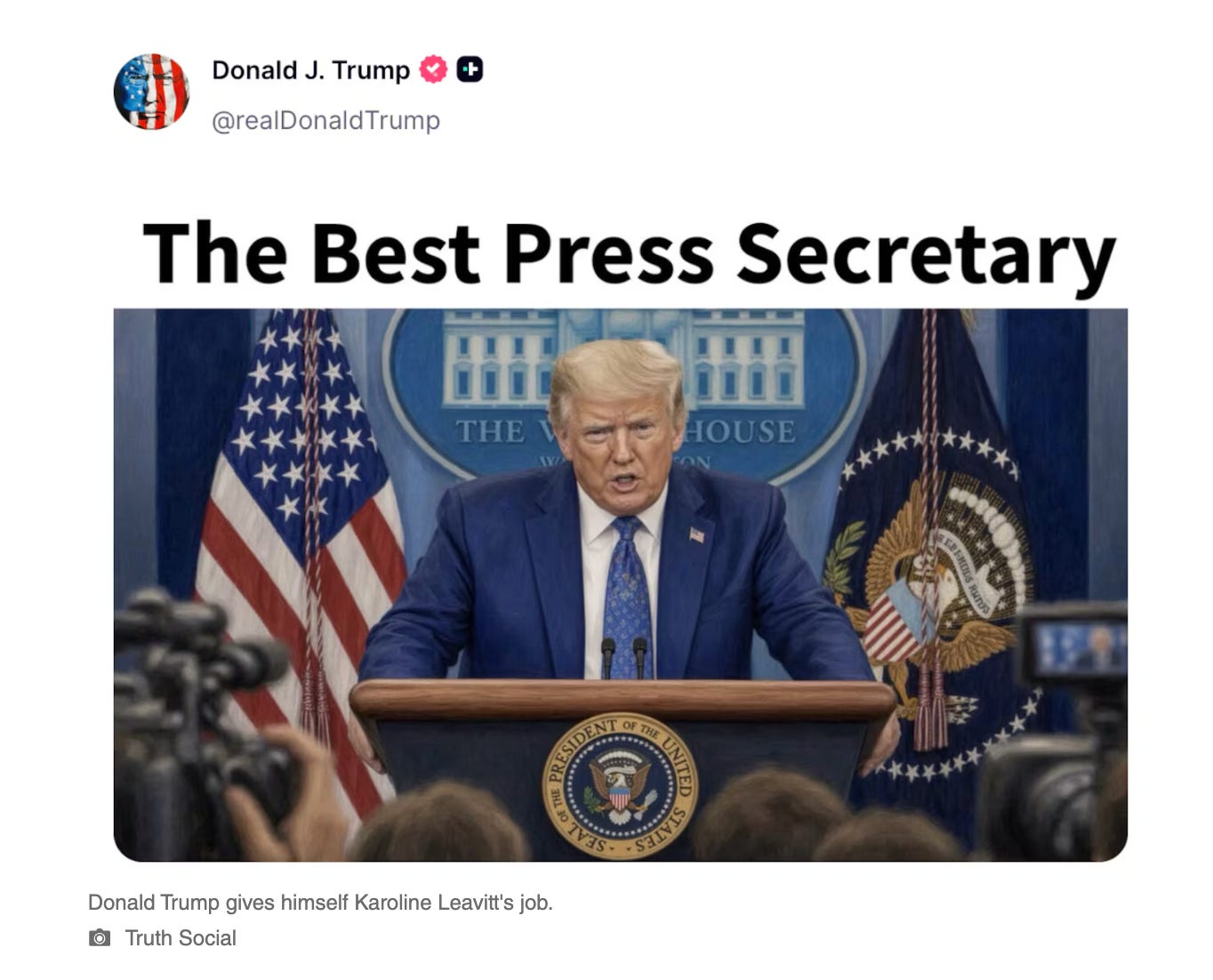
President Donald Trump has made a fitting choice to replace outgoing White House press secretary Karoline Leavitt. The twenty-eight-year-old is stepping down from the mouthpiece role to spend more time with her two young children and husband Nicholas Riccio, 60. An array of Trump acolytes have been linked to the position, including CNN’s regular conservative pundit Scott Jennings, whose possible hiring has sown dissent in MAGA ranks. But Trump, 80, used one of his trademark late-night Truth Social AI slop dumps to suggest his preferred candidate for Leavitt’s role: himself. Posting at 11:34 p.m Thursday, Trump shared an image of himself addressing the media with the bonkers caption “The Best Press Secretary.” As with many AI images Trump has flooded his feed with, the picture flatters him, making him look younger and smoother. The president employed a more extreme version of the AI tactics earlier this month, giving himself a major digital glow-up in a golfing photo with Gary Player - The Daily Beast
The journals…