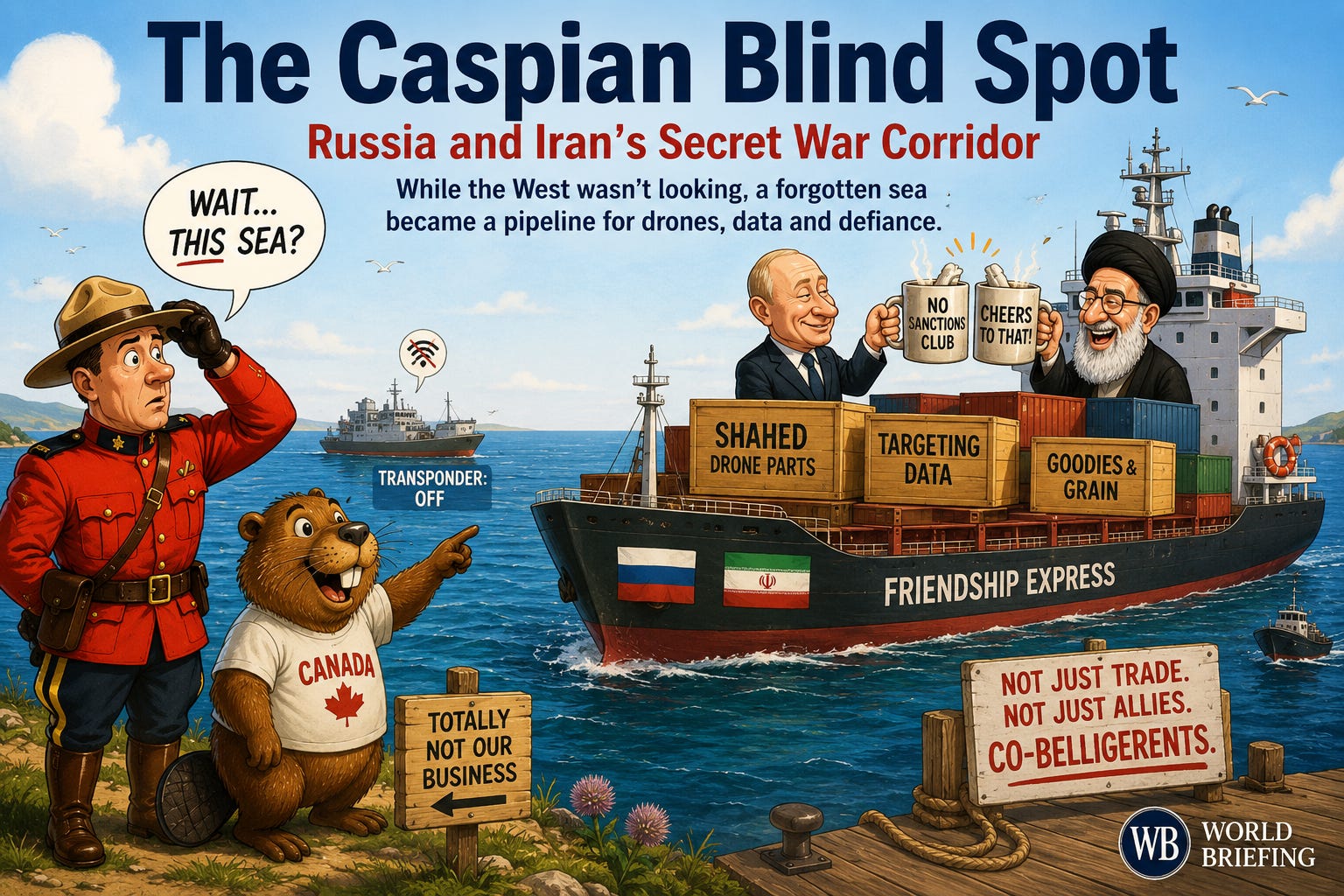
Israel bombed an Iranian naval base on the Caspian Sea last March — not because of what happened there, but because of what flows through it. That strike on Bandar Anzali was a message: the West has finally noticed that Russia and Iran have built a covert logistics corridor through a body of water that almost nobody in Washington was watching.
They should have been watching much sooner.
The Caspian connection is just one thread in what has become a deep and dangerous Russia-Iran operational partnership - one that goes far beyond smuggled wheat and drone parts. According to reporting verified by multiple Western media outlets, Russia has provided Iran with high-quality satellite targeting data used to strike U.S. military and diplomatic installations across the Middle East. Russian intelligence is also reported to have shared targeting information that Iran used against Israel. These are not the actions of a passive trade partner hedging its bets. These are the actions of a co-belligerent.
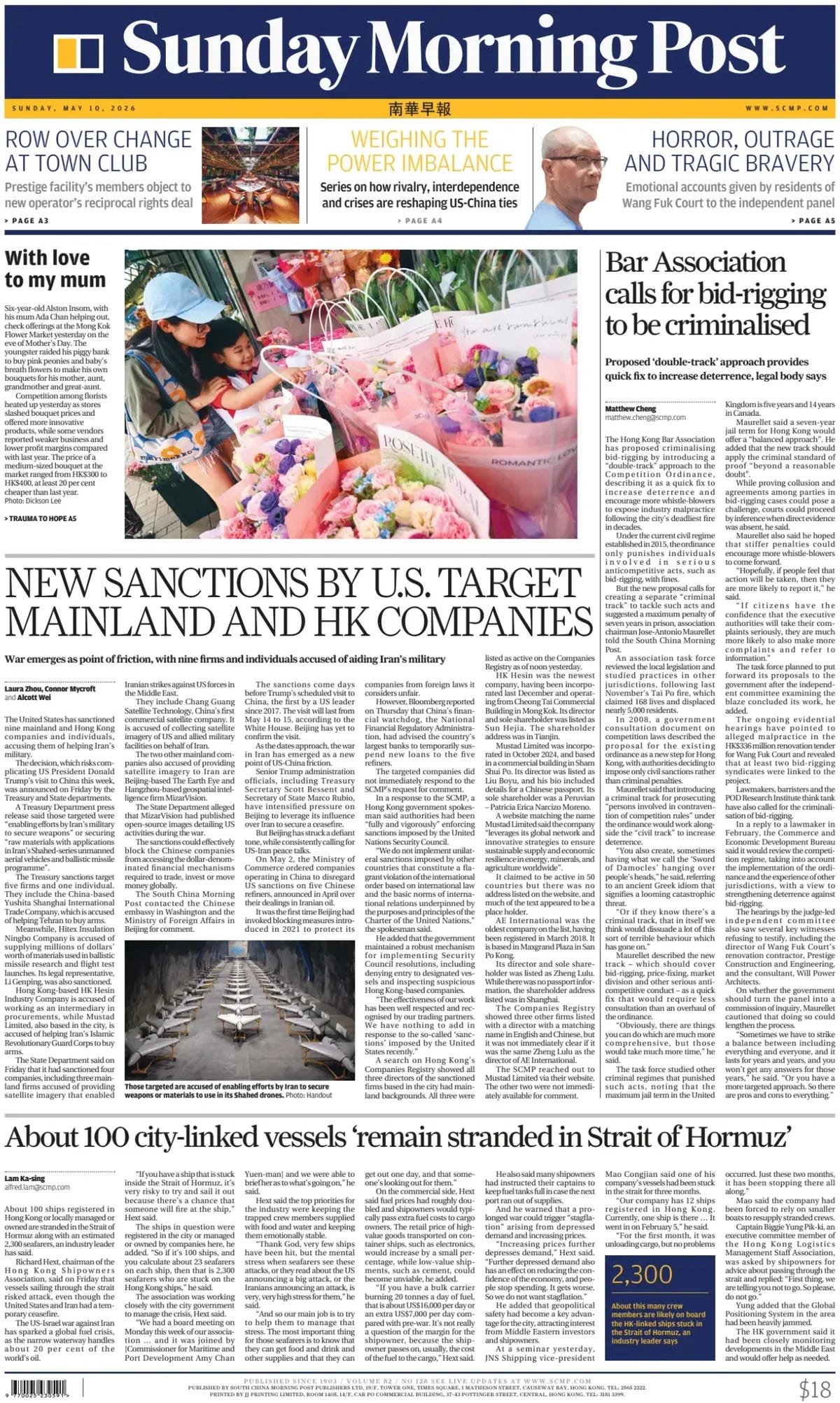
Against that backdrop, The New York Times has documented the Caspian’s role as the physical pipeline for that partnership. U.S. officials say Russia has been shipping drone components north-to-south across the sea, helping Iran rebuild an arsenal that was depleted by roughly 60 percent during recent fighting. Four Iranian ports along the Caspian are running around the clock to absorb Russian wheat, corn, cooking oils, and other essentials that can no longer move through the U.S.-blockaded Strait of Hormuz. Russian trade analysts told the Times that Caspian cargo tonnage could double this year.
The military exchange has flowed in both directions for years. Iran supplied Russia with Shahed drones that rained down on Ukrainian cities; Russia sent components back. By mid-2023, Moscow had begun manufacturing its own Shahed variant under Iranian license - and has since shared design improvements with Tehran, according to experts. Those same drones, refined through battlefield use in Ukraine, are now being rebuilt and redeployed by Iran. The loop is closed and it runs through the Caspian.
What makes this corridor so dangerous is how difficult it is to disrupt. The Caspian is inaccessible to U.S. naval interdiction - only the five bordering nations have access under international agreement, the newspaper reported. Ships routinely disable their transponders, making satellite tracking nearly useless. And the sea falls awkwardly across the boundaries of multiple U.S. military commands and State Department bureaus, producing what one analyst described to the Times as a “geopolitical black hole.”
That bureaucratic blind spot has real consequences. The same institutional fragmentation that allowed the Caspian to be overlooked as a trade route. the newspaper reported, has allowed it to be overlooked as an intelligence and interdiction challenge. The U.S. Treasury sanctioned one Russian vessel - the MG-Flot carrier at the port of Olya — for allegedly transporting Iranian ballistic missiles to Russia. Ukraine later struck it. But one sanctioned ship is not a strategy.
The United States needs a fundamentally tougher posture here, on multiple fronts. The drone pipeline that runs through the Caspian feeds the same weapons that are killing Ukrainians. The targeting intelligence Russia shares with Iran has put American service members and diplomats at risk. And a trade corridor designed to make both countries sanction-proof - if allowed to mature - will significantly erode the West’s primary tool of economic pressure.
Russia is not a bystander in Iran’s war. It is a partner, a supplier, and by sharing targeting data on American and Israeli assets, arguably something closer to a participant. The Caspian is where that partnership operates most freely. It cannot remain a blind spot.
Reporting drawn from The New York Times. Additional analysis by World Briefing
Russian President Vladimir Putin repeated the Kremlin’s oft-stated offer to transport and store enriched uranium from Iran if it would help seal a deal to end the war in Iran. Putin said Russia had transported enriched uranium from Iran once before, in 2015, and that Moscow was ready “to repeat this experience.” The Russian leader said Iran, the US. and Israel had all had agreed to the transporting the uranium out of Iran. “But then the United States hardened its position and demanded that the uranium be transported exclusively to US territory. Iran then hardened its position,” he said. Some US and other Western officials rejected earlier suggestions that Russia take possession of Iran’s uranium in light of the close relations between Moscow and Tehran - RFE/RL
Passengers are disembarking the cruise ship at the center of the hantavirus outbreak, Spain’s Ministry of Health said, in a carefully managed repatriation operation in Tenerife involving multiple nations. All passengers still aboard the vessel were screened Sunday and did not show symptoms, according to health authorities. Since the vessel departed Argentina last month, the deaths of three people have been linked to hantavirus — a rare disease typically caused by exposure to infected rats’ urine or feces. It remains a low risk to the general public, according to the World Health Organization, which also emphasized how the virus differs from Covid-19. The operation has caused tensions in the Canary Islands, an autonomous community of Spain. The territory’s leader said last week that he opposed the ship docking - CNN
Turkey’s grand unveiling of an intercontinental ballistic missile has backfired after an AI-generated promotional video showed the weapon seeming to strike its US ally. The Yıldırımhan missile was presented at a defence expo in Istanbul this week as capable of travelling 6,000km carrying a 3,000kg warhead at up to 25 times the speed of sound — placing Turkey among a small group of countries able to develop such weapons. But questions quickly arose about the real capabilities of the system, sparked by the AI video showing the Yıldırımhan hitting nuclear facilities and other targets that appeared to be in the US. The Americas would be well beyond the official range of the missile — and Turkish officials later admitted a working prototype of the Yıldırımhan had yet to be built for full testing. Turkey has been eager to showcase its military prowess ahead of a critical Nato leaders’ summit in Ankara this July. At the same time, the US-Israeli war with Iran has deepened Turkey’s ambition to increase its military deterrence amid a region wracked with conflict. “We intend to use it solely for deterrence purposes,” defence minister Yaşar Güler said at a launch event for the missile. “However, should the need arise, let no one doubt that we will deploy it without hesitation and in the most effective manner,” he added. There was no indication that Güler was aware that the video appeared to include targets in North America. Despite the fanfare, defence officials, industry representatives and military analysts soon questioned the true capabilities of the 18-metre-long missile. “It’s an overestimation. Turkey’s defence industry has many capabilities, and is improving fast, but it’s not yet at this level,” said one western defence official. “It seems very ambitious and questionable,” added Fabian Hoffman, a missile expert at the University of Oslo. Within days of unveiling the missile, Turkey’s ministry of defence clarified that the system was still in a testing phase. “Laboratory testing of the Yıldırımhan missile system, which has a warhead payload capacity of 3 tonnes, has been successfully completed, and field testing is proceeding,” it said on Thursday. Turkey’s booming defence industry has turned it into the world’s 11th biggest arms exporter and a key partner in Europe’s need to re-arm itself - FT
Russia accused Israeli authorities on Friday of caving in to pressure from Ukraine in a dispute over a consignment of grain that was turned away from an Israeli port last month. Ukraine says the grain in question was stolen by Russia from regions of Ukraine that Moscow’s forces have seized in the war. In a statement, the Russian Foreign Ministry rejected what it called “the absurd and unsubstantiated claims made by the Ukrainian side”. It said it deplored the decision by the Israeli importing company not to allow the grain to be unloaded at the port of Haifa.”Moscow regretted this step, clearly taken under pressure from Kyiv,” the statement said. “This runs counter to the Israeli authorities’ declared commitment to maintaining Russian-Israeli economic cooperation and threatens Israel’s own food security.” Ukraine said at the time that the fact the cargo had been turned away was a welcome development that showed the effectiveness of its legal and diplomatic actions - Reuters
Thailand’s Interior Ministry has ordered provincial authorities nationwide to take firm action against unruly foreign tourists, warning that those who break the law, intimidate Thai citizens or behave inappropriately could have their visas revoked and be deported immediately. Interior Ministry permanent secretary Arsit Sampantharat said on May 8, while carrying out duties in support of the 48th ASEAN Summit in the Philippines, that inappropriate behaviour by tourists in various provinces had affected Thailand’s tourism image and caused concern among residents in several areas. He said Prime Minister and Interior Minister Anutin Charnvirakul had been closely following the issue and had instructed relevant agencies, including administrative officials, security agencies and tourism authorities, to promote understanding among business operators and tourists about Thai culture and the country’s way of life. Reports from Surat Thani said Governor Chumphote Wannachatsiri had taken action in cases involving Israelis staying long term on Koh Phangan, Koh Samui and Koh Tao. Some were reportedly using tourist visas to work, while others were accused of inappropriate behaviour or activities. Authorities are also investigating and cracking down on suspected nominee-style businesses, working with security agencies, immigration police and the provincial employment office to enforce the law strictly - Straits Times
Air India has slashed its flight schedule due to soaring jet fuel prices, leaving Canadian residents hoping to visit the subcontinent with fewer options and higher fares. The airline confirmed to CBC News that they have reduced the number of flights in May on their Delhi-Toronto route from 10 a week down to seven, and their Delhi-Vancouver route from seven to five flights a week. The airline has cut flight volumes for April and May, with plans for more schedule trims in June and July, said CEO Campbell Wilson in an internal message to staff verified by The Canadian Press. “This is in response to the massive rise in jet fuel prices which, together with airspace closures and longer flying routes, has caused many of our international flights to become unprofitable to operate,” Wilson said in last week’s memo. The number of round-trip Air India flights scheduled between Toronto and Delhi fell to 31 in May versus 48 in March, a 35 per cent decrease, according to aviation data tracker Cirium.
The journals….