World Briefing Hot Take | June 2, 2026
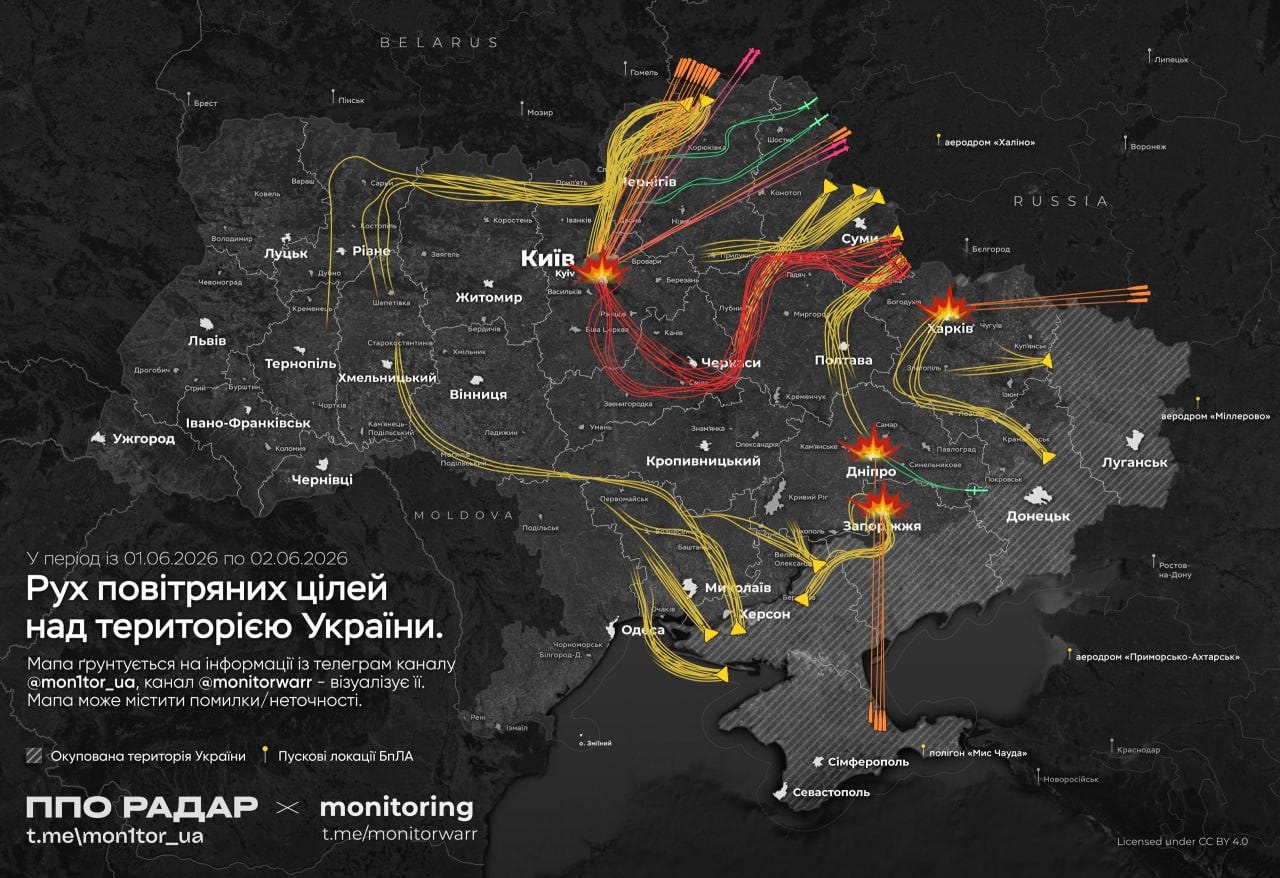
As Russian missiles and drones rained down on Kyiv, Dnipro and Kharkiv overnight - killing at least nine people, injuring at least 58 people in Kyiv alone, collapsing apartment buildings, trapping civilians under rubble - Vladimir Putin was also quietly admitting something his state media will never say out loud: Ukraine is hitting him where it hurts.
(As of 0530 BST, there were still incoming missiles and drones, according to some Ukrainian Telegram channels).
On Monday, the Russian government announced a ban on jet fuel exports through November 30 - the first of its kind in Russian history. The official explanation was bureaucratic boilerplate about “ensuring stability in the domestic fuel market.” The reality is more revealing. Ukrainian drone strikes have hammered Russian oil refineries for months, halting or scaling back facilities accounting for roughly a quarter of Russia’s total refining capacity and more than 30 percent of its gasoline output. Bloomberg reported this week that Russian refinery processing volumes have fallen to 4.69 million barrels per day - the lowest level since 2009. Moscow isn’t banning jet fuel exports because supplies are stable. It’s doing so because they aren’t.
The economic squeeze is being tightened from multiple directions. On Sunday, French naval forces intercepted and seized the Tagor, a Russian oil tanker sailing under a false flag more than 400 nautical miles off France’s Atlantic coast - the fourth such Russian vessel seized by France this year alone. The ship, which had departed from Murmansk, is suspected of belonging to Russia’s so-called shadow fleet: the aging, largely uninsured tankers Moscow uses to move oil around Western sanctions. “It is unacceptable that ships circumvent international sanctions, violate the law of the sea, and finance the war Russia has been waging against Ukraine for over four years,” French President Emmanuel Macron posted on X. The Kremlin, predictably, called it piracy.
The diplomacy: Beijing in the room
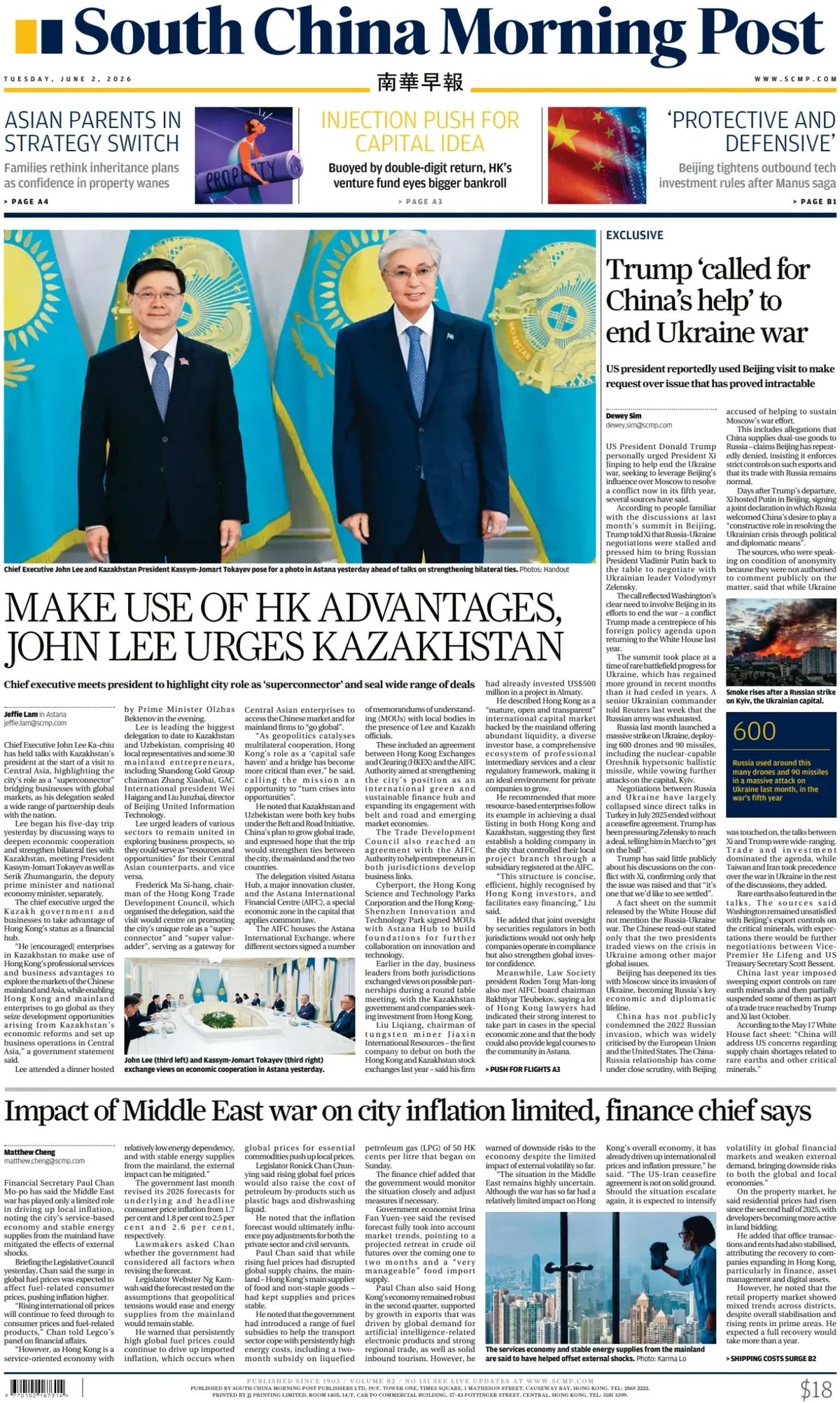
Meanwhile, diplomatic efforts to end the war are quietly pulling China into the frame. Multiple sources cited by the South China Morning Post confirm that at last month’s Beijing summit, U.S. President Donald Trump personally pressed President Xi Jinping to use Beijing’s leverage over Moscow to bring Putin back to the negotiating table. Trump has said little publicly - a White House fact sheet on the summit didn’t even mention Ukraine - and Beijing’s readout was characteristically vague. But the ask was made. Whether Xi acts on it is another matter. China has been careful not to directly arm Russia while benefiting enormously from discounted Russian energy and a West distracted by the war.
The NATO problem: a whimper, not a warning
And then there is the question of what the West is actually willing to do. After a Russian drone struck Romanian territory - a NATO member state - the response from Brussels and allied capitals was, to put it charitably, muted. Romania’s own leadership reportedly resisted invoking even Article 4 consultations, with suggestions that Russia simply needed to be “more precise” in targeting Ukraine. That sentence deserves to be read twice.
European Commission President Ursula von der Leyen declared that Russia had “crossed a line.” She also announced that Brussels is working on a 21st sanctions package. The 21st. If two decades of packages had the intended effect on Russian behavior, we would not be watching apartment buildings collapse in Kyiv tonight.
There is a square in Moscow, as I have noted before, that appears capable of accommodating an infinite number of red lines.
The deeper pattern: normalization by design
Which brings us to perhaps the most troubling dimension of last night’s assault. Russia has now launched mass aerial attacks against Ukrainian cities with such regularity that the global news cycle has developed a familiar rhythm: the overnight barrage, the casualty count, the Zelensky address, the Western statement of condemnation, the silence from Moscow. Wash. Repeat.
This is not incidental. The normalization of mass civilian bombardment is itself a Russian strategic objective - to exhaust Western attention, desensitize global audiences, and grind Ukrainian morale through repetition. Last night’s strike, which followed explicit public threats from Lavrov to Rubio, a Russian Foreign Ministry warning to evacuate Kyiv, and three consecutive nights of presidential warnings from Zelensky, was not a surprise. It was a demonstration: that Russia can announce a massacre in advance and face no meaningful consequence.
Zelensky’s urgent letter to Trump warning of critical shortages in Ukraine’s anti-ballistic missile defenses is the other side of this picture. Ukraine is not losing because its people lack will. It is absorbing these strikes with an air defense umbrella that is visibly, dangerously depleted.
The jet fuel ban, the shadow fleet seizure, the refinery data - these tell the story of an economy under genuine strain. But an economy under strain can still launch ballistic missiles at apartment buildings. And as long as the West responds to strikes on NATO territory with recommendations for Russian accuracy improvements, Putin has every reason to keep doing exactly this.
News Briefs
Russia launched one of its most intense overnight bombardments of 2026 in the early hours of Tuesday, striking Kyiv, Dnipro, Kharkiv and surrounding regions with a combined barrage of ballistic missiles, cruise missiles, and Shahed-type drones. As of this writing, at least nine people are confirmed dead and around 100 injured (58 in Kyiv alone according to the mayor) - figures authorities say are expected to rise, with rescue teams still working through rubble. As of 0530 BST, there were still incoming missiles and drones, according to some Ukrainian Telegram channels.
Kyiv takes direct hits across multiple districts
The capital was struck across at least six districts beginning around 1:30 a.m. local time, with waves of explosions reported through 4 a.m. A nine-story residential building in the Podilskyi district suffered a partial structural collapse after what officials described as a deliberate double-tap strike - a tactic designed to kill first responders. Mayor Vitali Klitschko confirmed at least four people were killed and 51 injured in the capital, including two children, with 35 requiring hospitalization. A 24-story and a 15-story apartment block in the Solomianskyi district were also struck. Fires broke out at gas stations, a medical clinic, a commercial building, and a construction site, while debris fell near a kindergarten in the Obolonskyi district. Power outages were reported across multiple districts. People are feared trapped under rubble.
Dnipro and Kharkiv also struck
At least five people were killed and 25 injured in Dnipro, where multiple residential buildings - including low-rise structures - were partially destroyed. At least 23 of the wounded required hospitalization, among them a 13-year-old girl. In Kharkiv, drone and missile strikes hit multiple city districts, injuring at least 10 people and damaging residential and administrative buildings.
The context: Zelensky warned this was coming
Ukrainian President Volodymyr Zelensky had issued explicit warnings for days. In his nightly addresses on May 29, 30, and again on June 1, he told Ukrainians that Russian strike preparations were confirmed by intelligence - and that he had “no belief that anyone in Moscow will come to their senses.” The attack comes just days after Russia’s May 24 assault, one of the largest strikes on Kyiv in a year, which targeted the Cabinet of Ministers, the Foreign Ministry, the Kyiv Opera Theater, and the Chornobyl Museum - killing four and wounding nearly 100 across Ukraine.
Russian Foreign Minister Lavrov had publicly told U.S. Secretary of State Rubio on May 25 that Russia planned to strike Ukrainian “decision-making centres” and urged Washington to evacuate its Kyiv embassy. No foreign missions left. Russia’s Foreign Ministry also issued a broader warning to foreign nationals to depart the city.
Zelensky has separately sent an urgent letter to President Trump warning of critical shortages in Ukraine’s anti-ballistic missile defense - a gap now on visible and deadly display.
Poland scrambles aircraft
Poland’s Air Force confirmed it scrambled Polish and allied aircraft overnight to protect Polish airspace amid the assault - a sign of the attack’s scale and western trajectory.
Developing — casualty figures expected to climb
Search and rescue operations are ongoing in Kyiv, Dnipro, and Kyiv Oblast. This brief will be updated as figures are confirmed.
Sources: Kyiv Independent, BBC World Service
US President Donald Trump personally urged President Xi Jinping to help end the Ukraine war, seeking to leverage Beijing’s influence over Moscow to resolve a conflict now in its fifth year, multiple sources said. According to people familiar with the discussions at last month’s summit in Beijing, Trump told Xi that Russia-Ukraine negotiations were stalled and pressed him to bring Russian President Vladimir Putin back to the table to negotiate with Ukrainian leader Volodymyr Zelensky. The call reflected Washington’s clear need to involve Beijing in its efforts to end the war - a conflict that Trump made a centrepiece of his foreign policy agenda upon returning to the White House last year. The summit took place at a time of rare battlefield progress for Ukraine. Trump has said little publicly about his discussions on the conflict with Xi, confirming only that the issue was raised and that “it’s one that we would like to see settled.” A fact sheet on the summit released by the White House did not mention the Russia-Ukraine war. The Chinese read-out stated only that the two presidents traded views on the topic among other major global issues.
The Russian government on Monday announced a ban on jet fuel exports until the end of November, as Ukrainian strikes on oil refineries throughout the country have led to slumps in domestic production and gasoline shortages in some places. In a statement, the government said the measure was introduced to “ensure stability in the domestic fuel market.” Supplies to countries that maintain active intergovernmental agreements with Russia will be exempt from the restriction. The embargo, which expires on Nov. 30, marks Russia’s first-ever ban on jet fuel exports, according to the RBC news outlet. Russian Transportation Minister Andrei Nikitin later told reporters that there was no shortage of jet fuel in the country and that the ban was introduced “based on the interests of our airlines.” Ukraine has stepped up its attacks on Russian oil infrastructure over the past several months in a bid to deprive the Kremlin of energy windfalls amid the continued closure of the Strait of Hormuz. Strikes on refineries have halted or scaled back production at facilities that account for around one-quarter of the country’s total refining capacity and more than 30% of its gasoline output, according to Reuters. Bloomberg reported that processing volumes at Russian refineries have plummeted to 4.69 million barrels per day — the lowest level since 2009 - Moscow Times
French authorities on Monday confirmed the country’s Navy intercepted and seized a Russian oil tanker sailing under a false flag. The Tagor, which departed from the Russian port of Murmansk, was boarded more than 400 nautical miles off France’s Atlantic coast on Sunday. French officials suspect the ship was flying a false flag and is part of the so-called shadow fleet of mostly aging oil tankers used to circumvent sanctions imposed after Moscow’s full-scale invasion of Ukraine in 2022. “It is unacceptable that ships circumvent international sanctions, violate the law of the sea, and finance the war that Russia has been waging against Ukraine for over four years,” French President Emmanuel Macron wrote on X. The operation was undertaken with the support of the United Kingdom, which recently expanded its military powers to detain Russian ships evading sanctions. Moscow’s envoy in Paris told Russian state media the Tagor’s captain is a Russian citizen. Kremlin spokesperson Dmitry Peskov on Monday condemned the seizure, describing it as “illegal” and bordering on “international piracy.” The latest incident marks France’s fourth seizure of a Russian ship this year. European capitals have clamped down on the Kremlin’s circumvention of Western sanctions, and a French court sentenced a ship captain in March for operating a Russian ship. The tanker is now being escorted to a port by French ships, France’s prefect for the Atlantic said in a statement - Politico
The EU and European Parliament on Monday agreed a controversial law aimed at speeding up the return of migrants with no legal right to stay in Europe, marking the bloc's toughest migration policy shift in decades. Policymakers say the so-called Return Regulation is key to accelerating returns and is the cornerstone of the EU’s crackdown on irregular migration. It also reflects a broader political shift in Europe, with conservatives — sometimes backed by the far right — pushing for a tougher approach to migration. According to official figures, only 29% of migrants with no legal right to remain in Europe leave the EU. “This is a really very important step in making sure that we have control over what is happening in the EU, over who comes but also who has to leave the EU,” Home Affairs Commissioner Magnus Brunner told reporters at the end of the talks. At the heart of the law is a provision allowing EU countries to set up deportation centres outside the bloc, known as return hubs, if they conclude an agreement with a non-EU country. “The next step is working more on migration diplomacy, together with third countries,” Brunner said, avoiding mentioning any possible third country to place return hubs. The hubs can be either places of transit or locations where a person is expected to stay, marking a significant departure from current rules. Most migrants can only be returned to their country of origin or to a country with which they have a proven connection. Under the new system, that requirement would be removed. Only unaccompanied minors would be exempt from being deported to a return hub, while families with children will be eligible. Some EU countries are already working to identify potential partner countries for future return centres. Germany, the Netherlands, Austria, Denmark and Greece teamed up last March to implement the controversial project, while Italy is already running a similar scheme in Albania, with two centres accommodating fewer than a hundred migrants in total - Euronews
Norway is reconsidering joining the EU, the country’s foreign minister said, citing a shift from a “benign world” to a “crazy world.” Norwegians voted in 1972 and 1994 to remain outside the bloc. However, the country joined the single market, meaning it is subject to EU trade agreements but has no say in negotiations. Tariff wars with Washington and NATO’s growing divisions are making membership attractive, Espen Barth Eide told the Financial Times. The EU would be keen to admit Europe’s biggest oil and gas producer, and is looking to add new members: Iceland is holding a referendum in August, and nine other states are candidates, including Ukraine. The bloc is less open to a British return, however - Semafor
Lebanon says Hezbollah has accepted a US plan for it to halt attacks on Israel and for Israel not to attack the Lebanese capital Beirut. The Lebanese embassy in the US said it had “received confirmation of Hezbollah’s acceptance of the US proposal for a mutual cessation of attacks”. Israeli Prime Minister Benjamin Netanyahu confirmed the agreement, but warned strikes on Beirut would go ahead “if Hezbollah does not stop attacking our cities and civilians”. The statements came after US President Donald Trump said he had spoken to both Netanyahu and Hezbollah representatives and “they agreed that all shooting will stop”, after Iran warned that Israeli military actions in Lebanon were a threat to the current US-Iran ceasefire. In a statement late on Monday, the Lebanese embassy said that “under the proposed arrangement, Israeli strikes on Beirut’s southern suburbs would cease in exchange for Hezbollah refraining from attacks against Israel”. It added that the ceasefire was “to be extended to encompass all Lebanese territory”. However Netanyahu said: “At the same time, the IDF [Israel Defense Forces] will continue to operate in southern Lebanon as planned.” After Trump said both sides had agreed to stop fighting some clashes continued - BBC
Jill Biden provided an update about her husband, former President Joe Biden’s cancer diagnosis. The former first lady, 74, told Today show co-host Craig Melvin on Monday that “Joe will live with cancer till the rest of his life.” “You know, he’s doing OK,” she told Melvin of her 83-year-old husband. “Craig, you’ve been through this with your brother; you know how tough it is. And I think if he had just been diagnosed with prostate cancer, that’s one thing, because that can be cured. But the fact that it metastasized to his bones, that makes it a whole different story.” The Bidens first announced that Joe had been diagnosed with stage 4 prostate cancer in May 2025. The 46th president had initially decided to run for a second term before withdrawing from the race in July 2024 amid concerns that he was not healthy enough to serve another term. His vice president, Kamala Harris, won the Democratic nomination but lost to Donald Trump in the 2024 presidential election. Asked why she didn’t urge her husband to drop out of the race sooner, Biden told Melvin that “it had to be his decision.” - The Daily Beast
The journals…..