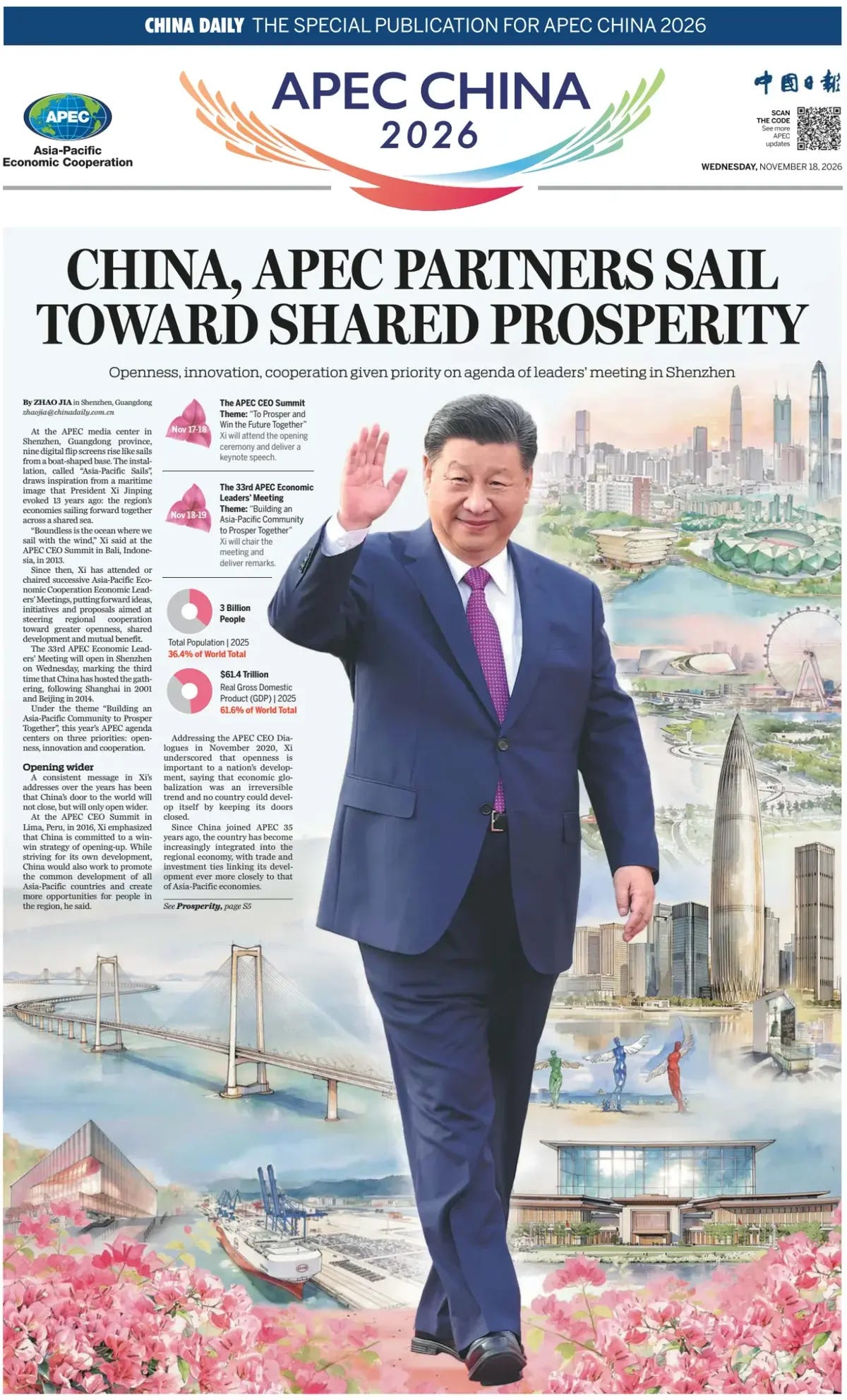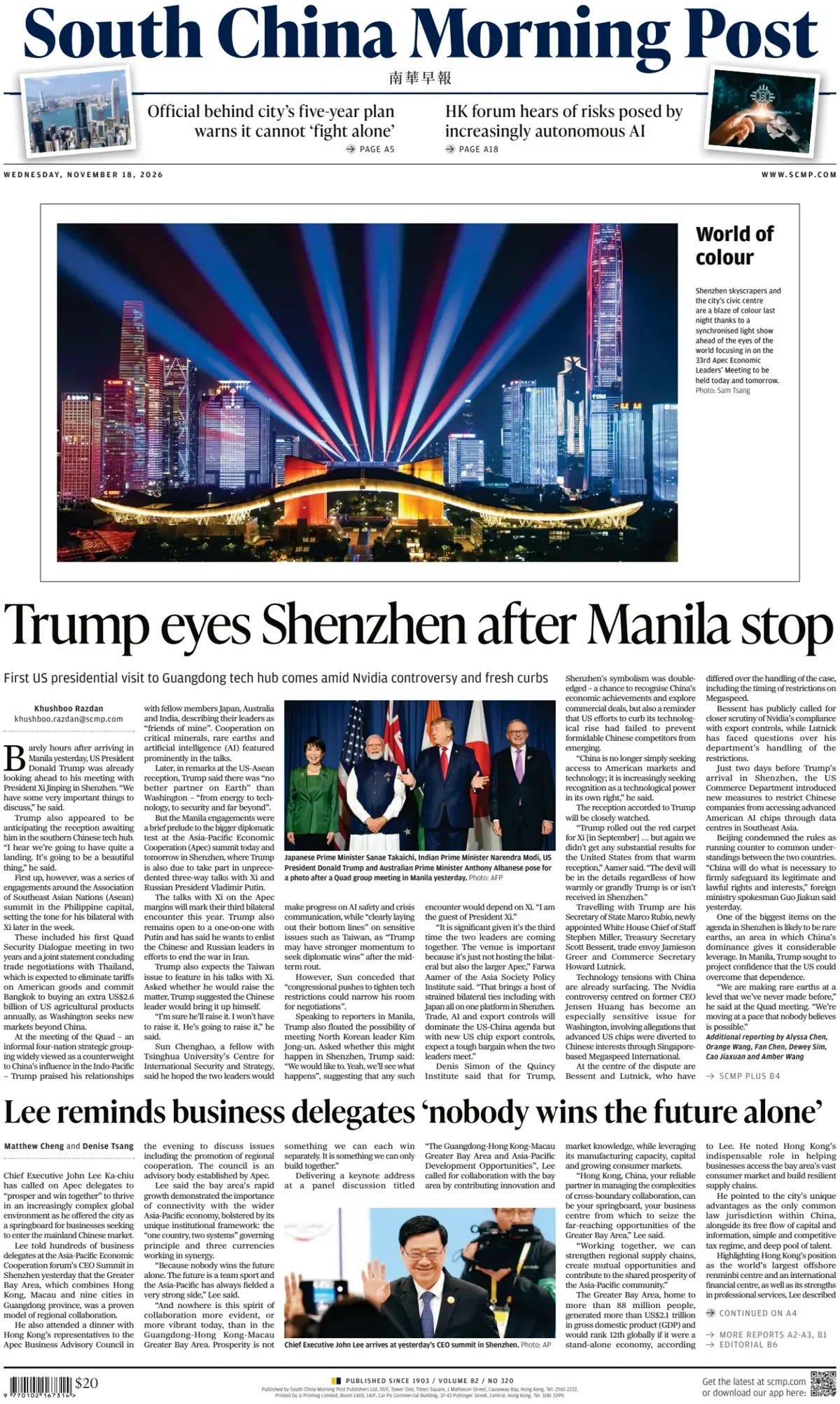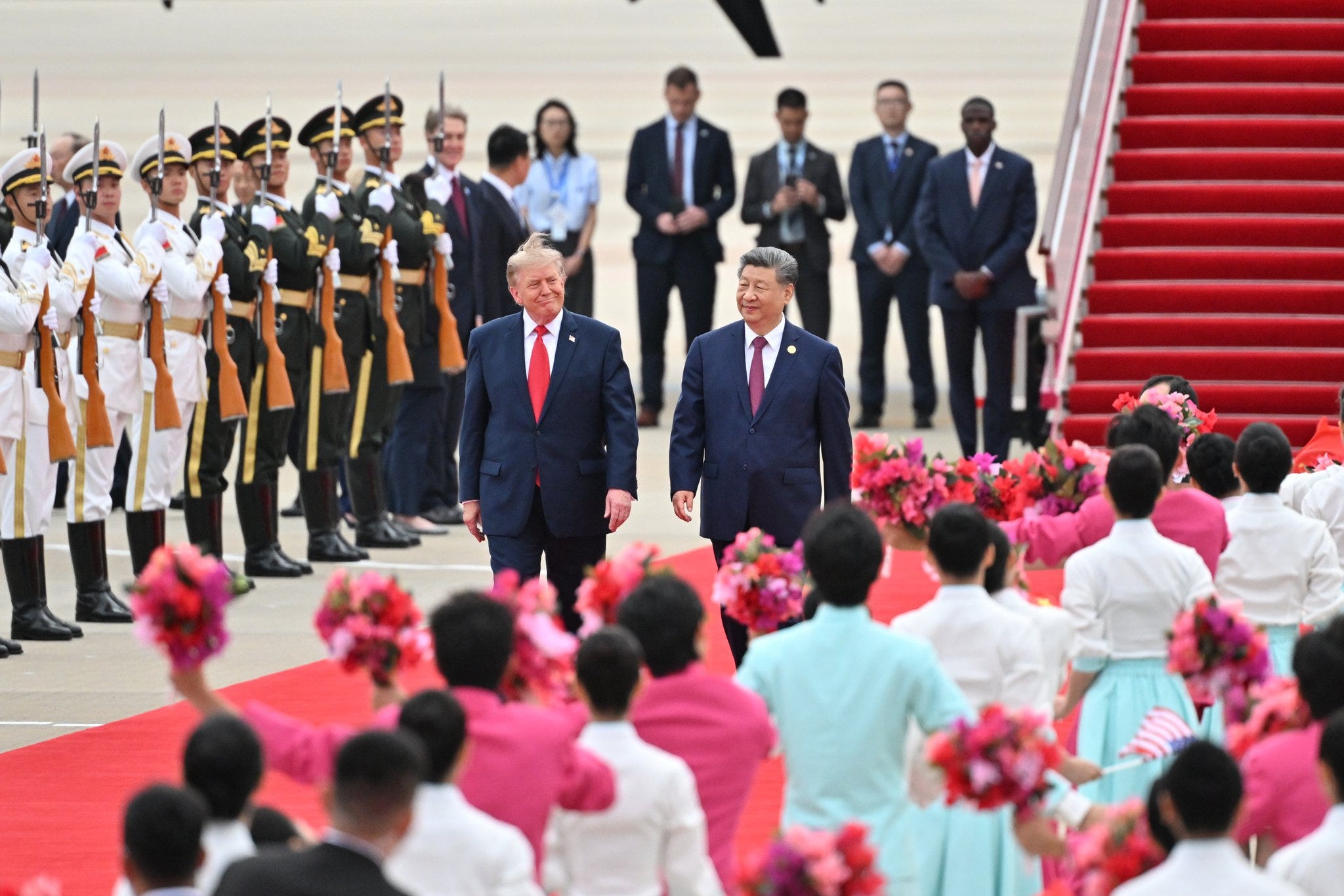
For a leader who scripts everything, Xi Jinping left nothing to chance today. When Air Force One touched down in Shenzhen from Manila, Xi was waiting on the tarmac, and greeted Donald Trump with a hug. The BBC called it a carefully choreographed moment of flattery. It was also pointed. When Trump flew to Beijing in May, Xi sent his vice president to the airport. In September, Trump went out of his way to meet Xi’s plane in Washington. Today the debt was repaid, at a time and place of Beijing’s choosing.
It will flatter Trump. That’s the point. Nothing in Chinese diplomacy happens by accident, and Xi knows exactly who he’s dealing with.
Then came the picture of the day. Before the APEC family photo, Vladimir Putin walked over to Trump. The two shook hands and exchanged greetings, with Xi standing between them, smiling. Earlier, Xi had welcomed Putin to China as an “old friend.”
For Putin, the moment is the victory. As the BBC’s Russia editor Steve Rosenberg points out, some Russian newspapers are already calling it a diplomatic triumph simply because it’s happening. In 2022, after the full-scale invasion of Ukraine, Putin was an international pariah. Four years on, he’s sitting down with the leaders of the world’s two great powers. And he got there without a single compromise on Ukraine: Moscow still refuses a comprehensive ceasefire and keeps waging war on its neighbour. Putin says he expects the meeting to deliver “a big potential benefit.” He’s already banked it.
On Thursday, on the sidelines of APEC, Trump, Xi and Putin hold their first-ever trilateral meeting. US officials say Iran is on the agenda, but Trump doesn’t intend to discuss Russia’s war with Ukraine.
"Vladimir Putin will use this meeting to send a holiday postcard to the rest of the world. Instead of 'Wish you were here', he'll sign it: 'Look: I'm here.'" - BBC’s Steve Rosenberg
The irony is hard to fathom. Trump will sit across from two men he openly admires as strongmen, and both have been helping the country America is at war with. US intelligence reporting found that Russia gave Iran information on the locations and movements of American troops, ships and aircraft, much of it imagery from Moscow’s satellite constellation. China’s role has been quieter but real. It has exported advanced radars to Iran and moved Iranian military navigation off US GPS and onto China’s BeiDou system. US intelligence also suggested Beijing might supply financial help, spare parts and missile components. In other words, the two leaders who will flatter Trump on Thursday have helped Iran see, and aim at, American forces. Any other president would treat that as the first item on the agenda. Don’t count on it coming up.
The spheres-of-influence fear. What worries me most is the logic underneath it all. Washington Post analyst Josh Rogin put it bluntly on CNN: strip away the diplomatic language and you’re left with a pact among the three biggest powers to stay out of each other’s backyards. Russia gets Europe, China gets Asia, and America the Western Hemisphere. I’ve been warning about this for months. If it takes hold, Ukraine, Taiwan, the Baltics and the Philippines stop being partners and become playgrounds.
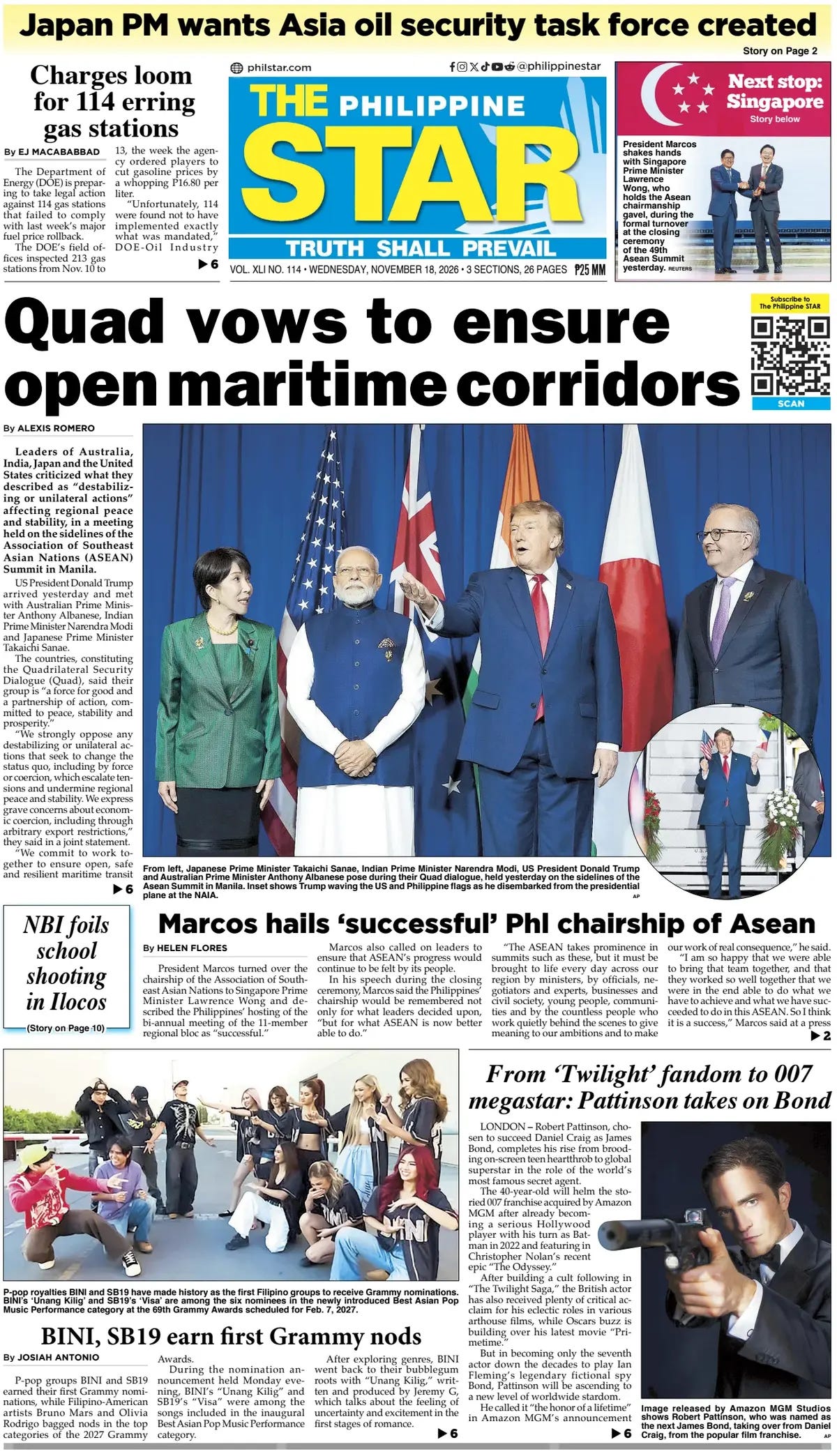
Asia is already nervous. Trump’s Manila stop didn’t reassure anyone. He was scheduled to land at 5:30pm, with ASEAN’s closing ceremony ending at 5:45pm. Treaty ally or friend, every capital noticed.
The summit’s biggest deliverable also slipped. ASEAN and China failed to conclude the long-delayed South China Sea code of conduct under the Philippines’ chairmanship, despite provisional agreement on about 80% of the draft. The unresolved issues are the big ones: whether the code would be legally binding, its geographical scope, its relationship with the 2002 Declaration, and its terms of reference. Singapore inherits the task next year. After two decades of talks, Beijing keeps the ambiguity it prefers.
Taiwan and the 2027 clock. American officials have long cited intelligence that Xi ordered the PLA to be ready to take Taiwan by 2027, the army’s centenary. That year starts in six weeks. After his earlier meetings with Xi, Trump declined to clearly commit to future arms sales to Taiwan or to defending it directly in a conflict. Taipei will be reading every word out of Shenzhen.
The twist. Xi and Putin aren’t dealing with a president at the height of his power. They saw the midterm results. They know Trump has two years left, and that Congress, Republican and Democrat alike, still believes in alliances. Any grand bargain struck in Shenzhen may not outlive January 2029. The question is how much damage it does in the meantime.
I’ll unpack what America’s choice means for the world at a fireside chat with Q in London this evening. More in the next edition.
Oxford Street, London. Mayor Sadiq Khan’s pedestrian makeover was meant to be a walkway, but it’s more of an obstacle course. 🚧
Then I summarize my live on BBC World with Matthew Amroliwala: what to watch at the APEC summit in Shenzhen, what to expect from tomorrow’s trilateral, and the dynamics between the three leaders.
News briefs
China’s President Xi Jinping on Wednesday pledged to stand up against trade protectionism, while his Russian counterpart Vladimir Putin criticized Western sanctions as the two set the stage for a high-stakes trilateral meeting with U.S. President Donald Trump. They delivered their speeches at an Asia-Pacific Economic Cooperation summit in the southern Chinese tech hub of Shenzhen, hours before Trump landed in China after meeting key regional allies in Manila this week. Xi’s remarks came after Washington announced further restrictions on China’s access to advanced AI chips from companies such as Nvidia, which could further complicate a fragile trade truce with Beijing. China has pledged to retaliate. “We must firmly uphold the rules-based multilateral trading system with the World Trade Organization at its core, support free and open trade and investment,” Xi told an audience of business executives. Western trade partners have criticized China for running annual trade surpluses exceeding $1 trillion through policies that support its manufacturing sector at the expense of its consumers. Beijing says its growth model is appropriate for an economy still catching up with the world’s richest, but Washington, Brussels and others are concerned about China’s supply chain dominance providing the country with geopolitical leverage and say its policies threaten their industries and jobs. Xi said China will continue to invest in its industrial complex and new technologies. The world’s second-largest economy will lower tariffs and further open up its markets, while standing up against protectionism and unilateralism, he added. His “message is likely to resonate with many Global South countries and reinforces Beijing’s effort to contrast its technology strategy with that of Washington,” said George Chen, partner and chair of digital practice at The Asia Group - Moscow Times
Donald Trump’s stop in Manila was meant to be a warm-up for his summit in China with Xi Jinping and Vladimir Putin. As the Daily Beast reports, it turned into a string of awkward moments. At a luncheon at Malacañang Palace hosted by President Ferdinand “Bongbong” Marcos Jr., Trump brought up General Douglas MacArthur’s 1935 Philippine field marshal’s baton. When someone apparently suggested he shouldn’t get one too, he shot back: “Why the hell shouldn’t I get that?”
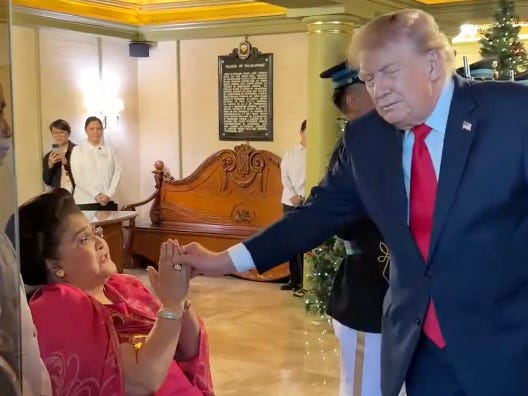
On the way out, he met former first lady Imelda Marcos, now 97. She handed him a gift and mentioned “the next world peace deal.” Trump told her “Xi loves you!” When she put her hands together as if praying, he tried to do the same but was still holding the gift, so he ended up pinching her fingers instead of shaking her hand.
I have a personal stake in this one. For many months in the 1990s, I chased the missing Marcos billions through Hong Kong and the Philippines. Estimates of what went missing run as high as $30 billion, and the Philippine Supreme Court overturned Imelda’s last remaining conviction only in September. I’ve met both Imelda and Bongbong, and both really know how to turn on the charm. Imelda once told me she had been absolutely over the moon with former Canadian Prime Minister Pierre Trudeau, almost smitten.
The European Commission is putting forward a new €45 billion (about $50 billion) loan to Ukraine today. Brussels hopes it will cover about two-thirds of Kyiv’s announced €70 billion shortfall for 2027. Under the proposal, €25 billion would go to the defence sector, €10 billion to the national budget and €10 billion to macro-financial assistance to shore up foreign currency reserves. Repayment would come from reparations Russia owes. Commission President Ursula von der Leyen says the money gives Ukraine a stronger hand in any negotiations to end or pause the war. Brussels is looking to Canada, Japan, Norway and the UK to cover the rest of the gap. But as RFE/RL’s Rikard Jozwiak reports, the plan risks getting tangled up in the fight over the EU’s next seven-year budget, worth €1.8 trillion. Czechia, Slovakia and Hungary were let off interest costs on the earlier €90 billion loan, and Bulgaria has signalled it wants the same treatment this time. All four get more out of the EU budget than they pay in. That prompted German Chancellor Friedrich Merz to threaten to halt the budget talks unless every member chips in for Ukraine. The plan to use frozen Russian assets is still blocked by Belgium. Leaders will take up the budget at their 26–27 November summit and aim for a deal by mid-December. Diplomats want everything settled before 2027 elections, and above all France’s presidential vote in the spring, can upend it.
Khrystyna Lysenko, a longtime coordinator, administrator and producer at Odesa’s Pershyi Miskyi TV channel, was killed in a Russian attack on the city on Wednesday morning. The channel announced her death on Instagram. Colleagues said she was walking to work along Yevropeiska Street and was three blocks from the office when she was killed. Odesa was hit in three separate attacks on Wednesday. Four people were killed and nine injured. Suspilne Odesa sent condolences to her family and to the Pershyi Miskyi newsroom. Lysenko’s death adds to the toll Russia’s war is taking on Ukraine’s media workers. Many of them face the same daily strikes as everyone else in the country’s cities.
The Democratic Republic of Congo’s Ebola outbreak is spiralling, with the disease spreading at a record pace despite a surge in funding. Rampant misinformation, widespread violence, and a lack of medical equipment have aided the spread of the Bundibugyo strain, which is now Africa’s biggest-ever Ebola outbreak by geographic reach. A lack of treatments or vaccines has also meant that the current outbreak is more fatal than ever: Around 50% of those who are infected die, the highest-ever mortality rate for Ebola. Although authorities are seeking more funding, more than $700 million remains unaccounted for by the DRC, according to the Africa Centres for Disease Control and Prevention, while frontline workers have gone unpaid for months - Semafor
The journals…