

Russia has dramatically intensified the personal security around President Vladimir Putin, installing surveillance systems in the homes of close staffers and sharply restricting his movements, according to a dossier from a European intelligence agency obtained by various news agencies. The measures, the report says, reflect mounting unease inside the Kremlin over a wave of assassinations of senior military figures, growing fears of a drone attack on Putin himself, and - most strikingly - the perceived risk of a coup attempt from within the Russian elite.
The intelligence report was also published today by Important Stories, an independent Russian investigative outlet, whose founder Roman Anin says it represents “one of the most important pieces of news about Russia in recent times.”
New Protocols, New Paranoia
According to CNN’s report, cooks, bodyguards and photographers who work directly with the president have been banned from using public transport and are permitted only phones without internet access. Visitors to the Kremlin must now undergo two rounds of screening. The Financial Times, citing its own sources, adds that surveillance systems have been installed in the private homes of staff in Putin’s immediate circle, and that the FSO - Russia’s Federal Protection Service - now conducts large-scale checks with dog units along the banks of the Moscow River, on standby for drone attacks.
Putin and his family have stopped visiting their regular residences in the Moscow region and at Valdai, his secluded property between St. Petersburg and the capital, both outlets report. CNN notes he has also made no visits to military facilities so far this year, despite regular trips throughout 2025. To manage public appearances, the Kremlin has been releasing pre-recorded footage - a detail the FT describes as an effort to “project normality.”
Since the 2022 invasion of Ukraine, Putin has spent extended periods - often weeks at a time - in upgraded underground bunkers, frequently in the Krasnodar region on the Black Sea coast. The FT reports he is often there micromanaging the war effort, growing increasingly detached from civilian affairs.
A Kremlin Blowup Over Dead Generals
The tightening of protocols was partly triggered by a tense Kremlin meeting following the assassination of Lieutenant General Fanil Sarvarov in Moscow on December 22, 2025 - killed, it is presumed, by Ukrainian agents. CNN reports that three days later, Putin summoned his top security personnel, where Chief of the General Staff Valery Gerasimov sharply criticised FSB director Alexander Bortnikov for failing to protect military officers, while Bortnikov complained of insufficient resources. Putin ultimately called for calm and directed participants to present solutions within a week.
The outcome, according to the intelligence report, was an extension of FSO protection - previously covering only Gerasimov among the military command — to ten additional senior commanders, including three of Gerasimov’s deputies, the FT notes.
The Shoigu Factor
The most significant claim in the European intelligence dossier concerns former Defence Minister Sergei Shoigu, now serving as Secretary of the Security Council. In a single, short section of the three-page document, he is described as a “destabilizing factor.” Adds the Organized Crime and Corruption Reporting Project’s Ilya Lozovsky: “It doesn’t make any claims about him (Shoigu) leading a coup. It openly acknowledges his weakened position.”
The March 5 arrest of Ruslan Tsalikov - Shoigu’s former deputy and close associate - on charges of embezzlement and bribery is described in the report as a breach of the informal agreements that protect elite figures, potentially leaving Shoigu himself exposed to prosecution.
CNN notes the report offers no direct evidence to support the coup allegation, and flags a conspicuous irony: by releasing the dossier, the European intelligence service would effectively be alerting the Kremlin to the very threat it describes. The outlet observes that European agencies have considerable motivation to amplify narratives of Kremlin instability, particularly as US support for Ukraine diminishes. Putin survived a previous insurrection in June 2023, when mercenary chief Yevgeny Prigozhin led a short-lived armed march on Moscow.
War Costs Closing In
CNN contextualises the security clampdown within a broader picture of a Kremlin under pressure. Western estimates put Russian losses at around 30,000 dead and wounded per month, with limited territorial gains to show for it. Ukrainian drones have struck deep inside Russia with increasing frequency - including a strike on a residential high-rise in an upscale neighbourhood of western central Moscow on Sunday night, according to local authorities. The economic toll is also mounting, with recurring mobile data outages in major cities drawing rare complaints even from pro-Putin urban elites previously insulated from the war’s effects.
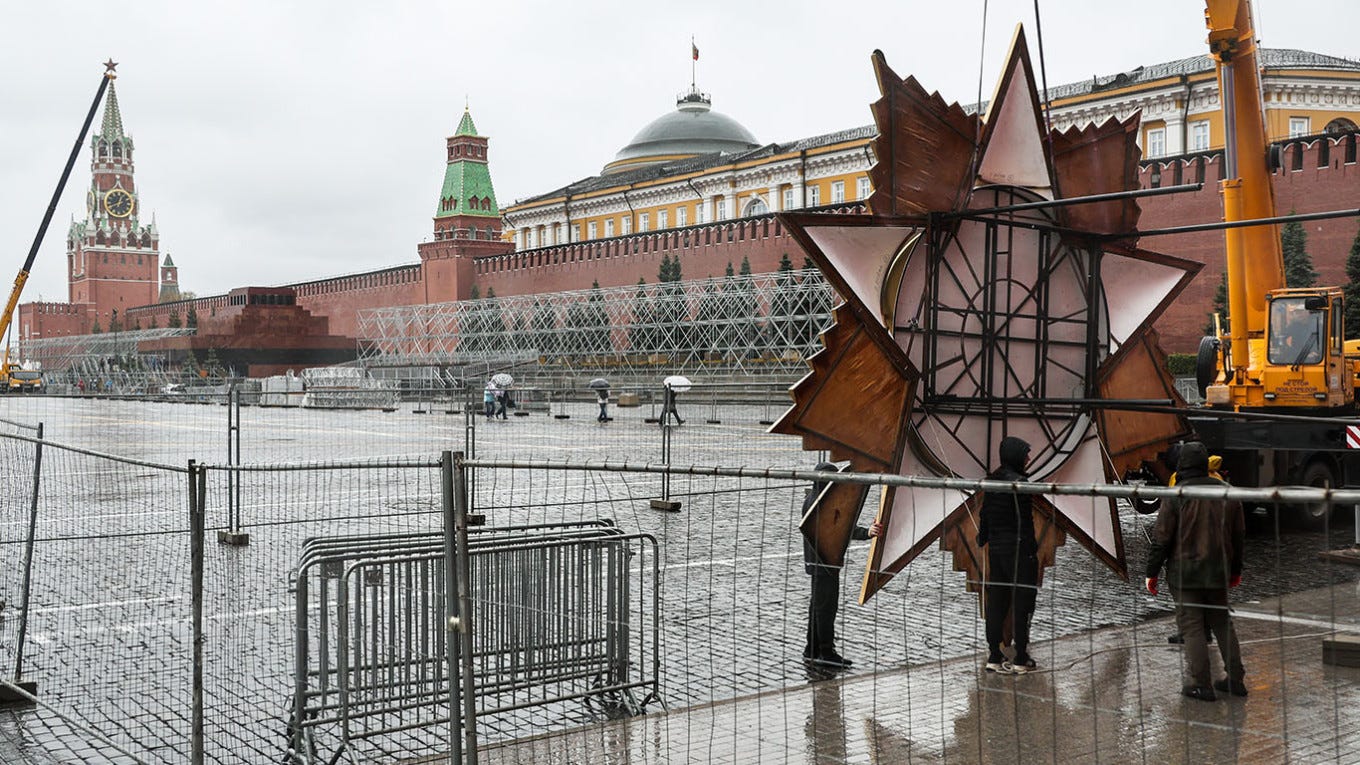
The security concerns have already shaped public ceremony. Moscow this week announced that its May 9 Victory Day parade on Red Square - the fifth since the full-scale invasion began - will take place for the first time in some two decades without heavy armour or missiles. Kremlin spokesman Dmitry Peskov cited the threat from longer-range Ukrainian strikes as a factor. Russian military blogger and Komsomolskaya Pravda war correspondent Alexander Kots suggested the parade itself was almost canceled because of the threat posed by Ukrainian drones, the Moscow Times reported. “It might not have taken place at all due to the terrorist threat,” Kots wrote on Telegram. “But the Supreme Commander has decided to honor tradition, albeit in a scaled-down form.”
A Regime at a Fork in the Road
For Roman Anin, the intelligence report points to something larger than a security reshuffle. Writing for Important Stories, he argues that Russia may be witnessing “the transition of the Russian regime into a fundamentally different state” - one in which the deadlock in Ukraine, drone strikes on oil infrastructure, and deepening economic and social pressures have set in motion an inevitable struggle among the siloviki clans for the throne of what he calls “a weakening dictator.”
Putin’s response, Anin writes, is to construct a new oprichnina - a term evoking Ivan the Terrible’s feared secret police - in the form of an FSO endowed with “unlimited coercive powers,” reflecting a ruler who “understands well what awaits him.”
Anin sees two plausible trajectories from here. In the first - what he calls the Iranian path - Putin successfully consolidates loyal security services, chiefly the FSO and the National Guard, into a Russian analogue of Iran’s IRGC. Backed by escalating repression targeting even previously untouchable elites, and by accelerating isolation from the internet and the outside world, he retains power by force. In the second - the Time of Troubles - the parallel with Ivan the Terrible runs to its darker conclusion: the oprichnina’s terror, compounded by economic exhaustion and war, tips Russia into internal collapse and civil conflict, as it did in the late sixteenth century.
“Which of these scenarios is more likely in Russia is not so important,” Anin writes. “What matters is that each of them is highly likely.”
A Recluse Running a War
Andrei Kolesnikov, a columnist at New Times quoted by the FT, offers a sardonic summary of Putin’s current posture: “Putin is like the new Banksy sculpture in London - he does not want to see or hear. He listens only to the security services, which now run all spheres of life, and hopes that people will adapt to this as the new normal.”
CNN notes that despite the bunker lifestyle and restricted movements, Putin has continued selective public appearances - meeting Chechen leader Ramzan Kadyrov and Iranian Foreign Minister Abbas Araghchi this week. The Kremlin has not responded to CNN’s request for comment.
TODAY’S SUBSCRIBER VIDEO
Three stories dominate today’s video.
In the Persian Gulf, President Trump has launched “Project Freedom” - a US military operation to guide stranded ships through the Strait of Hormuz. Iran has called it a ceasefire violation and threatened to respond with force. We look at what the operation actually means in practice.
In Yerevan, nearly 50 world leaders are gathered for the 8th European Political Community summit - with Ukraine’s future financing and security firmly on the agenda. President Zelensky is in the room, but a scandal is mushrooming at home that could complicate everything he’s come to ask for.
This video below is for paid subscribers only.
If you’re reading this on the free tier, today is a good day to upgrade. The Hormuz operation is moving fast - and its implications for oil markets, the Iran ceasefire, and Trump’s next move are anything but settled. The Yerevan summit is live. And the Ukraine scandal is the kind of slow-burn story that could reshape Ukrainian politics at exactly the moment Europe is being asked to write a €90 billion cheque. World Briefing tracks all of it - daily, in depth, and without the noise. Upgrade to paid and get full access to today’s video and everything that follows.
