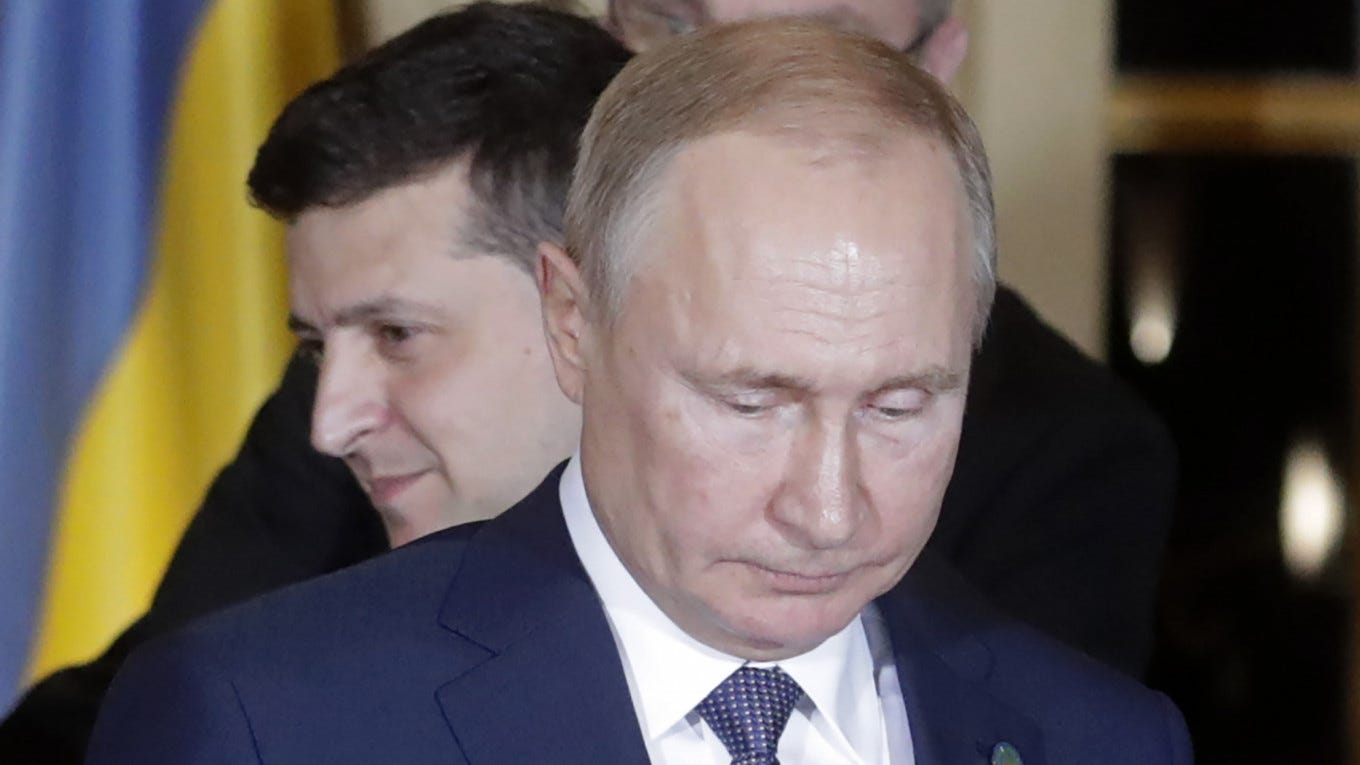
A brutal week in two capitals: Putin cornered by drones, a buckling economy and an Armenia vote slipping away - while Republicans in Washington break ranks to defy Trump on Ukraine. But a desperate Putin is the dangerous one, and tactical nukes can’t be ruled out.
My full analysis 👇
News Briefs
On the heels of a flurry of Ukrainian drone strikes deep in Russia and recent shifts in Ukraine’s favor on the battlefield, President Volodymyr Zelensky published on Thursday an open letter to President Vladimir V. Putin. The letter, posted on the Ukrainian president’s website, offered to resume peace talks — but taunted the Russian leader over wartime setbacks, inflation and Russia’s dependence on China. It also made note of Mr. Putin’s advancing age. Mr. Zelensky has at various points in the war recorded video statements addressing Mr. Putin or the Russian people, including on the first day of Moscow’s invasion in 2022. This letter was among the most scathing direct addresses to Mr. Putin so far. Mr. Zelensky noted that Mr. Putin has by now spent about half of his 26 years in power as Russia’s paramount leader fighting Ukraine. The timeline counts the Russian military intervention in eastern Ukraine that began in 2014 and the full-scale invasion launched in 2022. He offered a cease-fire if Mr. Putin wanted one. Mr. Zelensky said he would meet for direct talks outside the Trump administration’s negotiating process. Those talks, led by Steve Witkoff, a real estate investor, and Jared Kushner, President Trump’s son-in-law, ground to a halt after the U.S.-Israeli war against Iran began in February. Mr. Zelensky suggested including European nations and holding a leaders’ meeting in Switzerland, Turkey or an Arab state. He has offered direct meetings with Mr. Putin before, without result. Though addressed to Mr. Putin, the open letter seemed intended as well for Mr. Trump’s attention. And it was not clear whether Mr. Zelensky’s appeal was meant to jump-start talks or to denigrate a potential negotiating counterpart. Woven into the offer for peace talks were needling remarks about a strongman leader unable to defend his own capital, Moscow, or a second city, St. Petersburg, from a nation Mr. Putin invaded four and a half years ago with the goal of a quick win. “After 26 years in power, age is beginning to take its toll,” Mr. Zelensky wrote to Mr. Putin, who is 73, turning the knife. Mr. Zelensky, who is 25 years younger, has pointed to the Russian leader’s age to cast doubt on the stability of Russia’s one-man-rule political system. The letter also touched on reports of rising discontent in Russia over gasoline shortages from attacks on refineries, as well as inflation and war fatigue. The letter was posted a day after a drone strike on an oil depot outside St. Petersburg and a day before Mr. Putin is scheduled to deliver a speech to an economic conference at a venue outside that city on Friday. The attack sent a huge cloud of black smoke wafting over the highway leading from the city to the conference site. The letter appeared to be at least in part a publicity move, trumpeting the long-range drone strike on St. Petersburg, which had both an economic and a psychological impact on Russia. Even before that attack, Mr. Putin scaled down a Victory Day parade in Moscow last month amid worries of other Ukrainian strikes. “Now we can all see that Russians are finally becoming less comfortable with this reality,” Mr. Zelensky wrote. In his appeal for direct talks to end the war, Mr. Zelensky asked for a process apart from that led by the Trump administration. Running for election, Mr. Trump promised to end the war in a day, only to have talks stretch out now more than a year. Mr. Zelensky wrote that the United States had failed to deliver on what he said was an apparent agreement between Mr. Trump and Mr. Putin. “We have heard that you were promised in Alaska the resolution of certain issues concerning Ukraine and Europe,” Mr. Zelensky wrote, referring to a summit last summer in Anchorage. Russia has said that Mr. Trump agreed that Ukraine would cede land for peace. Ukraine has not done so. “You can see for yourself that Ukrainian and European issues are not decided in Anchorage,” Mr. Zelensky wrote - NYT
In a rare display of bipartisan cooperation and a rebuke to the administration’s approach toward Ukraine, the US House of Representatives approved a sweeping Ukraine aid and Russia sanctions package, with 18 Republicans joining Democrats to pass legislation that Republican leadership had sought to keep off the floor. The Ukraine Support Act passed 226-195 after supporters overcame months of resistance through a discharge petition -- one of the most difficult procedural mechanisms available in Congress. The vote marks the first comprehensive Ukraine-support legislation to pass the House during the 119th Congress and underscores growing unease among some Republicans over the administration’s handling of Russia’s war against Ukraine. The measure passed late on June 4 authorizes more than $1 billion in assistance for Ukraine, up to $8 billion in military financing loans, support for reconstruction efforts, aid to Baltic allies, and a new package of sanctions targeting Russia's financial, energy, mining, and government sectors. While the bill's prospects remain uncertain in the Republican-controlled Senate, where leaders have largely deferred to President Donald Trump's position on Russia sanctions, supporters described the vote as a significant political and symbolic victory. The vote came only a day after another group of House Republicans joined Democrats to pass a separate resolution limiting US military involvement against Iran without congressional authorization -- another indication of growing willingness among some lawmakers to challenge both party leadership and the White House on foreign policy matters. The next step for supporters is to move the legislation through the Senate. To become law, the Ukraine Support Act must be introduced, receive a vote, pass the upper chamber, and then be sent to the president's desk - RFE/RL
Russian Central Bank Governor Elvira Nabiullina will not attend this year’s St. Petersburg International Economic Forum because she is on sick leave, a spokesperson for the regulator told the news outlet RBC on Thursday.
Nabiullina was originally scheduled to speak at two panels on cyber fraud and economic growth at Russia’s flagship business and investment event on Thursday. Her name was suddenly removed from the list of participants ahead of the sessions. State Duma lawmaker Andrei Makarov, who moderated one of those panels, said the Central Bank chief was unable to attend for “objective reasons.”
A source close to one of Russia’s state corporations told the business newspaper Vedomosti that Nabiullina actually skipped the forum to attend the funeral of her adviser Alexei Mozhin, who died at age 69 on Wednesday, SPIEF’s opening day.
The Central Bank did not elaborate to RBC whether Nabiullina fell ill herself or was going to Mozhin’s funeral. At the economic panel Nabiullina was set to join, top Russian financial officials claimed the country has achieved absolute financial sovereignty and must permanently abandon any expectations of Western sanctions being lifted. Nabiullina’s third and final term as Russia’s top financial regulator ends on June 24, 2027. President Vladimir Putin is legally required to submit a nominee for her successor to parliament no later than March 2027 - Moscow Times
The men’s soccer World Cup kicks off next week at 16 stadiums across North America, just as summer weather arrives in many of the host cities. Millions of fans, players and workers could be exposed to potentially harmful heat, an NPR analysis finds. More than one-third of World Cup matches are at high risk for dangerously hot, humid conditions, NPR found, and dozens more matches come with moderate heat risk. NPR looked at two decades of temperature data for each host city, as well as the time each World Cup match is scheduled to start, and checked those temperatures against heat hazard guidelines from the Occupational Safety and Health Administration and the American College of Sports Medicine. The high-risk events identified in NPR’s analysis include multiple high-profile matches, such as the game that determines which team takes home third place in the World Cup, and the World Cup final. “Players can overheat, and match officials as well,” says Donal Mullan, a climate scientist at Queen’s University Belfast, who co-authored a study last year about heat risk at the 2026 World Cup. “They can also overheat and collapse,” Mullan warns. “This has happened to people.” Out of the 104 games, 67 of them are being held at locations and times that come with potential danger for heat illnesses, with 39 of those at high risk, according to their historical wet bulb globe temperature (WBGT). Miami, Houston, Dallas and Atlanta rank near the top in temperature for their games, with averages as high as 84 degrees Fahrenheit. Attendees and workers in those stadiums will have air conditioning. Stadiums in other parts of the U.S. don’t have the same infrastructure, with games in Philadelphia, New Jersey and Kansas City, Mo., averaging as high as 79 F with no roofs covering their stadiums. Miami’s stadium is the hottest venue without air conditioning. The historical average temperature this time of year is around 80 F. That threatens multiple matches with dangerously hot weather, including the match that determines which team wins third place in the tournament - NPR
After initially saying that spectators would be able to bring factory-sealed water bottles to matches, FIFA updated its official stadium code of conduct this week to prohibit fans from bringing in bottles. When the weather is especially hot, “venues will activate additional cooling capacity, including shaded areas, misting systems, cooling buses and expanded water distribution,” the FIFA spokesperson wrote to NPR.
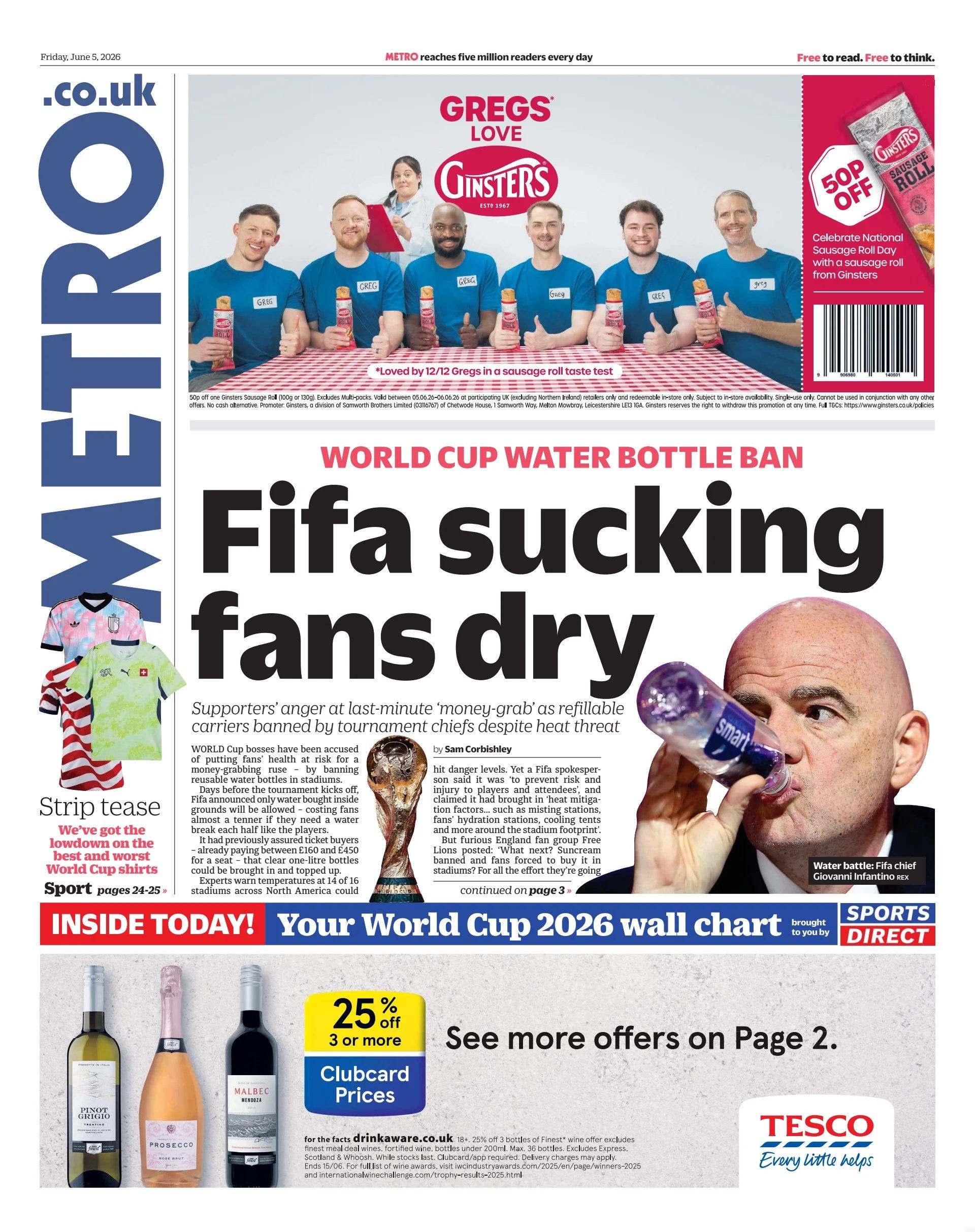
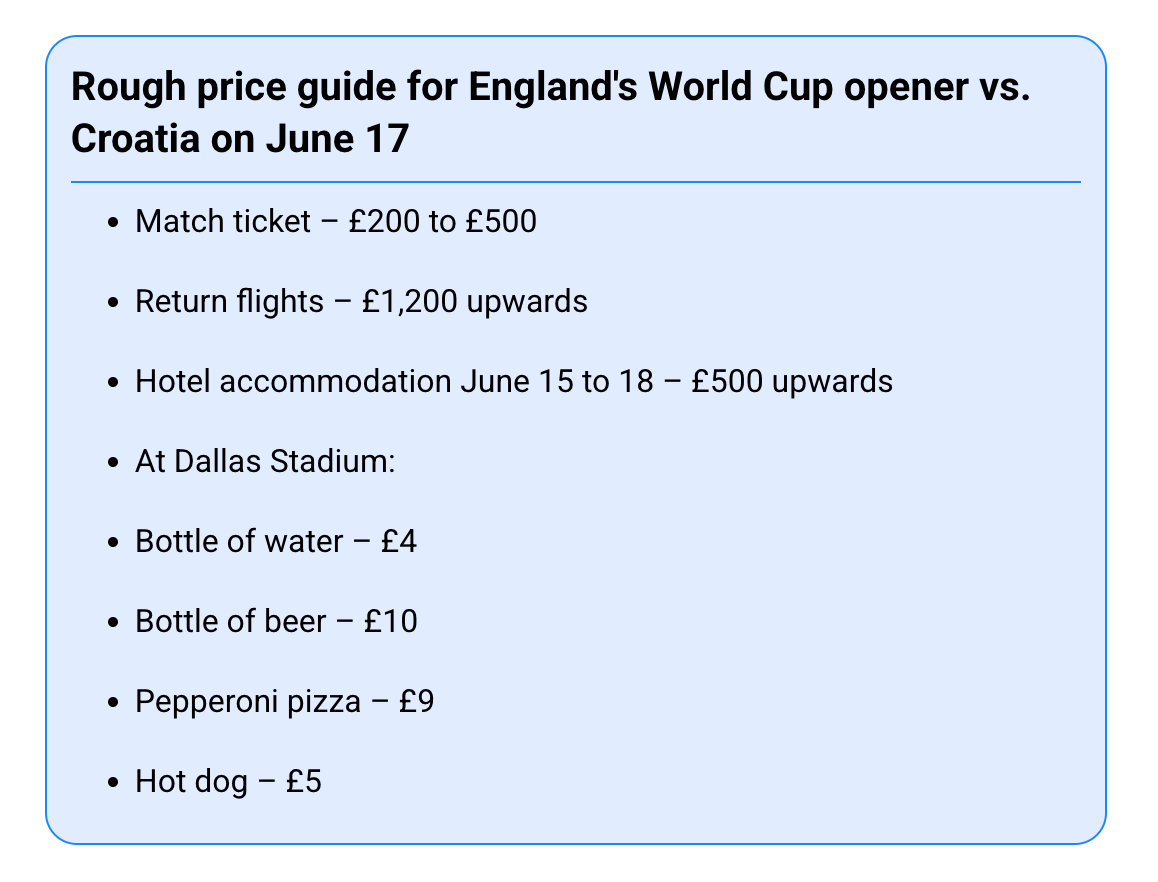
UK fans will now be banned from taking reusable water bottles into World Cup stadiums after an injury time U-turn by Fifa. The move, coming just a week before the tournament kicks off on June 11, has been criticised by England fans who hit out at the governing body’s ‘latest money-grab’. Fifa said it is designed to ‘prevent risk and injury to players and attendees’, despite experts warning that temperatures at 14 of the 16 grounds hosting matches could exceed dangerous levels. Fans hoping to cool down with a bottle of water while the players take their three-minute hydration break in each half will now have to hand over nearly £5 for the privilege. The code of conduct for ticket holders had previously permitted an empty, transparent, reusable bottle of up to one litre capacity to be brought in. But as first reported by The Athletic, an update to ticket holders on June 2 confirmed reusable bottles will no longer be permitted. Reacting to the new policy, the Free Lions England fans’ group posted on X: ‘What next? Sun cream banned and fans forced to buy it in stadiums? - Metro (UK)
Dozens of ultra-Orthodox extremists in Israel staged a violent riot outside the home of a top judge on Wednesday night in protest against the country’s military draft, shocking many Israelis and adding to a fraught atmosphere ahead of national elections. The police said on Thursday that 65 of the protesters were detained for questioning. The rioters damaged property at the home of Supreme Court justice, Noam Sohlberg, in Alon Shvut, a West Bank settlement, police said, though no injuries were reported. It was unclear why that particular judge’s house was targeted, but it was the Supreme Court that had issued a ruling two years ago, formally ending the decades-long military draft exemption for ultra-Orthodox Jewish men, known in Hebrew as Haredim. Despite the court ruling, most Haredi men still do not show up for service. The exemption is one of the most contentious issues dividing Israelis after nearly three years of war in the region. It is also expected to be a major issue during elections set to take place this fall. The exemption had been granted specifically to Haredi men who say they are engaged in full time Torah study. Prime Minister Benjamin Netanyahu condemned the violence on Wednesday night. His office said in a statement that he had spoken with Justice Sohlberg and made it clear that he expects law enforcement authorities to take a hard line against the rioters. Mr. Netanyahu’s right-wing government relies on the support of ultra-Orthodox political parties. It has been unable to muster enough support to pass a proposed military draft bill that would encourage the enlistment of some Haredi men, but that critics say would effectively exempt the majority of them. The Israeli military now says it is short of thousands of soldiers. Reservists have been called up repeatedly, often for hundreds of days of service at a time, fueling widespread resentment against the Haredim, who many Israelis say are dodging the draft and not sharing the national burden - NYT
Chinese leader Xi Jinping will travel to Pyongyang for a two-day state visit set for Monday 8 June and Tuesday, 9 June, both countries announced Friday, in what will be his first visit in nearly seven years. The trip comes just weeks after Xi separately hosted US President Donald Trump and Russian President Vladimir Putin in Beijing. The trip’s announcement also comes a day after North Korea unveiled a new facility to produce the ingredients for nuclear bombs, a move experts say suggests North Korean leader Kim Jong Un is eager to cement his country’s status as a nuclear weapons state ahead of Xi’s visit. During a visit to the plant, Kim announced plans to bolster the country’s nuclear forces “at an exponential rate.” - Euronews
US oil reserves are at their lowest level since 2004 as the energy impacts of the Iran war pile up, but countries are finding ways to adapt. The energy shock from the largest supply disruption in history feels “remarkably mild,” Semafor’s climate and energy editor argued. A decline in China’s oil imports has “shielded the rest of the oil market,” one strategist noted, while a new study showed impacts to the US are less pronounced than the 1970s energy crisis, owing to a rise in domestic oil production. “The world is learning to live without the Gulf’s seaborne exports,” a former US Treasury official wrote: The conflict has forced Asia and Europe to accelerate their transition to renewable energy - Semafor
The journals…..