

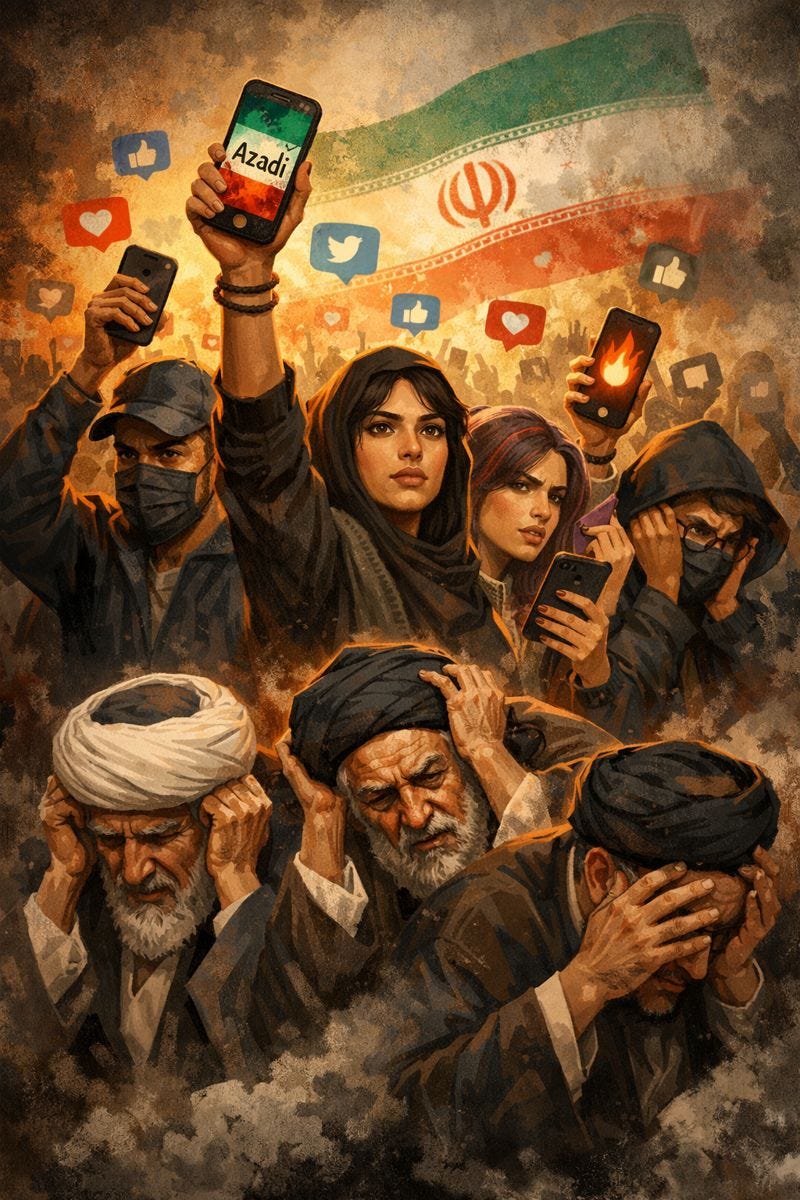
Iran’s leadership is facing mounting pressure from abroad and emerging dissent from within as street protests over its reeling economy and the threat of a new round of military strikes hang over the country. Demonstrations were reported in several cities, with markets and shops shuttered and students holding rallies at universities, on December 30. This follows two days of demonstrations that saw security forces launch volleys of tear gas to disperse crowds. People were chanting anti-government slogans to protest a sharp weakening of the currency. Videos posted on social media showed a third day of closures and demonstrations. One video, verified by RFE/RL, showed protesters pushing back security forces in Tehran. Projectiles were thrown at the police, who appeared to fire tear gas at the crowd. “We’re in a new phase of turmoil in the country, which is the phase of the dollarization of the Iranian economy...which led to protests,” Tehran-based political analyst Hamid Asefi told RFE/RL’s Radio Farda. “The situation in the bazaars and in the economy does not have a [bright outlook]. We can’t say that in 4, 5 months everything will be back to normal,” he added - RFE/RL
In the latest protests to grip Iran, protesters chanted anti-government slogans, and video on social media showed demonstrators chanting “Don’t be afraid, we are together” and “Azadi”, the Farsi word for freedom. The Guardian reported that footage also showed Iranian police in riot gear shooting teargas at protesters. The protests were the largest since a wave of demonstrations rocked the country after Mahsa Amini, 22, died in police custody following her arrest for not wearing the hijab correctly. At the time, Iranian police responded with force, imposing an internet shutdown and violently cracking down on demonstrations with teargas and gunfire. On Tuesday, the Iranian president, Masoud Pezeshkian, instructed the government to listen to the “legitimate demands” of protesters.
The United Arab Emirates’s defence ministry announced that it has voluntarily ended the missions of its “counterterrorism” units in Yemen, according to the state news agency WAM. The UAE’s Foreign Ministry emphasised in a statement that the country is not part of any regional attempt to undermine Saudi Arabia. Southern Transitional Council representative Nabeel bin Lasem told Al Jazeera that Rashad al-Alimi, the head of Yemen’s Presidential Leadership Council (PLC), were a “declaration of war against the south”. Four members of Yemen’s PLC rejected the move by council chief al-Alimi to declare a state of emergency and expel UAE forces from the country. Saudi Arabia said it hopes the UAE will respond to a request to leave Yemen within 24 hours and said that it is committed to the “security, stability, and sovereignty of Yemen.” The secretary-general of the Arab League, Ahmed Abu al-Gheit, called for an immediate end to the escalation in Yemen and expressed “deep concern” over the unfolding developments - Al Jazeera
A renewed ceasefire between Thailand and Cambodia over border clashes passed the 72-hour mark on Tuesday (Dec 30), an initial goal the countries set to secure a more lasting peace, but Bangkok said it had delayed the release of 18 Cambodian soldiers due to alleged breaches of the deal. The Southeast Asian neighbours agreed on a ceasefire that took effect at noon on Saturday, halting 20 days of fighting that killed at least 101 people and displaced more than half a million on both sides, and included fighter-jet sorties, exchanges of rocket fire and artillery barrages. The border clashes reignited early this month, following the breakdown in a ceasefire deal that US President Donald Trump and Malaysian Prime Minister Anwar Ibrahim helped broker to halt a previous round of conflict in July. Under the agreement signed by the defence ministers of both countries on Saturday, Thailand said it would release the 18 Cambodian soldiers after the ceasefire held for 72 hours. On Tuesday, Thai Foreign Ministry spokesperson Nikorndej Balankura said the military had detected many drones from Cambodia on Sunday night, which it saw as a breach of the deal, and so had reconsidered the timing of the handover of the soldiers. Cambodian authorities have strongly rejected the accusation of using drones, and issued an order prohibiting the use of drones across the country late on Monday - CNA
The Kremlin accused Ukraine of conducting a long-range drone strike targeting Russian President Vladimir Putin’s residence in Novgorod Oblast on December 29 - however, the circumstances of this alleged strike do not conform to the pattern of observed evidence when Ukrainian forces conduct strikes into Russia, and the Kremlin has offered no evidence to support its claim, the respected Institute for the Study of War says. Confirmed Ukrainian strikes in Russia typically generate evidence observable in open sources. Such evidence includes footage, often geolocated, of air defense operations, explosions, fires, or smoke plumes near targeted objects; statements from local and regional Russian authorities, usually downplaying successful Ukrainian strikes as “debris” from downed drones; and reports from local sources and media of fire or damage to such objects. ISW has not observed any such footage nor local or regional reporting about Ukrainian strikes near Putin’s residence to corroborate Lavrov’s claim of downing 89 Ukrainian drones over Novgorod Oblast. It is also inconsistent with the Russian Ministry of Defense’s (MoD’s) claim that Russian forces downed 47 Ukrainian drones over the oblast overnight on December 28 to 29, further undermining the claim. Ukrainian forces previously struck numerous military targets in Novgorod Oblast, which produced evidence. Russian opposition outlet Sota published an investigation into the alleged strike on December 29, reporting that Valdai residents did not hear air defenses operating overnight, even though Russian air defenses would have had to operate to down up to 91 Ukrainian drones. Ukrainian President Volodymyr Zelensky refuted the alleged strike and warned that Russia will use this claim to justify strikes against Kyiv City and Ukrainian government buildings. The Kremlin may intend to use this claimed strike to justify its rejection of any peace proposals that come out of recent bilateral US-Ukrainian and multilateral US-Ukrainian-European talks.
Russia attacked two civilian vessels in the Black Sea - Emmakris III and Captain Karam - with strike drones overnight. The enormous bulk carriers were entering Odesa port to load wheat. According to Ukrainian media Telegram channels, there are casualties. Earlier a port oil storage tank port was hit. Fortunately it was empty. A civilian ship with grain under Panamanian flag also suffered damage. The Emmakris III was seized by Ukraine in 2022, claiming it was tied to Russian entities involved in illegally transporting stolen Ukrainian grain. In mid-2025, Ukraine thwarted an attempt to hijack the seized vessel. It now is managed by Kyiv. Ukraine is a major global producer and exporter of agricultural products. During nearly four years of the war, the role of Odesa and its two other ports – Pivdennyi and Chornomorsk – as major trading hubs grew as other Ukrainian ports were destroyed, occupied, or disrupted by Russia’s forces. Given the most recent attacks on a critical component of the global food supply chain - World Port Odesa - it i fair to ask why western allies refuse to commit even a fraction of the military muscled it deployed to the Red Sea when it was blockaded.
President Vladimir Putin signed an executive order on Tuesday authorizing the military to summon members of its mobilization reserve next year for “special” assemblies aimed at protecting critical infrastructure. The order directs the government to draw up a list of facilities requiring protection, while the Defense Ministry is tasked with designating the military units responsible for conducting the assemblies. Russia’s mobilization reserve consists of volunteers who have signed contracts committing them to periodic service. Until recently, reservists could be assigned combat duties only during mobilization or wartime and were typically called up for training no more than once a year. In November, Putin signed legislation expanding the circumstances under which reservists can be deployed, allowing them to be summoned in peacetime for so-called “special” assemblies to safeguard critical infrastructure and other sites the government deems essential. The business newspaper Kommersant reported that recruitment campaigns have already begun in several regions to enlist reservists into units tasked with protecting such facilities. The move comes as Russia faces mounting challenges defending military sites and key infrastructure from Ukrainian drone attacks, which have increasingly targeted oil and gas installations vital to the country’s energy sector - Moscow Times
News Brief | Frozen Russian Assets: Euroclear in the Dock, Clearstream in the Shadows
Europe’s debate over what to do with frozen Russian assets is often framed as a technical, legal tug-of-war centered on one institution: Euroclear. But that narrow focus obscures a far more complex — and politically revealing — picture. In this exclusive World Briefing report, I look beyond the usual talking points to examine how responsibility, risk and scrutiny have been unevenly distributed across Europe’s financial plumbing - and why one powerful player has largely stayed out of the spotlight. I also draw on my recent on-air commentary to unpack how Russian pressure and intimidation are shaping political decision-making inside the EU, with real consequences for Ukraine’s war effort. This is the kind of deeper, connective analysis reserved for paid subscribers - reporting that goes past the headlines to show how money, power and geopolitics really intersect. If you value independent journalism that connects the dots so you don’t have to, please consider upgrading to a paid subscription to World Briefing.
