

Overnight drone strikes tore through central Odesa - and I was there. As a longtime resident and commentator, I witnessed the aftermath firsthand: the so-called “green zone,” the Red Cross compound, consulates, expat residences, and critical infrastructure all hit. By dawn, World Central Kitchen and local civil society were already mobilizing - a familiar rhythm in a city that refuses to stop. This is what war looks like from the ground. When I asked one resident whether he believed no inch of Ukraine is safe any longer, he paused - then said simply:
“We have to pray.”
▶️ Watch the full video above
This is World Briefing - outside, on the ground, for a reason.
If you value independent, field-based reporting, consider supporting it via my Patreon or PayPal platforms.
Iran’s supreme leader has broken his recent silence with a defiant statement hailing Iran’s control over shipping in the strait of Hormuz and vowing to guard the country’s nuclear and missile programmes. “Today, two months after the largest military deployment and aggression by the world’s bullies in the region, and the United States’ disgraceful defeat in its plans, a new chapter is unfolding for the Persian Gulf and the strait of Hormuz,” Mojtaba Khamenei said in a statement read by a state television anchor. The statement said Tehran would secure the Gulf region and eliminate what he described as “the enemy’s abuses of the waterway”, and that “new management of the strait will bring comfort and progress for the benefit of all the nations of the region and economic blessings will bring joy to the hearts of the people”. Iran has sought to extract a price for being attacked by exerting control over the strait, the narrow waterway through which about one-fifth of global oil typically transits. Speaking to mark Persian Gulf Day in Iran, Khamenei also vowed that Iran would “guard its modern technological capacities – from nano to bio to nuclear and missile – as their national capital and will guard it like their maritime land and air borders”. No recording or visual sighting of Khamenei has been broadcast since he was appointed supreme leader in early March. Reports have suggested that he was severely injured in the bombing that killed his 86-year-old father and predecessor on 28 February. He is said to be in hospital being treated for injuries. His new statement suggests Iran is determined to implement a new fees regime in the strait that it will present as benefiting the entire region as a belated assertion of regional sovereignty. Since 13 April the US has mounted a counter-blockade designed to stop oil tankers moving in or out of Iranian ports, seizing up the Iranian oil industry - The Guardian
Brent crude, the international standard for oil prices, jumped by over 7% during early trading on Thursday, touching $126 per barrel, the highest intraday level since 2022 when Russia initiated the full-scale invasion of Ukraine. The US benchmark crude, WTI, also rose more than 3% and hit over $110 per barrel. At the time of writing, prices have corrected slightly with the front month contract for Brent trading at around $122 per barrel and WTI at roughly $108.5. Prices are now the highest they have been since the start of the Iran war. US President Donald Trump is set to meet with the head of the US Central Command, Admiral Brad Cooper, on Thursday and receive a briefing on new military options for action in Iran, according to Axios which cites two unnamed people. The meeting signals the potential for fresh escalation in the Middle East as the resumption of combat operations is reportedly “seriously under consideration” and oil markets have reacted swiftly to the news. A ceasefire has held since early April but recent negotiating efforts have fallen flat with the two sides refusing to meet. Meanwhile, the US and Iran both maintain their blockade of the vital Strait of Hormuz. US Central Command has also reportedly asked for hypersonic missiles to be sent to the Middle East, which would mark the first time the US army has deployed that type of weapon - Euronews
The yen on Thursday weakened past a psychologically significant threshold of 160 to the dollar, at one point sinking to the lowest level in 21 months as fears over a prolonged war in the Middle East prompted investors to seek out safe haven assets like the the greenback. At one point during Wednesday trading in New York the yen depreciated to 160.48 per dollar. On Thursday morning in Tokyo, the yen was trading around 160.28 against the dollar - Nikkei Asia
U.S. President Donald Trump’s perceived fixation on personal legacy and flattery is shaping global diplomacy in unusual ways — including proposals tied to Ukraine’s war with Russia and regional infrastructure projects, Salon argues. According to the report, Ukrainian negotiators have floated - at least informally - the idea of naming a contested part of the Donbas region “Donnyland” as a way to appeal to Trump’s ego and encourage stronger U.S. backing against Vladimir Putin. The concept, described as partly tongue-in-cheek, underscores what analysts see as a broader trend: foreign leaders using symbolic gestures, branding, or personal appeals to influence Trump’s decision-making. (Trump-linked negotiators have attached the former president’s name to a proposed regional energy corridor known as TRIPP, aimed at further connecting Armenia with neighboring markets — another example of how branding and personal legacy are being woven into geopolitics). The article draws parallels to past efforts, including Poland’s proposed “Fort Trump” military base and Israel’s “Trump Heights” settlement in the Golan Heights, both seen as attempts to secure U.S. favor. It suggests such strategies reflect a belief among allies and adversaries alike that personal flattery can translate into policy outcomes. In the Ukraine context, the stakes are especially high. Any settlement over the Donbas - where Russian forces still control significant territory - could shape the future security architecture of Eastern Europe. The piece warns that an approach to diplomacy driven by personal validation rather than strategic calculation risks major geopolitical missteps, particularly in high-stakes conflicts.
Disinformation and Media Restrictions Are Making Modern Conflicts Harder to Resolve, Says Mediator
A veteran journalist-turned-conflict mediator is warning that a global “information vacuum” is undermining efforts to broker peace in today’s wars, as disinformation, state secrecy and media access restrictions strip away the factual foundation that negotiations depend on.
Writing in the South China Morning Post, Michael Vatikiotis argues that mediators cannot do their jobs without reliable information about who the key actors are, what positions they hold and why they are fighting - data points he describes as essential precursors to any peace process. That baseline, he contends, is now routinely missing or distorted.
Vatikiotis points to the Pakistan-led negotiations aimed at ending the Iran conflict as a case in point, noting that fundamental uncertainty surrounds what Washington and Tehran are actually bringing to the table.
He identifies several compounding factors. Local conflicts are increasingly hijacked by outside powers, blurring the line between internal grievances and external agendas and making it difficult to identify who truly controls the fighting parties. Meanwhile, formal mechanisms for managing great-power rivalry - arms control agreements, UN-led frameworks - have largely collapsed, leaving major powers less predictable and less constrained.
Media access, Vatikiotis argues, has deteriorated sharply. In the ongoing Iran conflict, he notes that a total internet blackout inside Iran and sweeping Gulf-wide press restrictions have created a void quickly filled by AI-generated imagery and unverified social media content. No independent reporters were present at US bases struck by Iran, and the Pentagon provided no clarification beyond what President Trump chose to disclose - including a claim that the USS Gerald R. Ford’s withdrawal from operations stemmed from a laundry room fire rather than drone strikes. Trump also suggested news organisations could face treason charges for reporting that he characterised as aiding the enemy.
Drawing a contrast with Vietnam War coverage - where more than 60 journalists died reporting from the front and whose work he credits with shifting public opinion - Vatikiotis calls for dedicated funding for independent media in conflict zones, legislative pressure on governments to lift blanket coverage bans, and accountability for the unnecessary withholding of public-interest information.
Without credible, ground-level reporting, he warns, peacemakers are left navigating some of the world’s most complex crises essentially blind.
Odesa endured one of its most intense nights of the year as Russian forces launched a mass drone assault on the city in the early hours of Thursday. At least 20 people were injured, including a 17-year-old boy, with two victims remaining in intensive care in serious condition as doctors fight for their lives. Ukrainian air defenses engaged the incoming barrage, intercepting the majority of drones, but multiple projectiles broke through. The heaviest damage was recorded in Odesa’s Prymorskyi district, where a high-rise apartment building and a five-story residential building were struck, sparking large fires on upper floors and rooftops that emergency crews worked to contain. Among the hardest-hit areas was the so-called “green zone” - the corridor between the Chinese and Turkish consulates - where a large apartment complex housing expatriates and serving as a base of operations for the Ukrainian Red Cross / ICRC took a direct hit. Educational institutions and critical infrastructure were also struck, leaving central Odesa without water for several hours. Across other districts, strikes hit infrastructure facilities, warehouses, and vehicle parks, destroying or damaging dozens of buses and passenger cars. More than 280 emergency workers were deployed, and operational aid centers were stood up to assist displaced residents. By morning, a full mobilization of civil society organizations, city officials, and World Central Kitchen volunteers were on the ground at the damaged apartment complex, providing emergency assistance to affected residents. The overnight assault follows a separate attack just days prior. On April 27, Russian drones struck three districts of Odesa, hitting residential buildings, a hotel, warehouses, and a funicular railway, with windows shattering across many buildings and the port area sustaining damage. Odesa, a major Black Sea port and focal point for Ukrainian grain and commodity exports, has been repeatedly targeted by Russian attacks throughout more than four years of war. The city’s port infrastructure - critical to global food supply chains - remains a strategic Russian target.
US President Donald Trump discussed a possible, brief Ukraine ceasefire in a lengthy phone call with Russian President Vladimir Putin on Wednesday. The truce, poised to coincide with Russia’s Victory Day holiday on May 9, would come several weeks after Kyiv and Moscow negotiated a ceasefire around Orthodox Easter, though each side accused the other of violations. Ukraine says its drones are increasingly capable of accurately striking deep within Russia: In the latest attack, an oil facility was reportedly struck Wednesday - Semafor
During a live recruitment session at Kuban State Agrarian University in Krasnodar, a Ukrainian intelligence officer posed as a Russian drone unit soldier before revealing his identity. He warned students that anyone signing a military contract would be killed, describing the front line as static for four years and the war as creating “a cemetery the size of two countries.” University staff cut the link after his threats and accusations were delivered. This operation was reportedly coordinated by Ukrainian intelligence services - Telegraph
A chemical emergency alert was issued in parts of the city of Perm on Thursday following a second day of Ukrainian drone strikes on industrial sites in the wider region, though local officials later claimed the warning was only a test despite residents reporting huge smoke clouds and a distinct chemical odor in the air. Perm region Governor Dmitry Makhonin said several industrial sites were targeted in the morning attack. He said workers at the facilities were sheltering in place as emergency responders arrived at the scene of the attacks. Makhonin claimed there was “no significant damage” and that no one was reported injured. Yet videos widely circulated on social media and in Russian news reports showed huge columns of smoke rising into the air. NASA satellite imagery also showed a prominent black streak of smoke rising above Perm and extending around 130 kilometers (80 miles) east of the city. Russian and Ukrainian Telegram news channels identified at least one target of Thursday’s attack as a Lukoil-operated oil refinery- Moscow Times
The spat between the US and China over Panama’s canal ports flared back up Wednesday, weeks before a high-stakes meeting of the countries’ leaders, Semafor reported. Washington’s top diplomat accused China of a “blatant attempt to politicize maritime trade” after Beijing briefly detained dozens of Panama-flagged ships in Chinese ports. The US earlier this month said China was “bullying” vessels in retaliation for Panama’s seizure of two canal ports from a Hong Kong-based company’s subsidiary earlier this year. The Trump administration has made dominance in the Western Hemisphere a foreign policy priority, and Panama in particular has been caught in the middle. Both superpowers are hunting for leverage ahead of the meeting next month; China recently blocked a major cross-border tech deal.
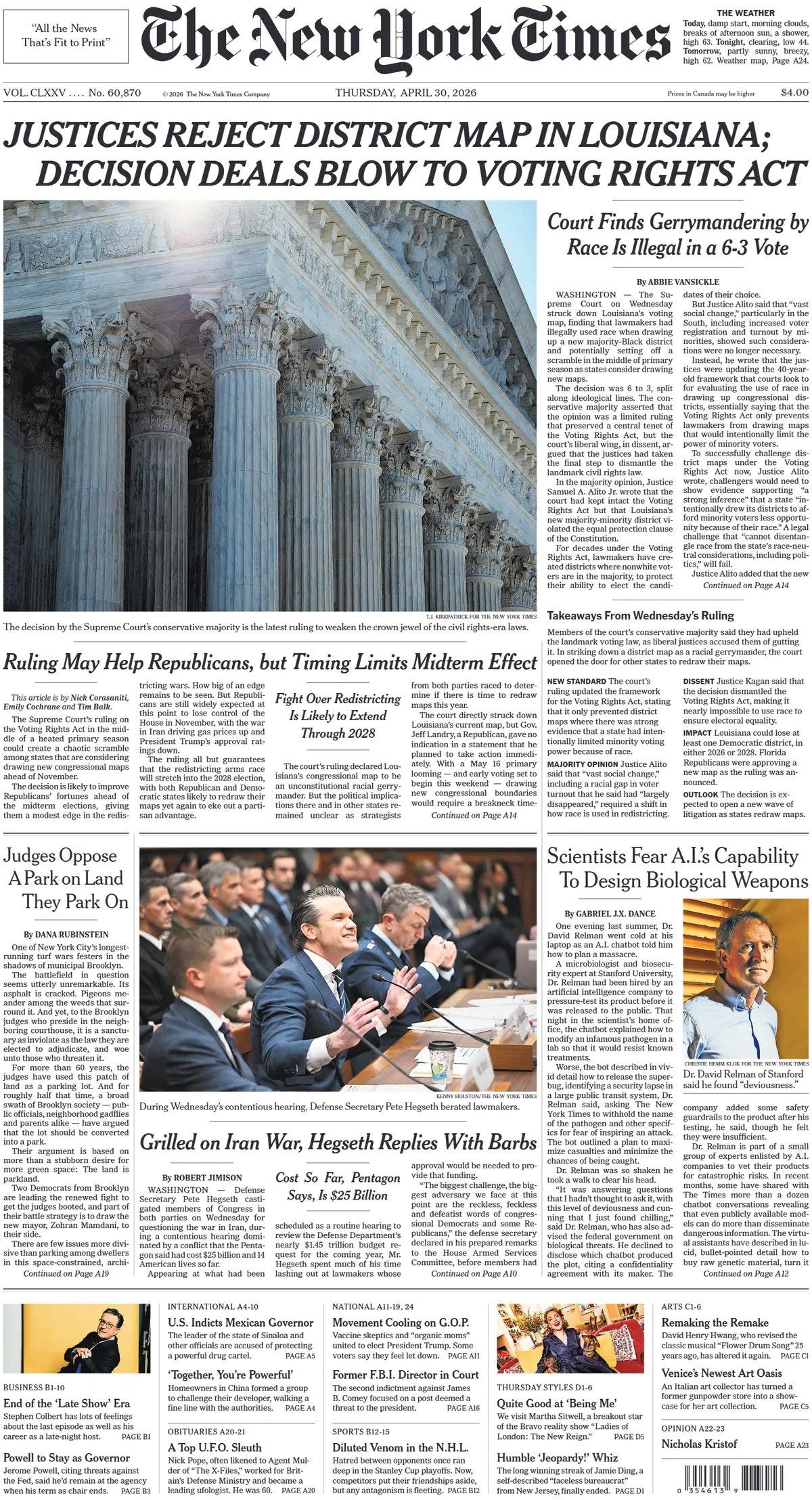
U.S. President Donald Trump on Thursday said he will nominate Fox News contributor Dr. Nicole Saphier as the next U.S. surgeon general. The move comes after Trump pulled his previous pick, Dr. Casey Means, whose confirmation process in the Senate stalled for months. Saphier is a breast radiologist. She is listed as the director of breast imaging at Memorial Sloan Kettering Cancer Center-Monmouth and the author of several books. That includes one book that critiques the U.S.’s response to the Covid-19 pandemic, arguing that political agendas often overshadowed scientific guidance. Means was nominated at the recommendation of her close ally Health and Human Services Secretary Robert F. Kennedy Jr. Her nomination had stalled in the Senate for more than two months over concerns about her controversial stances on vaccines, birth control, pesticides and psychedelics. Her brother, Calley Means, is a senior White House adviser - CNBC
The journals…..
Truth, not Trump lies and confusion. US is not winning against Iran. Russia is not winning against Ukraine.