L-R: A street scene in Dhaka, one of the coastal megacities facing the prospect of a ‘watery grave.’ A young boy at a marketplace in Chittagong, Bangladesh. Credit: M. Bociurkiw
The world’s fastest-growing cities are hurtling toward a convergence of climate and demographic pressures that could redraw the global map. A new scientific study warns that many of the planet’s great delta megacities — Shanghai, Karachi, Dhaka and beyond - now face a “watery grave” as sinking land meets rising seas, creating storm scenarios as destructive as a nuclear blast. These findings land as the UN reports that humanity is crowding at unprecedented speed into low-lying, flood-prone urban corridors across Asia and Africa, regions already pummelled by monsoon disasters that have killed more than a thousand people in recent weeks.
And where water is not overwhelming cities, it is disappearing altogether. Tehran — a metropolis that has doubled in population and quadrupled its water use since the late 1970s — is counting down to “day zero,” with reservoirs nearly empty and officials warning parts of the capital may need to evacuate. From megacities drowning to megacities drying out, the pattern is unmistakable: over-population, aging infrastructure and climate extremes are forming a lethal triangle that governments are dangerously unprepared to confront. (As I’ve written previously for CNN Opinion, world leaders have been sleepwalking through the climate crisis for years - a drift now compounded by the current occupant of the White House rolling back climate policies put in place by his predecessors.
Today’s World Briefing connects these cascading crises — and asks whether global leaders are ready for the urban century’s first true climate reckoning.
Many of the world’s largest and most vibrant cities may soon vanish from the map. Nature is preparing to reveal its most dangerous face, and coastal megacities such as Shanghai, Karachi, and Dhaka are now staring at the prospect of a ‘watery grave’. A new and alarming study warns that delta-based cities are becoming increasingly unsafe: the land beneath them is sinking while sea levels continue to rise. Scientists argue that this deadly combination is as catastrophic as a nuclear blast. Without urgent changes to their flood-management strategies, these cities may experience devastation similar to what struck New Orleans during Hurricane Katrina. This research, published in the journal One Earth, has sparked global concern. Experts say cities like Shanghai depend heavily on sea walls and embankments, defences that are no longer sufficient. Climate change has drastically intensified the threat. Researchers warn that when a powerful storm hits, these walls could collapse like a house of cards. The resulting disaster, known as a polder flood, is not an ordinary flood; water rushes in but has nowhere to escape. Professor Robert Nichols of the University of East Anglia states that the destructive power of the polder effect is gravely underestimated. The study examined 40 major delta cities, home to nearly 300 million people. The highest-risk locations include Shanghai, Ningbo, and Guangzhou in China; Yangon in Myanmar; Dhaka in Bangladesh; Karachi in Pakistan; and New Orleans in the United States. Each of the world’s seven largest river deltas has at least one major city in danger. Researchers even created a digital model for Shanghai using data from the ten most severe storms of the past fifty years, projecting conditions for the next seventy-five years. The findings were terrifying. Co-author Min Zhang reported that by 2100, the area flooded during a major storm could increase by 80 per cent, potentially submerging the entire city.
A UN report last month concluded that the world’s population is increasingly crowded into a group of often low-lying, middle-income megacities in Asia and Africa. Jakarta and Dhaka have dethroned Tokyo’s long-held status as the world’s biggest city, with 42 million, 37 million and 33 million people respectively. Mexico City and Sao Paulo were overtaken by Shanghai and Cairo among the global top 10. Bangkok, New Delhi, Karachi, Lagos, Luanda and Manila are some of the fastest growing among metropolises of more than 10 million. Many of these very regions have been hit by a devastating run of floods. The monsoon belt from Southeast Asia to West Africa is at the same time the swath of the globe that is urbanizing fastest, and the one where catastrophic rainfall is set to increase most dramatically. More than 1,000 people have been killed in a wave of storms that have stretched from Sri Lanka to Vietnam, with more than 700 dead in Indonesia and at least 267 fatalities in Thailand - Bloomberg
Iran’s capital is counting down to “day zero” - the day the water runs out and the taps run dry. Reservoirs that supply Tehran’s 15 million residents are almost empty. The Karaj dam, which supplies a quarter of the city’s drinking water, is just 8% full. Water rationing has begun in some areas, with the flow from taps reduced or even stopped altogether overnight. President Masoud Pezeshkian has urged people to use water sparingly - or the city, or at least parts of it, may even have to evacuate. Rain should start falling in the autumn after Iran’s hot dry summer. But according to the country’s National Weather Forecasting Centre, this has been the driest September to November period in half a century, with rainfall 89% below the long-term average. The combination of low rainfall and high heat has lasted for more than five years, leaving the country parched. But the weather - and the shadow of climate change - aren’t the only factors in Tehran’s water crisis. According to the Centre for Strategic and International Studies, the population of the metropolitan area of the city has almost doubled from 4.9 million in 1979 to 9.7 million today. But water consumption has risen even faster, quadrupling from 346 million cubic metres in 1976 to 1.2 billion cubic metres now. Increasing wealth has allowed more people to buy washing machines and dishwashers.

The Trump administration said on Friday that Europe is facing the “stark prospect of civilizational erasure” and pledged that the United States will support like-minded “patriotic” parties across the continent to prevent a future in which “certain NATO members will become majority non-European. The dark assessment of Europe’s future was released overnight as part of an annual update to the United States’ national security strategy around the world. Without naming them directly, the document says the United States should support political parties in Europe who fight against migration and promote nationalism. That describes several right wing populist parties like Reform U.K. in Britain and the Alternative for Germany, known as the A.F.D., which has been classified as an extremist party by German intelligence services. “In everything we do, we are putting America First,” Mr. Trump wrote in a foreword to the document, which he called a “road map to ensure that America remains the greatest and most successful nation in human history.” The Trump administration said on Friday that Europe is facing the “stark prospect of civilizational erasure” and pledged that the United States will support like-minded “patriotic” parties across the continent to prevent a future in which “certain NATO members will become majority non-European.” The dark assessment of Europe’s future was released overnight as part of an annual update to the United States’ national security strategy around the world. Without naming them directly, the document says the United States should support political parties in Europe who fight against migration and promote nationalism. That describes several right wing populist parties like Reform U.K. in Britain and the Alternative for Germany, known as the A.F.D., which has been classified as an extremist party by German intelligence services. “In everything we do, we are putting America First,” Mr. Trump wrote in a foreword to the document, which he called a “road map to ensure that America remains the greatest and most successful nation in human history.” - NYT
The Association of Tour Operators ATORUS has confirmed the launch of an evacuation plan for Russian citizens currently in Venezuela through the organization of special flights. The announcement, reported by local media and repeated internationally, immediately caused a stir on social media and sparked a heated debate about the fragile stability of the regime led by Nicolás Maduro, who has been targeted for months by the US federal administration, which considers him a drug lord. This measure comes at a time when Russian tourism in Venezuela has increased significantly: more than 6,000 visitors reached Margarita Island between August and November 2025 via direct charter flights from Moscow. These numbers suggest that relations between the two countries remain strong. However, the decision to evacuate Russian citizens, whether tourists, temporary workers, or personnel involved in commercial projects, has been interpreted as a warning sign highlighting the growing fragility of the Maduro regime. There are also reports suggesting that the special flights could involve officials, businesspeople, and figures close to the government who are interested in leaving the country in light of the possibility of an imminent conflict with the US. The situation is becoming increasingly thorny, partly due to recent restrictions on Venezuelan airspace, which emerged after tensions between Caracas and Washington. These restrictions had already forced tour operators to cancel or divert flights to alternative destinations, such as neighboring Cuba.
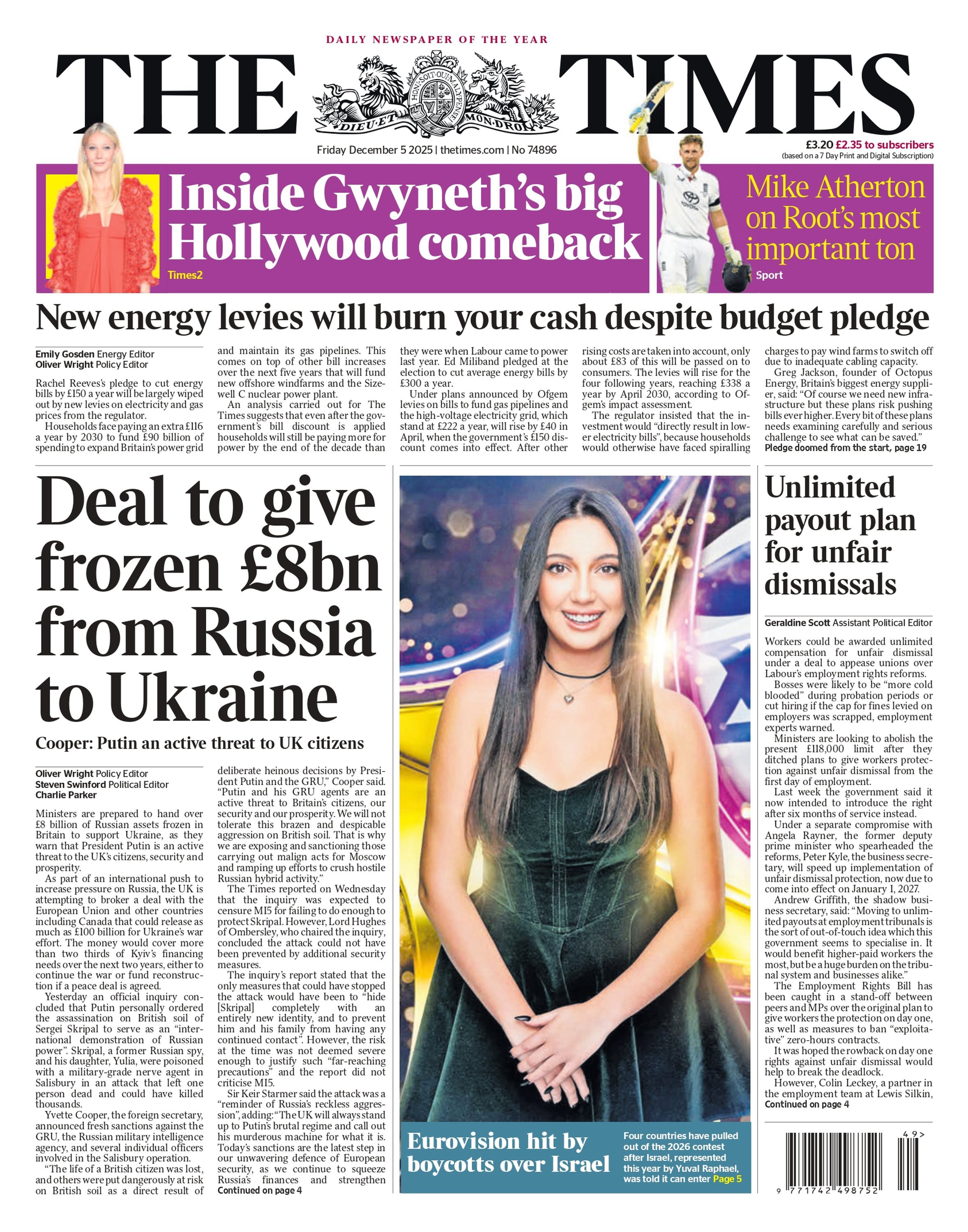
The UK government is ready to transfer £8 billion (over US$10.6 billion) in frozen Russian assets to support Ukraine. The Times stated that the UK government considers Russian leader Vladimir Putin a threat to the people, security and prosperity of the United Kingdom. The Times also noted that these funds would cover more than two-thirds of Ukraine’s financial needs over the next two years, both for continuing its defence against Russia and for funding the country’s recovery if a peace agreement is reached. As part of an international campaign to increase pressure on Putin, the UK is seeking to reach an agreement with the European Union and other countries, including Canada, to allocate up to £100 billion (over US$113 billion) for Ukraine’s military needs - UP
A suspected Ukrainian drone attack rocked the Chechen capital, Grozny, early on December 5 just hours after Ukrainian negotiators met with US officials in Florida seeking details from a meeting at the Kremlin between American and Russian teams on a proposal to end the war on Ukraine. Social media users posted videos -- verified by RFE/RL -- online showing a gaping hole in a high-rise building in Grozny, in an attack that hit less than 1 kilometer (0.6 miles) from the residence of the republic’s leader, Ramzan Kadyrov. Regional officials have yet to comment publicly on the attack, but sources told RFE/RL’s Caucasus.Realities that at least four more explosions occurred in Russia’s North Caucasus after a drone attack struck the high-rise complex, which houses government offices.
The sources said an empty police station in Gudermes and a Federal Security Service (FSB) building in Achkhoy-Martan were damaged in the blasts. No deaths were reported in any of the incidents - RFE/RL
As a follow-up to our lead story yesterday on the transfer of abducted Ukrainian children to North Korean camps, we are reproducing in full a post by Mykola Kuleba, Founder of Save Ukraine and the Ombudsman for Children with the President of Ukraine (2014-2021)
It has become known that Russia is moving Ukrainian children not only deep into the regions of the Russian Federation, but even to North Korea — a country completely isolated from the outside world. This effectively means the disappearance of these children into a regime with no access to information, oversight, or any chance of return.
At a recent UN session, human rights lawyer Kateryna Rashevska confirmed that Russia is systematically deporting Ukrainian children to 57 regions, imposing Russian citizenship, banning the Ukrainian language, rewriting their identities, and subjecting them to political indoctrination. Her testimony reinforces what Save Ukraine has been documenting for a long time.
And North Korea is only part of the picture.
We receive daily testimonies from the families we rescue: children and parents are being sent to Siberia, the Russian Far East, and even the Kuril Islands. These transfers are often presented as “rest”, “employment programs”, or “family resettlement”, but in reality they are deportations disguised as migration policy. At the same time, Russia is resettling its own citizens on occupied Ukrainian territories, deliberately reshaping their demographic landscape.
Thousands of Ukrainian children are being stripped of their right to remain Ukrainian, immersed in the cult of war, and trained to become part of Russia’s military machine. I have previously written about centers like “Voin”, where teenagers are taught to shoot, dismantle weapons, throw grenades, and “defend Russia”. This network spans 21 regions of the Russian Federation — and children from occupied territories are taken directly there.
As someone who sees these children every day after such “relocations”, I can say one thing: we must return every single child, no matter where they are taken — to central Russia, Siberia, or even North Korea. And we must ensure international accountability for all perpetrators of these crimes.
My thanks go to Kateryna Rashevska for raising her voice on the global stage. Only truth and persistence can break this silence. Please share this information. Every repost is an act of resistance against the attempt to erase Ukrainian children from their own land.
We must return every single (Ukrainian) child, no matter where they are taken — to central Russia, Siberia, or even North Korea. And we must ensure international accountability for all perpetrators of these crimes - Mykola Kuleba
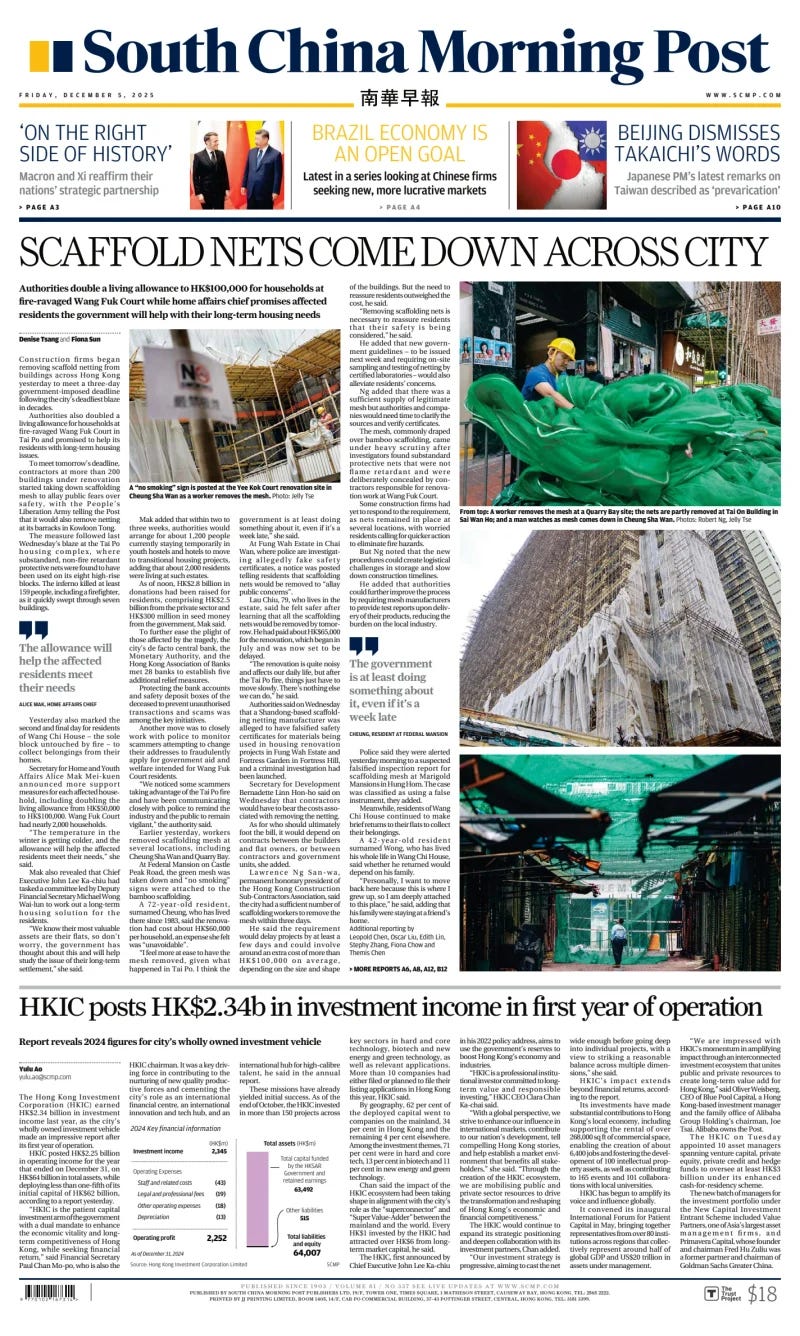
University student Miles Kwan, who launched a petition demanding answers from Hong Kong authorities after one of the city’s deadliest fires last week, was arrested and is now on bail, according to local media. The ferocious blaze had ravaged a densely populated housing estate in the northern Tai Po district, killing at least 159 people and displacing thousands. As public anger grew, the pro-Beijing authorities warned, repeatedly, against attempts to “exploit” the fire to “endanger national security”. Kwan was reportedly arrested by Hong Kong national security police on suspicion of sedition. Police told the BBC that it “would handle any action taken in accordance with the law and the actual circumstances”. There was also a strong public reaction to the arrest. To some, the decision to arrest him was “baffling”. To others, it was simply Beijing’s playbook, replicated. The Hong Kong government says that it’s about trying to protect rule of law in a testing moment for the city. Ronny Tong, a member of Hong Kong’s Executive Council, disputed the suggestion that Hong Kongers are being suppressed. “The government is trying to be prudent,” he tells the BBC. Regina Ip, another Hong Kong lawmaker, also defended the arrests. Authorities are being “extra careful” that public anger does not led to a “recurrence of the 2019 riots”, she told the BBC’s Newshour radio programme.
The journals….