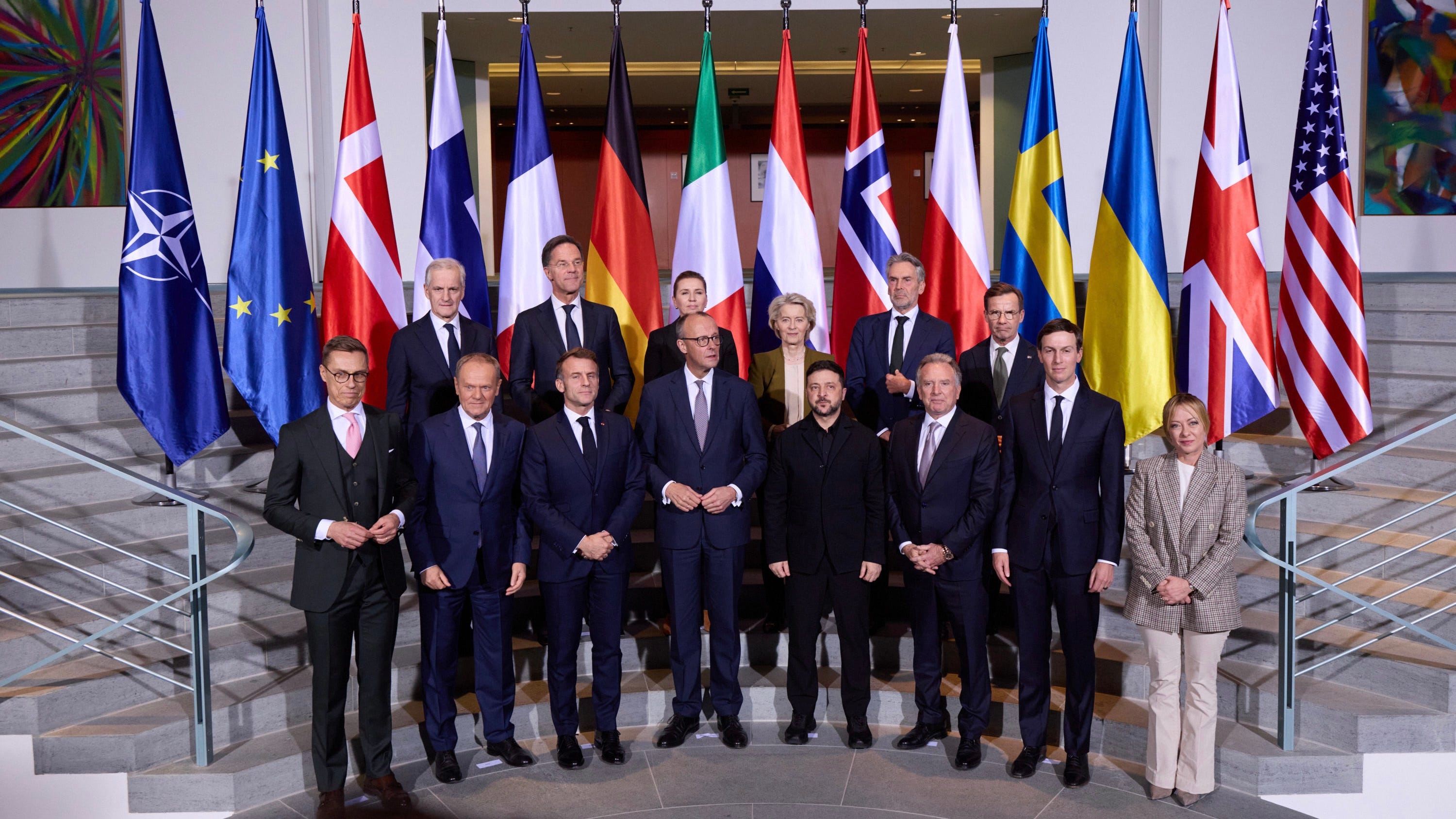
The United States, Ukraine and Europe have agreed on a NATO-like guarantee for the future security of Ukraine, two U.S. officials said on Monday, as they tried to come up with a revised peace proposal that would deter future aggression and still satisfy Russia. After two days of talks in Berlin, the American officials told reporters they had resolved or significantly closed gaps on 90 percent of their differences on a 20-point draft agreement to end the war. But they acknowledged that the question of where to draw a new Ukraine-Russia border in the Donbas, where much of the fighting continues, was unresolved. “For now we have different positions, to be honest,” President Volodymyr Zelensky of Ukraine said at a brief news conference on Monday. “But I think my colleagues have heard my personal position.” Mr. Zelensky has said it would be impossible for Ukraine to give up territory, mostly in Donetsk, that Russia has not taken on the battlefield. President Trump has told him, officials say, that he should surrender that territory, because he will most likely lose it in coming months if the fighting continues. Ultimately, the two American officials said, that negotiation would be left to President Vladimir V. Putin of Russia and Mr. Zelensky — and privately American and European officials say that is one of several issues that could derail what have been the most extensive negotiations on ending the fighting since Russia invaded Ukraine just shy of four years ago. The officials spoke on the condition of anonymity under rules set by the Trump administration for the negotiations. Most of the conversations over the past two days, the officials said, focused on the security guarantee, which is intended to deter Russia from invading Ukrainian territory again in coming years. The two officials were vague about the specifics, though they said that Mr. Trump was willing to submit any final agreement on American commitments to Ukraine to the Senate for approval. They did not say whether the guarantee would become a formal treaty - akin to what the United States has with Japan, South Korea, the Philippines and other allies — or whether any vote would simply be intended to show a bipartisan commitment - NYT
Russia will not accept any “compromise” regarding the occupied territories of Ukraine, Deputy Foreign Minister Sergei Ryabkov said on Tuesday. Ryabkov stated that Moscow has not scaled back its demands and wants to retain control over five Ukrainian regions: Crimea, Donetsk, Luhansk, Zaporizhzhia and Kherson. Aside from annexed Crimea and almost all of the Luhansk region, Russia does not control the entirety of any of the other three areas of Ukraine. In Zaporizhzhia and Kherson, Moscow forces do not have control of the regional capitals either. As the European leaders vowed to protect Ukraine against Russia in the future, including via military means, the Kremlin now also demands security guarantees for Moscow. The Kremlin spokesperson Dmitry Peskov said Moscow will not accept it if “Kyiv signs peace agreements and then begins to sabotage them”. Ukraine has never committed an act of aggression against Russia. The Kremlin also said on Tuesday that Russia is unlikely to participate in any possible Christmas truce. German Chancellor Friedrich Merz suggested on Monday in Berlin that Russia could pause its attacks during the holidays, which could eventually lead to the opening of negotiations for a genuine truce - Euronews
Ukraine has carried out a successful underwater drone strike on a Russian submarine in the port of Novorossiysk, causing critical damage to the vessel, its domestic security service says. In a statement on Monday, the Security Service of Ukraine (SBU) said the Kilo-class submarine was knocked out of operation in the first such attack by Sea Baby drones. The SBU said the submarine “carried four Kalibr cruise missile launchers” used to strike Ukrainian territory. It suffered “critical damage and was effectively put out of action”, the service said. There was no immediate comment from Russia on the Ukrainian claim.
A Canadian military counter-intelligence officer who is facing charges of espionage was allegedly sharing special operational secrets with Ukraine without the approval of his superiors, according to The Globe and Mail. Master Warrant Officer Matthew Robar was arrested last week and charged with multiple offences related to passing highly sensitive government secrets to a foreign entity. A source has told the Canadian newspaper that the veteran intelligence officer believed he was helping Ukraine in its war against Russia.
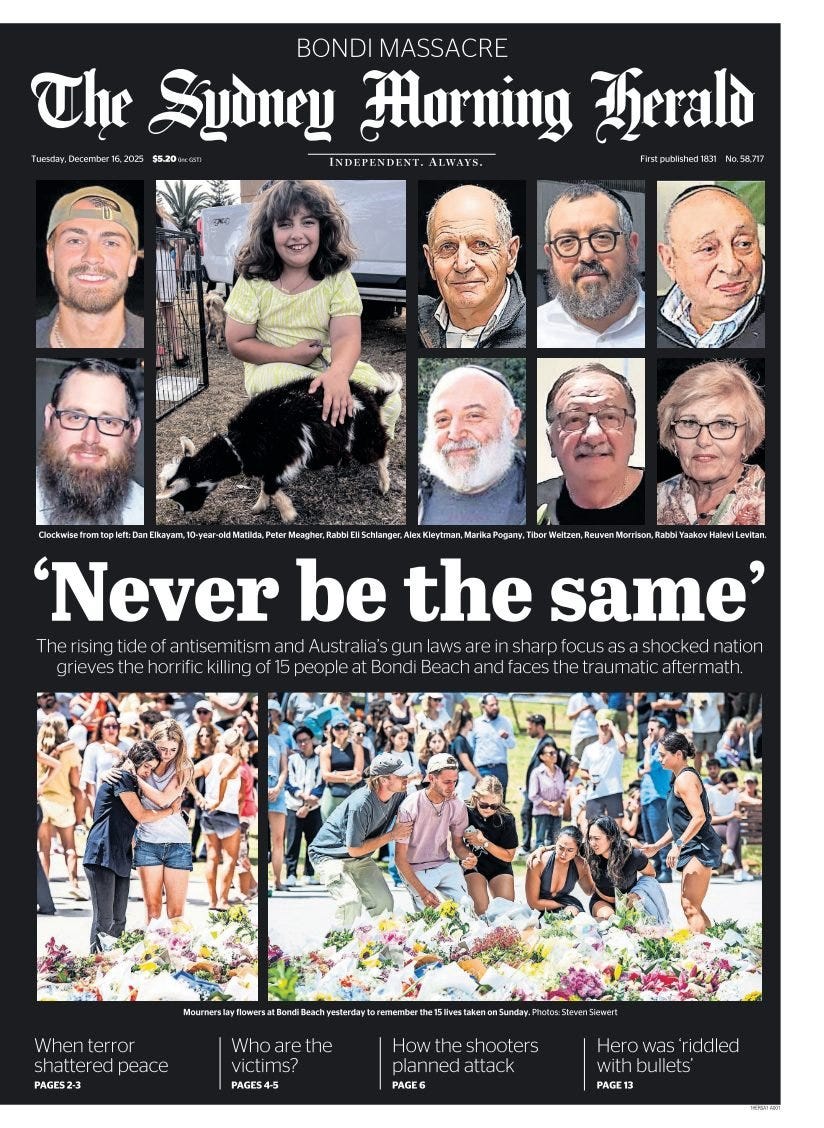
A recent mass shooting at Sydney’s Bondi Beach that killed 15 people has reignited a national debate on whether Australia’s gun laws – already among the toughest in the world – are strong enough. In an emergency meeting on Monday (Dec 15), Australia’s National Cabinet vowed to overhaul gun regulations. Its proposed reforms include a long-delayed national firearms register, limits on how many guns an individual can own, and a ban on foreign nationals holding gun licences. The announcement came as investigators continued to examine how a father-and-son pair were able to carry out the attack on Sunday targeting a Hanukkah gathering at one of Australia’s most iconic public spaces. Experts say the tragedy underscores both the strengths and weaknesses of Australia’s firearms regime, nearly three decades after landmark changes that followed the 1996 Port Arthur massacre. That attack, in which a lone gunman killed 35 people in the Tasmanian tourist town, led to sweeping new laws including a national gun buyback scheme and restrictions on semi-automatic weapons. Political sociologist Josh Roose said the Bondi attack could have been far deadlier had the perpetrators been able to access the types of weapons once available before the reforms - CNA
Myanmar’s military regime appealed to the international community to take back hundreds of foreigners who have been detained in a crackdown on scam centers in the country’s eastern Kayin state near the Thai border. In recent months, the authorities have raided two major scam centers, KK Park and Shwe Kokko, on the outskirts of Myawaddy, a trading town on the border with Thailand. The operations resulted in the detention of thousands of foreign nationals. Col. Min Thu Kyaw, who led the crackdown operations, said authorities were struggling to manage the detainees. “They are different nationals, who have different religions, morals and personalities,” he said. “We want the international community to come and call them quickly. It would be more convenient if they call them back as soon as possible.” On Sunday, Maj-Gen Aung Kyaw Kyaw, deputy minister for Home Affairs, told a press conference in Yangon, the country’s biggest city, that 13,272 foreigners from 47 countries had been detained since the start of the crackdown in January. While most have been deported, 1,655 are still in detention, he said. Myanmar is notorious for hosting cyberscam operations that target people all over the world. They usually involve gaining a person’s confidence with romantic ploys and luring them into bogus investment schemes. The U.N. Office on Drugs and Crime has estimated that such activities generate just under $40 billion in annual revenue for criminal gangs. The largest number of the remaining detainees awaiting deportation are Chinese nationals, with more than 500 people. They rest comprises groups of between 100 and 300 people each from Indonesia, Ethiopia, Vietnam, Kenya and India, he said - ABC
Myanmar’s military has acknowledged it conducted an air strike on a hospital in the western state of Rakhine that killed 33 people, whom it accused of being armed members of opposition groups and their supporters, but not civilians. Witnesses, aid workers, rebel groups and the United Nations have said the victims were civilians at the hospital. In a statement published by the state-run Global New Light of Myanmar newspaper on Saturday, the military’s information office said armed groups, including the ethnic Arakan Army and the People’s Defence Force, used the hospital as their base. It said the military carried out necessary security measures and launched a counterterrorism operation against the general hospital in Mrauk-U township on Wednesday. However, the United Nations on Thursday condemned the attack on the facility providing emergency care, obstetrics and surgical services in the area, saying that it was part of a broader pattern of strikes causing harm to civilians and civilian objects that are devastating communities across the country.

The Health Ministry in Gaza says two Palestinians have been killed and six wounded in Israeli attacks over the latest 24-hour reporting period. Since a ceasefire came into effect on October 10, the ministry said at least 393 Palestinians have been killed and 1,074 wounded. The overall death toll from Israel’s genocidal war on Gaza has now reached 70,667 with 171,151 people wounded since October 7, 2023. The ministry also announced the death of a two-week-old infant who died from hypothermia. Meanwhile, a Hamas official says Israel’s “blatant and outrageous violations” threaten the ceasefire agreement. - Al Jazeera
The US military carried out more strikes on alleged drug traffickers in the Eastern Pacific as the White House ramped up its campaign on what it alleges are narcoterrorist groups. The US — which for months has been carrying out attacks off the coast of South America that critics argue are illegal — said three vessels had been hit, killing eight people. Meanwhile, US President Donald Trump announced that fentanyl would be classified as a weapon of mass destruction, a move that expands Washington’s authority to crack down on the synthetic opioid’s trade, while raising the risk of the war on drugs expanding far beyond South America: The vast majority of US-bound fentanyl is produced in Mexico by cartels using Chinese precursor chemicals - Semafor
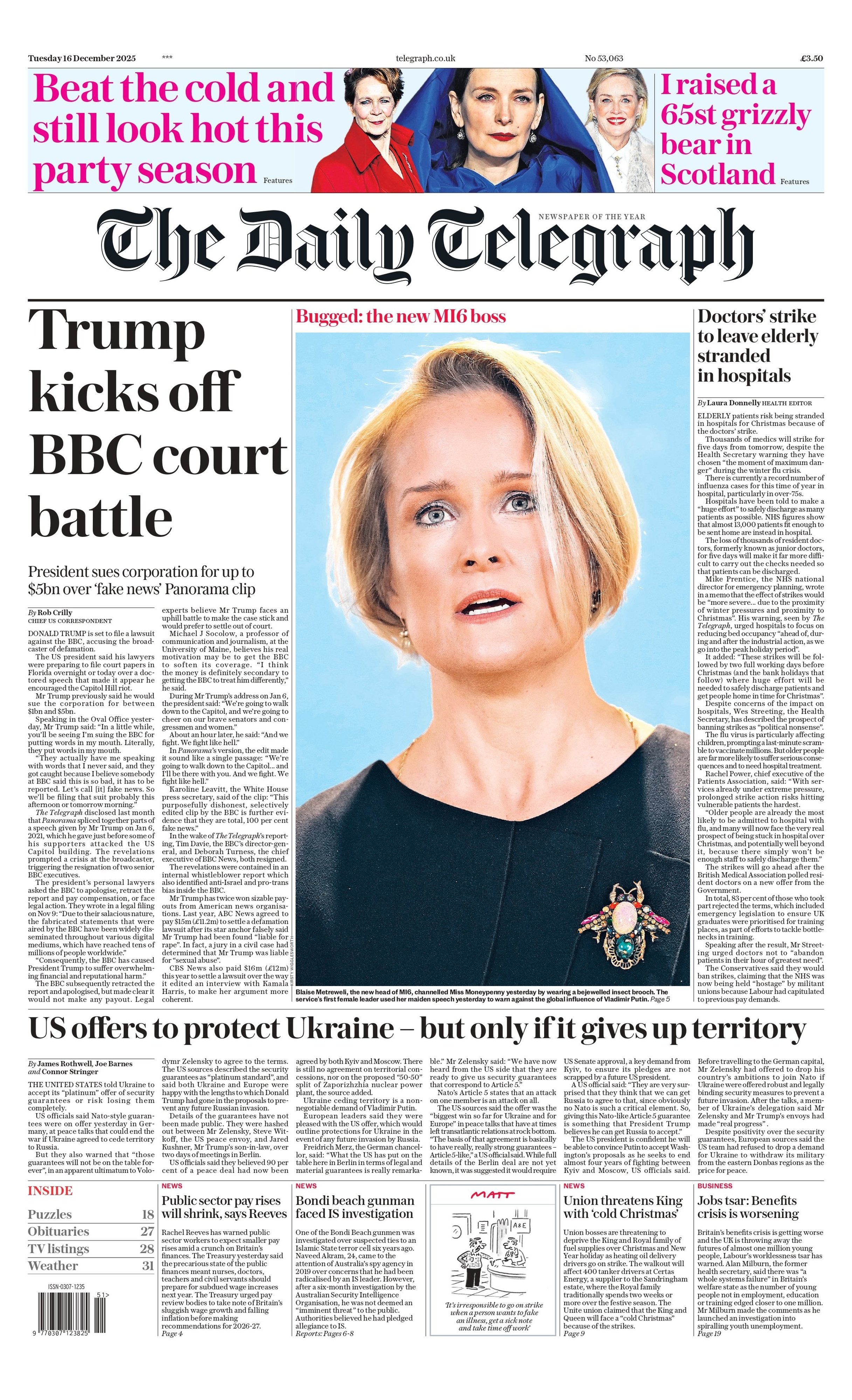
The BBC has said it will defend itself against a $5bn (£3.7bn) lawsuit filed by US President Donald Trump over an edit of his 6 January 2021 speech in a Panorama documentary. Trump accused the broadcaster of defamation and of violating a trade practices law, according to court documents filed in Florida. The BBC apologised to him last month, but rejected his demands for compensation and disagreed there was a “basis for a defamation claim”. Trump’s legal team accused the BBC of defaming him by “intentionally, maliciously, and deceptively doctoring his speech”. A BBC spokesperson said: “As we have made clear previously, we will be defending this case.” Trump said last month he planned to sue the BBC over the documentary, which aired in the UK ahead of the 2024 US election - BBC
The journals….