President Donald Trump is formally launching his newly minted “Board of Peace” this week with a headline-grabbing $5 billion pledge to rebuild Gaza and promises of thousands of personnel for an international stabilization force - yet key details remain opaque, major allies are hedging their participation, and the estimated $70 billion reconstruction bill dwarfs the initial commitment. Framed as both a Gaza initiative and a broader vehicle for resolving global crises, the board is already raising questions in Europe about mandate, governance and whether this is peace-building - or a parallel power play designed to sidestep the United Nations and reshape the postwar international order on Washington’s terms.
President Donald Trump said members of his newly created Board of Peace have pledged $5 billion to rebuild war-ravaged Gaza and will commit thousands of personnel to international stabilization and policing efforts, with the formal announcement set for the board’s first meeting in Washington on Thursday. It is not clear how many of the more than 20 members of the Board of Peace will attend the first meeting. Israeli Prime Minister Benjamin Netanyahu, who held White House talks with Trump last week, is not expected to be there. Trump did not detail which member nations were making the pledges for reconstruction or would contribute personnel to the stabilization force. But Indonesia’s military said Sunday that up to 8,000 of its troops are expected to be ready by the end of June for a potential deployment to Gaza as part of a humanitarian and peace mission. It’s the first firm commitment that the Republican president has received. Rebuilding the Palestinian territory will be a daunting endeavor. The United Nations, World Bank and European Union estimate that reconstruction of the territory will cost $70 billion. Few places in the Gaza Strip were left unscathed by more than two years of Israeli bombardment. The ceasefire deal calls for an armed international stabilization force to keep security and ensure the disarming of the militant Hamas group, a key demand of Israel. Thus far, few countries have expressed interest in taking part in the proposed force. Trump’s new board was first seen as a mechanism focused on ending the Israel-Hamas war in Gaza. But it has taken shape with his ambition for a far broader mandate of resolving global crises and appears to be the latest U.S. effort to sidestep the United Nations ( as well as, potentially the Security Council veto power of China and Russia) as Trump aims to reset the post-World War II international order. Many of America’s top allies in Europe and elsewhere have declined to join what they suspect may be an attempt to rival the Security Council. Trump also confirmed that Thursday’s meeting will take place at the U.S. Institute of Peace, which the State Department announced in December it was remaining the Donald J. Trump U.S. Institute of Peace. The building is the subject of litigation brought by former employees and executives of the nonprofit think tank after the Republican administration seized the facility last year and fired almost all the institute’s staff - Politico
The European Commission’s Dubravka Šuica will attend the first formal gathering of the Board of Peace, sources told Euronews. The move signals Brussels is not prepared to fully write off cooperation with the Trump-chaired board, even if most EU member states have rejected a formal membership and the Commission’s legal concerns over its charter and governance. A Commission spokesperson said that Šuica will participate only in the “specific part” of the meeting “dedicated to Gaza”, adding that her participation comes in the context of the EU’s “long-standing commitment to supporting the ceasefire” and international efforts to “support the reconstruction and post-war recovery” of the territory. The spokesperson stressed that it is not joining as an official sitting member of the Board. Italy, Romania, Greece and Cyprus have all accepted invitations by the Trump administration to participate as "observers." - Euronews
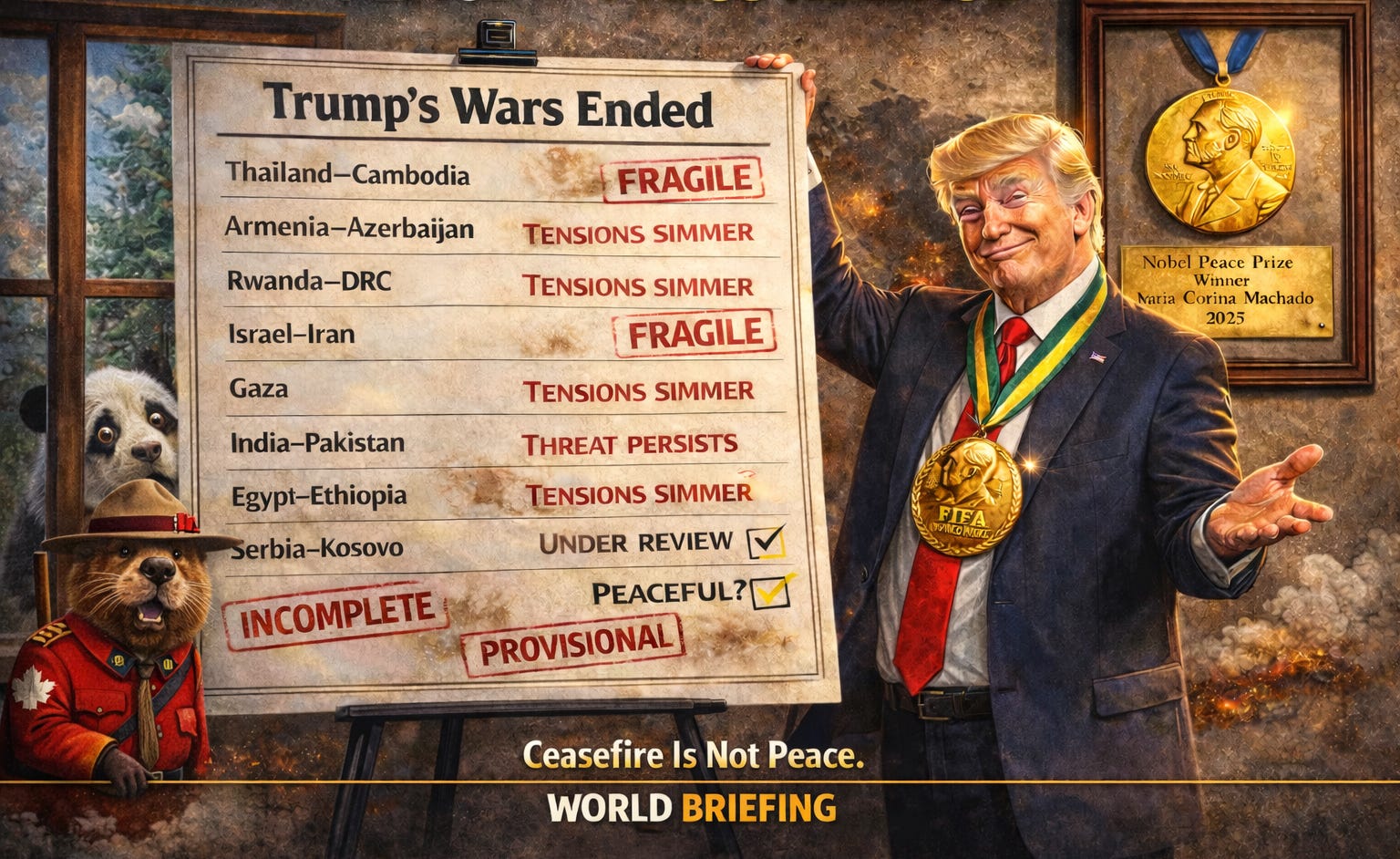
Donald Trump’s Board of Peace appears more like a ‘club of rights abusers rather than a board of peace’ - Elaine Pearson, Human Rights Watch
Iran held live military exercises on Monday in the Strait of Hormuz a day before nuclear talks between the United States and Iran were set to resume, an apparent show of its power as President Trump threatens military action and calls for regime change if diplomacy fails. The drills, led by the Islamic Revolutionary Guard Corps navy, were meant to address “potential security and military threats,” the state-run IRNA news agency reported, citing the Revolutionary Guard. They come after weeks of mounting tensions with the United States as Mr. Trump has ordered a buildup of American forces in the Middle East and threatened to strike Iran if its leadership does not agree to a deal on its nuclear program. On Friday, he made his most overt endorsement yet of regime change, saying it would be the “best thing” for Iran. The Pentagon has been building up an “armada” in the region, to use Mr. Trump’s word. That includes the U.S.S. Abraham Lincoln aircraft carrier, accompanied by three warships equipped with Tomahawk missiles. That is at the center of a dozen warships in the region, including in the Arabian Sea, the Persian Gulf, the Red Sea and the eastern Mediterranean Sea. The Iranian exercises come as another round of talks were set to begin in Geneva on Tuesday, with fundamental differences over Iran’s nuclear program. Analysts said they saw Iran’s exercises as an effort to discourage the Americans. Exerting control over the Strait of Hormuz — a narrow 90-mile waterway that connects the Persian Gulf to the open ocean and a key shipping lane for oil and gas — could be meant to show that Iran would be willing to go as far as closing the strait if it needed leverage - NYT
The United States is set to host talks between envoys from Russia and Ukraine in Geneva, Switzerland, on Tuesday and Wednesday, days before the fourth anniversary of the full-scale Russian invasion of its neighbour. Ukrainian President Volodymyr Zelenskyy says diplomacy will be more effective with “justice and strength”, after Russia launched a large-scale missile and drone attack at targets across Ukraine. For its part, Russia also reported dozens of Ukrainian drones were fired overnight. Rustem Umerov, Ukraine’s national security and defence council chief, will head the Ukrainian delegation, while the Russian team will be led by Russian President Vladimir Putin’s adviser, Vladimir Medinsky. The Geneva talks follow two rounds of US-brokered negotiations held in the United Arab Emirates in January and early February. Russia and Ukraine described both rounds of talks as constructive, but they failed to achieve any breakthrough - Al Jazeera
Russian private companies continue to utilize European logistics chains to secure a steady supply of essential chemicals and components, including large volumes of glycerin routed through EU-linked intermediaries. The Kyiv Independent has identified a Russian petrochemical manufacturer with close ties to the military that continues to operate in Latvia and Germany, using entities and individuals sanctioned by Ukraine to help sustain imports of lubricants and glycerin into Russia. The company exploits loopholes in EU sanctions to keep dual-use chemicals flowing into Russia, with raw glycerin still largely unrestricted despite its potential use in propellants and explosives.
Moscow courts on Monday sentenced exiled Russian-Georgian journalist Yekaterina Kotrikadze and Russian businessman Yevgeny Chichvarkin to several years in prison in absentia after finding them guilty of spreading “fakes” about Russia’s invasion of Ukraine. Prosecutors accused Kotrikadze, news director and anchor of the exiled broadcaster TV Rain, of posting about alleged war crimes committed by Russian troops in Ukraine on her personal Telegram channel in the spring of 2022. Chichvarkin, owner of the Michelin-starred restaurant Hide in London, was accused of posting a Russian Anti-War Committee statement on his Instagram in August 2024. Witnesses in both trials described suffering “emotional distress” after reading Kotrikadze’s and Chichvarkin’s social media posts. Several other journalists employed at TV Rain have also been convicted or face “war fakes” charges, including Koktrikadze’s husband, Tikhon Dzyadko, who serves as editor-in-chief of the exiled broadcaster. TV Rain suspended operations in March 2022 after Russia ordered it to stop broadcasting over its critical coverage of the war in Ukraine. It later resumed broadcasting abroad and is now based in Amsterdam - Moscow Times

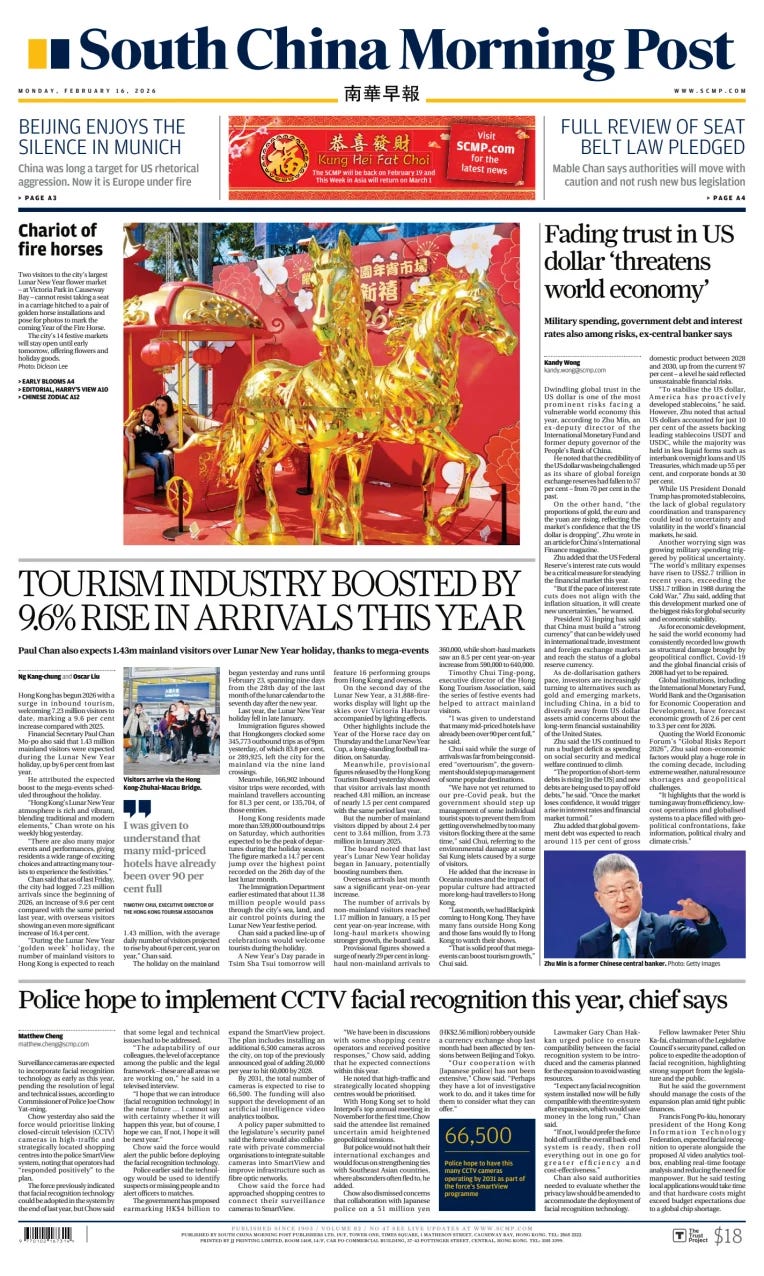
Click here to avail of this special Year of the Fire Horse offer!
U.S. Secretary of State Marco Rubio met Hungarian Prime Minister Viktor Orbán in Budapest Monday and declared a “golden age” in bilateral relations as Hungary heads toward an April parliamentary election. In a joint press conference on the final stop of his European tour, Rubio praised a partnership that he said is “as close as I can possibly imagine it being,” stressing President Donald Trump’s “extraordinarily close relationship” with the Hungarian leader and arguing that “your success is our success.” He added that it is in Washington’s national interest for Hungary to thrive “as long as you’re prime minister,” saying the two countries have “not even scratched the surface of what we can achieve together.” The warm words were in sharp contrast with Rubio’s message days earlier at the Munich Security Conference, when he urged European leaders to revive the transatlantic alliance. Rubio stopped short of a formal election endorsement ahead of the April vote. Orbán is trailing his rival Péter Magyar in opinion polls. - Politico
UK bank bosses will hold their first meeting to establish a national alternative to Visa and Mastercard, amid growing fears over Donald Trump’s ability to turn off US-owned payment systems. The meeting, chaired by Barclays’ UK chief executive, Vim Maru, will take place this Thursday and bring together a group of City funders that will front the costs of a new payments company to keep the UK economy running if problems were to occur. The City-funded, but government-backed, initiative has been under discussion for years. However, Trump’s recent threats against Nato allies over Greenland have amplified concerns that an over-reliance on US companies could put UK payments – and the wider economy – at risk. About 95% of UK card transactions are made using payment systems owned by Mastercard and Visa, according to a 2025 report by the UK’s Payment Systems Regulator. That dominance has become far more relevant as cash use across the country continues to decline. “If Mastercard and Visa were turned off, it would send us back to the 1950s,” before cards dominated the UK economy, and businesses wholly relied on cash, one executive familiar with the project told the Guardian. “Of course, we need a sovereign payments system.” The potential disruption could be vast. In Russia, where businesses are reliant on Visa and Mastercard for 60% of payments, US sanctions that forced the companies to turn off their services left ordinary people stranded without access to funds and unable to buy goods - Guardian
Nigeria’s election season officially kicked off as the poll organizer set Feb. 20, 2027, as polling day, even though campaigning is already well underway for a contest that will test the popularity of President Bola Tinubu’s attempt to overhaul one of Africa’s largest economies and resolve multiple security crises. Tinubu is widely expected to seek reelection, despite not yet declaring his intentions, with pro-Tinubu campaign posters appearing around major Nigerian cities since last year. The 73-year-old launched his presidency in 2023 by scrapping fuel subsidies and removing a currency peg, changes that initially drove up inflation but have since helped to attract investment and boost economic growth. He is expected to face familiar heavyweights, some of whom are banding together to form an opposition coalition. Atiku Abubakar, a former vice president who came second in the last election, and Peter Obi, a former state governor who came third, are part of that coalition, but it remains unclear who will be at the top of the ticket. Both are still considered Tinubu’s strongest challengers going into 2027 - Semafor
The journals….