US-Iran Ceasefire on the Brink as Trump-Xi Summit Looms
A fragile US-Iran ceasefire is teetering, oil markets are rattled, and the fate of a critical global shipping lane hangs in the balance - all as Presidents Trump and Xi sit down for what may be one of the most consequential summits of the year.
According to CNN, President Donald Trump declared the ceasefire is on “massive life support” after Tehran’s latest counterproposal - which reportedly included a demand for recognition of Iranian sovereignty over the Strait of Hormuz - was dismissed by Washington as “simply unacceptable.” Iran’s foreign ministry pushed back, calling its terms “reasonable” and “generous.”
The standoff is already hitting consumers. Oil prices climbed sharply following Trump’s rejection of Iran’s offer, stoking fears that the Strait of Hormuz - through which a significant share of the world’s oil supply passes - could remain closed indefinitely. Oman’s foreign minister, following talks with the International Maritime Organization, called for urgent action to free vessels stranded along the strait.
The economic stakes are growing by the day. Analysts warn that a prolonged closure risks a historic energy shock, according to Semafor. Despite a disruption of nearly one billion barrels of oil, crude prices have so far stayed below their 2022 peak, cushioned by large reserves, US exports, and market expectations that the strait would reopen. But that buffer may not hold: Morgan Stanley has warned that without a deal by late June, oil could top $130 a barrel. JPMorgan, meanwhile, forecasts that US pump prices could hit $5 a gallon, with crude shortages hitting refined products hardest. The US Energy Secretary refused to rule out that scenario, floating a possible suspension of gasoline taxes as relief. Across Asia, nations are already pivoting to coal, the Financial Times reported.
Against this backdrop, this week’s Trump-Xi summit carries enormous stakes. Trump is under mounting domestic pressure to end the conflict, driven by rising gas prices and growing public opposition to the war. Washington is expected to press Beijing to use its considerable leverage over Tehran - China is Iran’s largest oil purchaser and is reported to be supplying Iran with satellite imagery and other military support - to push Iran toward a deal.
What remains unclear is what Washington might offer Beijing in return. Possible concessions could include cancelling a planned arms sale to Taiwan, or quietly giving China greater latitude to pursue its ambitions in Taiwan and the broader South China Sea - a trade-off that would alarm US allies across the Indo-Pacific and raises profound questions about the price of peace in one region versus stability in another.
Sources: CNN; Semafor; World Briefing Plus reporting
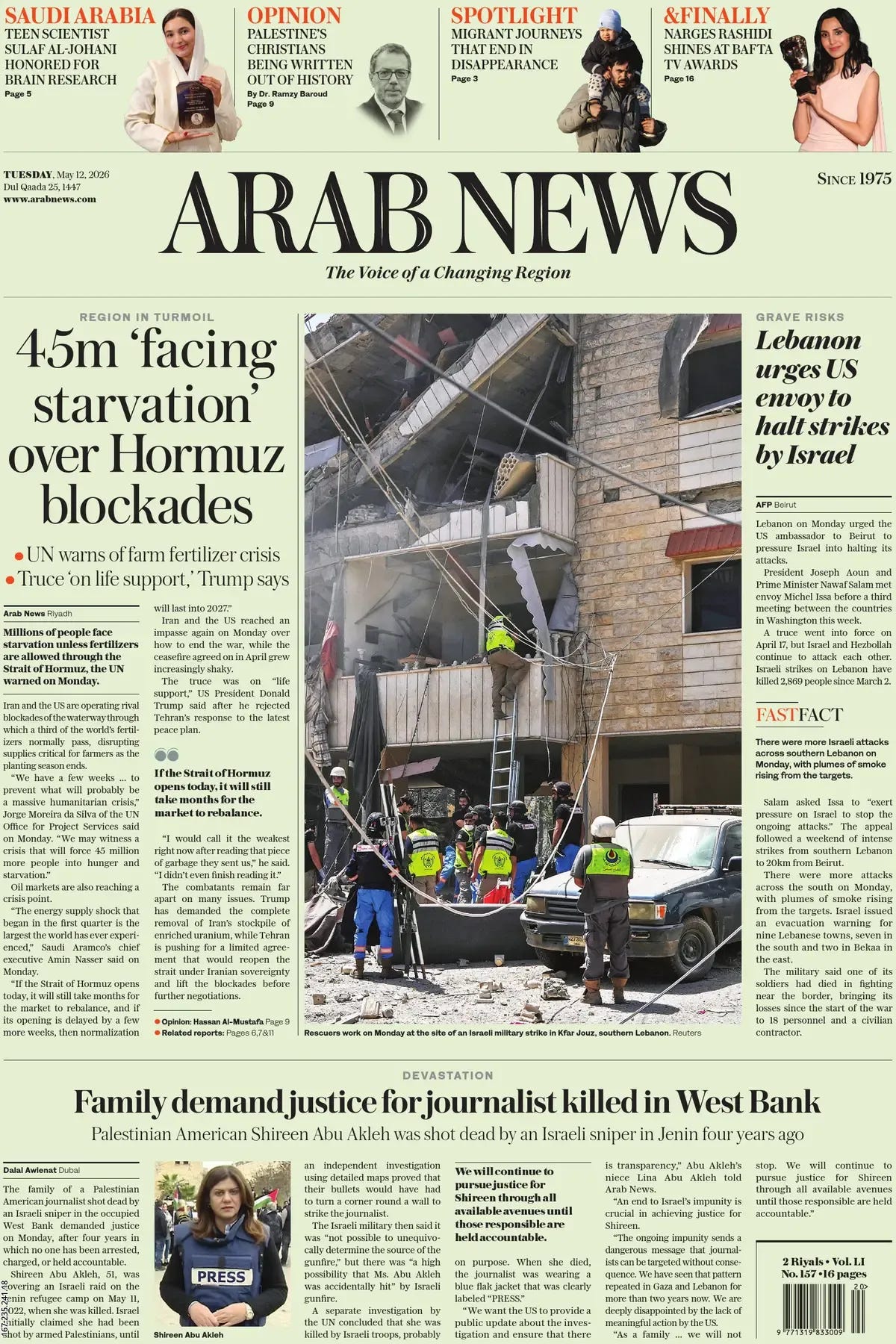
Tens of millions of people could face hunger and starvation if fertilisers are not soon allowed through the Strait of Hormuz, the head of a UN task force aimed at averting a looming humanitarian crisis told AFP on Monday. “We have a few weeks ahead of us to prevent what will likely be a massive humanitarian crisis,” Jorge Moreira da Silva, executive director of the United Nations Office for Project Services (UNOPS) and leader of the task force. “We may witness a crisis that will force 45 million more people into hunger and starvation.” While the ultimate hope is for a "lasting peace" deal in the region and "freedom of navigation for all commodities" through the strait, "the problem is the planting season can't wait", Moreira da Silva said, with some ending in African nations within weeks.
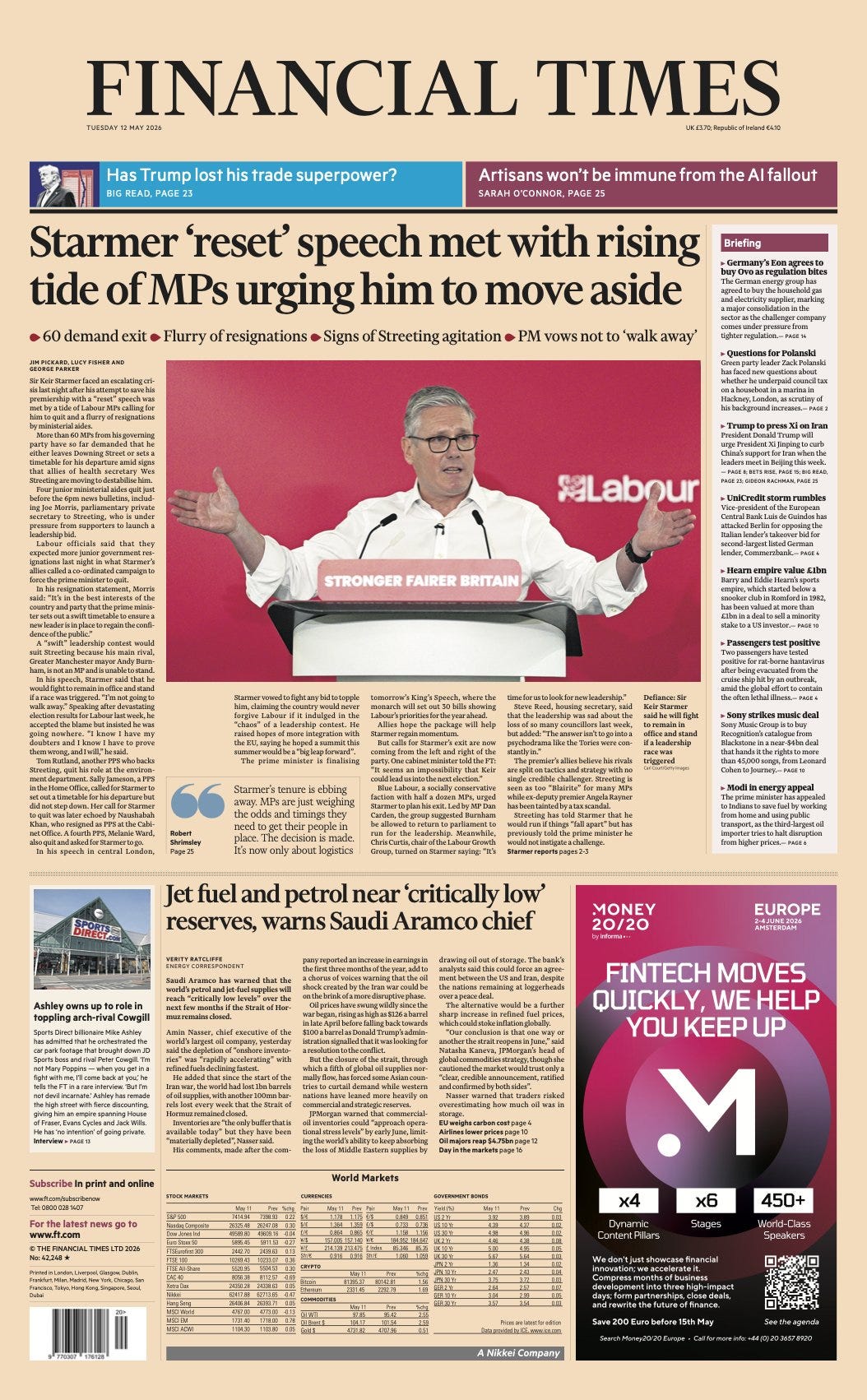
The CEO of the world’s largest oil company has warned that the world’s petrol and jet fuel supplies will reach “critically low levels” over the next few months if the Strait of Hormuz remains closed. Amin Nasser, chief executive of Saudi Armando said Monday that the depletion of “onshore inventories” was “rapidly accelerating” with refined fuels declining fastest, the Financial Times reported. He added that since the start of the Iran war, the world has lost 1bn barrels of oil supplies, with another 100mn barrels lost every week that the Strait remained closed. Inventories are “the only buffer that are available today” but they have been “materially depleted,” Nasser said. JPMorgan warned that the commercial oil inventory could “approach operational stress levels” by early June, limiting the world’s ability to keep absorbing the loss of Middle Eastern supplies by drawing oil out of storage.
U.S. Public Health Response to Hantavirus Outbreak Draws Widespread Criticism

Health experts are raising alarms over what they describe as a slow and disjointed U.S. response to an ongoing hantavirus outbreak linked to a cruise ship - one that has generated international headlines but little visible action from American public health authorities.
The Centers for Disease Control and Prevention was notably absent in the early days of the outbreak, with no disease investigators dispatched, no public briefings held, and no alerts issued to physicians. It wasn’t until late Friday that the CDC accelerated its response, deploying a team to Spain’s Canary Islands to meet American passengers and arranging a medical evacuation to a University of Nebraska quarantine facility.
The agency also issued its first health alert to U.S. doctors - days into an internationally recognized outbreak. When officials finally held a briefing Saturday, it was by phone only, for invited reporters, and under rules set by aides to Health Secretary Robert F. Kennedy Jr. that barred journalists from naming the speakers. The CDC’s acting director, Dr. Jay Bhattacharya, made his first on-camera appearance Saturday morning on Fox News, where he told viewers not to worry - but got key facts wrong, including the nationalities and ages of passengers who had died.
Experts say the muted response reflects deep structural problems. The Trump administration has laid off thousands of CDC scientists and public health professionals, withdrawn from the World Health Organization, and at times restricted CDC scientists from communicating with international counterparts. In place of WHO engagement, the administration has pursued bilateral health agreements with roughly 30 individual countries - an approach critics say is wholly inadequate for managing global health threats.
“You can’t possibly cover a global health crisis by doing one-on-one deals with countries here and there,” said Lawrence Gostin of Georgetown University.
The contrast with past outbreaks is stark. During the 2020 Diamond Princess COVID crisis, the CDC deployed personnel, ran quarantines, coordinated with the WHO and Japan, held public briefings, and rapidly published data that became a global reference. This time, it has been the WHO - not the CDC - setting the pace, conducting risk assessments, and leading international coordination. “This just shows how empty and vapid the CDC is right now,” said Jennifer Nuzzo, director of Brown University’s Pandemic Center.
The outbreak itself - caused by hantavirus, which does not spread easily between people - has not escalated into a broader public health crisis. But experts warn that is due to the nature of the virus, not the strength of the U.S. response. “This is a sentinel event,” said Dr. Jeanne Marrazzo of the Infectious Diseases Society of America. “Right now, I’m very sorry to say, we are not prepared.” President Trump, meanwhile, told reporters the situation appears to be “under very good control.”
The last passengers have left the hantavirus-hit cruise ship, as authorities confirmed three new positive cases linked to the deadly outbreak. The MV Hondius departed Tenerife for the Netherlands on Monday after its final six passengers - four Australians, one Briton and one New Zealander - and some crew members disembarked. Three passengers have died after travelling on the ship, two of whom were confirmed to have had the virus. An American and a French national who had previously returned home have tested positive, authorities said. Seven cases of hantavirus linked to the MV Hondius have been confirmed, with two others suspected, according to the World Health Organization (WHO). Spain’s health ministry said one Spaniard who is quarantining in Madrid after being evacuated from the vessel had also provisionally tested positive for hantavirus on Monday.
The three-day ceasefire that U.S. President Donald Trump proposed — and that Russia and Ukraine both agreed to - expired at midnight on May 12. The truce ran from May 9 through May 11. Both sides accused each other of violating it throughout all three days. Ukrainian President Volodymyr Zelensky said on May 10 that Russia had not launched any large-scale air strikes, but that Russian forces on the front line were not observing any quiet and were not even particularly trying to. Russian troops, he said, were continuing their assault activity in the directions that were key for them. Russia’s Defense Ministry reported on the afternoon of May 11 that Ukrainian forces had struck Russian positions with drones and artillery fire. Russian troops, the ministry said, had responded in kind to Ukrainian actions. Authorities in Russian and Ukrainian regions — including the Kharkiv, Kherson, Belgorod, and Kursk regions — reported deaths and casualties from drone strikes. Kremlin aide Yuri Ushakov said on May 9 that there were no agreements to extend the ceasefire - Meduza
Moscow expects an explanation from Armenia over President Volodymyr Zelensky’s “anti-Russian statements” delivered at a European summit in Yerevan, Kremlin spokesperson Dmitry Peskov said on May 10. Zelensky visited Armenia for the European Political Summit held on May 4-5, marking his first visit to the South Caucasus country. The president held bilateral meetings with Armenian Prime Minister Nikol Pashinyan and other leaders, and urged the European community to increase pressure on Russia in order to end its war against Ukraine. Armenia has the right to hold any summit as part of its multi-vector foreign policy, Peskov told Russian state news outlet Vesti. However, platforming “anti-Russian” positions is “inconsistent with the spirit of relations” between Moscow and Yerevan, Peskov said, criticizing Pashinyan for not pushing back against such statements. “The main thing is that Armenia doesn’t take an anti-Russian stance. That’s what’s most important to us,” Peskov added. Separately, Russian President Vladimir Putin issued veiled threats toward Armenia over its push to join the EU. The Russian leader said Armenia should hold a referendum on its EU bid and drew parallels between Yerevan’s European aspirations and EuroMaidan events in Ukraine. “We are witnessing the consequences of developments surrounding Ukraine,” Putin said. “And where did it start? With Ukraine seeking to join the European Union.” - Kyiv Independent
The U.S.-brokered 72-hour ceasefire between Russia and Ukraine expires Monday as both countries accuse each other of violating it. I provided some context to CBS News.
The head of the International Committee of the Red Cross is sounding the alarm: Iraq, still scarred by decades of war, cannot afford to be swept into another regional conflagration. ICRC President Mirjana Spoljaric issued the warning at the close of a two-day visit to Baghdad, where she met with senior Iraqi officials including President Nazar Amidi and outgoing Prime Minister Mohammed Shia al-Sudani. “Millions of people in Iraq continue to endure the consequences of wars and must be spared from further cycles of violence,” she said. Spoljaric also highlighted a mounting humanitarian crisis largely out of the headlines: Iraq has absorbed nearly 6,000 detainees transferred from Syria, among them hundreds of children who have spent close to a decade in camps with no schooling, no healthcare, and no prospects. “Iraq should not have to shoulder this alone,” she said, calling on all concerned states to share responsibility for a lasting solution. During her visit, Spoljaric toured Karkh Central Prison in Baghdad, where the ICRC works to reconnect detainees — including foreign nationals — with their families, and advises authorities on health, infrastructure, and humane treatment standards. Her Iraq stop is part of a broader regional tour, with the ICRC warning that military escalation across the Middle East risks erasing years of hard-won stability and dealing a severe blow to regional economies.
The journals…..