By Enzokuhle Jojo, World Briefing South Africa Correspondent
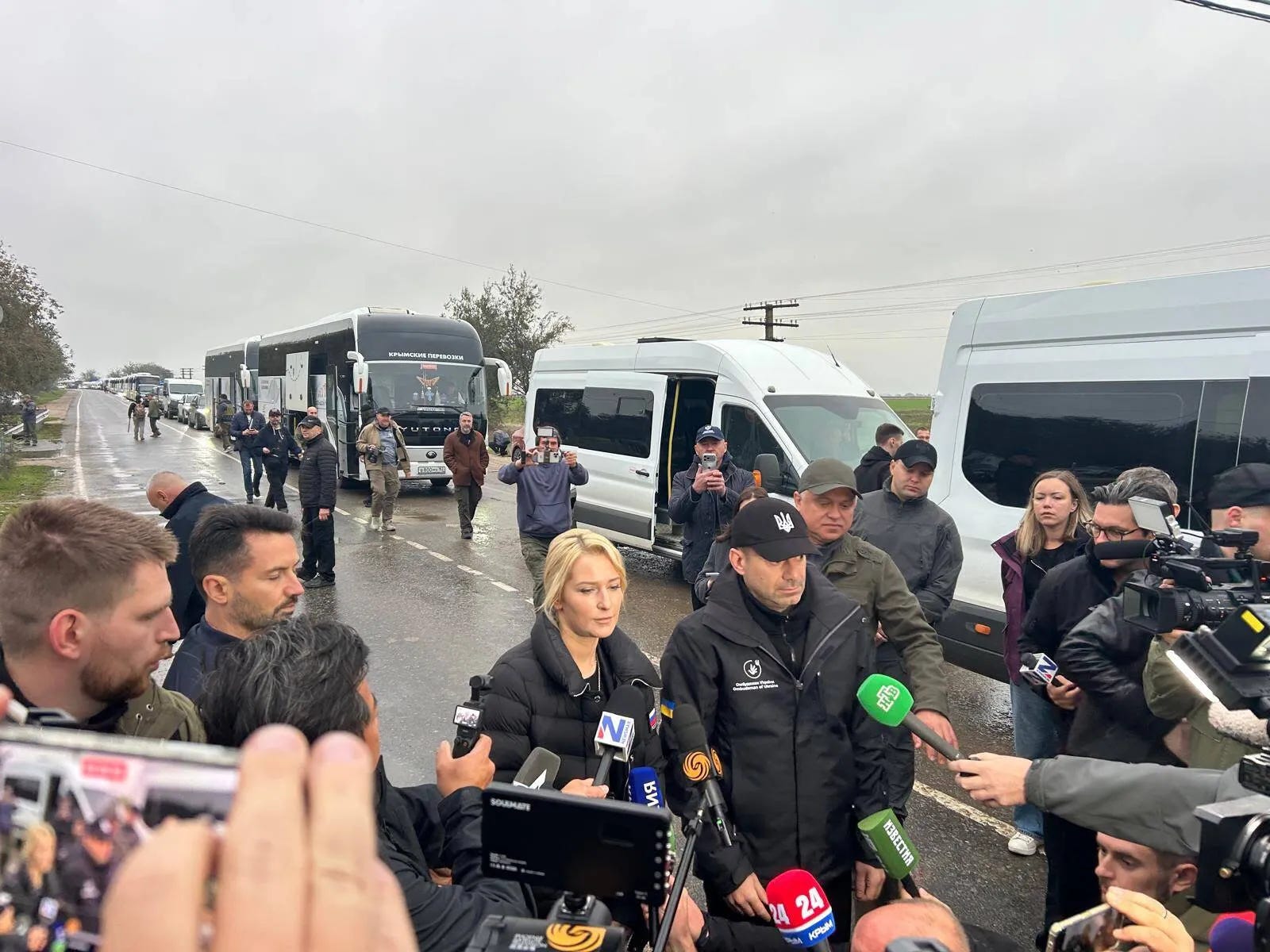
Hundreds of residents of the Russian-occupied Ukrainian town of Oleshky reached Ukrainian-controlled territory on Saturday, under a local ceasefire that Melania Trump says she secured. The journey took 19 hours. Many stepped off the buses at the Ukrainian-Belarusian border wrapped in blue and yellow flags and were reunited with family, as volunteers with hand-drawn welcome signs handed out coffee. One man, Dmytro, had counted 1,711 days since he last saw his wife, CNN reported. The oldest evacuee was 94 and the youngest just over a year old, and pets were brought out too, Dmytro Lubinets, Ukrainian Parliamentary Human Rights Commissioner, said..
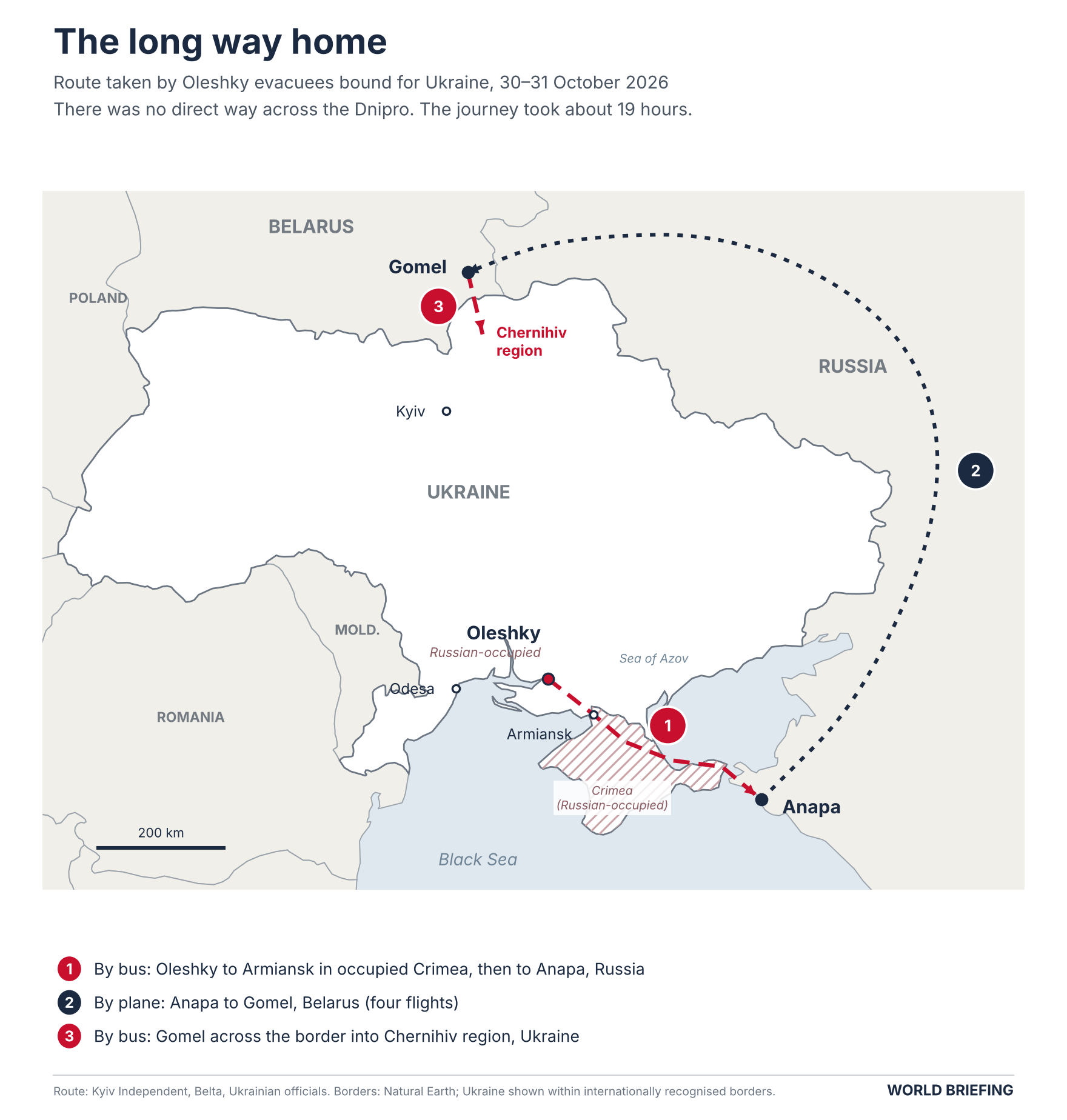
There was no direct way across the Dnipro. Buses took residents first to Armiansk in occupied Crimea, then to Anapa in Russia’s Krasnodar region, where they boarded four planes to Gomel in Belarus before crossing into Chernihiv region. About 750 people registered to leave, split between 11 buses bound for Ukraine and four for Russia, according to Newsmax’s Alex Salvi, one of the few non-Russian journalists inside the town. Kyiv has not given a figure. Ukrainian authorities barred disclosure of the number of evacuees and the crossing point, citing the safety of residents who stayed and of future missions. Some residents chose to remain.
The truce, which covers only the Oleshky area, ends at 22:59 on Sunday. Across the Dnipro in Kherson, usually under Russian drone and artillery fire, residents used the lull to fill the markets, walk the streets and retrieve belongings from damaged homes. One couple came back from Lviv, they said, “to breathe the warm Kherson air,” Suspilne reported. Most expect the attacks to resume. Sources in Ukraine’s armed forces told Suspilne that Russian troops were using the pause to rotate units, bring in personnel and clear mines on the left bank. The quiet had a cost. On its first day, Volodymyr Obertas, a press officer with the 34th Marine Brigade who often accompanied journalists to the front, was killed by an explosive device in central Kherson, Suspilne and Ukrainska Pravda reported. He was from Oleshky.
In Odesa, the week of the truce was unusually quiet. That ended shortly after 1am on Sunday, when air raid sirens sounded across southern Ukraine, followed by Russian drones launched from the Black Sea.
Lubinets credited the First Lady with personal involvement at every stage. He called it the first ceasefire since 2022 to hold so long along such a stretch of front, and said both sides hoped the mechanism could be used again. Her office says the deal was built on the same back channel she has used to reunite children separated by the war. The operation has put fresh attention on that record, which is harder to verify than the White House suggests.
The White House says Mrs Trump has helped reunite 34 children with their families since August 2025. Ukraine credits her with 26, according to Lubinets, speaking to the Kyiv Independent. Either figure is small against the scale of the crisis. Ukraine has verified 20,651 cases of children deported or forcibly transferred by Russia, Interfax-Ukraine reported. Bring Kids Back UA says about 2,700 children have been brought back, a figure that also includes children returned from occupied territory.
The White House announced the Oleshky truce on 23 October and said it would begin on 29 October. It took effect two days earlier, on 27 October, Ukrinform reported. Kremlin spokesman Dmitry Peskov confirmed her coordinating role to ABC News, and Lubinets, who led Kyiv’s negotiators, thanked her publicly, the Associated Press reported.
The White House statement put the town’s remaining population at 1,700 to 2,000, mostly elderly, along with about 50 children. Local Ukrainian authorities estimate about 6,000 people across the wider Oleshky community, including at least 180 children, MOST reported, citing regional official Tetiana Hasanenko.
The arrangement drew concern in Kyiv. On 3 October, Lubinets proposed the International Committee of the Red Cross as a neutral third party and said Russia rejected it, Interfax-Ukraine reported. He later said representatives of Ukraine, the United States and Russia would be on the ground. No Red Cross, UN or EU presence, and no independent monitoring of the route through Russia, has been reported. A volunteer told the Kyiv Independent that Russia began moving people before the agreed start, and that hospital patients were warned they faced “filtration” if they left.
Kateryna Lisunova, a Washington-based journalist for Ukrainska Pravda who also advises the advocacy group Razom for Ukraine, said that with no official US representatives or independent observers on the ground, it was “very difficult” to say what role Mrs Trump was actually playing.
Russia’s side of the mission was led by Yana Lantratova, whom the State Duma appointed human rights commissioner in May 2026. She is under US and EU sanctions and has been linked to the 2022 removal of children from a Kherson-region orphanage, BBC reported. She denies wrongdoing.
In an interview with the Russian state broadcaster Rossiya 1, she singled out a family with seven children who had left Oleshky together, pledging their safety. She did not say whether they went to Russia or Ukraine.
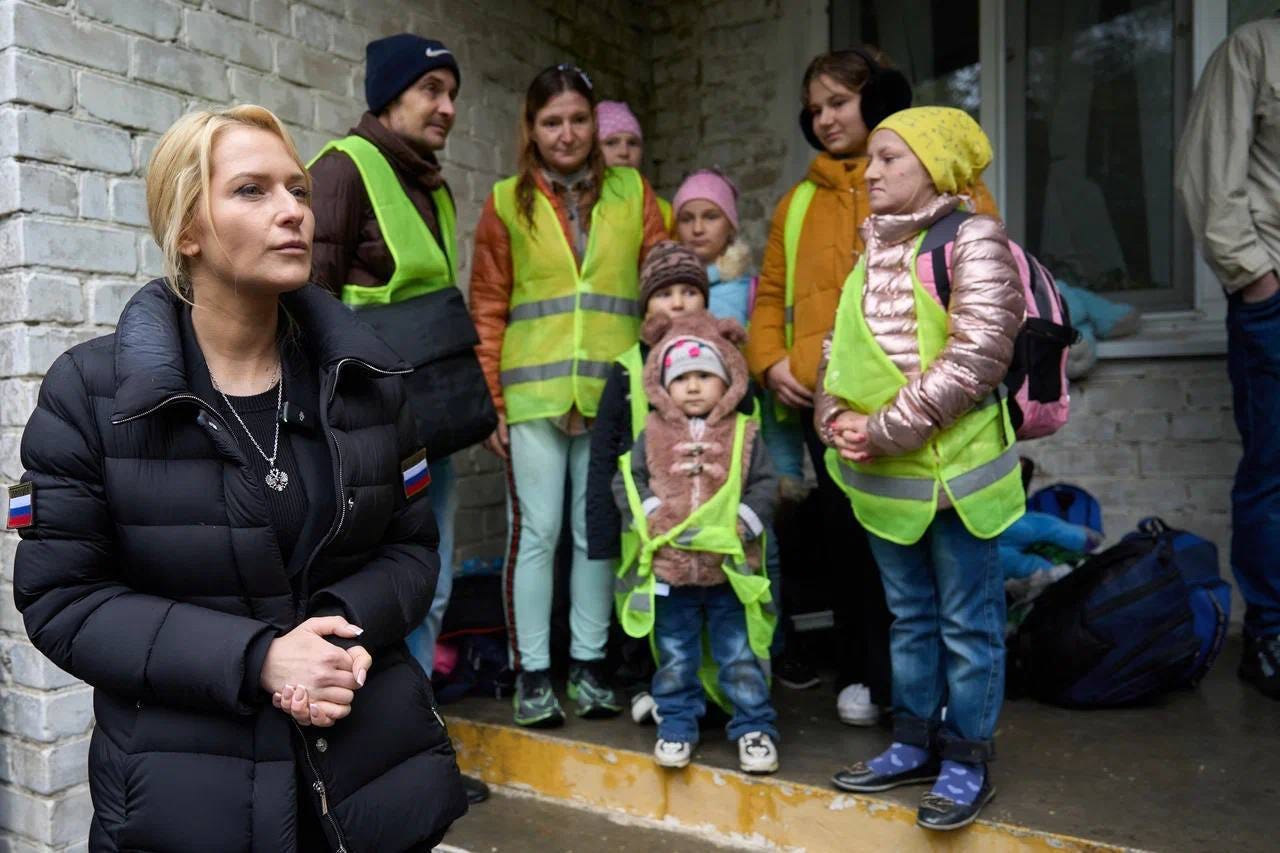
Oleshky has its own history here. In the autumn of 2022, Russian occupation authorities removed 84 residents of the town’s boarding school for children with disabilities, in three groups, according to the Emile Foundation. Most have not come home.
Mrs Trump’s was not the only intervention. Vatican News said Pope Leo XIV asked Vladimir Putin for an Oleshky truce on 16 October. The White House statement did not mention him.
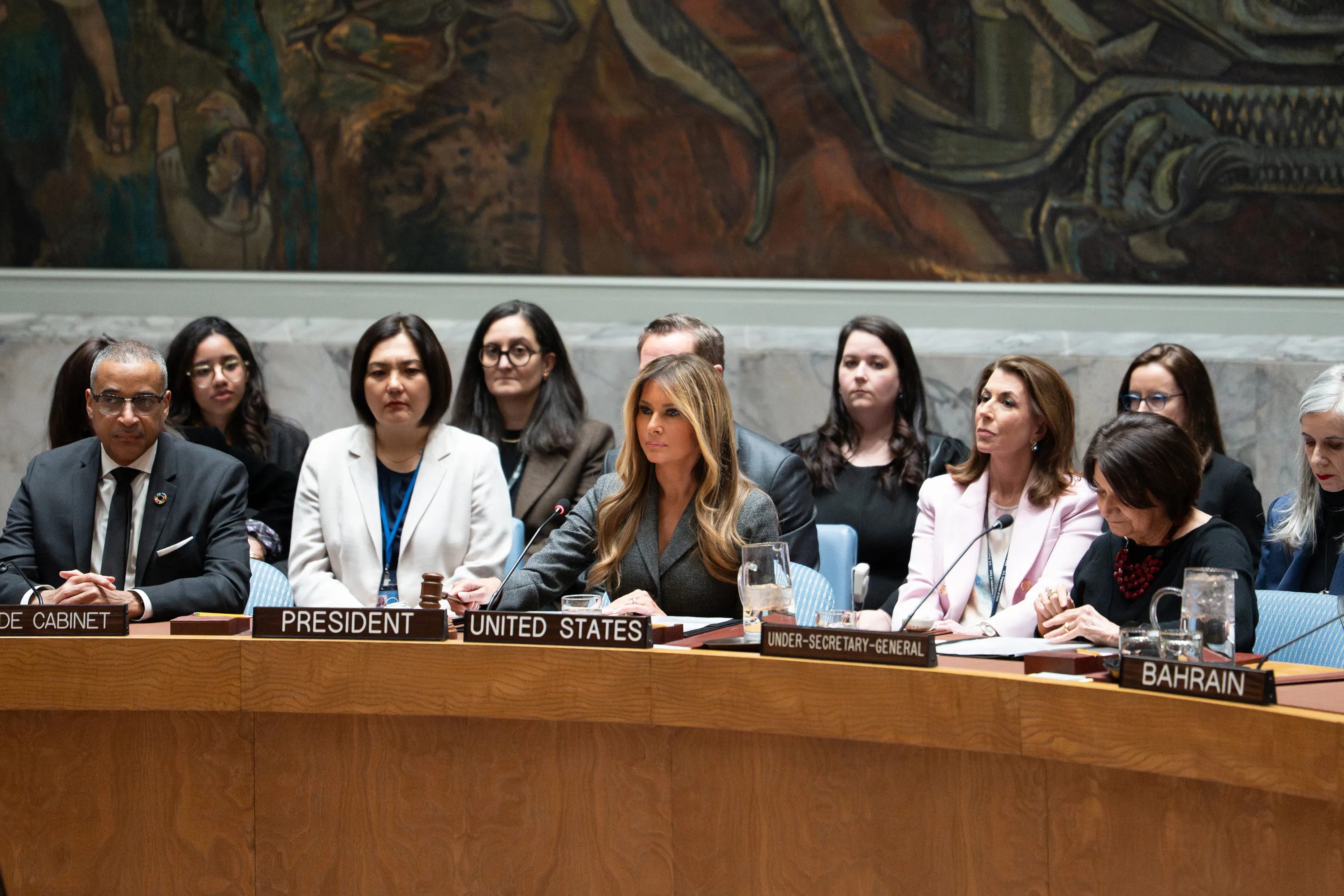
The child reunifications behind the channel can be partly checked. Six rounds were announced between 10 October 2025 and 17 August 2026. In the first, Mrs Trump said one of eight children, a girl, was returned from Ukraine to Russia, according to her own statement. For the third, in February, the White House gave no figure. Maria Lvova-Belova, Russia’s children’s commissioner, said five Ukrainian children went to Ukraine and one child to Russia, the Kyiv Independent reported.
Kyiv’s figures line up with the White House’s own round-by-round count for the first four rounds. Those rounds totalled 28 children. Subtracting the two sent to Russia leaves 26, the number Lubinets gave on 30 April. In March his office had credited her with 19 children in three groups, Ukrinform reported, which matches the first three rounds. Lubinets said Kyiv holds weekly talks with her team and that Russia cannot ignore requests relayed through the United States.
Ukraine has not publicly confirmed the six children reunited in July and August, which the White House described only as Ukrainian and Russian children, TASS reported. Officials have not said which way each child went, the New York Times reported, and no identities have been published.
The 26 confirmed by Kyiv amount to roughly 1 per cent of all returns. In October 2025, President Donald Trump said estimates of the number of children taken ranged from 20,000 to 300 and that “nobody really knows,” according to the White House transcript.
Russia says it moved children out of combat zones for their safety. International humanitarian law allows the temporary evacuation of children but bars an occupying power from deporting or forcibly transferring civilians. The International Criminal Court issued arrest warrants in March 2023 for Mr Putin and Ms Lvova-Belova over the alleged unlawful deportation and transfer of children. In March 2026 a UN commission of inquiry found the deportations amount to crimes against humanity, and said 80 per cent of the children in the cases it examined had not returned. The inquiry found that Russia had set up no effective way to return the children and had instead focused on placing them long-term with Russian families or institutions, often without telling relatives where they were.
Whether the Oleshky mechanism is used again, as Lubinets hopes, may depend on how much either side is willing to say about whom it moved.
Additional reporting by Michael Bociurkiw in southern Ukraine.
Hot Take
Mrs Trump has achieved more than her sceptics expected, and less than the White House claims. Kyiv, which has every reason to keep the Trump White House onside while it depends on American weapons and intelligence, credits her with helping bring 26 Ukrainian children home. The White House’s own round-by-round figures back that number. Securing even a short pause in fighting around one devastated town is a result many seasoned diplomats have not managed in this war.
Credit, however, depends on evidence. One of the two children said to have gone to Russia is known only from the word of Russia’s children’s commissioner, herself wanted by the International Criminal Court. The six most recent reunifications have not been confirmed by Kyiv, and the White House has never said which way each child went. Its Oleshky statement also made no mention of the Pope, who had asked Putin for the same truce a week earlier.
The route should still concern her. Evacuees bound for Ukraine travelled through Russia, the country accused of deporting thousands of Ukrainian children, with no independent monitoring and a Russian ombudsman whom Kyiv suspects of taking part in those deportations. Those who reached the Chernihiv region made it home. But four buses went the other way, and no one independent saw who boarded which bus, or why. That is where this ceasefire’s record will be tested.
Being credited with roughly one per cent of Ukraine’s child returns is no failure. Overstating it would be. Kyiv has reasons to keep its numbers quiet while people remain in Oleshky; Washington has fewer. If Mrs Trump’s office can help silence the guns around a town, it can publish how many people left, how many were children, and which side each chose. That figure would strengthen her record far more than any announcement.
The other children of Oleshky
Before this week’s evacuation, Oleshky was already part of the deportation story. In the autumn of 2022, Russian occupation authorities removed 84 residents of the town’s boarding school for children with disabilities. The Emile Foundation says it has located 46 of them, and 13 have returned home.
One former resident, Sasha Danylchuk, was moved to a care home in occupied Strilkove and then to Penza in Russia. When he finally came back, through Moscow and Minsk, he carried only a Russian passport and a Russian military ID. Ukraine is now restoring his documents, Ukrainska Pravda reported.
Another, Heorhiy Bursky, was returned after an investigation by The Reckoning Project, published in New Lines Magazine, exposed the deportations.

A little milestone worth celebrating! 🎉🦫
World Briefing has cracked Substack’s Top 20 Rising in News — now at #19! And with more than 1,800 readers, our independent little news operation keeps growing. A huge thank you to everyone who reads, shares and supports this work. Your backing helps keep independent journalism alive - and the geopolitical dots connected!
News Briefs
Democrats head into Tuesday’s US midterms with the political tide running strongly in their favour, according to CNN’s latest aggregate of election models. The forecast, presented overnight by CNN chief data analyst Harry Enten, projects Democrats winning 237 House seats to the Republicans’ 198. That would comfortably clear the 218 needed for a majority and mark a net gain of roughly 20 seats from the current Republican-held chamber. Independent forecasters broadly agree: Nate Silver’s model put Democratic odds of retaking the House at about 93 percent in mid-October. The bigger surprise is the Senate, long seen as a Republican firewall. Democrats now have a 71 percent chance of winning the upper chamber in Enten’s aggregate, up from 28 percent in January. The projected outcome is a 52–48 Democratic majority, a net gain of five seats. The forecast map shows Democrats competitive in states such as Texas and Alaska, where Mary Peltola has held a narrow polling lead. Driving the shift is President Donald Trump’s net approval rating of minus 24. CNN describes it as the worst for any president heading into a midterm. Prediction markets have moved in step. Kalshi now gives an 83 percent chance that Democrats will hold a majority of governorships after the vote, up from 27 percent in late March. A note of caution: Enten himself has pointed out that mid-October polls have underestimated Republicans in 15 of 16 elections since 1994. The House margin looks large enough to absorb a polling miss. The Senate, which hinges on a handful of tight races in Republican-leaning states, is far less certain. A 71 percent chance still leaves Republicans holding the chamber roughly three times in ten. If the forecasts hold, Trump would face a Democratic-controlled Congress for the final two years of his term. That would mean subpoena power, budget leverage and a far tougher legislative path for the White House.
Russia’s Foreign Minister Sergei Lavrov used a G20 foreign ministers’ gathering in Atlanta on Friday to signal that Moscow has not moved an inch on Ukraine. Speaking to reporters on the sidelines, he said the Kremlin’s stance was the same as when the full-scale invasion began. He said Russia still could not accept Ukraine as a military threat to its security interests. Lavrov also took aim at Volodymyr Zelensky. He argued that the Ukrainian president’s repeated pledges to acquire more weapons for strikes deep inside Russia were poisoning the atmosphere ahead of new negotiations. Both sides have said they are open to resuming trilateral talks with the US, the first since early this year. Zelensky has floated a meeting in Abu Dhabi between November 6 and 10, and wants Europe at the table. Lavrov was equally gloomy about Washington. He complained that the current administration had kept every Biden-era sanction in place, expanded intelligence-sharing with Kyiv, and kept arms flowing. He pointed to Friday’s State Department approval of a sale of 500 Patriot PAC-3 missiles to Ukraine. The cold shoulder was mutual. G20 foreign ministers dropped the customary family photo, and some made clear they did not want to be pictured alongside Lavrov.
Ukrainian president Volodymyr Zelenskyy thanked the U.S. for approving the sale of Patriot interceptors but urged Washington to fast-track the delivery of the defensive missiles. Zelenskyy praised the “strong decision” by the U.S. to approve the sale of 500 Patriot PAC-3 interceptors to counter Russian ballistic missiles — but said the years-long wait to deliver them was too long for Ukraine’s urgent needs. “It has been stipulated that deliveries may begin ONLY IN A FEW YEARS,” Zelenskyy wrote in a Facebook post on Friday night. “We are asking our American partners to find a solution for the time when there is a real danger and a real need to use PAC-3 interceptors,” he added - Politico
Norway has answered Donald Trump’s latest insult with a joke at his expense. After the US president branded the country a “s—house,” Visit Norway, the state-mandated tourism site run by Innovation Norway, launched a feature asking whether it has the world’s best ones, Bloomberg reports. The answer comes in photos: architect-designed roadside restrooms on the Helgeland coast, above the Aurlandsfjord, at Eggum in Lofoten and a gold-clad loo on Senja island, all part of Norway’s National Tourist Routes. According to Bloomberg, the feature has drawn about 80,000 views from 173 countries, arguably more attention than Foreign Minister Espen Barth Eide’s rebuttal the day after Trump’s remark. A Visit Norway official said the country has “fantastic toilets” and saw a chance to turn the slight into publicity. The jibe fits Trump’s running grievance over the Nobel Peace Prize, which is awarded in Oslo. At a Michigan rally last Sunday, he again complained he should have won it, citing the wars he says he has settled.
The journals…