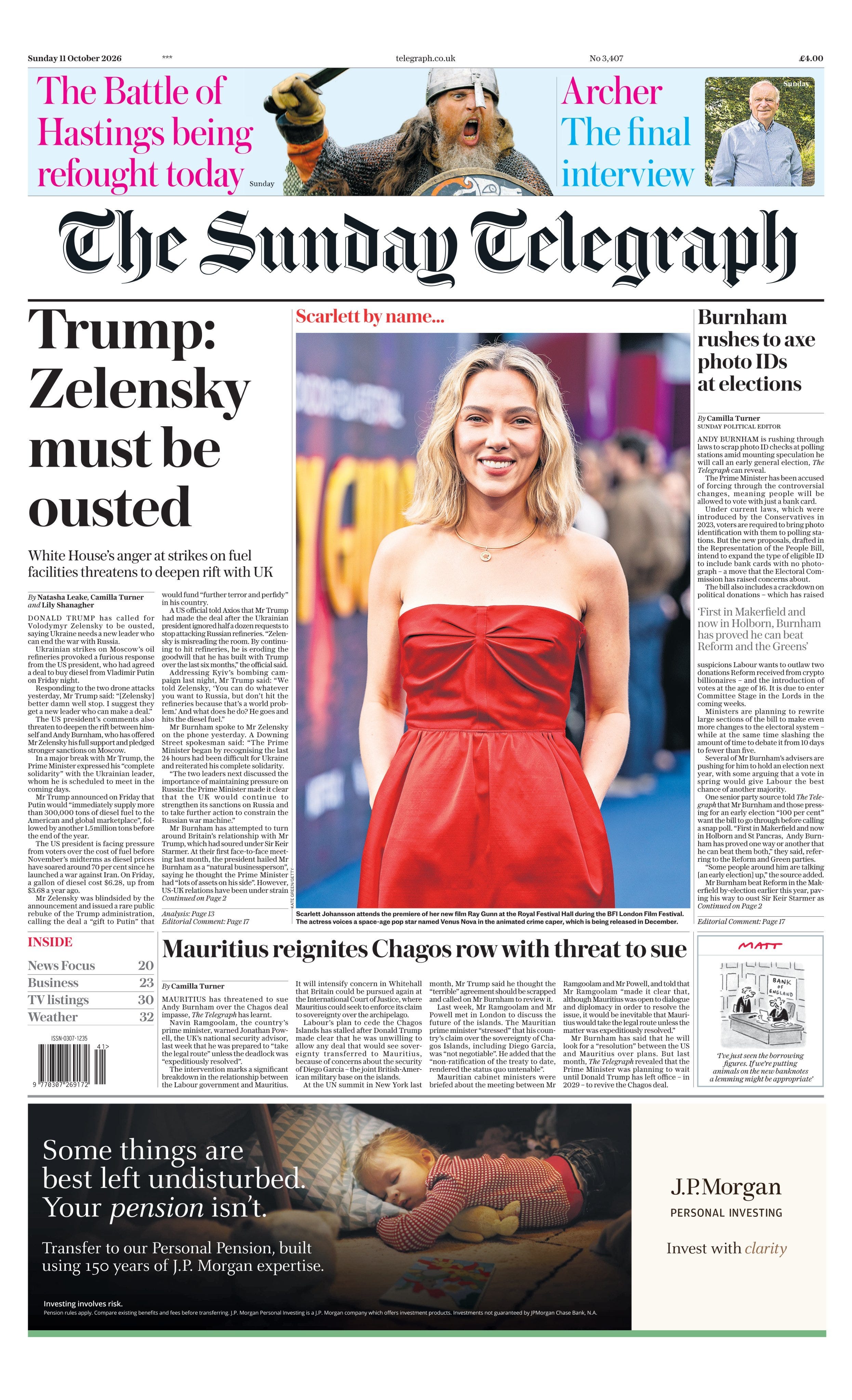
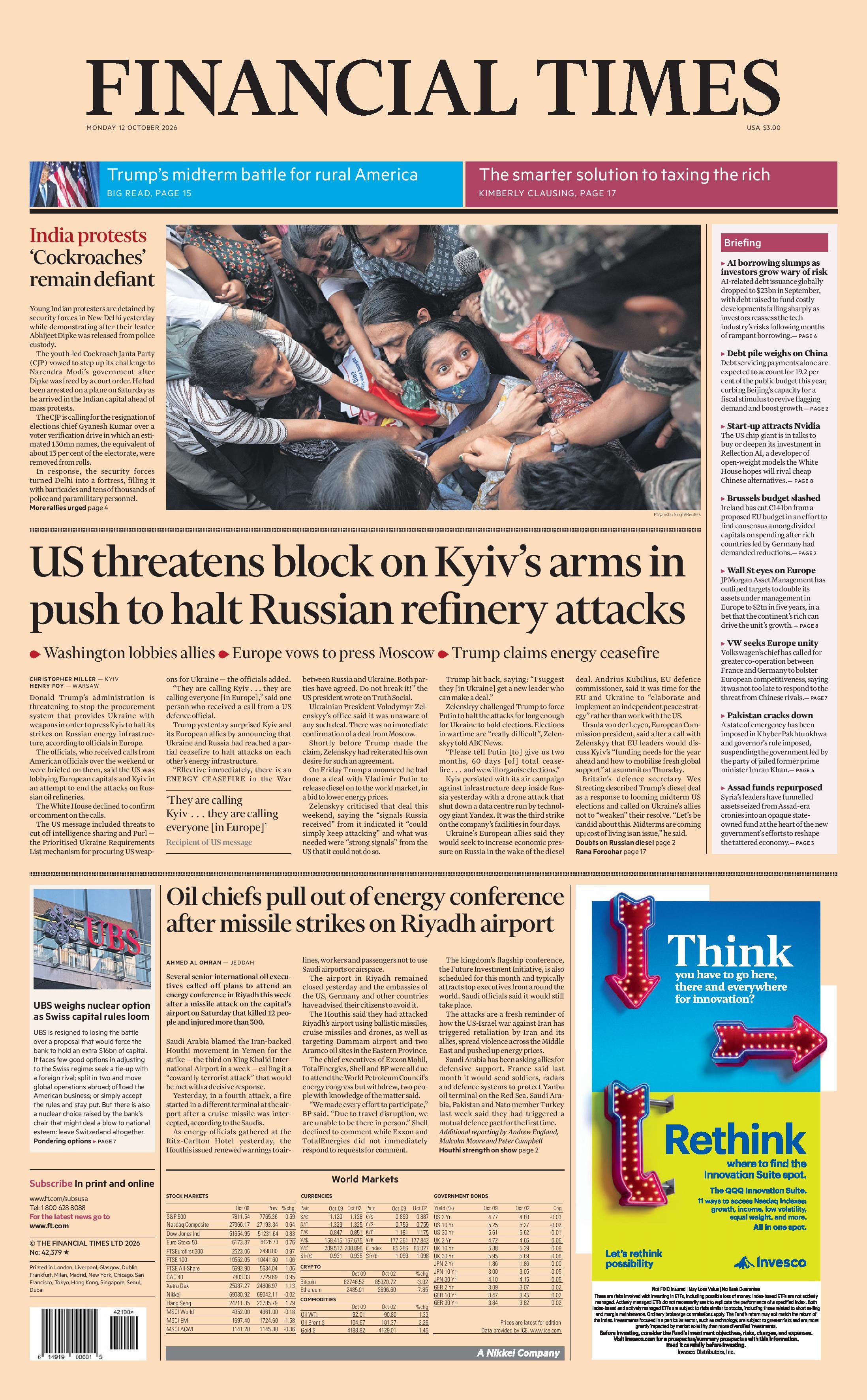
Several of the world’s top oil executives have pulled out of the World Petroleum Congress in Riyadh this week after a deadly run of missile strikes on the Saudi capital’s airport. The FT reports that the chief executives of ExxonMobil, TotalEnergies, Shell and BP were all due to attend but have withdrawn, citing two people familiar with the matter. BP said it had tried hard to take part. “Due to travel disruption, we are unable to be there in person,” it said. Shell declined to comment, and Exxon and TotalEnergies did not respond.
Some US officials are also rethinking trips to the kingdom. Saudi officials insist the Future Investment Initiative, the kingdom’s flagship gathering of global financiers later this month, will go ahead (the official website makes no mention of the disruptions, with the speaker list including the King of Jordan, the prime minister of India and the president of South Korea).
The pull-outs follow Saturday’s missile strike on a passenger terminal at King Khalid International Airport, which killed 12 people and wounded more than 300, some critically. It was the deadliest attack on a Gulf Arab state since the Iran war began. Riyadh blamed the Iran-backed Houthis and called the strike a cowardly terrorist attack that would meet a decisive response. A fourth attack on Sunday set off a fire in a different terminal. Saudi authorities said a cruise missile had been intercepted, and AP reported injuries. The airport stayed closed, and the US, German and other embassies told citizens to avoid it.
As energy officials gathered at Riyadh’s Ritz-Carlton on Sunday, where delegate prices are priced at north of US$3,500, the Houthis renewed their warnings to airlines, workers and passengers to stay away from Saudi airports and airspace. The group says it has used ballistic missiles, cruise missiles and drones, and has also targeted Dammam airport and two Aramco sites in the Eastern Province.
The official handling has deepened the unease. Semafor reports that foreign embassies warned citizens away from the airport hours before Saudi authorities acknowledged Saturday’s attack, while state-aligned Al Arabiya aired reruns. Since the war began on February 28, Gulf governments have curbed coverage and criminalized social media posts. Saudi Arabia had projected an image of insulation from the conflict, and that image is now cracking.
Riyadh is turning to its allies for help. France said last month it would send troops, radars and air defence systems to protect the Yanbu oil terminal on the Red Sea. Last week, Saudi Arabia, Pakistan and NATO member Turkey triggered their mutual defence pact for the first time. President Trump says the US may join strikes on the Houthis and will decide quickly. If it does, the Gulf is likely to bear the brunt of any retaliation.
Sources: Financial Times, AP, Semafor, Reuters
Deadly strikes on Riyadh’s airport threaten more than travel to Saudi Arabia. It also threatens one of the last practical corridors for airlines flying between Europe and Asia. Western carriers already avoid Russian airspace, and the Iran war has pushed many of them out of Iranian and Iraqi skies too. Europe’s aviation regulator, EASA, also advises against flying over Bahrain, Kuwait, Qatar, the UAE and Oman. That has left Saudi Arabia, along with Egypt, as the main workaround. Some European airlines have been routing south across the kingdom specifically to avoid the central Gulf. That option is now narrowing. On September 30, EASA issued a conflict-zone bulletin, valid until mid-November, telling the airlines it oversees to avoid parts of Saudi airspace in the west of the country. Across the rest of the kingdom, it told them to fly with caution. The Houthis have gone further. Since October 5 they have warned all airlines that Saudi skies are a military operations zone, sparing only the airspace over Mecca and Medina.
Several carriers have already cut service to Riyadh. Lufthansa Group has suspended flights to the city until at least October 16, and Emirates, Etihad and Air India have also cancelled flights. The bigger question is whether airlines that only cross Saudi airspace will start avoiding it too. If they do, passengers should expect longer flights and higher fares. Earlier detours around the Gulf added an hour or more to some Europe–Asia journeys, and the remaining alternatives run over a contested Red Sea or take much longer routes. Airlines are also likely to treat the conflict as an extraordinary circumstance, which usually rules out compensation for delays and cancellations.
Sources: EASA, Reuters, Gulf News, Euro Weekly News
The Trump administration is threatening to choke off Ukraine’s weapons supply to force Kyiv to stop striking Russian oil refineries, the Financial Times reports. Officials briefed on weekend calls from US counterparts said the threats include cutting intelligence sharing and blocking PURL, the mechanism Kyiv’s European allies use to buy US weapons for Ukraine. Washington is lobbying European capitals as well as Kyiv. The White House declined to comment. The pressure follows two Ukrainian drone attacks on Moscow’s oil refineries on Saturday. Trump said Zelensky “better damn well stop” and suggested Ukraine find a new leader who can make a deal. He complained that Kyiv had been told to hit Russia however it liked but leave refineries alone, and went after diesel anyway. A US official reportedly said that Zelensky had ignored about half a dozen such requests before Trump struck his own fuel deal with Putin. Multiple power plants in Ukraine were struck by Russia hours after Trump claimed an “energy ceasefire” between the two countries. A drone hit a power plant in Kyiv, causing outages in the capital, and strikes on Kharkiv’s energy infrastructure and Odesa’s internet network followed. Earlier, Trump said Russia and Ukraine had agreed to halt strikes on each other’s energy infrastructure. “Effective immediately, there is an ENERGY CEASEFIRE in the War between Russia and Ukraine. Both parties have agreed. Do not break it!” he wrote on Truth Social, without giving further details. The ceasefire announcement came two days after Trump said Putin would immediately supply more than 300,000 tons of diesel to US and global markets, with another 1.5 million tons to follow by year-end. Trump is under pressure over fuel costs before November’s midterms. US diesel prices have climbed about 70% since the Iran war began, reaching $6.28 a gallon on Friday, up from $3.68 a year earlier. Zelensky publicly rebuked the deal as a gift to Putin that would bankroll more Russian terror. Zelensky said he had not been informed of the energy ceasefire. “It was news for me. But if Russians agree to an energy ceasefire, Ukraine will agree,” he told Axios. Kyiv’s allies said they were awaiting details. There was no immediate confirmation of an agreement from Russia, which has escalated deadly attacks in recent weeks. Its only response was strikes on Ukrainian power plants. “If President Trump negotiated it with Putin, please tell us when the ceasefire begins. We are ready, and we will accept it,” Zelensky said.
In an interview with ABC News, Zelensky said Ukrainians would decide whether they want a new leader, responding to Trump’s call for Ukraine to pick a new leader. “First of all, with all respect to President Trump, it’s up to our society, up to our people to choose one or another leader,” Zelensky said. The day before, Trump had said Ukraine needed a new president who would agree to end the war. Zelensky said his country could hold elections if Russia agreed to a 60-day total ceasefire.
The United Kingdom, Germany and Poland have reaffirmed their support for Zelensky after Trump said the country needed a new leader. Polish Prime Minister Donald Tusk wrote on X that he was “absolutely convinced” nobody could break Ukraine and its president in their “fight against Russian aggression.” German Foreign Minister Johann Wadephul also backed Zelensky on Sunday, while calling for greater pressure on Moscow to return to peace talks. “We need continued consistency and clarity on the side of Ukraine,” he told Reuters at a meeting of the governing Christian Democrats.
Kyiv kept up its long-range campaign regardless. A Ukrainian drone strike on Sunday shut down a data centre run by Russian tech giant Yandex, the third strike on the company’s facilities in four days. (FT)
A bipartisan group of six senators on Sunday called on the Trump administration to “immediately reverse course” on a plan to purchase diesel from Russia to lower high fuel prices. They said the administration had failed to consult Congress or submit any justification for its decision, as required by statute. “The United States should not provide Putin with a financial lifeline while Russia continues to kill Ukrainian civilians. The Administration must immediately reverse course,” they wrote. The signatories are Republican Sens. Susan Collins of Maine, Lisa Murkowski of Alaska, Thom Tillis of North Carolina and John Curtis of Utah, and Democratic Sens. Jeanne Shaheen of New Hampshire and Richard Blumenthal of Connecticut. (AP)
The deal may matter more to Moscow than the cash. Pro-war Russian Telegram bloggers calculate that the promised deliveries add up to about 1.8 million tonnes, or roughly 13.5 million barrels, and cast the deal as Washington bowing to a global diesel shortage. They argue the bigger prize could be access to spare parts and custom-built units for refineries knocked out by Ukrainian drones. Those parts are made to order and slow to source around sanctions, and with Washington now an interested party, manufacturers may be more willing to look the other way. They conclude that the deal, in its current form, benefits Russia far more than the West, and could undercut the strategy of squeezing Moscow through sanctions and lost export revenue.
Sources: Financial Times, Euronews, Axios, ABC News, Politico, Reuters, AP
Watch: Live on BBC World this weekend, I called the U.S.-mediated talks what they are: buffoonery on an epic scale. While Ukraine’s negotiators sat across from Steve Witkoff and Jared Kushner, Trump was cutting a diesel deal with Putin behind their backs. Kyiv should turn to a more neutral mediator, such as Turkey, Oman or Pakistan.
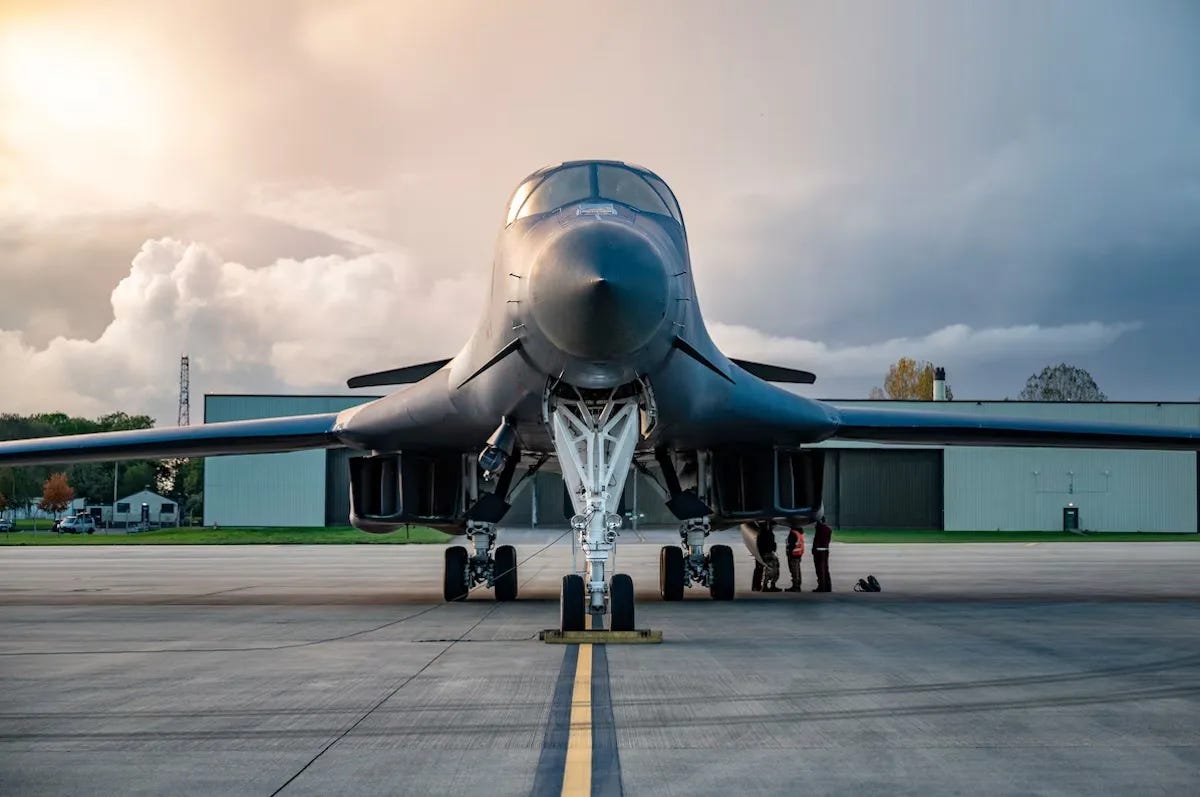
The US has pulled its B-1 bombers out of Britain over fears of an Iranian-linked drone attack. Former Pentagon official Stephen Bryen argues in Asia Times that bringing them home won’t make them any safer.
Writing in a piece first published on his Weapons and Strategy Substack, Bryen says the US withdrew all 12 B-1s from RAF Fairford on October 4, after intelligence warned that a drone strike on the base was imminent. Reports say the aircraft went to Ellsworth Air Force Base in South Dakota. Bryen says the feared attack would have used drones launched from trucks near the base. That echoes Ukraine’s Operation Spiderweb in June 2025, which hit Russian strategic bombers deep inside Russia.
Bryen’s core argument is that the drone threat follows the aircraft home. He points to more than 350 unauthorized drone incursions detected at roughly 100 US military installations in late 2024, and says the pace has stayed high since. Ellsworth itself has reported repeated waves of drones in restricted airspace nearby. Bryen reads that as a sign the base has been systematically scouted. Drones recovered near US bases have been commercial, mostly Chinese-made models, and he notes they are easy to buy and hard to trace.
In Britain, Lakenheath, Mildenhall, Feltwell and Fairford have all seen unauthorized drone activity. RAF Akrotiri in Cyprus, which also hosts US units, was hit by a Shahed-type drone on March 1. Bryen says the UK lags the US on countermeasures, and that most incursions on either side of the Atlantic go unchallenged.
His warning is that drone surveillance could become an actual strike at any moment, and that bases in the US are no more secure than those abroad.
The journals…