

A major World Briefing investigation scheduled for today will now publish tomorrow. More shortly.
The verdict first: Tuesday/Wednesday night was not an escalation. It was a confirmation. Russia fired 28 missiles and 115 drones at Kyiv and its region, and Ukrainian air defence brought down not one ballistic missile. Not one. Seventeen dead and 44 wounded in the capital region; 22 killed and at least 85 injured nationwide. The targets were not barracks or bunkers but a parcel depot, a tile factory, a hardware chain’s warehouse and a suburban railway platform, below.
1. The targets tell the story
Nova Poshta - the Kyiv sorting centre, hit with cluster munitions according to the company. Three dead, eight injured. Nova Poshta is not a logistics firm in Ukraine, it is a nervous system: medicine, court documents, spare parts, volunteer aid to the front.
Epicentr - What I call Ukraine’s Home Depot or IKEA. Its Kyiv logistics centre destroyed and the Kalynivka ceramics plant effectively lost, furnaces gone, one worker killed. The company is shifting production abroad and estimates close to two years to rebuild.
Rozetka - also a crucial cog in the consumer distribution chain. The main Brovary warehouse of the country’s largest online retailer, destroyed with its stock. Second week running: on 1 August a jet-powered Shahed hit a Rozetka building with 270 people inside.
Silpo says six employees died in fires at two distribution centres. Novus, Fozzy and the logistics operator Raben were also struck. These are all household consumer names in Ukraine. FOZZY group, which is one of Ukraine’s largest retailers that operates supermarket chains, said Russian shelling caused fires at two of its distribution centers. It said that six of its employees were killed and more were injured, CNN reported.
The same morning, Ukrainian drones hit a Wildberries sortation centre in Tula, injuring one. That is the exchange rate. Kyiv burns a Russian parcel hub and hurts a warehouseman; Moscow burns Ukraine’s and kills seventeen people. Both sides are now waging war on the supply chain of ordinary life. Only one can defend against it.
2. Zero for twenty-eight, and Pyongyang is refilling the magazine
The Patriot is the only system in Ukraine’s inventory that can stop a ballistic missile, and Ukraine is out of missiles for it. On 1 August, one of 27 ballistics was intercepted. Last night, zero. Zelensky said it plainly this morning: interceptors would have saved the people who died.
The Financial Times reported this week that Trump refused his request for 300 PAC-3s in the Oval Office last week, citing depleted US stocks and Gulf commitments, and that Washington has cooled on licensing Ukrainian production - the idea Trump himself floated at the Ankara summit. The report rests on people familiar with the meeting. The White House has not responded to it, and World Briefing has not been able to confirm it independently.
Then, the same day, this. Ukraine’s Defence Intelligence told Reuters that a North Korean missile unit is deploying to Voronezh Oblast - around 90 personnel folded into Russia’s 112th Missile Brigade, six launchers, 120 ballistic missiles as the target figure, with 40 KN-23s and KN-24s already delivered. Treat that as what it is: a claim by one side's military intelligence, which Reuters says it could not independently verify, and on which neither Russia's defence ministry nor North Korea's UN mission would comment. If it holds up, Voronezh is 95 miles from the border - not a symbolic posting but inside the launch basket.
Line the three up and the winter becomes visible. Ukraine cannot intercept ballistics. Washington has refused the missiles that would change that. Pyongyang is topping up the Russian stockpile and sending crews with it. We can only assume what Iran continues to send via its Caspian Sea corridor to Russia.
Russia’s constraint on this campaign was never doctrine or appetite. It was inventory. North Korea is removing the constraint - and in doing so has turned a relationship the West wrote off as a transaction of desperation into a working supply line in the one munition category where Ukraine has no defence. Seoul and Tokyo are watching what happens when a NATO-armed country cannot stop them.
Ukrainians have already done this arithmetic themselves, and faster than most of the Western press. More on that below.
3. Eight people on a platform
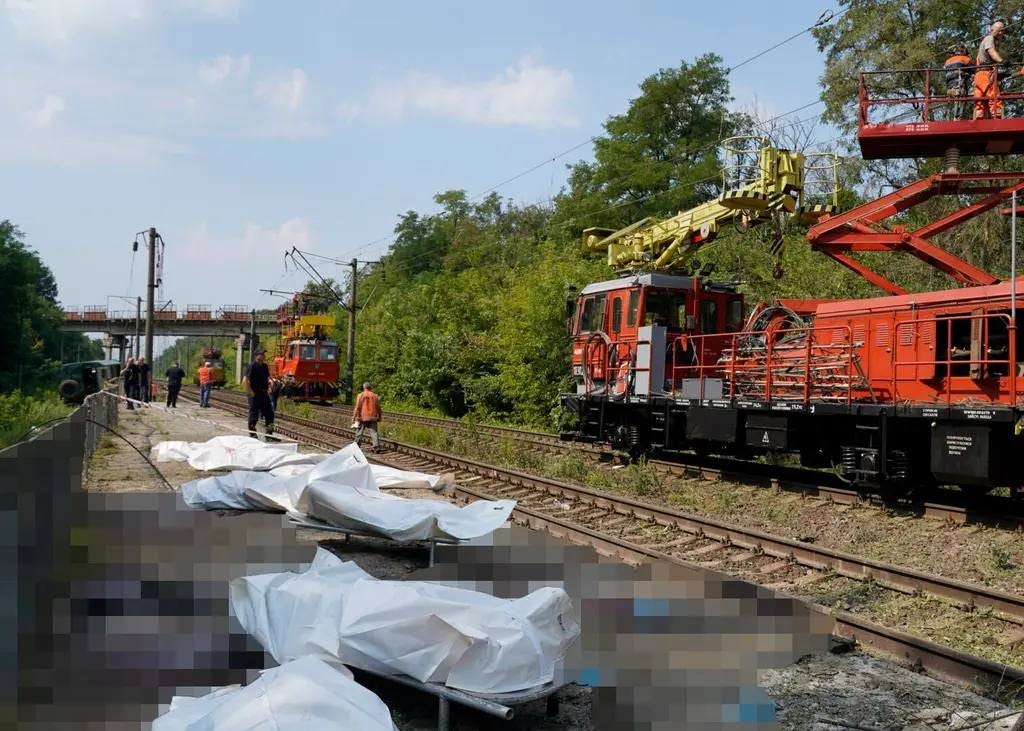
Look at that photograph above before reading on, because it is not a grief picture. It is evidence.
There is nothing on that platform. Cracked concrete, a rusting railing, weeds. No canopy, no structure, nothing within a hundred metres that would stop a fragment. And in the same frame, the overhead line crews are already up on the hoists restringing the catenary while the dead lie beside them. Ukrzaliznytsia will run trains through Kvitneve tonight. The state can replace a 25-kilovolt contact wire in a morning. and yet - it could not put a concrete box on that platform in four and a half years.
The sequence matters more than the total. Brovary had been under drone attack on and off since early evening - hours of it - before the ballistics came down on the town and the capital together, in what residents call the heaviest bombardment of the war there. Somewhere inside those hours a train was delayed. People stood on that platform and waited. Eight of them were killed. They were not caught out by a three-minute warning; they had been listening to drones half the night. They stayed because the train was the way home and there was nowhere else to go.
Afterwards, neighbours in polo shirts and borrowed surgical gloves carried their own dead up the steps while a young policewoman logged it on a clipboard.
This is Vitali Klitschko’s liability and he cannot outrun it. The state ombudsman found problems at 93 percent of 1,066 shelter sites inspected nationwide, including 125 in the capital — locked doors, facilities listed as public that turned out to be unusable. Residents say that when they press, officials pass responsibility back and forth.
And then the detail that may take this out of the realm of bad luck. Oksana Zhyrnyak, a 44-year-old kindergarten teacher who lives beside the railway line, told the Kyiv Independent that no air raid alert was issued at all - just three explosions, one after another. She was at home with her children. She saw the glow from the bedroom, ran to her son and lay on top of him. Hers is one account from one street, and we have not been able to check it against the oblast alert logs. But if no siren sounded in Brovary last night, that is a second failure sitting on top of the first.
And let us try to be clear about why this has gone unresolved for four years. Zelensky and Klitschko have been feuding over who bears responsibility for the shelters in the capital and the oblast around it since long before last night - a fight about jurisdiction and blame that has outlasted several ministers and produced, on the evidence of Kvitneve, nothing. Eight people paid for that stalemate on a railway platform. Kvitneve is not even Klitschko’s to answer for - the platform belongs to Ukrzaliznytsia and the district to the oblast administration. That is precisely the problem. Three authorities, one feud, and no shelter on the platform.
Odesa, meanwhile, has installed eight mobile shelters along its seafront for 35 million hryvnias - reinforced modules rated to 100 kPa, holding up to 135 people, wheelchair ramps. Ukrzaliznytsia has deployed 800 of them at stations lacking permanent protection. The technology is cheap and it arrives on a truck. There was no engineering reason for Kvitneve to be bare last night. Only an administrative one. Watch my video below for the mobile Odesa shelters…
4. “Four years of full-scale war, and there is damn-all”
The sharpest analysis published today came from neither a think tank nor a wire service. It came from Yanina Sokolova, filming two minutes to camera outdoors, addressing her audience - deliberately - not as viewers but as civil society (her Ukrainian-language video is below).
Her sequence, in order. There will be more ballistic missiles, because the North Koreans will help Russia go on destroying not just Ukrainian businesses but Ukrainian lives. Winter is ahead. So we need to talk about mobile shelters, and “they need to stand in every settlement,” beside every stop “where people gather in numbers.” There are none in Kyiv or Kyiv Oblast, she says.
Note what she has just done. She linked the Pyongyang pipeline to the shelter deficit before most Western coverage had connected either, and she did it standing exposed, outside - and just as the smoke was clearing from heavy overnight strikes on Kyiv.
Then the detail no analyst could supply. She was in a shelter with her children this morning and she counted: roughly a minute and a half between the alert and the first impact, then thirty to forty seconds between strikes. Which means, as she says, that if you are not at home, and there is nothing near you, and you live in a high-rise - reaching shelter is simply “unreal.” Hold that against the three-minute figure officials prefer to cite.
Four years of full-scale war, she says, and there is damn-all. People will keep dying as long as they have nowhere to hide. At least a mobile shelter stops shrapnel, and that alone would be enough to matter.
And then the ask nobody in officialdom wants to hear. Press your local authorities. And businesses, she urges - if you have a transport stop outside your door, or a large warehouse holding your stock, put in a mobile shelter yourselves.
Read that last line against the past twenty-four hours. Two hundred and seventy people were inside that Rozetka warehouse on 1 August. Six Silpo employees died at distribution centres. Three Nova Poshta drivers died last night. Russia has designated commercial logistics as a target set; Sokolova is telling commercial logistics to act like it. Duty of care is no longer an HR abstraction. Epicentr can move ceramic production to two foreign plants inside a week - these are not helpless institutions.
5. The thing I keep saying on air
Ukrainians are breaking. Not collapsing - breaking, quietly, on the inside. I hear it from taxi drivers and from television anchors who go on air composed and then admit privately they have not slept properly in months - or - increasingly so, that they have been diagnosed with depression. Four and a half years of sirens. The pitch a Shahed makes when it turns. The nightly calculation of whether the corridor is far enough from the window. Those of us here too long without a break hear sirens when they are none…
Serving-age men have it worse, and Western coverage misses this almost entirely. As I was reminded this evening, many now avoid leaving their flats at all - not because of the missiles but because of the recruitment officers, the street checks, the vans at transport hubs. So a man weighs whether the pharmacy is worth the risk, stays home, and the missiles come to him anyway.
The bottom line: Russia has worked out that it need not break the Ukrainian army if it can break Ukrainian daily life, and that Ukraine’s magazine empties faster than its own - a magazine Pyongyang is now refilling from an hour’s flight away. One side’s ally is resupplying it. The other side’s ally (the Trump administration) said no.
Kyiv’s answer cannot only be a request to Washington that Washington has already refused. It has to include what is entirely within Ukraine’s own gift, and what a broadcaster at a bus stop had to be the one to say out loud: open the shelters, spend the shelter money, and tell every large employer in this country that a concrete box outside the loading bay is now a cost of doing business.
Eight people stood on a platform last night with nowhere to go. That was not Moscow’s decision alone.

World Briefing is written from the field. Paid subscribers get Saturday video analysis. Upgrade via this link— and lock in 30% off an annual subscription to World Briefing Plus.
News Briefs
China has announced a series of economic measures against the United States, including controls on drone exports and a ban on dealings with six American entities. The move is in response to recent restrictions imposed by Washington. Tensions are simmering between the world’s two biggest economies ahead of an expected visit by Chinese President Xi Jinping to the US in September. This comes despite signs of warming ties during his meetings with US President Donald Trump in Beijing in May. China’s Commerce Ministry said the sanctions are a response to recent US moves, including a ban by the US Federal Communications Commission (FCC) on imports of Chinese drones, and a decision by the Department of Homeland Security to add 43 Chinese companies to the Uyghur Forced Labor Prevention Act entity list, preventing imports of goods made with forced labour. The measures “seriously violate the important consensus reached by the two heads of state and severely damage China’s legitimate rights and interests,” the ministry said in a statement. “China has no choice but to take necessary countermeasures in response.” Beijing said it was acting with restraint and urged Washington to scrap its measures and cease its “erroneous practices”. It warned of further sanctions if the US rolls out new restrictions against China - Euronews
A visit by officials from Afghanistan’s unrecognized Taliban government to Moldova has triggered a political storm in the small Eastern European country. Three officials from the Taliban’s Agriculture Ministry arrived in Chisinau on August 3 for a days-long visit after they were granted visas. The militant Islamist group, which seized power in 2021 after the withdrawal of international troops, has tried to use the trip to boost its international image and legitimacy. The Taliban government is considered one of the most repressive regimes in the world. The international community has blacklisted Taliban leaders and cut off the group from the global financial system. At the center of the controversy is Vasile Sarban, the Moldovan official who invited the three Taliban officials. He said he made the decision at the request of private Moldovan companies keen to export to Afghanistan. “I believe it is right for the authorities of Moldova to look after Moldova's economic operators,” Sarban, an official in Moldova’s Agriculture and Food Industry Ministry, later said. "If our producers say they have nowhere to sell, the state should help them find markets." But the comments from Sarban have failed to quell the growing uproar over the visit. When the Taliban delegation in Chisinau, the Moldovan Foreign Ministry rushed out a statement confirming that visas had indeed been issued but immediately distancing itself from the Taliban's narrative. The ministry stressed that the visitors "are not targeted by international sanctions" and reiterated that "the Republic of Moldova strictly complies with international sanctions regimes and does not recognize the Taliban government in Afghanistan." "There will be no bilateral meetings or official contacts with the delegation's representatives," the ministry’s statement added. The Moldovan government also announced that it was launching an investigation into how the visas were issued - RFE/RL
Extreme heat could disrupt flights and travel plans as the planet warms. On the hottest days, thinner air can make it harder for aircraft to get off the ground safely. Airlines may have to lighten the load by removing passengers or cargo, or carrying less fuel. The snag is well known at airports in desert climates around the world, from the U.S. Southwest to the Middle East. But even less extreme heat can create similar challenges at airports with higher elevations or shorter runways. Researchers say human-caused climate change could make such disruptions more common. With heat waves searing parts of the United States and Europe this summer, Las Vegas illustrated how extreme heat can interfere with air travel. American Airlines offered compensation to customers who voluntarily gave up their seats on a July 24 flight from Harry Reid International Airport after temperatures reached 114 degrees Fahrenheit (47 degrees Celsius). The airline described reducing a plane’s weight as a standard industry practice in hot-weather destinations when conditions require it to ensure a safe takeoff. The explanation comes down to physics. Hot air is thinner than cool air, making it harder for a plane’s wings to generate lift and for jet engines to generate the thrust needed for takeoff, explained Ross Aimer, a retired United Airlines captain and CEO of Aero Consulting Experts. The Federal Aviation Administration does not set a single maximum temperature for takeoff. Instead, the FAA says, operating limits vary based on an aircraft’s make and model, its weight and the airport’s altitude. A 2017 study by researchers from Columbia University, NASA’s Goddard Institute for Space Studies and the Logistics Management Institute projected that some airports could see weight restrictions on 10% to 30% of flights departing during the hottest part of the day by midcentury if greenhouse gas emissions continued to rise. The study examined 19 airports around the world and found that airports with short runways, high elevations and hotter climates would be affected most. A more recent study concluded that current climate prediction models indicated planes taking off from four European airports would have to shed the weight equivalent of 10 passengers per flight by 2065. Airports can be especially vulnerable to the urban heat island effect, which is the phenomenon of built-up areas becoming hotter than their surroundings, said Jennifer Brady, a data scientist with Climate Central. With little shade or green space, vast expanses of heat-absorbing pavement and constant activity from airplanes, ground vehicles and air conditioning systems that generate waste heat, “all of the elements are there for it being one of the hottest spaces in a city,” Brady said - AP
The journals…

Is it not wholly appropriate for Ukraine to search in all markets for suitable systems. What might Israel have that would be of significant use. USA may not be willing or able but surely others have capabilities. Is Europe or Nato actually engaged or have we reached the end of the moral road? Shades of Hungary and Czechslovakia, both delivered to the Russian Bear by the west to placate them in fear of nuclear war. And so repeats history. Dear Ukraine, send the women and children away and fix bayonets. No one else is coming to your aid.