On 25 August, a US Air Force C-17A Globemaster III landed at Moscow’s Vnukovo Airport and sat on the tarmac for several hours. Flight trackers had it before officials did. By the time the diplomatic motorcade footage surfaced on Russian social media, the story had escaped: CIA Director John Ratcliffe was in Moscow, the first CIA director to visit the Russian capital since the full-scale invasion of Ukraine.
The Wall Street Journal reported the purpose first. CBS News and RFE/RL have since independently confirmed the thrust of the reporting. Ratcliffe was there to tell Moscow not to attack a NATO member state. RFE/RL’s sources put a sharper point on it: the warning was specifically about Estonia, Latvia and Lithuania.
Everyone involved is working hard to make it sound like nothing.
Sergei Naryshkin, head of Russia’s SVR, confirmed on Thursday that the meeting happened and immediately drained it of significance. A “working-level meeting,” he said. A “standard working format.” Nothing special. He noted that he meets foreign intelligence chiefs almost weekly, in person or online. Dmitry Peskov confirmed Ratcliffe met intelligence officials but not Putin, though Putin was briefed. President Trump called the trip “very sort of semi-routine,” then added that “something may come out of it.”
You do not send the director of the CIA to Moscow on a semi-routine basis. There is no such thing.
Why the assessment changed
For four and a half years, Washington’s working assumption was that Putin would not open a second front while the first one was consuming him. That assumption has been quietly retired.
One factor appears to be Ukraine’s increasingly effective deep-strike campaign. Wave after wave of long-range drones have hit refineries, logistics hubs and warehouses inside Russia, from the Afipsky refinery to the Astrakhan gas processing plant to Ozon distribution centres. The concern in Washington is that mounting pressure inside Russia may not simply pin Putin down; it could encourage Moscow to seek leverage elsewhere.
Heather Conley of the American Enterprise Institute framed the logic to the Journal: the objective is not territory, it is fracture. Challenge NATO’s credibility, and separate the United States from its allies. As she put it, the question mark is how Washington would respond.
That is precisely the question a limited incursion is designed to ask.
The summer of alarm bells
Ratcliffe’s flight was the culmination of something, not the start of it.
A letter dated 30 July, seen by RFE/RL, went to European Commission President Ursula von der Leyen warning of a “deteriorating security environment” in the Baltics, citing an “increased frequency of airspace violations and drone incursions.” It was signed by the three Baltic commissioners - Kaja Kallas, Andrius Kubilius and Valdis Dombrovskis - along with their Polish and Finnish EU commissioners. That put senior European officials from five of NATO’s most exposed eastern and northern members on the same piece of paper.
RFE/RL also independently reports additional summer intelligence about possible Russian false-flag operations and explicitly says there was no indication of an imminent conventional attack. The reporting also makes clear that the exposure is not confined to the Baltics. Recent cases of alleged or suspected Russian involvement in assassination attempts, arson and drone incursions span Germany, Poland and Slovakia.
This is the shape of the actual threat. Not tank columns crossing a border, but sabotage, deniability, and a NATO membership arguing among itself about whether Article 5 has been triggered.
The British front
Run parallel to all of this: London is now being threatened directly.
On Monday, on his first foreign trip as prime minister, Andy Burnham stood outside St Sophia Cathedral in Kyiv on Ukraine’s 35th independence day and announced Britain would release classified technical information on British-made Storm Shadow components to help Ukraine build its own long-range missiles.
Peskov called it adding fuel to the fire. Burnham’s reply: “Who started the fire? That’s the question, isn’t it?”
Maria Zakharova then warned that any British military facilities and equipment, in Ukraine and beyond its borders, could become targets. Kremlin adviser Andrei Fedorov, a former deputy foreign minister, told the BBC that Moscow had not entirely ruled out paramilitary action against British factories producing drone and missile components, and that a response might eventually be visible rather than merely verbal. Attacks from “unknown sources” is the operative phrase, and it is not subtle.
Classified Storm Shadow component data are the escalation Moscow has spent three years insisting it would not tolerate, the Kremlin’s red line. Handing over the means of production, rather than the weapons themselves, moves the target from a stockpile to an industrial base - one that sits in Lancashire and Hertfordshire, not Kharkiv.
Connecting the dots
A number of things are happening at once.
Ukraine’s drone campaign has made Russia’s war economy hurt. At the same time, Moscow appears to be looking for softer places to apply pressure: the Baltic states, where deniability is cheap, and Britain, where the industrial supply chain is exposed. And Washington, having watched this develop over a summer of intelligence, sent its spy chief to say the quiet part in person.
And here is the contradiction: Washington is warning Moscow not to test NATO at precisely the moment it is telling the alliance’s European members to prepare to carry more of the burden themselves.
The uncomfortable precedent is November 2021. Bill Burns flew to Moscow and warned against invading Ukraine. By his own account, Putin was unmoved. The invasion came three months later.
That does not mean this warning fails. It means the warning itself is the signal worth reading. You send a CIA director when you have specific intelligence and you want the other side to know you have it.
What to watch
The NATO readout. Elbridge Colby met Mark Rutte and allied ambassadors in Brussels on Thursday, telling them Europe must take primary responsibility for its conventional defence while insisting the United States remains committed to NATO. The more important question now is what allies were told behind closed doors about Ratcliffe’s Moscow warning - and what leaks out afterward.
The Iran thread. CBS reports Ratcliffe also raised Iran, warning of further sanctions if the Strait of Hormuz does not reopen to shipping. Ratcliffe’s trip came a day after Washington launched a new pressure campaign against Tehran. A single trip carrying two warnings tells you something about how thin the channels have become.
Sabotage attribution. Watch how European governments characterise the next factory fire, rail incident, drone sighting, territorial waters incursion. The shift from “under investigation” to naming Russia is the real escalation ladder here.
Whether Moscow answers. Naryshkin says he meets counterparts weekly. If the channel is genuinely routine, expect a reciprocal contact within weeks. Silence would be the more telling response.
A Russian military lieutenant colonel was killed in a car explosion in St. Petersburg, the local news outlet Fontanka reported Thursday. The blast occurred around 10 a.m. local time near a supermarket in the Shushary neighborhood. The officer’s wife was also in the car and badly injured, Fontanka reported. Investigators later confirmed the death of one person and hospitalization of another but described the incident only as a “vehicle fire,” not an explosion. They added that a criminal probe was underway. Russia has accused Ukraine of carrying out several assassinations of military officers since the full-scale invasion. Ukrainian sources have claimed responsibility for some of the attacks while denying involvement in others. There was no immediate comment from officials in Kyiv in response to Thursday’s reported blast - Moscow Times
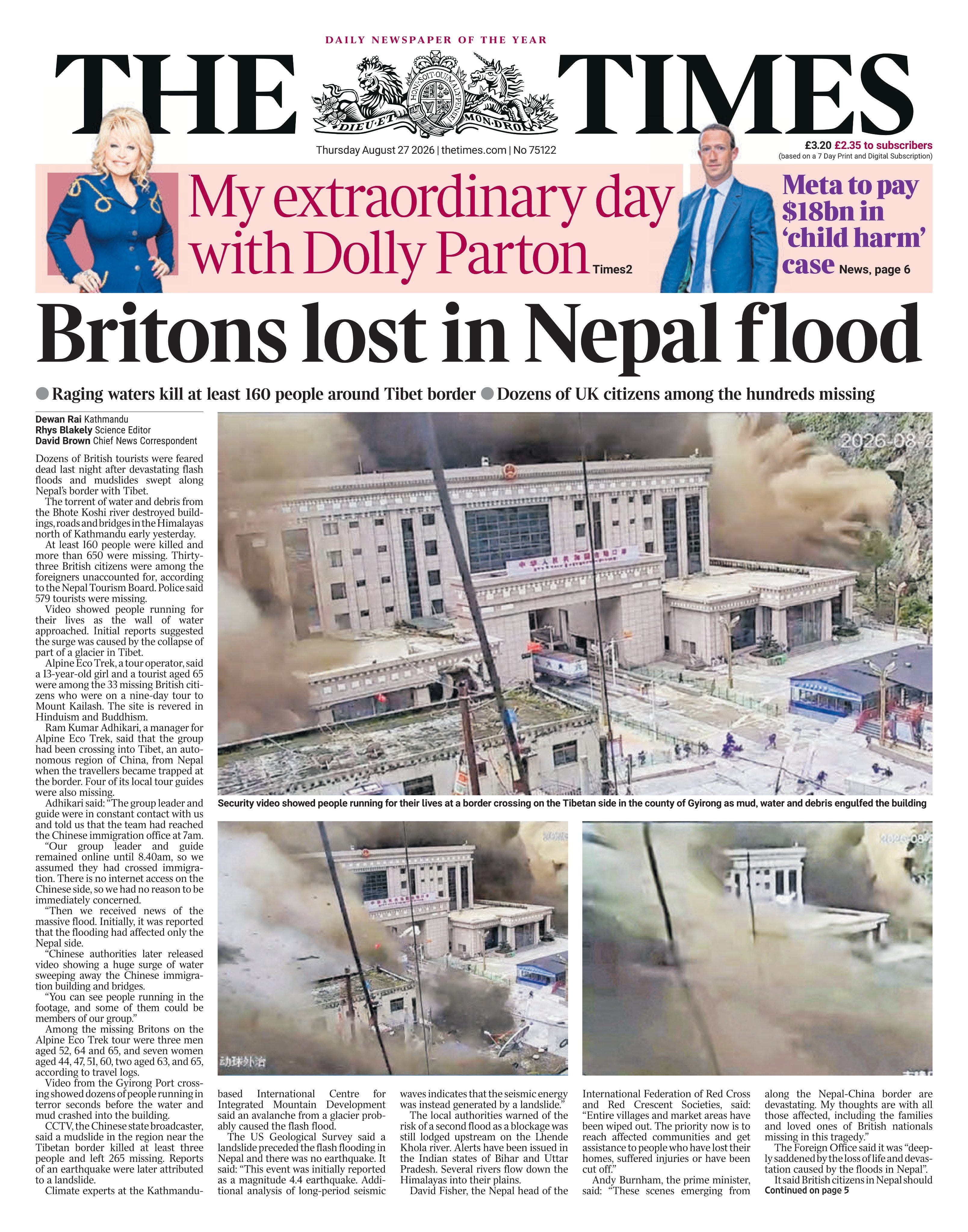
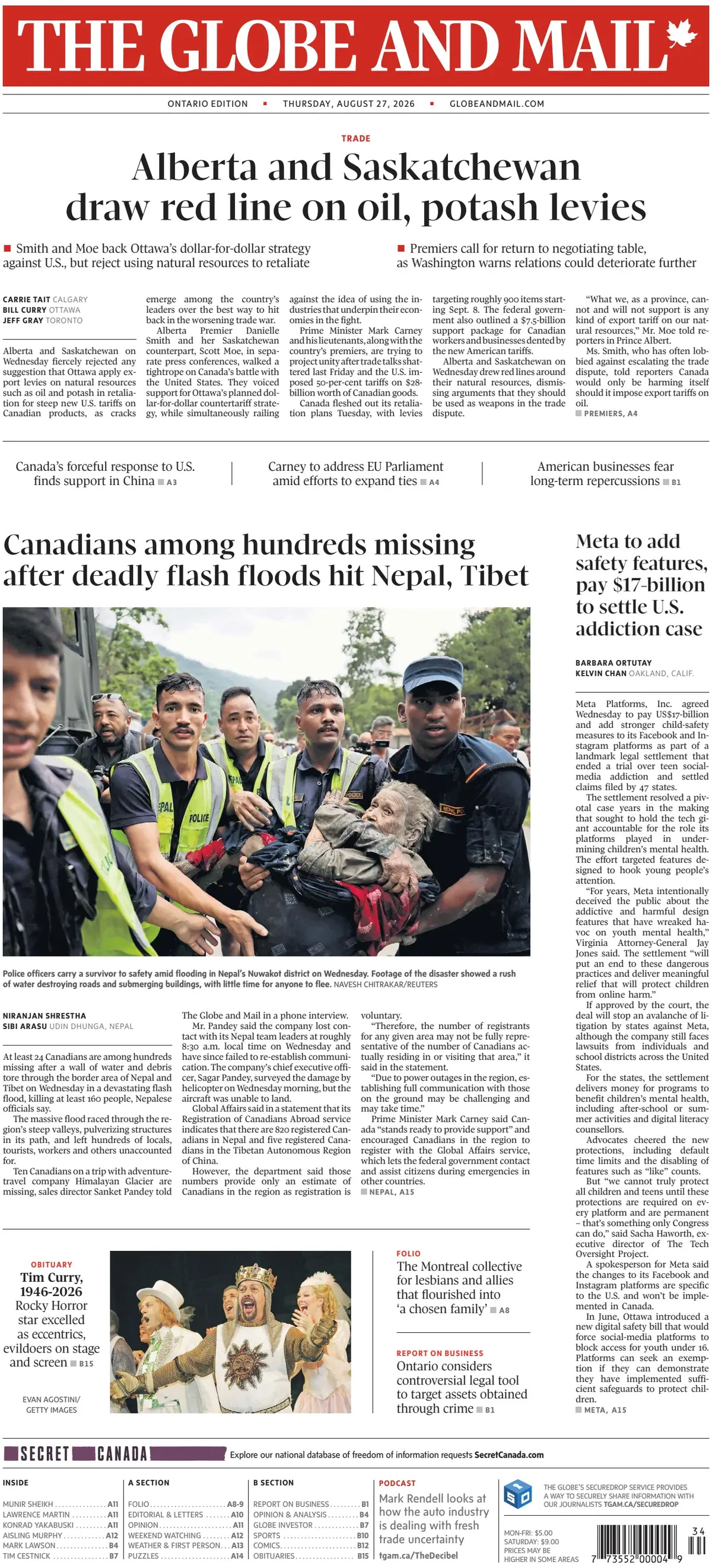
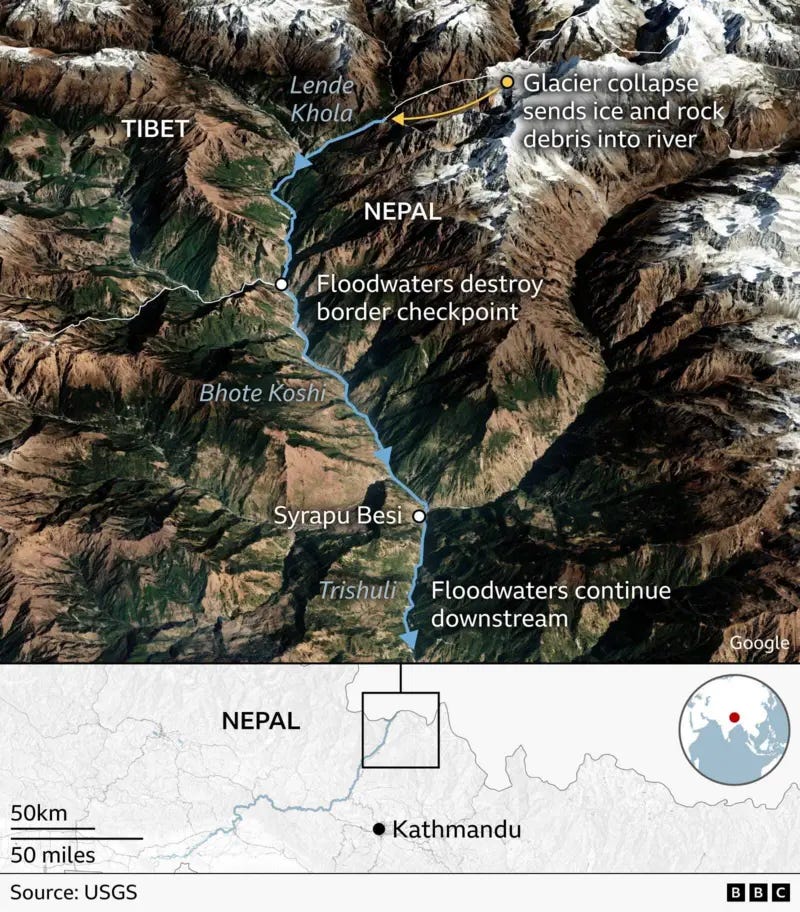
More than 1,000 people were missing in Nepal and the Tibet region of China after a torrent of mud, water and ice swept away villages and bridges. Officials said at least 335 people had been killed. A lake of rising water has formed at a site along the China-Nepal border - prompting fears it could burst its banks. Among the missing were hundreds of foreign tourists. The Nepal Tourism Board said on Thursday that 644 tourists were out of contact, including 517 foreign nationals. They include visitors from 19 European countries as well as China, India, the United States, Canada, Ukraine, Singapore, Malaysia, South Korea and Australia. Nepali officials are urging travellers to inform the nearest police or security authority, local administration, travel agency, guide or tour operator of their location and in a statement said “please remain calm, stay informed and follow official safety instructions”. The disaster has particularly affected Rasuwa and neighbouring Nuwakot, north of Kathmandu and close to Nepal’s border with Tibet. Nepal has long been one of Asia’s most popular destinations for backpackers, hikers and adventure travellers, attracted by its dramatic Himalayan landscape, relatively affordable travel and combination of mountain trekking, historic cities and Buddhist and Hindu culture. The country is home to eight of the world’s 10 highest mountains, including Mount Everest, and official figures show 1.16 million international tourists visited Nepal in 2025, including more than 165,000 who went trekking. The International Federation of Red Cross and Red Crescent Societies said the worst-affected areas were “extremely difficult to reach” - with many vital supplies being delivered by helicopter. The United Nations said about 10,000 households needed “immediate relief.” - NYT/Euronews/Telegram/BBC
Rescue efforts in China are being led by the People’s Liberation Army, but state media said they face multiple challenges.The Air Force did manage to use a brief weather window to fly a drone over the area to try to find survivors and assess how safe it was for rescue teams to enter. The border town of Gyirong is the main crossing for people and traffic heading between Nepal and China. Video footage appears to show a crushing wall of water crashing through buildings and washing away trucks and cars. Thousands of pilgrims were making a journey along this route from Nepal towards a sacred mountain in Tibet. This is also one of the most controlled and politically sensitive regions of China. Access to Tibet is restricted for foreigners. All the information we receive is from Chinese state media which is also carefully controlled - BBC
Meta vowed to institute sweeping changes to Facebook and Instagram as part of an $18 billion settlement with 48 US states that had accused the platforms of promoting “known harmful” and addictive features to children and teenagers. Meta said Wednesday it will hold users under 18 to two-hour daily limits and block usage at night unless parents consent, potentially transforming how young Americans interact with social media apps and providing a template for thousands of similar lawsuits globally; part of the settlement will only be paid out if TikTok and YouTube introduce similar restrictions. Meta is locked in a separate fight over backlash against data centers as anti-tech sentiment among US voters balloons into a “bipartisan rebellion” against AI, Semafor’s David Weigel wrote - Semafor
Dolly Parton fans are pushing to honor the country singer in a huge way following her death by renaming Nashville International Airport after her. A Change.org petition calling for the airport to become “Dolly Parton International Airport” has now passed 100K signatures ... gaining more than 50K supporters in the day since Dolly died Tuesday at 80. The petition was launched in January 2025 and had been sitting at around 53K signatures before news of Dolly's death ignited a massive new push. Sheryl Crow is all for it too ... saying during a Katie Couric Instagram Live Stream that renaming the airport after Dolly is a no brainer. Tennessee State Representative Todd Warner also says he plans to introduce legislation seeking the change. It would be a major hometown tribute ... Dolly was born near Knoxville, became a music superstar in Nashville and spent much of her life there. As we first reported, Dolly’s inner circle scrambled to bring close family and friends to Nashville after her health took a dire turn over the weekend. Those close to her initially hoped she would recover and be released, as she had after prior health setbacks, but the situation became increasingly serious. Dolly died Tuesday morning at Vanderbilt University Medical Center in Nashville after being admitted early Friday with various ailments. Her reps later revealed she had been battling cancer and was surrounded by loved ones when she died - TMZ
The journals…