🔥 World Briefing Hot Take
The widening war in the Middle East is doing more than disrupting travel. It has, almost overnight, shattered the carefully cultivated veneer of calm, predictability and effortless glamour that Gulf hubs - especially in the UAE - spent years and untold petro-dollars building.
That image was never incidental. Dubai and Doha did not just sell convenience. They sold reassurance. They marketed themselves as sleek, frictionless global crossroads somehow insulated from the turbulence around them. Manmade islands of calm in a troubled neighbourhood, if you will.
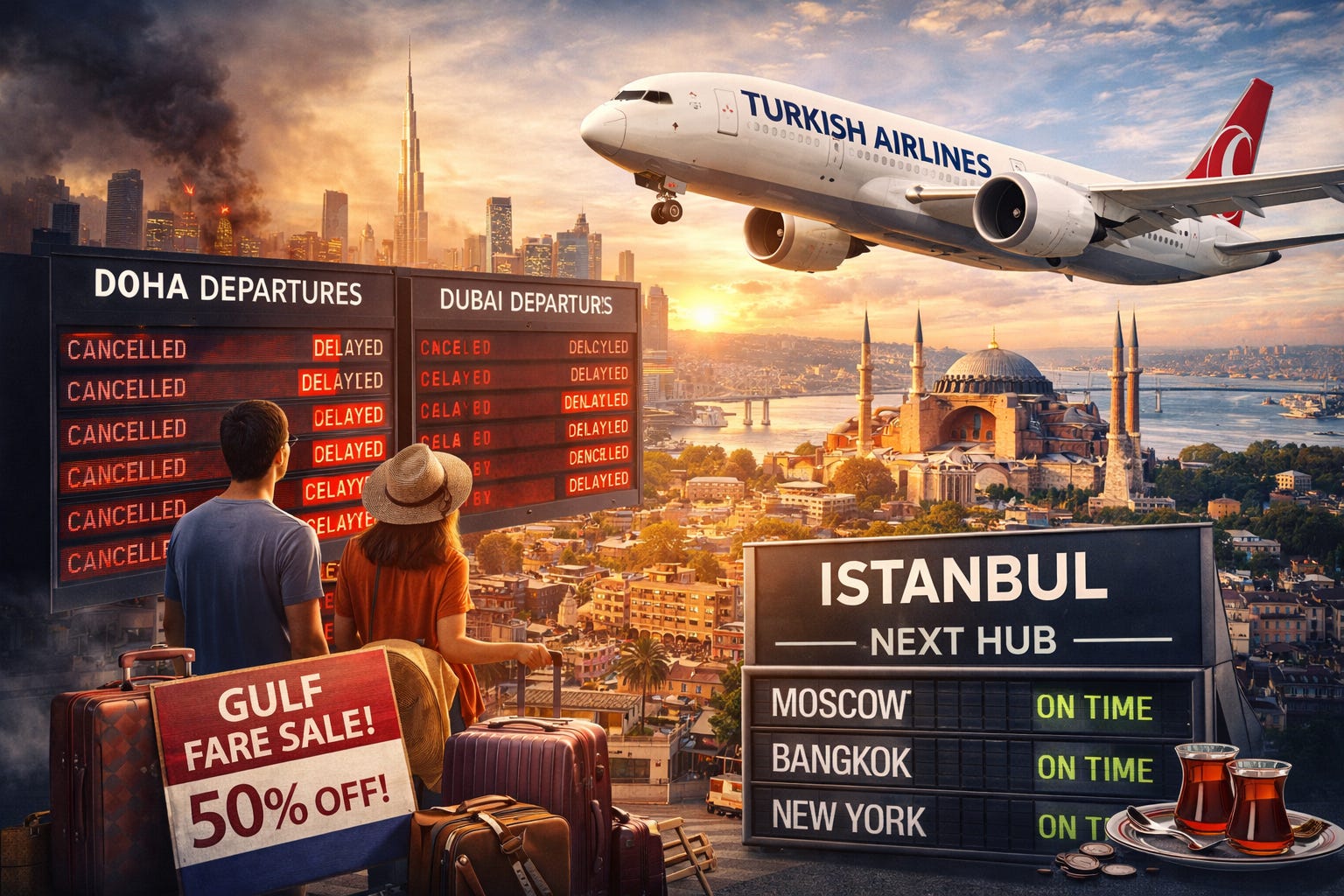
But once airspace closures, diversions and regional insecurity began piling up due to the joint Israeli-U.S. attack on Iran, that illusion cracked fast. And once travelers begin to feel uneasy about transiting through your hub - or holidaying in the wider region at all - no amount of glossy PR, paid influencer co-opting or bargain fares can fully restore confidence.
That is the deeper problem now facing Gulf carriers such as Qatar Airways and Emirates. You can slash prices and flood the market with promotions, but if passengers no longer feel at ease, cheap seats only go so far. Confidence is the real currency of long-haul aviation. Once punctured, it is painfully hard to rebuild.
Enter Turkish Airlines
With Istanbul Airport as its base - huge, modern, highly navigable and with serious room to grow (its my main hub of choice for business travel) - Turkish Airlines has emerged as the clearest beneficiary of this moment. Geography helps, of course. Istanbul sits at the crossroads of Europe, Asia and Africa, making it a natural fallback when the Gulf becomes unstable. But geography alone does not explain this. Turkish Airlines also has the scale, the network and the operational flexibility to absorb disruption in ways many rivals simply cannot.
And then there is one hugely under-appreciated advantage: Russian airspace.
Unlike most Western carriers, Turkish Airlines can still fly to Russian destinations and transit Russian airspace, an edge that became especially valuable after sanctions and reciprocal restrictions following Russia’s full-scale invasion of Ukraine in 2022. In normal times, that already gave Turkish a time-and-cost advantage on certain eastbound routes. Now, with Middle East airspace also constrained, that advantage becomes even more significant. Fewer detours. Lower costs. Better routing. In this environment, that matters enormously.
Turkish Airlines also benefits from something else: it flies where others often won’t. Its network (53 domestic and 303 international destinations in 132 countries) is not driven by commerce alone. Like several state-backed carriers, it doubles as an instrument of Turkish soft power, serving destinations that might seem politically awkward, risky or commercially marginal to more conservative airlines (up until February 2022, Turkish flew to more destinations in Ukraine than the national flag carrier). In calmer times, that can look eccentric. In times like these, it looks smart.
While Turkish Airlines is the obvious winner, a fair question has to be asked: is there room for other, lesser airlines to step up?
Not really. Not at anything close to Turkish’s scale.
A lot of airlines simply do not have the spare aircraft. Air Canada is a good example, stretched thin like many global carriers by aircraft shortages, delivery delays (the first of its 18 firm-ordered Boeing 787-10 Dreamliners are now expected to arrive between June and Q4 2026 rather than 2025, losing roughly two "summer seasons" of utility), and the lingering post-Covid pilot crunch. Across the industry, carriers are still grappling with huge Boeing backlogs and wider supply-chain strain. So even where commercial opportunity exists, many airlines simply do not have the metal to seize it.
Chinese airlines are better positioned than most, at least on paper. Like Turkish Airlines, they can still overfly Russian airspace, giving them a crucial time-and-cost advantage on Asia-Europe routes while many Western rivals are forced onto longer and more expensive detours. With Middle East airspace now constrained too, that edge becomes even sharper.
But Chinese carriers face a reputational hurdle. Operationally, they may be well placed. Psychologically, they are not the natural first choice for many premium and long-haul travelers. While Turkish Airlines isn’t perfect, at least in the air it out-performs many rivals.
And that is what makes this moment so significant. Turkish Airlines has the hub, the hardware, the route map, the overflight advantage, airline alliance membership and the brand familiarity. And with an operational fleet of 24 cargo aircraft, it’s well-positioned to grab valuable cargo traffic from its Gulf rivals at a time when time-sensitive shipments are facing massive constraints. Others may grab scraps around the edges. Turkish is positioned to take the feast.
If this conflict drags on, Istanbul will not just be a useful alternative to Doha or Dubai. It could come out of this crisis as the dominant east-west hub of a far more anxious age.
** Pro tip: Watch for Turkish Airlines’ Q1 2026 earnings release in May, experts says. It will reveal whether the carrier met its 7–9% capacity growth target despite operational strain. If growth falls short, expect fare increases and slot constraints at Istanbul through summer 2026. - with files from ATC, My Savvy Traveller, World Briefing sources
From our editorial partner, My Savvy Traveller, read a review of a recent Business Class flight on the Turkish flag carrier. Click here
You might also find this article of interest from our friends at CODA Story: The influencer bubble: Can content creators continue to airbrush the Gulf? As Iran strikes its neighbors, an army of influencers goes to work online, but the script is wearing thin. Click here


Oman’s foreign minister - whose country mediated the recent U.S.-Iran talks - has delivered one of the most damning assessments yet of the Trump administration’s handling of the Iran war, arguing in an op-ed for The Economist that Washington “has lost control of its own foreign policy” to Israel. Badr bin Hamad Al Busaidi said a deal with Tehran had been within reach before the joint U.S.-Israeli strike, and described the attack as “a shock,” underscoring just how abruptly diplomacy gave way to war. he argued that Iran’s retaliation against alleged American targets in neighboring states was an “inevitable result” of the initial assault and “probably the only rational option available” to Tehran’s leadership. He warned that the conflict threatens the Gulf’s wider economic model - one built around aviation, tourism, technology and global investment - and said the architects of the war had badly misjudged both Iran’s likely response and the region-wide fallout. In his telling, the biggest American mistake was not tactical but strategic: allowing itself to be drawn into a war promoted by Israel’s leadership under the false assumption that Iran was so weakened that military pressure and decapitation strikes would quickly force surrender. The foreign minister argued that both Iran and the United States now stand to lose from a prolonged conflict, and that core U.S. interests - preventing nuclear proliferation, protecting energy flows and preserving investment opportunities - are best served by “Iran at peace.” Al Busaidi floated possible paths back to negotiations, while acknowledging how hard that will be after an administration that, in his view, twice shifted from talks to bombing and assassination. The broader damage may be harder to repair: beyond the battlefield, this episode risks teaching adversaries and partners alike that negotiating with Washington can be a deadly trap rather than a route to de-escalation.
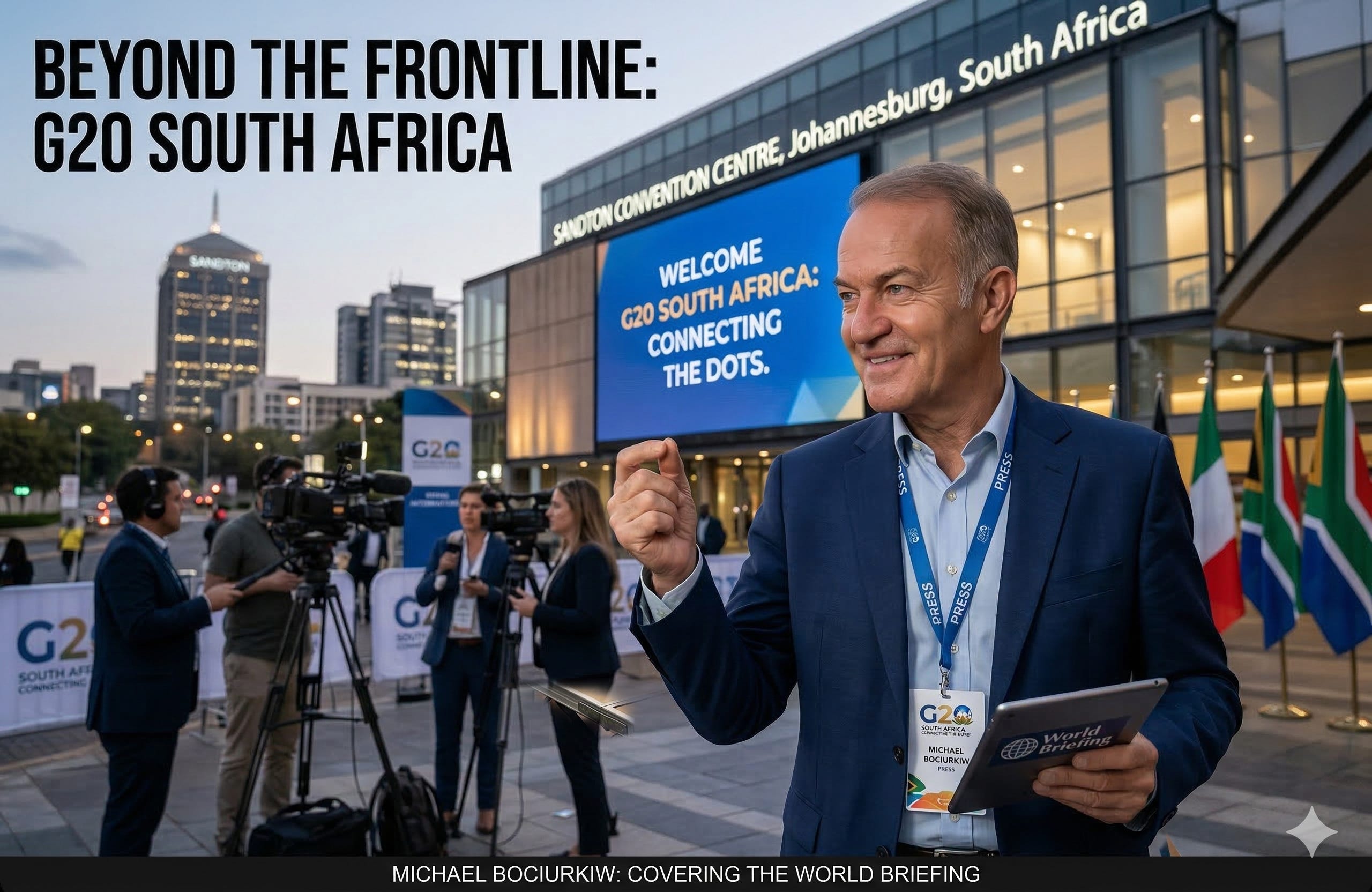
From the Gulf and Ukraine to the Philippines and southern Africa, the geopolitical dots are multiplying by the day.
Upgrade to World Briefing Plus by becoming a paid subscriber and stay ahead of the headlines — or support my independent global reporting through Patreon or PayPal.
The Sri Lankan government has initiated the preliminary discussions with Emirates and Qatar Airways to utilise Mattala Rajapaksa International Airport in Sri Lanka as an alternative transit hub, as the escalating geopolitical tensions continue to paralyse the primary aviation networks in the Middle East. One observer said: “If Emirates or Qatar do commit, even partially, it would be a huge lifeline for Mattala and a win for Sri Lanka’s tourism push. But both airlines are extremely cautious about adding new hubs.” Another asked where the jet fuel would come from amid a global shortage.
The USS Gerald R Ford, the largest warship in the US Navy, is heading back to the Middle East after months at sea, but according to new reports, morale may be running low, as the aircraft carrier’s troubled plumbing has been causing some chaos on the ship. The Wall Street Journal reported mounting stress among sailors aboard the aircraft carrier, whose deployment has already stretched beyond eight months and could reach 11, potentially breaking the record for the longest continuous deployment by a US Navy ship. Crew members told the WSJ that they have missed funerals, birthdays and family milestones. One sailor reportedly missed the death of her great-grandfather, and another is considering leaving the navy after nearly a year away from her toddler daughter. According to reports, the ship is experiencing extensive plumbing problems, which social media dubbed the “toilet wars”. An earlier NPR report on 15 January revealed worsening sewage and toilet system failures aboard the USS Gerald R Ford, issues that have reportedly persisted even as the carrier continued its deployment. The article described ongoing blockages in the carrier’s advanced waste system, a feature that had previously drawn scrutiny during the ship’s early service period. Both the NPR and WSJ reports said that there are now a few working toilets for the roughly 5,000 sailors on board, 45-minute lines, and a vacuum system that cannot be fixed without returning to the dockyards - Middle East Eye
The journals……