Video briefing, filmed in Istanbul: why women closing in on top jobs from Nashville to New York to Geneva is rare good news.
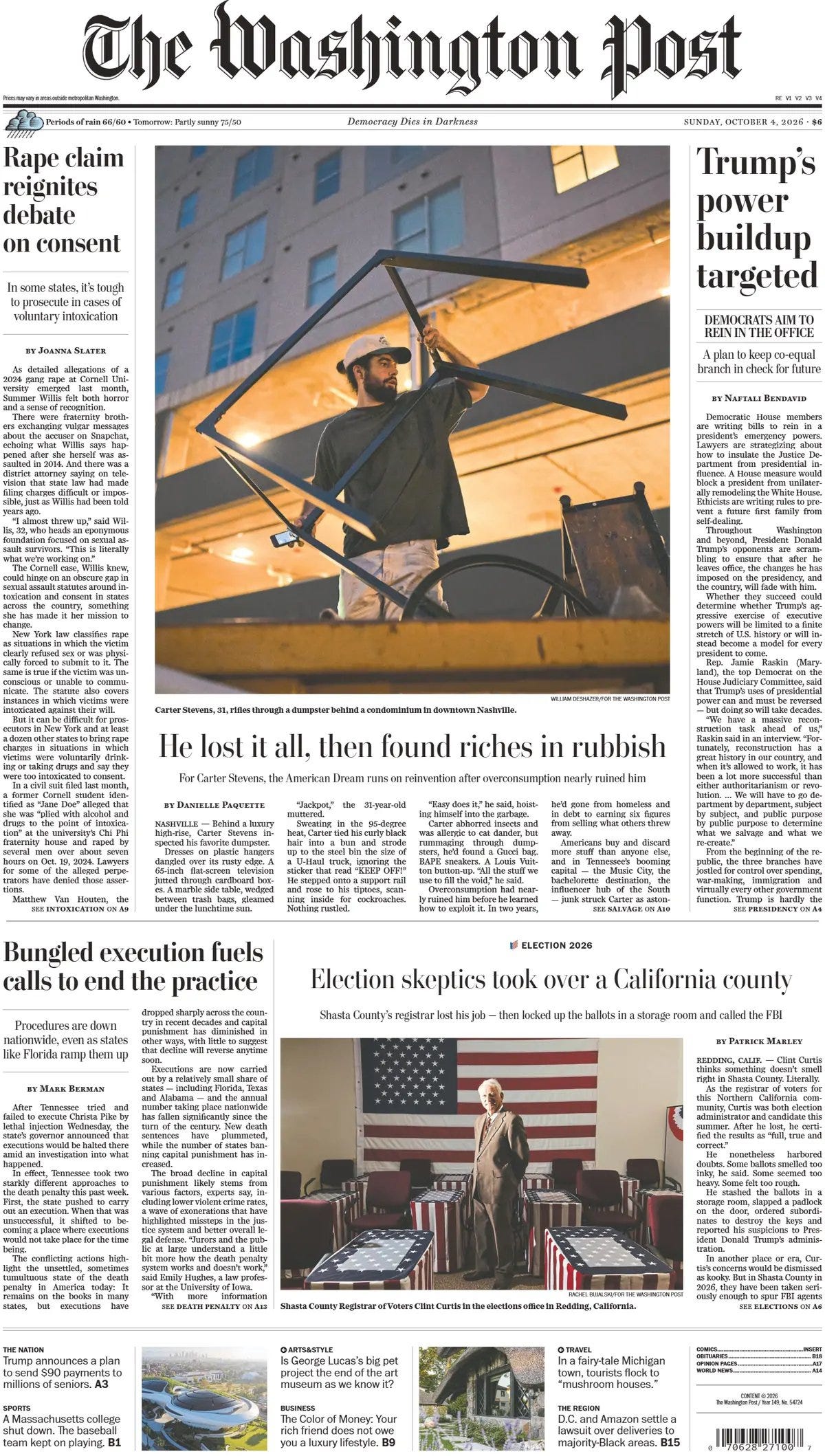
A striking front page (see below) in Knoxville this morning: “Madam Governor.” Tennessee, a deeply red state, is about to make history. For the first time in the state’s 230 years, both major parties have nominated women for governor, so Tennessee will almost certainly get its first female governor. Republican Senator Marsha Blackburn faces Democrat Jerri Green, a Memphis city council member, on November 3. A third independent female candidate is also gaining ground. Only six women had ever run for governor in Tennessee before this year.
The same trend is playing out on a much bigger stage. At the UN, the race to succeed António Guterres, who retires at the end of the year, is increasingly led by women. In the Security Council’s fourth secret straw poll on Tuesday, Costa Rica’s Rebeca Grynspan widened her lead, with 10 “encourage” votes against three “discourage” and two “no opinion.” She has already cleared the nine-vote threshold the Council needs to recommend a candidate. In second place is Guyana’s first-ever female foreign minister, Carolyn Rodrigues-Birkett, who briefly took the lead in the August poll. The UN has never had a woman as secretary-general in its 80-year history. The decisive factor is still the P5 veto, and Rodrigues-Birkett is reportedly facing pushback from Washington over her perceived closeness to China and her positions on Gaza.
At a debate at Goals House during UNGA week, I argued that this is far more than a symbolic milestone. As I often said during my years as a UNICEF spokesperson, the evidence is clear: women in leadership and decision-making roles drive more inclusive, gender-responsive, and family- and community-friendly policies. At a time when children and families bear the brunt of conflicts from Gaza to Sudan to Ukraine, a woman at the helm of the UN would be good news indeed.
In Geneva, the Wold Health Organization (WHO) succession is also shaping up as a contest with strong female candidates, I was told at the UNGA in New York. Six candidates have been nominated to replace Tedros Adhanom Ghebreyesus: Qatar’s Hanan Al-Kuwari, Saudi Arabia’s Hanan Balkhy, Belgium’s Hans Kluge, Spain’s Maria Neira, Indonesia’s Budi Gunadi Sadikin and Gevorg Tamamyan of Botswana. Three of the six are women. The Executive Board will draw up a shortlist in January 2027, and the World Health Assembly will make the final choice in May. (UNICEF, where I worked for the better part of a decade, has had several female executive directors;
The common thread is that women may be taking charge of institutions at the point when they are most strained: a UN facing budget cuts and calls for reform, and a WHO still recovering from Washington’s 2025 exit. The cynical reading is the “glass cliff,” where women are handed the top job once the building is already on fire.

Polls have closed in Brazil’s general election, after voters queued in long lines for a tight first round of the presidential race. After casting his ballot, 80-year-old left-wing President Luiz Inácio Lula da Silva warned that the choice was between democracy and “barbarism”. His challenger, right-winger Flávio Bolsonaro, 45, said he wanted to “free the Brazilian people”. The result is forecast to be close. BBC Brazil’s poll aggregator shows that the gap between Lula and Bolsonaro is only two points. If no candidate gets more than 50% of the vote, the election will go to a run-off on 25 October. Just over 90% of votes have been counted so far, with no candidate claiming more than 50% at the time of writing. Bolsonaro leads with 48.05%, while the incumbent Lula trails with 43.97%. According to Brazil’s Superior Electoral Court (TSE), more than 158.7 million Brazilians, including one million people abroad, are eligible to vote in the election. Lula is challenged by 11 candidates, although the vote count so far indicates that candidates other than Lula and Bolsonaro will get only about 10% of the vote - BBC
Merz in Kyiv: Solidarity, with Strings Attached
Friedrich Merz arrived in Kyiv by train early Sunday, bringing economy minister Katherina Reiche and a delegation of German business leaders. The message was solidarity; the subtext was that support for Ukraine can pay off for Germany too. “You can rely on us,” the chancellor posted on X, adding that Germany’s own security hinges on how this war ends. Russia answered within hours. Mayor Vitali Klitschko said an air strike hit the city’s North Bridge shortly after Merz’s visit began, with sirens sounding and black smoke rising over the Dnipro. Drones had already struck the South Bridge on Friday and Saturday, injuring several people. On Saturday, Moscow’s foreign ministry warned foreigners, diplomats included, to stay out of Ukraine. It said strikes would continue systematically, framing them as retaliation for Ukrainian attacks on Russian soil.
Zelensky offers a different explanation. He says Ukrainian intelligence has obtained documents showing Putin has signed off on a “new doctrine” that widens the range of civilian targets ahead of winter. The aim, he told the FT, is to cut major cities off from the rest of the country and push people to leave. In Zelensky’s view, Putin wants to look strong while his army loses ground and takes heavier casualties. Kyiv’s answer, he says, will be to hit Russian oil refineries harder, not civilians.
France 24’s Gulliver Cragg, filming on the riverbank with the bridge behind him, said Merz’s core line was that an unchecked Russian war machine would eventually be turned on Germany and Western Europe. That is “exactly what Ukrainians want to hear,” Cragg said. What worries him is the next sentence: the anti-corruption and tax reforms Brussels attaches to European money. Cragg granted that those reforms strengthen Ukraine. But if Europe’s leaders say Russia will come for them next, Zelensky may be tempted to ask why the money should depend on reforms at all. Connecting the dots: Merz’s security argument also gives Kyiv leverage against his conditionality.
Berlin has its own evidence of that threat. Last month it formally blamed Moscow for an explosive-laden drone found at Leipzig/Halle airport, a hub for Western military aid. Merz warned of potentially severe hybrid attacks to come.
This is only Merz’s second Ukraine trip as chancellor. Since May 2025, Germany has overtaken a retreating Washington as Ukraine’s largest military donor. Merz loosened the constitutional debt brake to fund rearmament and roughly €10bn a year for Kyiv. He is celebrated in Kyiv and across European capitals, but at home he faces record-low approval ratings and growing unrest in his own party.
Moldovan President Maia Sandu on Saturday hit out at Moscow after saying debris from five Russian air attack weapons violated the country’s airspace and exploded on the country’s territory. “I condemn Russia’s attack on Ukraine this morning. Its war is dangerously reaching Moldova,” she wrote on X. “Russian air attack weapons, including Banderol missiles and drones, violated our airspace and exploded on our soil. In all, three missiles and two drones flew over the country between 7.45 a.m. and 8 a.m., with fragments later found in the country’s eastern districts of Hincesti, Anenii Noi and Causeni. The police were dispatched to secure the debris, which caused a fire to break out but no casualties. Meanwhile, Lithuania temporarily closed its airport in Vilnius for around an hour on Saturday morning and scrambled NATO jets after a dangerous objectwas spotted in the skies, possibly crossing the border from Belarus - Politico
Ukraine’s campaign against Russian refineries is reshaping what Russians drive, The New York Times reports. Electric vehicle sales, including hybrids, nearly doubled to more than 83,000 in January–August from 43,000 a year earlier, per Russia’s Ministry of Industry and Trade. Pure E.V.s and plug-in hybrids now make up 11.5 percent of the market, up from about 5 percent in January — slightly ahead of the U.S., though far behind China’s 45 percent. Most are Chinese, a sign of Moscow’s sanctions-era pivot east. The trigger is fuel scarcity. On Friday, only 46 percent of Russian gas stations had fuel, according to the tracker Gdebenz; in Nizhny Novgorod, just 27 percent. Moscow saw hours-long queues in July and August, and emergency permission to sell lower-grade fuel has led to breakdowns, mechanics told The Times. E.V. dealerships are now sold out, and lines are forming at chargers, whose number has grown from under 1,500 in 2022 to more than 8,000. Tax breaks, free parking and toll exemptions help. But cost, patchy infrastructure and machismo remain barriers. One driver waiting for gas told the paper E.V.s are “bad for men’s health.” The bigger picture: a fuel crisis once felt as a distant nuisance is becoming a political problem for the Kremlin.
The US kicked out two more members of the Iranian delegation on Sunday who had remained in New York after the UN General Assembly had concluded. This occurred a few days after they were asked to leave the country, according to Axios. “Secretary Rubio means business. Two more members of the Iranian delegation were found still in New York long after the UN General Assembly had passed. They have now been kicked out of the country,” says a US official. According to the official, the two Iranian diplomats failed to comply with the State Department’s demands, which were presented to the Iranian mission to the UN on Monday. The demands called for the immediate departure of the entire delegation from the country. As early as Friday, the Iranian mission to the UN was informed that the US was aware that two of its diplomats were still in New York, despite requests for them to leave the country. As a result, the Iranian side was again told that these two individuals must leave immediately. One of the Iranian diplomats left on the evening of Friday, October 2, and the other on Saturday morning.
The journals…