

🔥 World Briefing Hot Take: Munich’s Sugar High — and the Strategic Hangover
I listened carefully to Marco Rubio’s speech at the Munich Security Conference. And I had two physical reactions: either I was about to get a cavity from all the syrup poured over the transatlantic relationship, or an ulcer from the hypocrisy embedded in it.
Rubio waxed poetic about shared civilization, about America being a “child of Europe,” about intertwined destinies and deep affection. It sounded like a sentimental family reunion speech.
But here’s the problem: this wasn’t a reconciliation. It was lipstick on a pig.
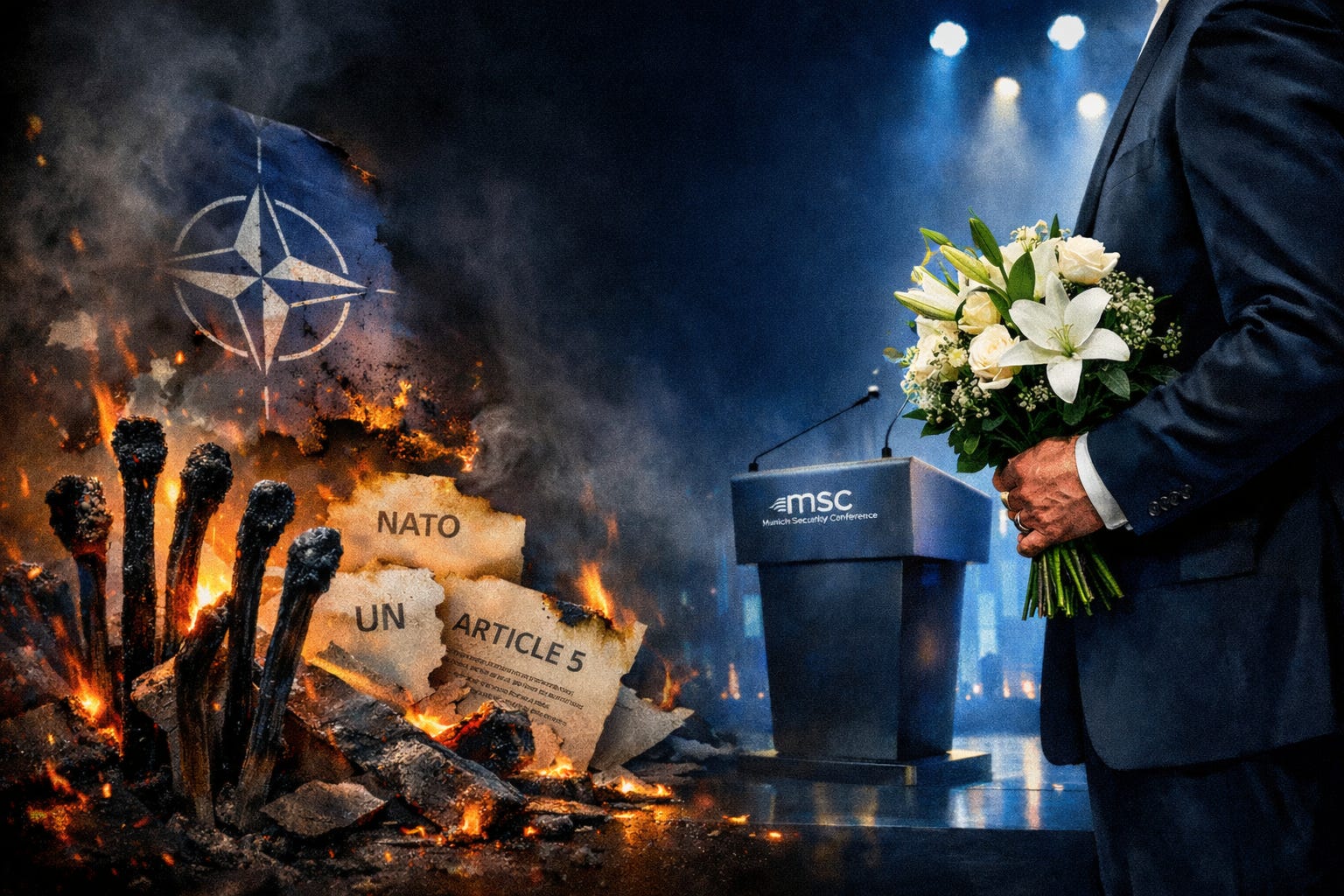
For years now, the Trump team has taken a blowtorch to the transatlantic relationship - undermining NATO cohesion, questioning Article 5 commitments, sidelining the European Union in negotiations, attacking multilateralism, and flirting with parallel diplomatic structures that deliberately circumvent institutions Europeans overwhelmingly support.
You don’t torch the house and then show up on Valentine’s Day (the speech was actually delivered on Feb 14!) with flowers and expect applause (which, in fairness, he did receive at the Bayerischer Hof in Munich).
But let’s face reality: Rubio is certainly not the only American voice in play.
Inside the White House, there are clearly competing camps. Rubio delivered reassurance. Meanwhile, other corners - J.D. Vance, Pete Hegseth, and others - have openly questioned continued military commitments to Ukraine and Europe’s defense posture. This matters. Because Rubio alone does not decide transatlantic policy. Donald Trump does. And Trump has consistently demonstrated a transactional, unilateral instinct - one that sees alliances less as shared values and more as leverage. So Munich heard one message. But Europe must ask: which America is real? Or which Donald Trump will we see next time he shows up on our shores?
It may also be that that the Trump team has belatedly realized that they actually need European and Gulf allies to actualize their overseas ambitions - for example confronting Iran. Power projection, they seem to have realized, is geography-dependent. You cannot “America First” your way around the map.
But let’s be clear: Europe also bears some responsibility for Trump’s tantrum diplomacy. For decades, European capitals outsourced their security to Washington. Defense budgets lagged. Political will wavered. The peace dividend was spent elsewhere. Now, under pressure, NATO members are pledging 5% of GDP on defense. But already we see creative accounting. Italy promoting a €13.5 billion bridge linking Sicily to the mainland (also dubbed as “the bridge to nowhere” or un ponte verso il nulla) as a “dual-use strategic military asset” to pad defense spending numbers? That’s not strategic seriousness. That’s bureaucratic theatre.
Rubio framed the relationship in civilizational terms. Munich heard warmth. But what matters is whether policy follows poetry.
News Briefs:
U.S. Secretary of State Marco Rubio on Saturday called to revitalize alliances between the United States and its European allies, at a time when President Trump’s aggressive, America First policies have inflamed tensions with some longtime partners. In his speech at the Munich Security Conference, Rubio stressed to allies its shared history with America, calling the U.S. a “child of Europe.” He also reinforced the Trump administration’s rhetoric suggesting that Europe faces the prospect of “civilizational erasure” amid its immigration policies. “We gather as members of a historic alliance that saved and changed the world,” Rubio told attendees. Rubio described Europe as having grown complacent in the years since the fall of the Soviet Union, having allowed their military budgets to shrink, their jobs to be outsourced and immigration to threaten the “cohesion” of society, he said. “We made these mistakes together. And now, together, we owe it to our people to face those facts and to move forward to rebuild,” Rubio said. Overall, his speech was marked by a softer tone toward Europe than Trump has taken in recent months, with Trump criticizing them as “weak” and home to a “decaying” group of nations, as well as those made by his predecessor at last year’s conference. Or Vice President JD Vance, who pilloried European leaders for their efforts to combat hate speech and disinformation and for censoring right-wing views - NPR
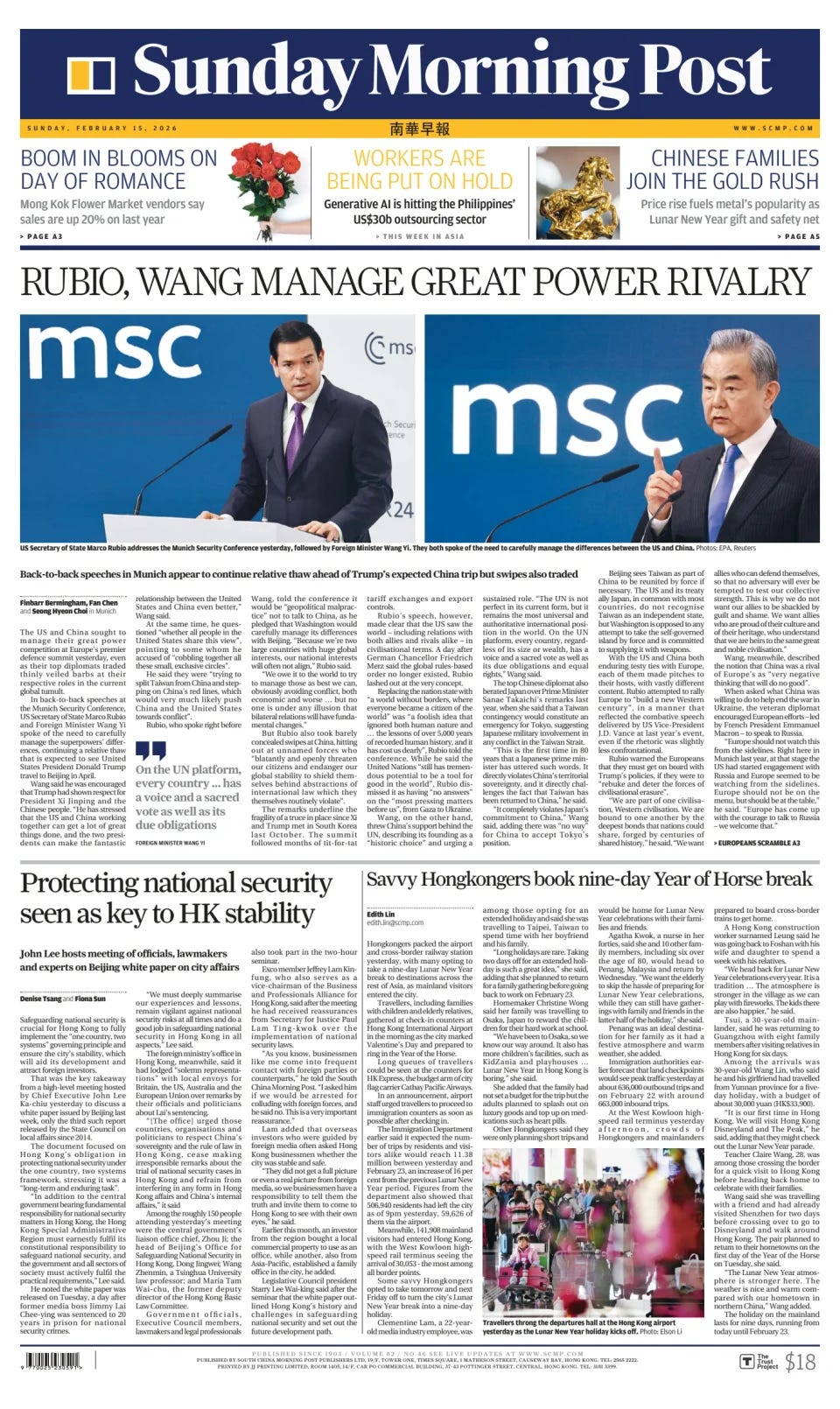
The US and China sought to manage their great power competition at Europe’s premier defence summit on Saturday, even as their top diplomats traded thinly veiled barbs at their respective roles in the current global tumult. In back-to-back speeches at the Munich Security Conference, Marco Rubio and Chinese Foreign Minister Wang Yi spoke of the need to carefully manage the superpowers’ differences, continuing a relative thaw that is expected to see US President Donald Trump travel to Beijing in April. Wang said he was encouraged that Trump had shown respect for China’s President Xi Jinping and the Chinese people. “He has stressed that the US and China working together can get a lot of great things done, and the two presidents can make the fantastic relationship between the United States and China even better,” Wang said. At the same time, he questioned “whether all people in the United States share this view”, pointing to some whom he accused of “cobbling together all these small, exclusive circles”. He said they were “trying to split Taiwan from China and stepping on China’s red lines, which would very much likely push China and the United States towards conflict”. Rubio, who spoke right before Wang, told the conference it would be “geopolitical malpractice” not to talk to China, as he pledged that Washington would carefully manage its differences with Beijing. “Because we’re two large countries with huge global interests, our national interests will often not align,” Rubio said. “We owe it to the world to try to manage those as best we can, obviously avoiding conflict, both economic and worse … but no one is under any illusion that bilateral relations will have fundamental changes.” But Rubio also took barely concealed swipes at China, hitting out at unnamed forces who “blatantly and openly threaten our citizens and endanger our global stability to shield themselves behind abstractions of international law which they themselves routinely violate”. The remarks underline the fragility of a truce that has been in place since Xi and Trump met in Busan, South Korea, last October. The summit followed months of tit-for-tat tariff exchanges and spiralling export controls - SCMP
Satellite imagery reveals that China is accelerating nuclear buildup, a force designed for a new age of superpower rivalry. The New York Times reported Sunday that in a valley in Sichuan Province engineers have been building new bunkers and ramparts. A new complex bristles with pipes, suggesting the facility handles highly hazardous materials. Another valley is home to a double-fenced facility known as Pingtong, where experts believe China is making plutonium-packed cores of nuclear warheads. The main structure, dominated by a 360-foot-high ventilation stack, has been refurbished in recent years with new vents and heat dispersers. More construction is underway next to it. China’s buildup complicates efforts to revive global arms controls after the expiration of the final remaining nuclear arms treaty between the United States and Russia. Washington argues that any successor agreements must also bind China, but Beijing has shown no interest. “The changes we see on the ground at these sites align with China’s broader goals of becoming a global superpower. Nuclear weapons are an integral part of that,” said Renny Babiarz, a geospatial intelligence expert who has analyzed satellite images and other visual evidence of the sites and shared his findings with The New York Times. He likened each nuclear location across China to a piece of a mosaic that, seen as a whole, shows a pattern of rapid growth. “There’s been evolution at all of these sites, but broadly speaking, that change accelerated starting from 2019,” he said.
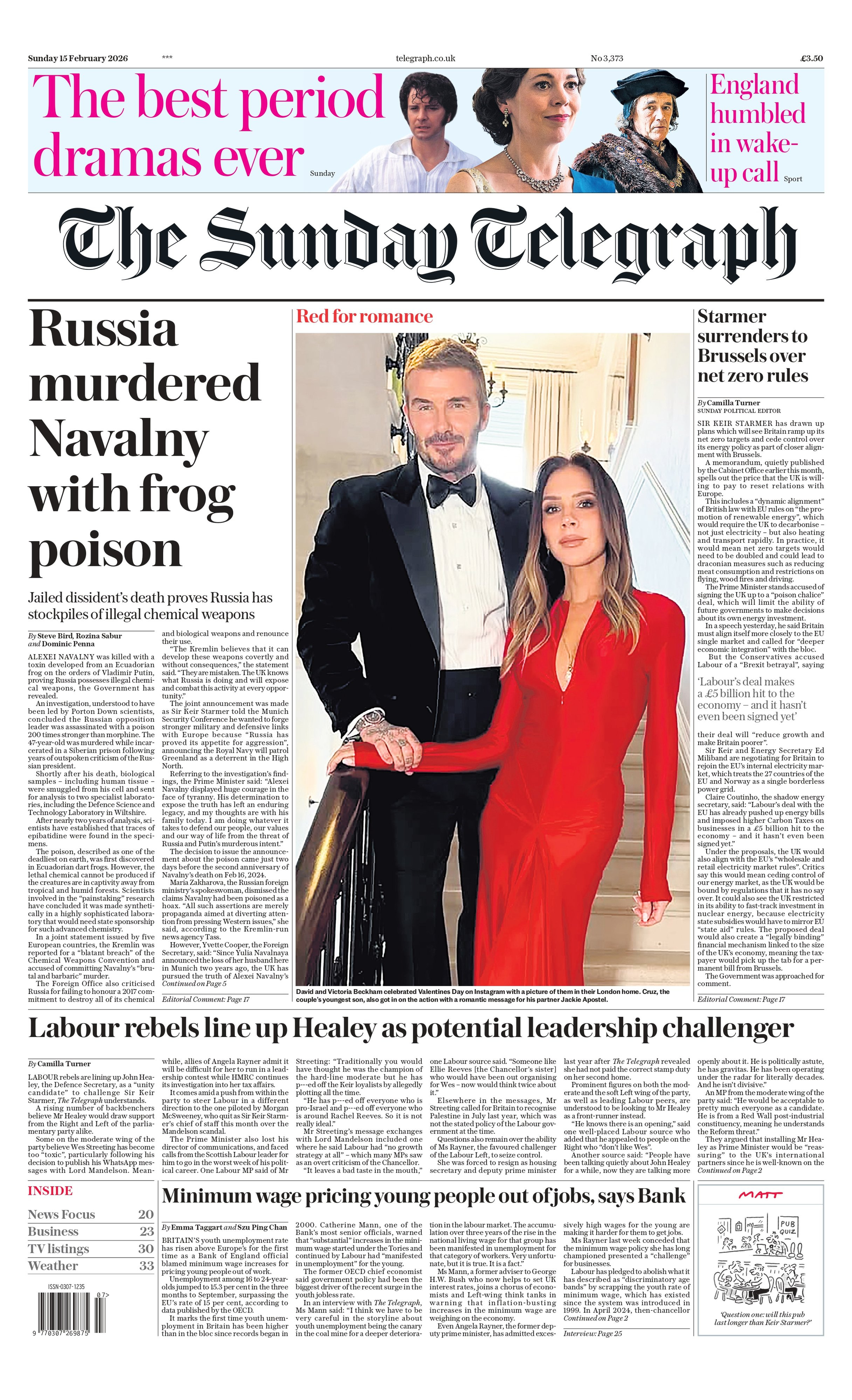
The governments of five European countries on February 14 released a statement saying they are confident that the Russian opposition politician Aleksei Navalny was poisoned with a lethal toxin not found naturally in Russia -- a poisoning that led to his death in a Russian prison two years ago. The UK, Sweden, France, Germany, and the Netherlands made their conclusion based on analyses of samples from Navalny that confirm the presence of epibatidine -- a toxin derived from poison dart frogs in South America -- that is known to cause paralysis and respiratory arrest. Speaking to RFE/RL on the sidelines of the Munich Security Conference, Dutch Prime Minister Dick Schoof said that “there is a high possibility that Russia killed Navalny by poison…I think it’s a serious offense,” he added, “and I hope that it will [show] the world that Russia is playing a dirty game.” In the joint statement, the five capitals note that “Russia claimed that Navalny died of natural causes. But given the toxicity of epibatidine and reported symptoms, poisoning was highly likely the cause of his death. Navalny died while held in prison, meaning Russia had the means, motive, and opportunity to administer this poison to him.”
In a swift reversal of longstanding norms, Kazakhstan has begun planning to deport or extradite several Russian citizens since the start of the year. If sent back, their lawyers say they face lengthy prison sentences, forced conscription and, in some cases, torture. To make matters worse, experts say the Kazakh government is circumventing the law to make it happen. The news has unsettled the tens-of-thousands-strong Russian emigre community in Kazakhstan, a Kremlin-friendly nation in Central Asia that was nonetheless seen as a safe haven for refugees fleeing Putin’s regime — until recently. In some sense, the legal guardrails that once protected them seem to have come off. Experts told The Moscow Times that sending citizens back to a country where they face such clear danger violates numerous international human rights treaties to which Astana is an observer. One Russian living in Kazakhstan, speaking to The Moscow Times on condition of anonymity, said that the news has “caused alarm” in the Russian diaspora community. He is now planning to leave the country. “Before, I felt I could live peacefully and build a career here,” the source said. “But alas, unfortunately, that is now becoming dangerous.” A friend, he said, aptly described the sense of fear: “It’s as if the Motherland is catching up.” - Moscow Times
World Briefing is reader-supported. No institutional sponsors. No Olympic committees. No corporate guardrails. If independent, on-the-ground reporting matters - please consider upgrading or encouraging a colleague or friend to do so. You can also support World Briefing with a one-time suggested donation via this link.
The beleaguered Washington Post has had to scrap a new brand campaign, with a new tagline meant to convey its connection to America: “We the People.” As the Post was about to debut the campaign, it ran into a major snag. As part of its rebranding as MS NOW, MSNBC announced that it was launching a $20 million brand campaign that would play across television, podcasts, and in physical spaces like airports. The tagline: “We the People.” MS NOW’s campaign and its massive budget forced the Post to put its campaign on ice. It was the second time the Post had tried to juice its brand in about a year. In 2024, the Post paper announced it was rolling out a new marketing campaign with the tagline “Switch On.” While neither the “We The People” campaign nor the “Switch On” campaign were intended to supplant the paper’s slogan, “Democracy Dies in Darkness,” the paper had surveyed readers for the “Switch On” marketing campaign, and the “Dies in Darkness” motto hadn’t been testing as well. - Semafor
Paramount Skydance is considering a fresh round of layoffs at CBS News, according to three people familiar with the matter, and the cuts could total at least 15% of current staff, marking the latest move by editor in chief Bari Weiss as she attempts to focus the news division on streaming video and presenting more points of view to audiences. CBS News declined to make executives available for comment. Discussions around layoffs and staff reductions remain fluid, two of these people say, and a timeline for putting them into place — if that decision is final — could start as early as March and as late as May. And while the discussions around personnel have not solidified, they are serious, one of these people said. Some staffers have already chosen to head to the exits. About 11 producers tied to “CBS Evening News” have opted for buyout packages that were initially offered last month - Variety
On Valentine’s Day at the Milan Cortina Olympics, a renewed supply of free condoms for the athlete villages was promised by the organizers after going short during the week. “We can confirm that condom supplies in the Olympic Villages were temporarily depleted due to higher-than-anticipated demand,” the Italian organizing committee said in a statement Saturday. “Additional supplies are being delivered and will be distributed across all villages between today and Monday.” Providing condoms for athletes has been a gift from organizers — and a constant fascination to the world — for decades. While 300,000 condoms were provided for more than 10,500 athletes at the 2024 Paris Summer Games, the original stock was much lower for these Winter Games. “I think 10,000 have been used, 2,800 athletes — you can go figure, as they say,” International Olympic Committee spokesman Mark Adams said Saturday. “It clearly shows that Valentine’s Day is in full swing in the village.” Reports of no condoms in week one of the games followed an absence of plush toys of the official mascots, Milo and Tina, in the opening days. They proved more popular than expected in the official Olympics merchandise stores - AP

The journals…..
I don’t know how any serious policymaker could listen to anyone from the administration and think that what they say will shed any light on what will actually happen.