


Revelations that abducted Ukrainian children are being transferred thousands of kilometres away to North Korea mark a chilling escalation in Russia’s war — and a new threat vector for the Asia-Pacific. This is no longer just a European security crisis: Moscow is now exporting its campaign of forced displacement and ideological indoctrination into North Asia, with Pyongyang acting as an eager partner. It should set off alarm bells from Tokyo to Seoul to Canberra. If Vladimir Putin is allowed to expand this web of coercion unchecked, the long-term consequences for regional stability will be profound. Today’s developments are a stark reminder that Ukraine urgently needs sustained military support — and that sanctions and diplomatic isolation must tighten further to make Russia’s cross-continental abuses untenable.
Several Ukrainian children abducted by Russian forces were forcefully transferred to North Korea, Ukrainian officials said. Kateryna Rashevska, a legal expert at Ukraine’s Regional Center for Human Rights, told a US congressional subcommittee on the abduction of Ukrainian children by Russian forces that Kyiv registered at least two cases of children from Eastern Ukraine deported by Moscow to North Korea. Rashevska said during the hearing that “12-year-old Misha from the occupied Donetsk region and 16-year-old Liza from occupied Simferopol (in Crimea) were sent to Songdowon camp in North Korea, 9,000 km from home.” She said: “Children there were taught to ‘destroy Japanese militarists’ and met Korean veterans who, in 1968, attacked the US Navy ship Pueblo, killing and wounding nine American soldiers.” Since the beginning of Russia’s all-out war in early 2022, Pyongyang has provided support to Moscow, including weapons supplies and troop deployment. Last year North Korea sent up to 12,000 troops to Russia to reinforce the troops. As of today, Kyiv has brought back around 1,800 children out of over 19,500 abducted by Russia since the start of its full-scale invasion. The figures represent the children for whom detailed information is available, including their place of residence in Ukraine and their location in Russia. The actual number is likely to be much higher. Russia’s Children’s Rights Commissioner Maria Lvova-Belova has previously said that Russia “accepted” 700,000 Ukrainian children between February 2022 and July 2023. Testifying at the US congressional subcommittee, Yale Humanitarian Research Lab (HRL) Executive Director Nathaniel Raymond said that according to his team’s research, at least 35,000 Ukrainian children — whose ages at the time of capture ranged from 8 months to 17 years — are temporarily or permanently in Russia’s custody. Many of them are taken to camps in temporarily occupied territories in Ukraine and in Russia - Euronews
The UN General Assembly approved a resolution on Wednesday demanding the return of all Ukrainian children who Russia has illegally deported. A total of 91 countries including the US voted in favour while 12, including Russia, Belarus and Iran were against. The resolution demands that Moscow return all Ukrainian children forcibly displaced or deported since 2014. It also calls for an end to further deportations, family separations, changes in citizenship, adoptions, fostering and ideological indoctrination. “There will be no just peace in Ukraine without the unconditional return of Ukrainian children. This resolution is not about politics. It is about humanity,” Ukraine’s Deputy Foreign Minister Mariana Betsa said at the UN General Assembly debate.
We all knew this day would come: the main memorial in central Kyiv for fallen Ukrainian service members and foreign fighters reaches full capacity.
Airports in western Ukraine that were shut down in February 2022 following Russia’s full-scale invasion could reopen within days or weeks once Kyiv gives the green light, sources told World Briefing. But political resistance remains strong, with several factions insisting that Kyiv Boryspil — the country’s main international gateway — must be the first to resume operations when conditions allow. Officials in the capital also worry that reopening Lviv Danylo Halytskyi International Airport ahead of Kyiv could symbolically elevate the western city to the role of de facto capital (it served briefly as the West Ukrainian People’s republic in 1918). Despite occasional Russian drone and missile strikes, Lviv lies far enough west that aircraft departing the city would enter EU airspace within minutes, sources noted. Israeli technical support for restoring airport operations has been on offer for weeks, should Ukraine choose to proceed. World Briefing has also learned that limited general aviation activity has continued at some western Ukrainian airfields, and that several aircraft were covertly flown out of the country earlier in the war. Rumours last year about a possible reopening of Uzhhorod Airport — which sits directly on the Slovak border — have not materialised, with sourecs saying the facility is too small to meaningfully ease the pressure on travellers. The closure of Ukrainian airspace has inflicted enormous economic, political, and social costs. Ukrainians permitted to travel abroad face long, expensive overland journeys to airports in Moldova, Romania, Poland, and beyond — while the country continues to lose significant tourism and business revenue.
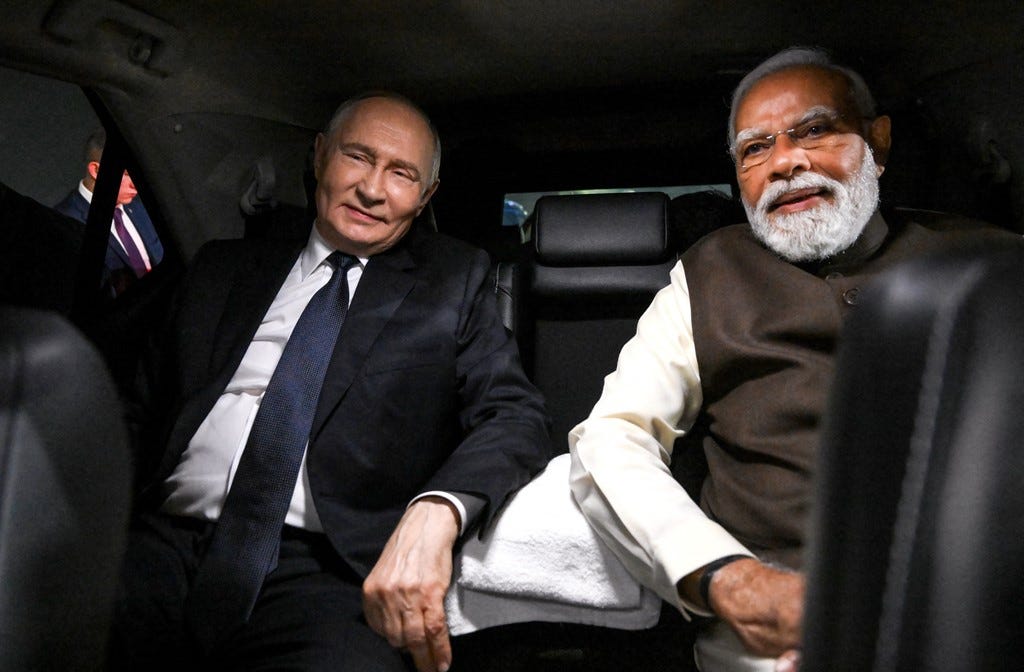
President Vladimir V. Putin of Russia arrived in New Delhi on Thursday for an annual summit that marks his country’s partnership with India. He and Prime Minister Narendra Modi are expected to discuss their defense dealings and announce agreements to ease trade and the flow of workers from India to Russia. Looming over the bilateral discussions will be a third country whose actions are testing the strength of that relationship: the United States. The timing is especially fraught for India, which has been searching for a way to resolve its economic tangle with the Trump administration. Mr. Trump has accused India of financing Russia’s war on Ukraine by buying its oil, and last month, India’s biggest oil companies stopped buying Russian crude almost entirely after U.S. sanctions on Russian oil giants threatened the companies that do business with them. The bilateral summit signals to the world that India and Russia are committed to a relationship that dates back to the Soviet era. For Mr. Putin, it’s an opportunity to show the world that Russia has a partner of global significance. They plan to hold wide-ranging discussions, on topics like increasing India’s imports of Russian fertilizer and the construction of small nuclear plants in India. A new agreement on labor mobility is also expected, according to the Kremlin spokesman, Dmitri S. Peskov, and Indian government officials, which would make it easier for Russian companies to hire workers from India. Russia has been facing a labor shortage exacerbated by its war in Ukraine and a decline in migrants from Central Asia - NYT
The Russian president told India Today in an interview that he is delighted to be meeting his “friend” Narendra Modi and adds there are “numerous topics” the pair need to discuss. Asked about energy, Putin says the “instrument of our energy cooperation with India remains unaffected by current conditions, fleeting political swings or indeed, the tragic events in Ukraine”. And on US tariffs on Russian oil firms, Putin says those who attempt to “hinder economic ties with third countries ultimately encounter difficulties and suffer losses…I am confident that once this perspective becomes firmly established, such tactics of applying external pressure will fade away.” - Sky News
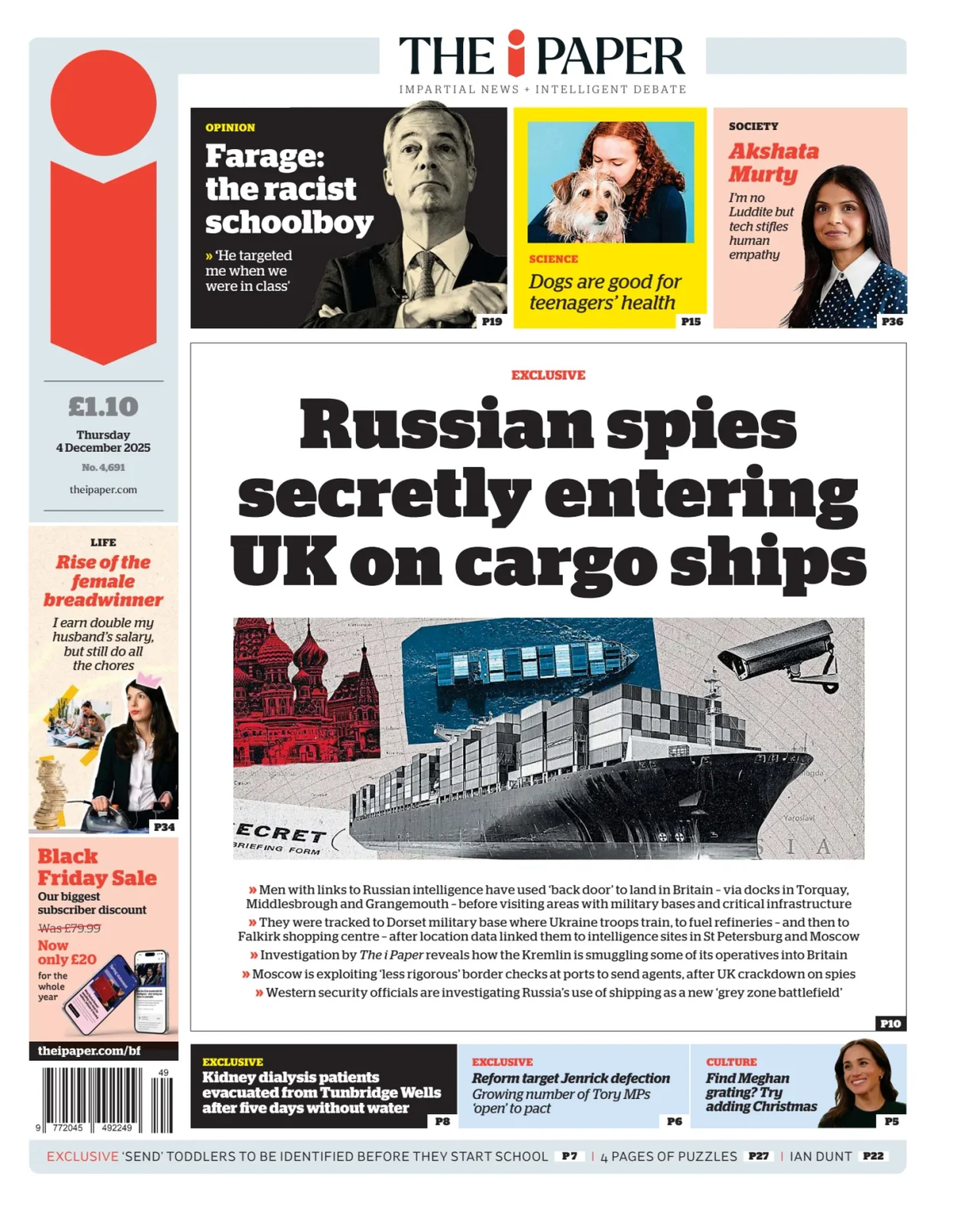
Russian spies are “secretly” entering the United Kingdom on cargo ships, according to The i-Paper. Men with links to Russian intelligence have been using a back door to enter Britain - via docks in three southern coastal cities - before visiting bases with military bases and critical infrastructure. They were tracked to the Dorset military base where Ukrainian troops train, to fuel refineries and then to a shopping centre, after location data linked them to intelligence sites in St. Petersburg and Moscow. The newspaper says Russia is exploiting ‘less rigorous’ border checks at ports to deploy agents in response to a UK crackdown. Western officials are investigating Russia’s use of shipping as a new ‘grey zone battlefield,’ the newspaper wrote.
The British government has summoned the Russian ambassador to the Foreign Office to answer for Russia’s ongoing campaign of “hostile activity” against the UK. It comes on the back of a new report into the death of Dawn Sturgess. The mother-of-three died as a result of an assassination attempt on former Russian spy Sergei Skripal. Responding to the report, Prime Minister Sir Keir Starmer says: “The Salisbury poisonings shocked the nation and today’s findings are a grave reminder of the Kremlin’s disregard for innocent lives... The UK will always stand up to Putin’s brutal regime and call out his murderous machine for what it is. Today’s sanctions are the latest step in our unwavering defence of European security, as we continue to squeeze Russia’s finances and strengthen Ukraine’s position at the negotiating table.” Today’s report says the GRU (Russian military intelligence) is responsible for Sturgess’s death - after Putin directed them to kill Skripal - Sky News
The United States on Thursday announced plans for what it calls a “New G20” as it prepares to host the 2026 G20 Leaders’ Summit, welcoming Poland as a new member while explicitly excluding South Africa, which US Secretary of State Marco Rubio accused of prioritising “spite, division, and radical agendas” during its current presidency. In a blog post authored by Rubio, titled ‘America Welcomes a New G20’, the Secretary of State stated that the US hosting the G20 Leaders’ Summit, set for December 2026 in Miami, Florida, will also mark America’s 250th anniversary. The US will host the G20 summit for the first time since 2009. The first Sherpa and Finance Track meetings are slated for December 15 and December 16 in Washington, with subsequent gatherings throughout the year. The US will invite “friends, neighbours, and partners”, including Poland, which Rubio praised as a success story of post-Cold War resilience. The starkest departure is the exclusion of South Africa, the current G20 host, which Rubio lambasted for squandering its post-apartheid potential through “redistributionist policies that discouraged investment” and “racial quotas” that have crippled the economy. He accused the African National Congress (ANC)-led government of scapegoating its citizens and the US, tolerating violence against Afrikaner farmers, and aligning with adversaries like Iran and Hamas sympathisers. South Africa’s G20 presidency, Rubio claimed, was marred by ignoring US inputs, blocking negotiations, and even “doxxing” American officials, focusing instead on “climate change, diversity and inclusion, and aid dependency”.
Changes by the Trump administration have left US diplomats demoralized and less able to do their jobs, according to a scathing new report by the union representing foreign service officers. The report, based on a survey of foreign service members, found that a vast majority of respondents — 98% — said morale had declined since January, and a third were considering leaving the foreign service early. Twenty-five percent of the foreign service has “resigned, retired, seen their agencies dismantled, or been removed from their posts” since January, the report said, and more are considering leaving. The findings of the report from the American Foreign Service Association (AFSA) underscore concerns voiced for months by career diplomats and foreign policy experts about the negative impact of the Trump administration’s sweeping changes to the State Department and foreign assistance programs. Scores of diplomats have lost their jobs due to the dismantling of the US Agency for International Development (USAID). More than 240 foreign service officers were given termination notices in July, to take effect later in the year, as part of the State Department’s drastic reorganization. The report is being released as the department moves forward with those terminations, which AFSA has said is in violation of the law. “The U.S. Foreign Service is being systematically undermined by its own leadership,” AFSA President John Dinkelman warned in the report, which is set to be released on Wednesday afternoon. “The Foreign Service—the very institution tasked with navigating our global interests—is being dismantled in real time.” - CNN
The journals……
the levels of cruelty are unfathomable