The Kremlin says peace talks are over for now. The more useful question is what changed its mind.
Dmitry Peskov told reporters Friday that negotiations are on a “deep pause” while Russian forces advance in the east - a shift from his summer line confirming ongoing dialogue with US negotiators. Ukraine, he said, knows Moscow’s demands and won’t discuss them. Putin’s precondition is unchanged: full Ukrainian withdrawal from Donetsk, or is it the entire Donbas?
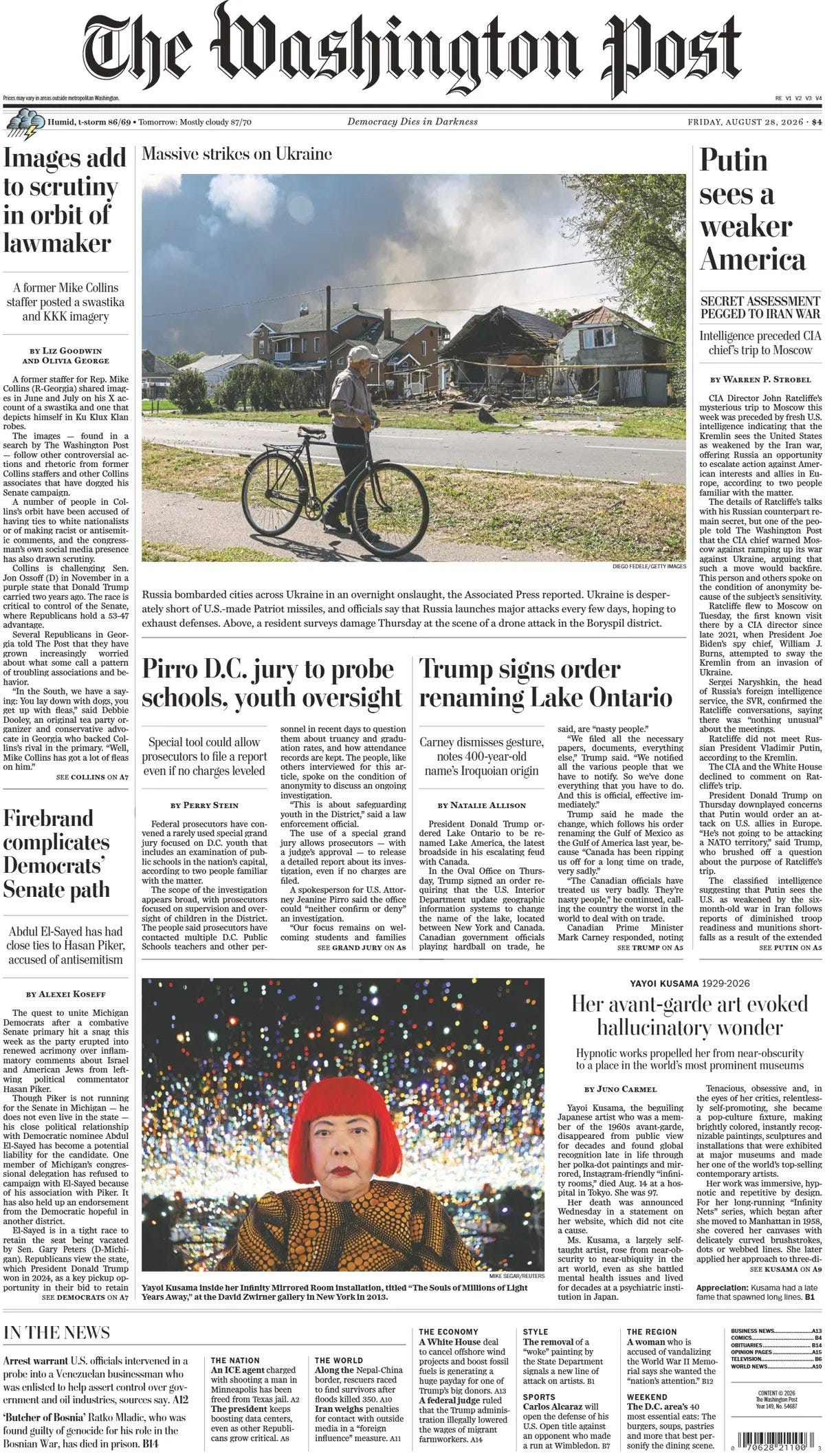
The timing is the story. Peskov spoke days after CIA Director John Ratcliffe’s unannounced trip to Moscow - and three outlets have three explanations for it. The New York Times reported he went to push a peace deal. The Wall Street Journal tied the visit to Russian mobilization plans. The Washington Post reported that the trip was preceded by fresh classified intelligence indicating the Kremlin believes the United States has been weakened by six months of war with Iran, and that Ratcliffe’s mission was less about Putin being cornered than about Russia’s conclusion that Washington is depleted and cannot intervene. The assessment reportedly points to shortages of Patriot interceptors, Tomahawks and other munitions after the Iran campaign.
That is not an abstraction in Kyiv. The Associated Press reported this week that Ukraine is badly short of American-made Patriots and that Russia now mounts major barrages every few days to burn through what remains.
The arithmetic showed up on Aug. 27. Ukraine’s Foreign Ministry said Kyiv spent 872 minutes - nearly 15 hours - under air raid alert across 13 separate alarms, a single-day record for the capital since February 2022. Eight more followed by Thursday morning. Regional governor Tymur Tkachenko reported one killed and four injured. Ukraine’s Air Force counted 164 drones launched nationwide, 137 downed. Odesa, among other cities, have also been badly hit this week. Warehouses are a major target.
Ratcliffe’s reported but debatable argument to his counterparts was that escalation would drive Trump toward Zelensky. It is a threat priced in a currency Moscow has just judged Washington short of. Meanwhile the president himself waved the danger away Thursday - “He’s not going to be attacking a NATO territory” - while declining to explain his intelligence chief’s errand. The gap between the White House line and the agency’s own reading is doing more work here than anything Peskov said.
Watch Belarus. Lukashenko arrived in Russia Thursday for talks with Putin scheduled Saturday, officially on bilateral cooperation and “security matters.” If the Kremlin wants to test a depleted America without touching Article 5, Minsk is the cheapest place to do it.
And then, for millions of Ukrainians, there’s winter coming into clearer focus….
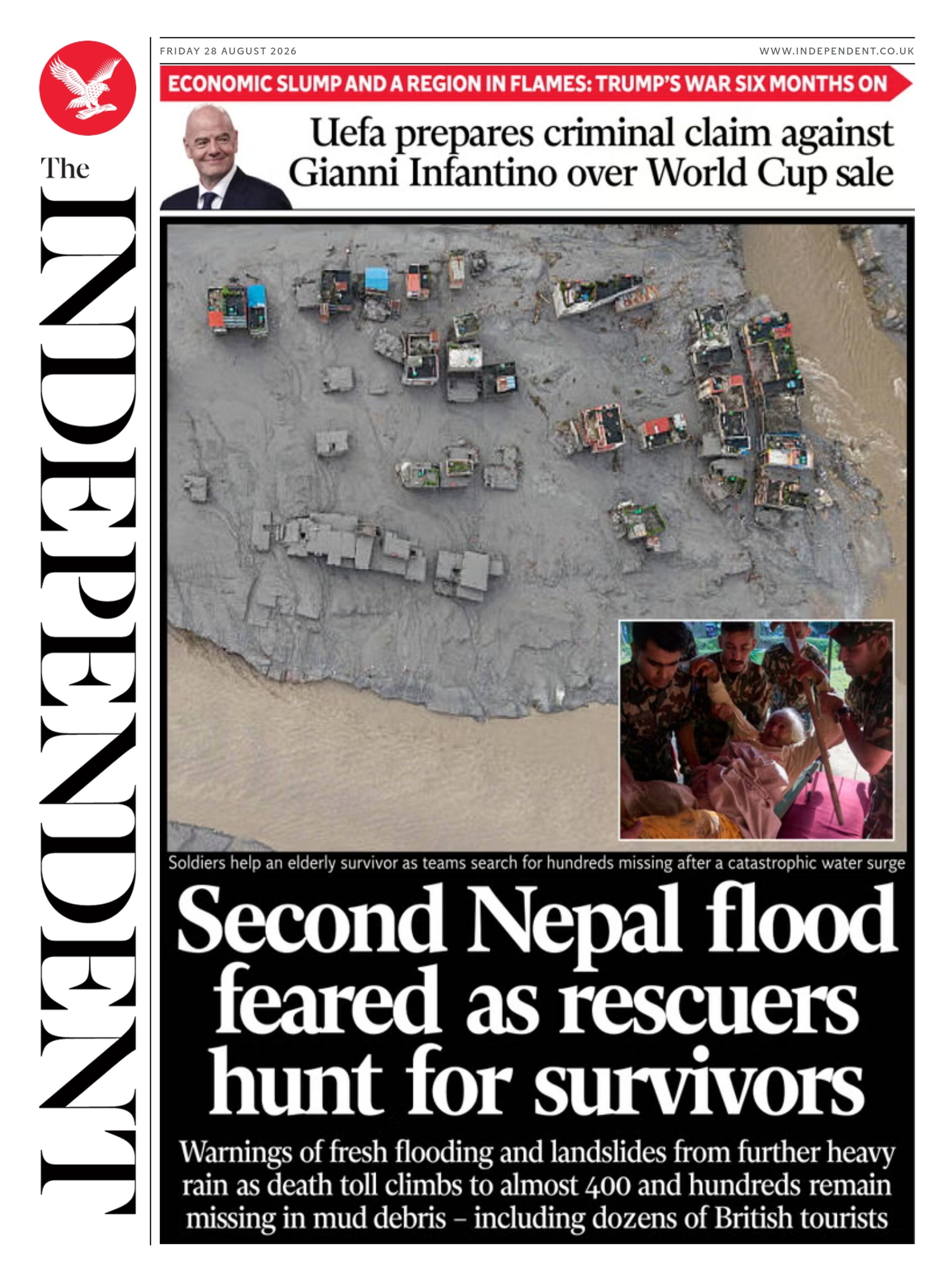
Rescuers worked through mud and debris Friday in areas devastated by a catastrophic flash flood along the Himalayan border between Nepal and China, continuing the search for hundreds of people still missing as the death toll rose and authorities warned that a newly formed, overflowing lake could trigger further flooding. Nepali police say the death toll there has risen to 547, and the disaster management authority said Friday that 977 people were still unaccounted for. Meanwhile, there is little information on survivors on the Chinese side, where the death toll rose to five Friday and China state media reported 558 people were missing. Flood survivors, including injured people, were taken to Kathmandu and other locations. Foreigners from multiple countries were among the missing, many of them trekkers and pilgrims. Randhir Jaiswal, Indian External Affairs Ministry spokesman, told reporters that 320 Indian nationals remain uncontactable. Meanwhile, the International Red Cross said it estimates at least 93,000 people “have been affected and are in great need.” Scientists said it is too early to draw a direct connection between global warming and Wednesday’s catastrophe. However, they said that as Earth’s temperature rises because of human activities such as burning oil, gas and coal, the chances of such disasters increase, especially in the Himalayan mountains, which are warming considerably faster than many other parts of the world - AP
China’s embassy guards in London have been accused of brandishing electroshock weapons at protesters to intimidate them. London and Beijing are now embroiled in a diplomatic row over the incident, which is also being investigated by police. UK Government officials warned China that actions by a foreign state to intimidate or harm individuals on British soil would not be tolerated, The i Paper has been told. Security workers allegedly pointed the weapons towards protesters during heightened tensions outside the embassy in Portland Place on 3 July. UK officials have raised the matter directly with the embassy, a Government source said, while a Metropolitan Police investigation remains ongoing. “Any attempts by a foreign state to coerce, intimidate, harass, or harm individuals on UK soil will never be tolerated,” the source added. The diplomatic row is likely to raise fresh questions over China’s conduct and its alleged attempts to silence dissidents in the UK. While ministers will await the outcome of the police investigation, the insider said: “Where there is evidence of a crime, we will not hesitate to act.”
President Donald Trump told reporters at the White House on Thursday that the Strait of Hormuz is open, that the United States has “control” of the waterway alongside its blockade of Iran, and that American minesweepers have cleared it entirely. Millions of barrels, he said, are moving out every day. Ship-tracking data tells a narrower story. Kpler recorded 121 crossings through the strait in the week of 17–23 August, up marginally from 118 the week before - and still a fraction of normal pre-war traffic. Just over half of last week’s transits were classified route-undetermined; 56 moved under the unilateral scheme Iran has imposed since the conflict began - passage on IRGC terms rather than freedom of navigation. The mine-clearance claim also comes amid continuing attacks on commercial shipping. On volumes, Energy Secretary Chris Wright puts flows at roughly 9 million barrels per day; independent trackers have recorded considerably less, with some estimates closer to 5 million. Wright attributes the gap to covert transits that trackers cannot see. Insurers and charterers are not pricing an open strait: they are pricing one that is partially open, conditional, and unsafe.
Donald Trump had to be called out live on air by Fox News after the 80-year-old president had a meltdown over the network’s reporting on his Iran war. During Thursday’s Special Report, the program’s chief correspondent, Jonathan Hunt, described how there had been “no significant developments” between the U.S. and Iran to end the now six-month conflict. Hunt also noted, accurately, that Trump had confirmed there were no plans for talks between the two countries. Trump, who spends an extraordinary amount of time watching cable news in the White House, then blasted Hunt and Special Report anchor Bret Baier in a Truth Social rant. “Jonathan Hunt of FoxNews did a particularly inaccurate report on the Failing Islamic Republic of Iran. I don’t want to meet, they do,” Trump wrote. “In fact, they are begging to make a deal. Bret Baier should straighten out his flunkies, for a change! President DJT.” After showing Trump’s Truth Social post on screen, Baier then humiliated the president and corrected him on several fronts. “First of all, Jonathan Hunt is not a flunky. He’s a great reporter,” Baier said. “Second of all, Mr. President, we didn’t say you wanted to meet. In fact, we played a soundbite that you didn’t want to meet, and there are no negotiations. “We said that Treasury Secretary Bessent is hoping to meet with G20 countries to increase the pressure on Iran, and that Gulf state allies, including Qatar, are inside Tehran trying to get Iran to agree to concessions,” Baier added. “That was what was said.” Trump’s war with the Middle Eastern country has dragged on for six months with no real end in sight. The president’s meltdown at Fox News for stating that there isn’t even currently a plan to try to end the war came after he shared some AI slop on Truth Social declaring “Mission Accomplished” in Iran - The Daily Beast
The US is reportedly in talks with Venezuela’s interim government to take a “massive” stake in the South American country’s oil resources. The proposed deal would give Washington part ownership of fields containing 90 billion barrels’ worth of proven crude deposits, more than doubling US reserves. “Calling this deal huge would be an understatement,” a US official told Axios. Venezuela’s oil production has jumped under Washington’s custodianship, though questions abound about where those profits, which were intended to help rebuild the country, have ended up. Meanwhile, Venezuela is also considering quitting OPEC, potentially dealing a further blow to the oil cartel it helped to found just four months after the UAE left, Bloomberg reported.
Malaysia to repatriate 1,500 Myanmar refugees as hostility toward Rohingya grows
Malaysia said Thursday it has finalised the first phase of a voluntary repatriation programme that will return some 1,500 Myanmar refugees home, CNA reports. The Home Ministry said the first phase takes place on September 29 and covers 1,476 Myanmar nationals identified by the Myanmar government. “The repatriation process will use two Myanmar Navy warships and one hospital ship,” the ministry said.
Prime Minister Anwar Ibrahim had earlier said Myanmar agreed to take back 5,000 ethnic Rohingya amid rising tensions with local communities. Per the ministry, roughly 4,008 people — mostly Rohingya — will be channelled into the Refugee Registration Document (DPP) programme this year, while 5,000 others go through voluntary repatriation. It counted 10,388 Myanmar nationals in immigration detention depots as of August 15, though not all qualify as refugees.
The BBC, meanwhile, reports a fierce new wave of hostility against Rohingya nine years after a former prime minister encouraged them to come. Barred from public schools, Rohingya children attend unlicensed community learning centres now increasingly exposed to haphazard, sentiment-driven crackdowns; several have closed in recent months. One school in Selangor suspended classes for a month and reopened in late July telling students not to wear uniforms and to head straight home. Rohingya have also been evicted from villages they had lived in for years, with some residents telling Malaysian media their presence risked social problems. UNHCR puts the Rohingya population in Malaysia at more than 126,000 — second only to Bangladesh — though rights groups believe the true figure is higher.
Singapore: Forest Clearance Plans Trigger Rare Public Protest
Government plans to rezone forested land for housing have triggered an unusual burst of open dissent in Singapore, Al Jazeera reports.
The Housing and Development Board announced last month it would clear about 15 of Maju Forest’s 23 hectares at Sunset Way, plus at least 10 hectares of Gillman Forest. Petitions have drawn more than 60,000 signatures, and over 2,000 people rallied this month at Speakers’ Corner — Singapore’s designated venue for citizens to hold demonstrations without a police permit, subject to restrictions.
Per the report, official impact assessments found 178 animal species at Gillman and 113 at Maju, including the Sunda pangolin and the critically endangered straw-headed bulbul, of which a third of the global population lives in Singapore. Al Jazeera also cites a 2023 study estimating the city-state is on course to clear 7,331 hectares of forest — 1.2 times its existing parks and reserves combined.
The government cites housing demand. Al Jazeera quotes Minister of State for National Development Alvin Tan telling parliament that flat launches are oversubscribed more than fourfold. Days before the rally, Tan said more green space would be retained than originally planned, conceding it would mean fewer homes.
The debate widened on 23 August, when PM Lawrence Wong announced plans to merge several southern islands into a larger landmass for industry and defence - a reclamation project that will require enormous quantities of fill material.
The sand question
That dependency has its own file. Mongabay reports that Cambodia appears to have resumed sand exports to Singapore despite a national ban imposed in 2017 after dredging was found to be damaging riverine and coastal ecosystems. Khlem Yonviseth, director of the Koh Kong provincial mining department, told Mongabay the ban had been lifted and that his office licensed the dredging and approved the exports; Mongabay reports he provided no documentation, that it could find no official announcement of any lifting, and that relevant national agencies did not respond to requests for comment.
According to Mongabay, the dredging on the Trapeang Rung River falls within the boundaries of Tatai Wildlife Sanctuary and Botum Sakor National Park. The outlet traced at least four bulk carriers from Koh Kong to Singapore’s Tuas Port, site of a state-backed reclamation project, after activist group Mother Nature Cambodia tracked the vessels in videos published in July and August. Mongabay reports the licensed company, Catalyst Marine and Resources, is linked to Starhigh Asia Pacific, a Singaporean firm active in regional sand mining. The reporting establishes the shipping route and the licence; it does not establish that the sand was illegally exported.
The journals….