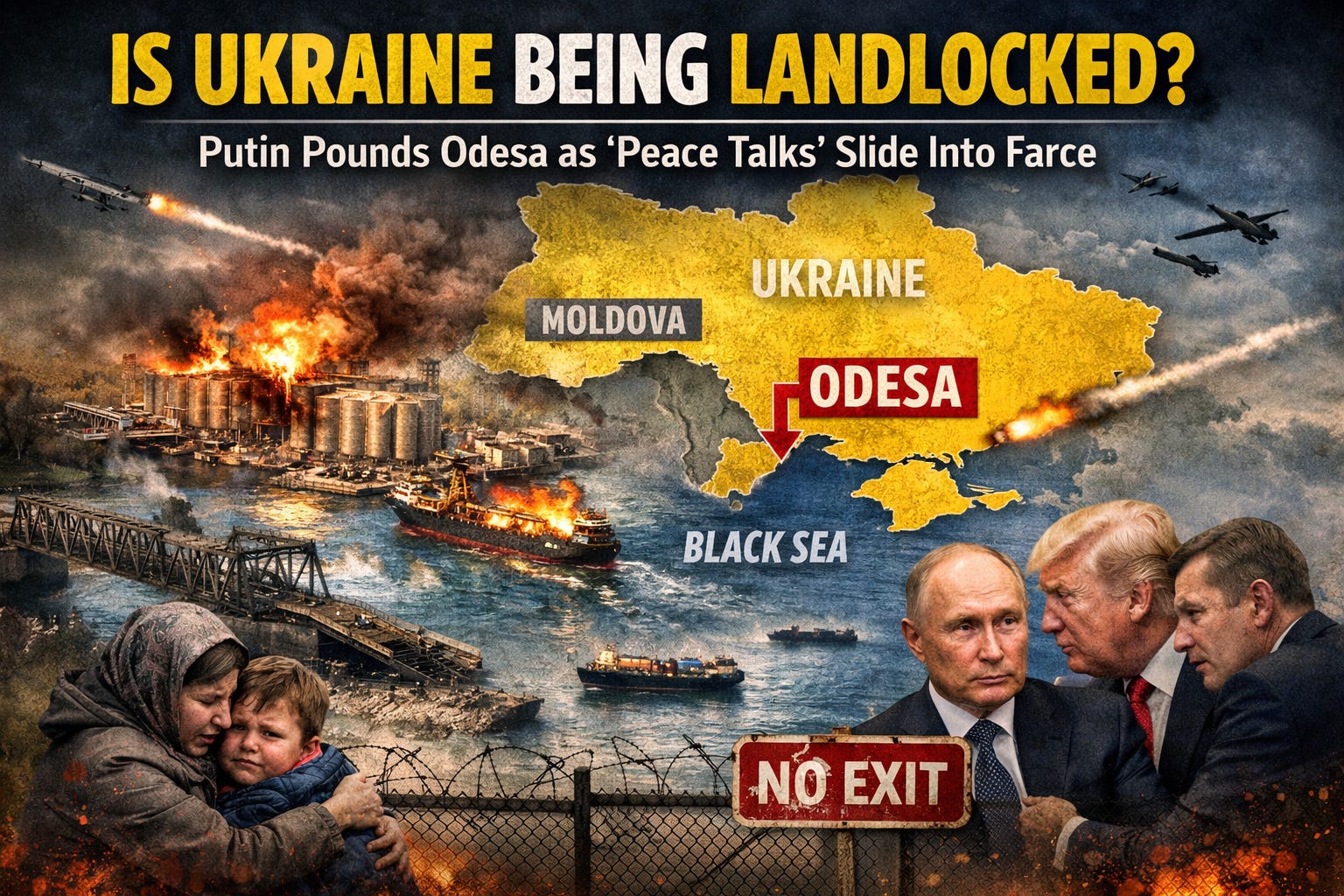
The ferocity and frequency of Russian attacks on the southern Ukrainian Black Sea port of Odesa have entered uncharted territory. Relentless drone and missile strikes are triggering prolonged power blackouts, cuts to heating and water, and the temporary severing of a key artery linking Odesa oblast with neighboring Moldova — a disruption carrying severe humanitarian and economic consequences. Little wonder many people in southern Ukraine say they are nearing a breaking point. For Ukrainians, the pattern feels ominously deliberate: the opening phase of President Vladimir Putin’s long-stated ambition to render Ukraine landlocked by systematically pummelling Odesa and Mykolaiv, choking off the country’s access to the sea.
What makes the world’s relative silence all the more jarring is Odesa’s central role in the global food supply chain, particularly as a gateway for Ukrainian grain exports to food-insecure countries in Africa. While Western navies swiftly mobilized to protect shipping lanes in the Red Sea, there has been no comparable show of muscle to deter Russia’s de facto blockade of Ukraine’s ports. Why isn’t the Trump administration targeting Russia’s fleet of “ghost ships” ferrying sanctioned oil with the same chutzpah it has shown in seizing Venezuelan vessels carrying sanctioned crude to China and beyond?
At the same time, Moscow is playing a familiar long game in U.S.-brokered “peace” talks — grinding Ukraine down militarily while floating maximalist demands that no Ukrainian president could realistically sign. Those talks are increasingly overshadowed by reports of highly personalized diplomacy involving Donald Trump’s inner circle, raising concerns that strategic negotiations are being reduced to a mix of spectacle, back-channel dealing and self-enrichment — even as Russia escalates its war and pushes Ukraine closer to economic strangulation.
Against this backdrop, the behavior of some Western leaders who insist they “stand with Ukraine” is beginning to look almost farcical. As Times Radio host Carole Walker pointedly asked yesterday — moments before an interview with the founder of World Briefing — why is Keir Starmer’s Labour government devoting political energy to woke-tinged legislation banning the boiling of live lobsters and reforming hen cages (yes, really), rather than redoubling efforts to arm Ukraine at a moment when the country’s access to the sea — and its economic survival — are under direct assault?
Russian President Vladimir Putin has shown a keen interest in engaging directly with Steve Witkoff, a close confidant and informal envoy of U.S. President Donald Trump, according to reporting by The Wall Street Journal. The paper notes that Moscow’s interest may extend beyond diplomacy, potentially involving a high-profile gesture tied to U.S.–Russia relations. “Vladimir Putin was interested in meeting Witkoff—so interested that he might consider releasing an American prisoner to him,” a source said. The report underscores how prisoner diplomacy and highly personalized back-channel engagement are once again surfacing as tools of Kremlin statecraft amid efforts by Trump’s team to position itself as a broker in ending the war in Ukraine. Such direct outreach, however, also raises concerns among former officials and diplomats, as it can bypass established checks and balances within the U.S. national security apparatus and the State Department. According to the reporting, Witkoff attended some meetings alone, relying on an interpreter provided by the Kremlin - an arrangement that would normally be considered highly irregular given counterintelligence risks. The concerns are compounded by the fact that the United States has been without a Senate-confirmed ambassador in Moscow for months, weakening Washington’s ability to cultivate contacts, gather intelligence, and maintain institutional oversight at a critical moment in U.S.–Russia relations.
Russia carried out a series of overnight air attacks on Kyiv and key energy infrastructure targets. According to reports as of about 19:00 GMT, three people were confirmed dead in various regions. The attacks hit as far west as Khmelnytsky, and Polish jets were scrambled as a result. President Volodymyr Zelenskyy warned Ukrainians to prepare for the possibility of Christmas day strikes. Ukrainian air defense officials said Russian troops were carrying out a combined attack using cruise missiles and strike drones on December 23, with a large-scale air raid alert declared across the country. Zelenskyy stated that Russia launched over 650 drones and more than 30 missiles in the overnight attack on Ukraine. Separately, authorities in the Black Sea port of Odesa reported a second drone attack in less than 24 hours late on December 22, damaging port infrastructure and a civilian vessel. Today, power outages lasting as long as 13 hours are expected in the Kyiv region after critical infrastructure was hit - RFE/RL
US President Donald Trump announced that he will invite President Kassym-Jomart Tokayev of Kazakhstan and President Shavkat Mirziyoyev of Uzbekistan to the G20 Summit in Miami next year. Trump held separate telephone conversations with the leaders ahead of the announcement. The invitation underscores Washington’s growing focus on Central Asia, emphasising peace initiatives, conflict resolution, and expanded trade and economic cooperation in a region rich in strategic minerals. President Trump posted on his social media platform, Truth Social, that US relations with both Kazakhstan and Uzbekistan are “spectacular.” Economic cooperation between the US and Uzbekistan is expanding rapidly. Projects worth tens of billions of dollars are underway across civil aviation, automotive manufacturing, mining, agriculture, energy, infrastructure, chemistry, and information technology - Euronews
Far-right German politician Ringo Mühlmann has taken a noteworthy interest in exposing information his political opponents say could be of great interest to Russian intelligence. Using the rights afforded to him as a lawmaker for the Alternative for Germany (AfD) in the parliament of the eastern German state of Thuringia — where the AfD is the strongest party — Mühlmann has repeatedly asked the regional government to disclose intricate details on subjects such as local drone defenses and Western arms transports to Ukraine. “What information does the state government have about the extent of military transit transports through Thuringia since 2022 (broken down by year, type of transport [road, rail], number of transits, and known stops)?” Mühlmann asked in writing in September. One day in June, Mühlmann — who denies he is doing Russia’s bidding — filed eight inquiries related to drones and the drone defense capabilities of the region’s police, who are responsible for detecting and fending off drones deemed a spy threat. Such questions from AfD lawmakers on the state and federal parliaments have led German centrists to accuse the far-right party’s lawmakers of using their seats to try to expose sensitive information that Moscow could use in its war on Ukraine and to help carry out its so-called “hybrid war” against Europe. “One cannot help but get the impression that the AfD is working through a list of tasks assigned to it by the Kremlin with its inquiries,” Thuringian Interior Minister Georg Maier, a member of the center-left Social Democratic Party (SPD), told German newspaper Handelsblatt - Politico
Thailand and Cambodia will resume talks later this week to work toward a more durable ceasefire along their border, Thailand’s foreign minister said Monday, stressing that progress depends on detailed bilateral negotiations rather than public declarations that internationalize the dispute. A ceasefire agreement in October was rushed to ensure it could be witnessed by U.S. President Donald Trump and lacked sufficient details to ensure the deal to end the armed conflict would hold, Thai Foreign Minister Sihasak Phuangketkeow said after an Association of Southeast Asian Nations foreign ministers’ meeting in Kuala Lumpur. While Cambodia has publicly said it is ready for an unconditional ceasefire, Bangkok never received any direct proposal and Thailand believed such statements were aimed at increasing international pressure rather than resolving the issue, Sihasak said following the ASEAN meeting that was arranged to seek ways to end the crisis. The general border committee involving both nations will meet Wednesday to iron out detailed measures toward a lasting ceasefire, he said. Thailand appreciates the U.S. effort but “in the end, it’s up to the two counties to be ready and sort things out bilaterally,” he said - AP
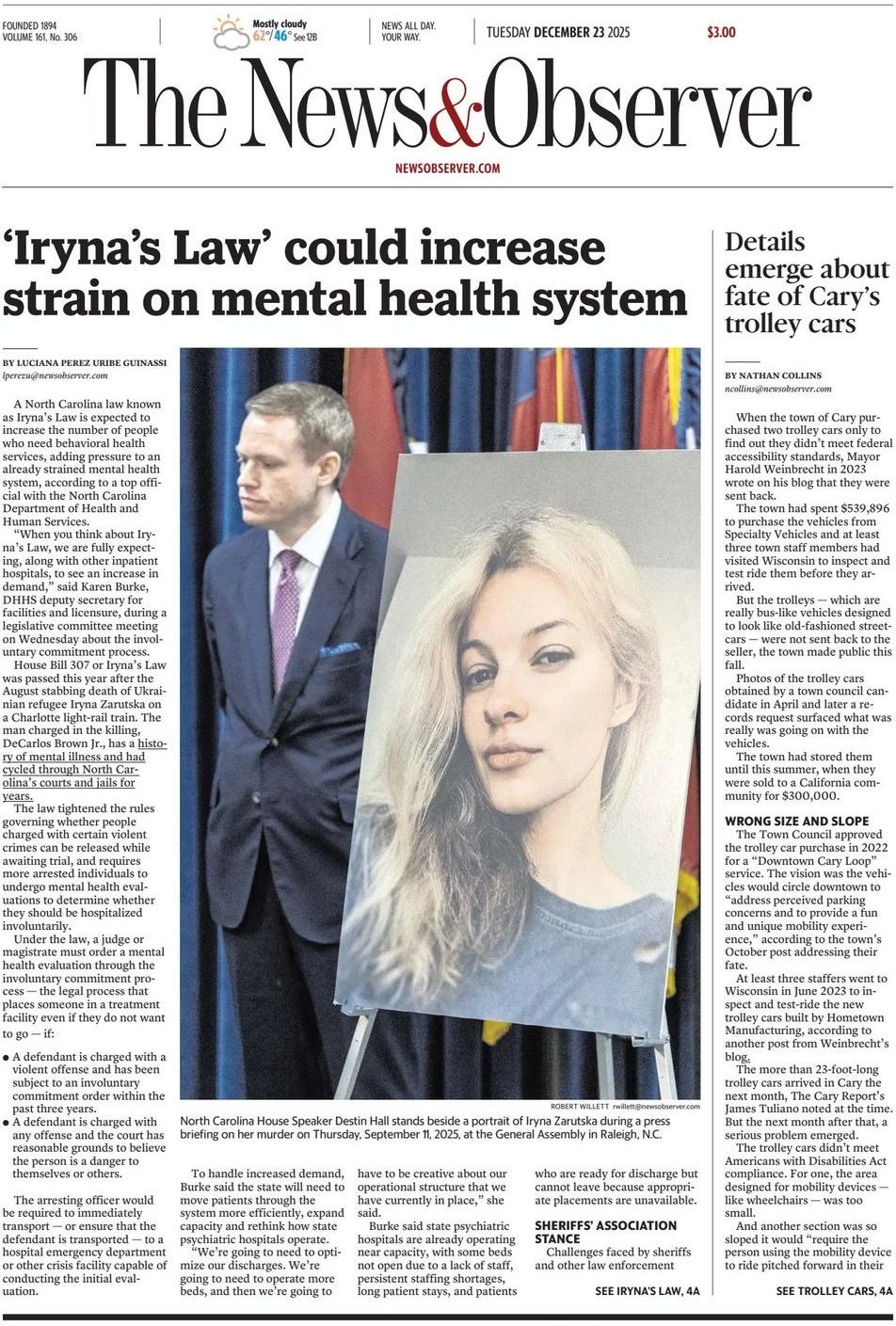
A North Carolina law named after Iryna Zarutska, a Ukrainian refugee who was stabbed to death on a Charlotte light-rail train, is expected to increase the number of people who need behavioural health services in the U.S. state of North Carolina. This is according to an official with its Department of Health and Human Services. “When you think about Iryna’s Law, we are fully expecting, along with other impatient hospitals, to see an increase in demand,” said Karen Burke, a DHHS deputy secretary. House Bill 307 or Iryna’s Law was passed this year after the August stabbing of Zarutsky. The man charged in the killing, DeCarlos Brown Jr., has a history of mental illness and had cycled through North Carolina’s courts and jails for years. The law tightened the rules governing whether people charged with certain violent crimes can be released while awaiting trial, and requires more arrested individuals to undergo mental health screening to determine whether they should be hospitalized involuntarily - The News and Observer
According to the December 2025 report on cybersecurity innovations, Singapore is the most cyber-resilient country in the world. A new study by a cybersecurity company, Check Point, analyzed over 35 countries, comparing their technical capabilities, cybersecurity education, and job markets.
Singapore ranks 1st among the most cyber-resilient countries, scoring the highest in technological infrastructure, national cybersecurity strategies, and cybercrime regulations.
With the most job opportunities in cybersecurity and almost 1,500 professionals per 100K workers, Estonia takes 3rd place.
The US ranks 6th in the world for cybersecurity, with almost 1.3 million people employed as cybersecurity specialists.
The study evaluated 38 countries around the world by looking at the key factors affecting cybersecurity: technical capabilities related to technological infrastructure and resources, cybersecurity institutions, and national cyber strategies. The report also looked at long-term cybersecurity skill development that includes educational and workforce programs, international cooperation, cybersecurity regulations, as well as overall digital development levels in the country, and the ratio of cybersecurity jobs to overall employment. The final score took into account these key criteria, highlighting countries that excel across all these categories.
The journals….