

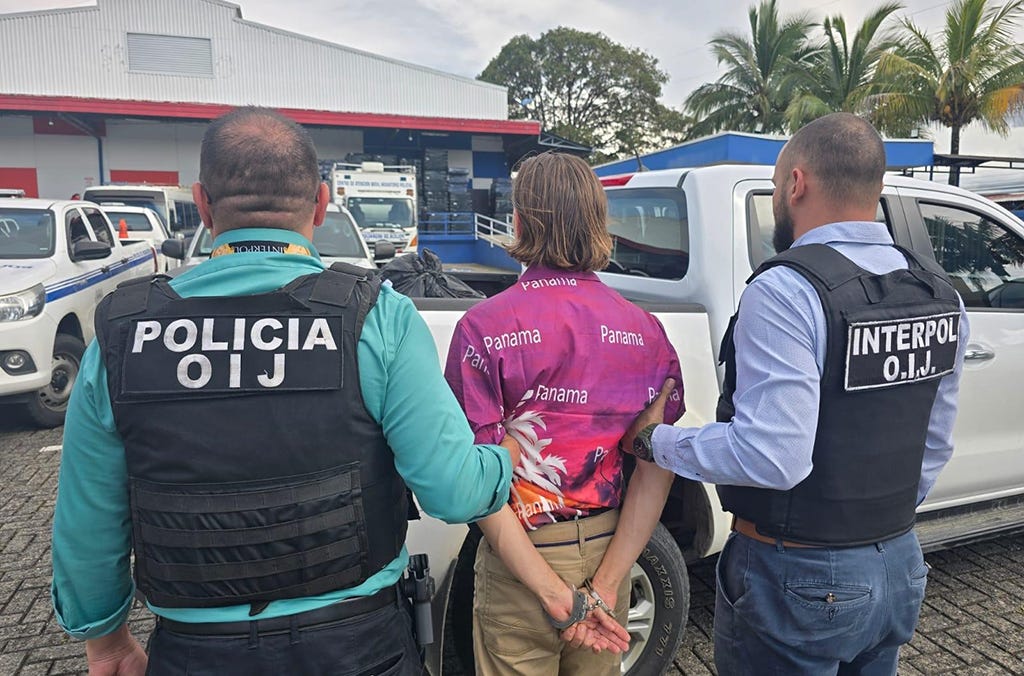
Thousands of files provided by a whistleblower at Interpol (the International Criminal Police Organization) expose for the first time the extent of Russia’s apparent abuse of the international policing agency to target its critics abroad. The data provided to the BBC World Service and French investigative outlet, Disclose, reveals that Russia is using Interpol’s wanted lists to request the arrest of people such as political opponents, businessmen and journalists, claiming that they have committed crimes. Analysis of data also suggests that over the past decade, Interpol’s own independent complaints unit has received more complaints about Russia than anyone else - three times more than the next highest country, Turkey. In addition, it indicates complaints against Moscow’s requests have led to more cases being overturned than for any other country. After Russia’s full-scale invasion of Ukraine, Interpol introduced extra checks on Moscow’s activity “to prevent any potential misuse of Interpol’s channels in relation to the targeting of individuals within or beyond the conflict in Ukraine”. But the leaked documents suggest these did not prevent Russia abusing the system and the whistleblower told us some stricter measures were quietly dropped in 2025. “When you’re hit with a red notice, your life changes completely,” says Igor Pestrikov, a Russian businessman, whose name appears in the leaked files. A red notice is an alert to all of its 196 member countries, asking them to locate and arrest a person. A red diffusion is a similar request but is only sent to individual countries. Pestrikov found he was named in a red diffusion after he fled Russia in June 2022 - four months after the invasion of Ukraine - and applied for asylum in France - BBC
An INTERPOL Red Notice is a request to law enforcement worldwide to locate and provisionally arrest a person pending extradition, surrender, or similar legal action, the agency says. Currently there are 6,476 Red Notices in circulation. One of them for example, submitted by Russia is requesting the extradition of 31-year-old Burliiat Akhmedkhanova for “getting trained with the aim of terrorist activity; participation in the activity of a terrorist organization; participation in the activity of an illegal armed formation.’ Another female - 44-year-old Govkhar Agaverdieva - who holds Russian and Azerbaijan citizenship is wanted by Moscow for “participation in activities of terrorist organization; Participation in an armed formation on the territory of a foreign state that is not provided for by a federal law of this state, for purposes contrary to the interests of the country.”
Russia has previously attempted to gain control of Interpol: in 2018 for the election of its president, Russia put forward Alexander Prokopchuk, a general in Russia’s Interior Ministry. But due to media attention and political pressure, he was defeated by South Korean candidate Kim Jong Yan. It brought to the fore the problem of the abuse of Red Notices by Russia and other states.
Over the weekend, cops in Batumi, Georgia detailed a Turkish citizen placed by Ankata on Interpol’s red notice list. The detained man was wanted by Turkey on charges of illegal acquisition and storage of ammunition, intentional harm to health, and damage to property. Extradition procedures are underway, the MIA said - 1TV
Separately, INTERPOL backs a project called ‘Identify Me’ - a public appeal to identify women whose bodies were found in six European countries, many of whom are believed to have been murdered. The agency says most are cold cases; women who died 10, 20, 30 or even 40 years ago. They were found in Belgium, France, Germany, Italy, the Netherlands, or Spain. “Despite extensive police investigations, these women were never identified, and evidence suggests that some of them could have come from other countries. Who they are, where they are from and why they were in these countries is unknown,” it said. INTERPOL has issued what is called Black Notices for each women - alerts are for police only. It say details have been publicly released, including facial reconstruction images, “in the hope that someone might recognize them and to help determine the circumstances surrounding their death.” The women were found in a wide variety of locations - including next to a freeway, in a cardboard box, in a bog, a well, dam and forest.
The abuse and exploitation of Red Notices, Interpol and the U.S. judicial process by authoritarian regimes constitute a rapidly growing problem for the United States and other democratic societies. This problem is especially evident in the cases of political asylum seekers whose applications are denied by the U.S. immigration authorities based on abusive Red Notices requested by authoritarian governments - Terrorism, Transnational Crime and Corruption Center, 2018 conference report
Historically it has been Russia who is one of the main perpetrators of abusive red notices…I have a steady flow of clients who are subject to Russian red notices who are either politically connected, or often pro-Ukraine, or alternatively as a result of corporate raiding” - British barrister Ben Keith, who has represented many clients wishing to have their names removed from Interpol's wanted lists (via BBC)
Ukrainian President Volodymyr Zelensky sought more air defense support from allies on Sunday as hundreds of buildings in Kyiv remained without heating for a second day after Russian strikes. Russia has hit Ukrainian energy infrastructure throughout the nearly four-year war, but Kyiv says this winter has been the toughest yet, with hundreds of Russian drones and missiles overwhelming air defenses during particularly fierce frosts. “This week alone, the Russians have launched more than 1,700 attack drones, over 1,380 guided aerial bombs, and 69 missiles of various types,” the president said as he arrived in Vilnius. “That is why missiles for air defense systems are needed every day, and we continue working with the United States and Europe to ensure stronger protection of our skies,” he added. Russian bombardments have hit Kyiv particularly hard, forcing half a million people to evacuate. “There are currently 1,676 high-rise apartment buildings in Kyiv without heating following the enemy’s attack on Kyiv city on Jan. 24,” said mayor Vitali Klitschko. Freezing temperatures and repeated airstrikes have slowed efforts by repair crews working to restore heating and electricity - AFP
The Kyiv-Pechersk Lavra National Reserve sites, which are on UNESCO’s World Heritage List, sustained damage due to the Russian attack on Kyiv on the weekend, Tetiana Berezhna, Ukraine’s Deputy Prime Minister for humanitarian policy and Minister of Culture said on her Facebook page. “The last destruction due to hostilities on the Lavra’s territory was recorded during World War II. The Russian attack damaged Building No. 66 – the entrance part of the Far Caves complex. Building No. 67 – the Annunciation Church was also affected.”
LIVE from the Foreign Correspondents’ Club of Hong Kong 🇭🇰
Ahead of two major conversations this week — tomorrow’s “Year Ahead” panel at the FCC, and Wednesday’s Africa-focused deep dive here in Hong Kong — I wanted to give you a quick on-the-ground preview of what to expect, and why it matters now.
If you value independent reporting and sharp analysis that cuts through the noise, please consider upgrading to a paid subscription - it directly supports the work behind World Briefing.
👇👇👇 (watch below)
Iran’s nationwide Internet blackout remained largely in place as the reported death toll from recent protests continued to rise, with one account saying the number of fatalities may exceed 30,000. The digital rights watchdog NetBlocks said on January 25 that Iran’s Internet shutdown has now passed 400 hours, adding that “brief connectivity spikes” may give a false impression of wider restoration. It said circumvention tools such as VPNs have allowed limited online communication. Human rights groups say the blackout has hampered protesters’ ability to organize and restricted the flow of information, making independent verification of casualties difficult. The US-based rights organization HRANA, whose figures RFE/RL has been regularly citing since the violent crackdown began in Iran earlier this month, says its confirmed death toll is now 5,848, and the number of fatalities still under investigation is 17,091. However, a report published by Time magazine says the number of fatalities in the Iran protests may exceed 30,000, according to two senior Iranian health officials it spoke to. The report, published on January 25, says the majority of deaths occurred during January 8–9, when the government’s crackdown on nationwide protests reached its peak. Due to intense censorship and the prolonged Internet shutdown, reported death toll figures for the protests cannot be independently verified - RFE/RL
Venezuela’s acting president Delcy Rodríguez said Sunday she has had “enough” of Washington’s orders, as she works to unite the country after the US capture of its former leader Nicolás Maduro. Rodríguez has been walking a tight-rope since being backed by the US to lead the country in the interim; balancing keeping Maduro loyalists on board at home while trying to ensure the White House is happy. Now, almost a month into her new role, Rodríguez has pushed back on the US, amid ongoing pressure including a series of demands for Venezuela to resume oil production. “Enough already of Washington’s orders over politicians in Venezuela,” she told a group of oil workers in Puerto La Cruz city, at an event broadcast by state-run channel Venezolana de Televisión. “Let Venezuelan politics resolve our differences and our internal conflicts. This Republic has paid a very high price for having to confront the consequences of fascism and extremism in our country.” The White House has maintained steady pressure on Venezuela since Maduro and his wife, Cilia Flores, were seized in a raid in early January and taken to the US, where the former leader is facing charges. Rodríguez, Maduro’s former deputy, has insisted in recent weeks that the US does not govern Venezuela but, equally, has not sought confrontation with Washington - CNN
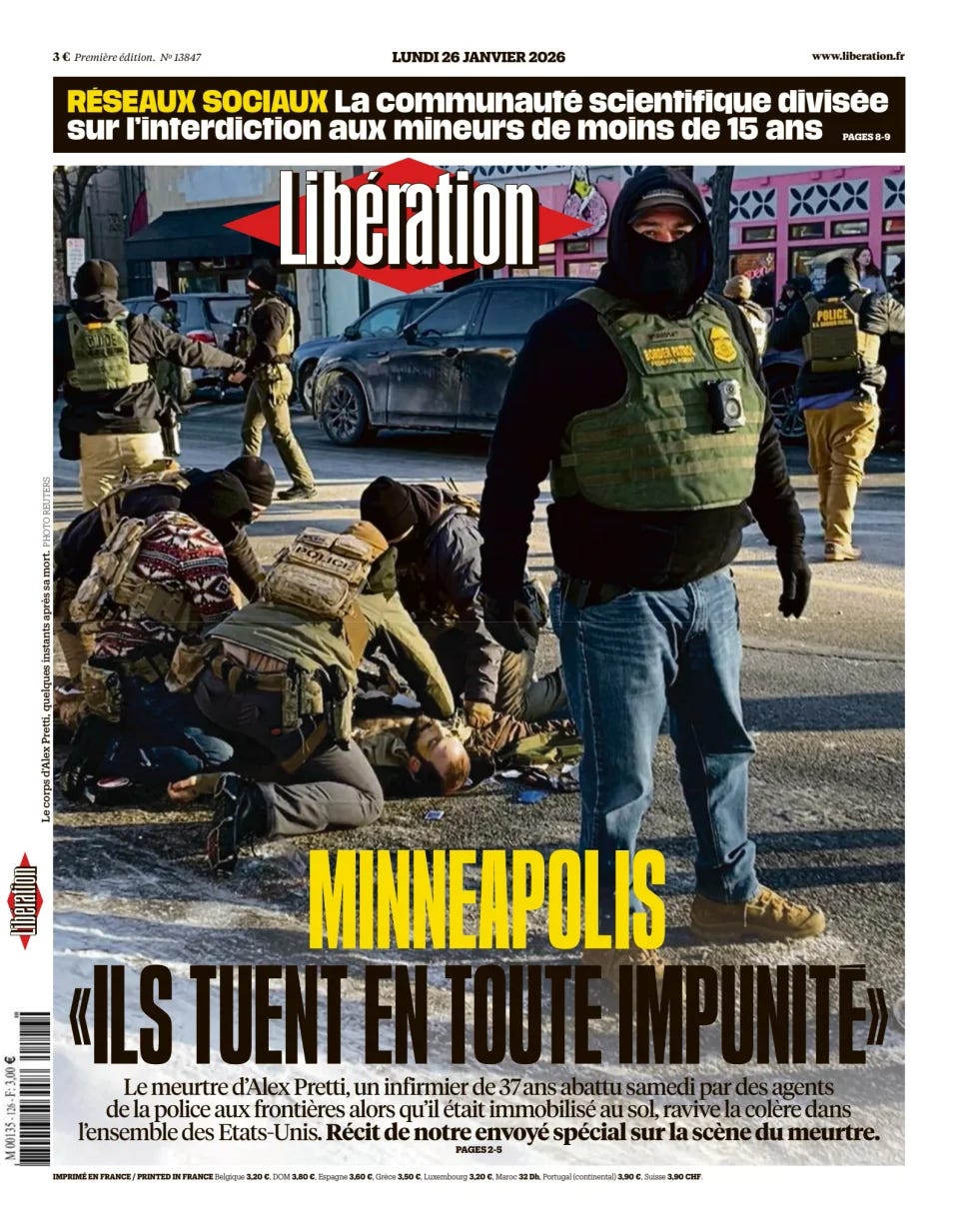
Leaders of law enforcement organizations expressed alarm Sunday over the latest deadly shooting by federal officers in Minneapolis while use-of-force experts criticized the Trump administration’s justification of the killing, saying bystander footage contradicted its narrative of what prompted it. The federal government also faced criticism over the lack of a civil rights inquiry by the U.S. Justice Department and its efforts to block Minnesota authorities from conducting their own review of the killing of 37-year-old Alex Pretti. In a bid to ease tensions, the International Association of Chiefs of Police called on the White House to convene discussions “as soon as practicable” among federal, state and local law enforcement. “Every police chief in the country is watching Minneapolis very carefully,” said Chuck Wexler, executive director of the Police Executive Research Forum, a police research and policy organization. “If a police chief had three officer-involved shootings in three weeks, they would be stepping back and asking, ‘What does our training look like? What does our policy look like?’” Pretti’s death came on the heels of the Jan. 7 fatal shooting of Renee Good and another incident a week later in Minneapolis when a federal officer shot a man in the leg after being attacked with a shovel and broom handle while attempting to arrest a Venezuelan who was in the country illegally - AP
Israel said Sunday its military was conducting a “large-scale operation” to locate the last hostage in Gaza, as Washington and other mediators pressure Israel and Hamas to move into the next phase of their ceasefire. The statement came as Israel’s Cabinet met to discuss the possibility of opening Gaza’s key Rafah border crossing with Egypt, and a day after top U.S. envoys met with Prime Minister Benjamin Netanyahu about next steps. The return of the remaining hostage, Ran Gvili, has been widely seen as removing the remaining obstacle to moving ahead with opening the Rafah crossing and proceeding with the U.S.-brokered ceasefire’s second phase. Late Sunday, Netanyahu’s office in a statement said: “Upon completion of this operations, and in accordance with what has been agreed upon with the United States, Israel will open the Rafah crossing.” It gave no details on how long that would be, but Israeli military officials were quoted in local media as saying the operation could take days to complete. The return of all remaining hostages, alive or dead, has been a central part of the first phase of the ceasefire that took effect on Oct. 10. Before Sunday, the previous hostage was recovered in early December - Politico
The US government is reportedly pursuing a $1.6 billion investment in an American rare earth company, its largest such foray into the sector, as Washington looks to build up its domestic mineral supply chain. The planned 10% stake in USA Rare Earth, the Financial Times reported, marks the latest intervention by the Trump administration into private industries it deems central to national security: The government has stakes in at least six other minerals companies. USA Rare Earth’s CEO told Semafor last year that she welcomed the administration’s involvement. “We have a very fragile supply chain that relies on the whole country of China,” she said. “Our job now… is to take this off of the geopolitical leverage game board.” - Semafor
The journals….
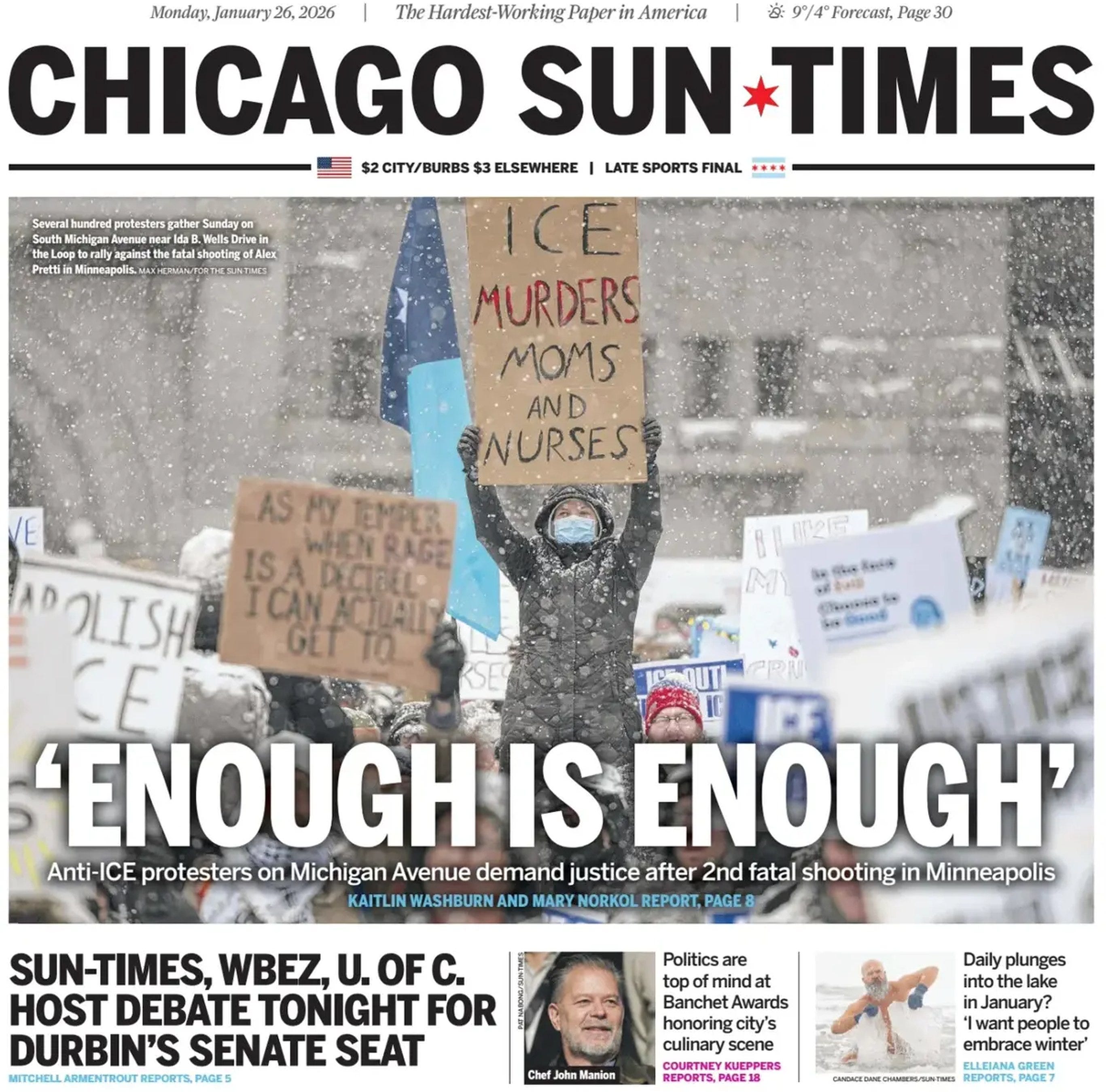
“This is the way of life, too. We experience things, and because of that, we get a new perspective on the world. We may wish to go back to that innocent view that we once held, but we can never go back to that old way of looking at the world because our new view will always taint the old one.” (John Collings, You Can Never Go Back to the Green, January 9, 2019). So, how do we handle this cognitive dissonance positively and progressively? I’ve been thinking about this a lot. It could start with a redefinition of the terms of reference for Freedom & Morality. Freedom, for example, is seen quite differently by Americans and by Russians. For example, Russians and Americans each think they have more Freedom than they do. Russians use a different definition for Freedom while Americans think they have absolute freedom, but actually don’t. Morality, Hanno Sauer, in his book The Invention of Good and Evil, points out many of the flaws in the way we think about morality. One of his conclusions is that Social Ideologies and Political beliefs are both fragile and unstable. Beliefs and ideologies have been defined by intellectuals in the past. In today’s world, the loudest voice is the most influential. I think the Intellectuals of the World have to step up and retake their leadership role in this area. I see Mark Carney as the type of leader and intellectual who could re-shape ideologies of a whole country.