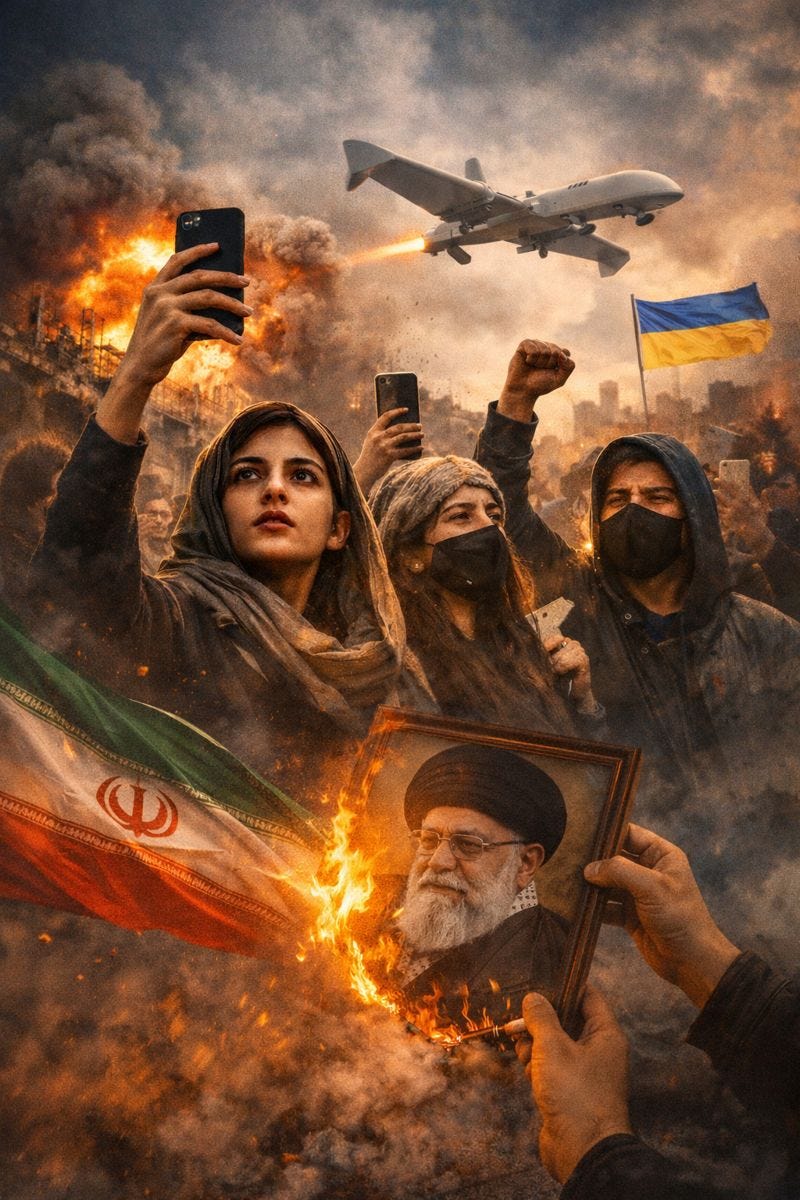
Over the past week, as protests flared again across Iran - triggered by inflation but fuelled by something far deeper- I found myself listening closely not just to headlines, but to people, some of the most revealing conversations unfolded in the back seats of Uber and Lyft cars in Toronto and Vancouver - cities home to some of the world’s largest and most politically engaged Iranian diaspora communities.
Without exception, the Iranians I met over the years were thoughtful, intelligent, brave, and quietly defiant. Many told me they left behind entire livelihoods - careers, homes, even extended families - because life under clerical rule had become unbearable. And strikingly, many believe this protest cycle could be different: not just an economic revolt, but a genuine inflection point capable of pushing Iran’s entrenched power structure closer to collapse.
Why this matters far beyond Iran’s borders is often overlooked. From the very start of Russia’s full-scale invasion of Ukraine, Tehran has been a key enabler of the Kremlin’s war effort - supplying drones, military technology, and likely personnel that have helped Russia sustain its assault on Ukrainian cities and infrastructure.
There is also a powerful recent precedent for how people power - amplified by technology - can force accountability. In January 2020, Iran’s air defenses shot down Ukraine International Airlines Flight PS752, killing all 176 people on board. Iranian authorities initially denied responsibility and attempted a cover-up. But smartphones, social media, and youth-led outrage inside Iran boxed the regime into a corner. Within days, officials were forced to admit the truth.
In today’s World Briefing video - open to all subscribers - I widen the lens further. I revisit a moment from a 2023 World Briefing panel I moderated in London, where CNN correspondent Nima Elbagir spoke compellingly about the power of people-led movements, particularly in Iran and Sudan. Her words feel newly urgent now, as Gen Z activism, digital mobilization, and transnational solidarity converge in ways authoritarian regimes increasingly struggle to contain.
As we look ahead to 2026, a central question emerges: are we entering an era where people power - supercharged by smartphones, social media, and a fearless younger generation - can once again force truth, accountability, and even regime change?
Protesters and security forces clashed in several Iranian cities on Thursday, with six reported killed in the first deaths since the unrest escalated. Shopkeepers in the capital, Tehran, went on strike on Sunday over high prices and economic stagnation, actions that have since spread to other parts of the country. Iran’s Fars news agency reported on Thursday that two people were killed in clashes between security forces and protesters in the city of Lordegan, in the province of Chaharmahal and Bakhtiari, and three in Azna, in neighbouring Lorestan province. State television reported earlier that a member of Iran’s security forces was killed overnight during protests in the western city of Kuhdasht. Dozens of arrests were also reported by the authorities across multiple cities. Al Jazeera’s Tohid Asadi, reporting from Tehran, said Iran’s economic woes are putting significant pressure on Iranians. “These protests initially started sporadically, but later they have spread into smaller cities across,” he said. “We can see this public mood and dissatisfaction in the protests,” he said, adding that the confrontations between the protesters and security forces mainly happened in smaller cities - Al Jazeera
Venezuelan security forces have detained at least five Americans in recent months as the US has built a pressure campaign against Venezuelan President Nicolás Maduro, a US official familiar with the matter told CNN. The circumstances of the individual cases vary, and some could have been involved in drug smuggling, the official said. US officials are still collecting information about what the Americans were doing in Venezuela and at the time of their detention, the official added. Trump administration officials believe that the Maduro regime is detaining the Americans to build leverage against the US, the official said, as the pressure campaign against the Venezuelan leader — including the US strikes on drug boats, a CIA strike on Venezuelan port facility and recent oil blockade — has intensified in recent months. The tactic mirrors that of Russia, Venezuela’s longtime ally, which has detained numerous Americans on Russian soil in recent years to use as leverage in Moscow’s tense relations with the US. The New York Times was first to report on the recently detained Americans. The State Department did not respond to multiple requests for comment. The White House did not immediately reply to a request for comment. Trump administration officials have resisted saying that they are actively seeking regime change in Venezuela but have accused Maduro of being illegitimate and a narco-trafficker. The administration has been increasing pressure on Maduro, including the “blockade” of sanctioned oil vessels and other financial tactics - CNN
Tens of thousands of app-based delivery workers in India went on strike over New Year’s Eve, protesting a system they say is defined by relentless pressure, including requirements to deliver items in under 10 minutes. The workers are calling for “fair pay, dignity and safety,” as well as an immediate ban on a marketing hook that commits them to delivering groceries to any address within a roughly three kilometer (1.8 miles) radius within 10 minutes – no easy feat in India’s notoriously traffic-clogged cities. They are also protesting against the automated systems used by the platforms to penalize delivery workers and reduce their ratings when delays occur, and are asking for comprehensive social security including health insurance and pensions. More than 200,000 workers joined the strike, according to the Indian Federation of App Based Transport Workers who organized the strike. While quick commerce is a global phenomenon, in India, a nation of 1.4 billion people and where a roughly a million new jobseekers enter the market each month, it has become a brutal battleground. Fueled by a burgeoning middle class with money to spend, speed has become an essential weapon in the corporate battle for market share - CNN
The Ukrainian army said on Friday (Jan 2) it only hit “military targets”, a day after Russia accused Kyiv of firing drones at a hotel and cafe in Ukraine’s occupied south, killing 27 people. Russian-installed authorities in Ukraine’s southern Kherson region said those killed were revellers celebrating the New Year and that two of the dead were children, describing the incident as a “terrorist act”. A source in Ukraine’s defence forces confirmed a strike took place, but said the attack targeted a military gathering that was closed to civilians. AFP was not able to verify either account. The hotel where Moscow says the strike took place lies in Khorly, a Black Sea resort town the Russian army has occupied since early 2022. The region’s Russian-installed governor, Vladimir Saldo, published images on Thursday that appeared to show the burned-out interior of a building as well as fragments of charred bodies. In comments to AFP, Ukrainian army spokesman Dmytro Lykhoviy accused Russia of repeatedly resorting to “disinformation and false statements”. “Ukraine’s defence forces adhere to the norms of international humanitarian law and strike exclusively at enemy military targets,” he said - AFP
Executions in several countries that retain the death penalty surged in 2025, despite abolition campaigns gaining momentum worldwide. An Iran-focused nonprofit estimated that the country executed at least 1,500 people in the first 11 months of the year — more than double the number the year before — while Saudi Arabia’s 356 executions were the highest on record, according to AFP. The US, meanwhile, put 47 people to death in 2025, nearly twice as many as in 2024 and the most since 2009. Figures are unavailable for China, which keeps most executions secret but is widely believed to be the world’s leading executioner. Globally, the practice is falling out of favor: The UN says 170 states have stopped using it - Semafor
The journals….