🔥 World Briefing Hot Take
Donald Trump built his political brand on ending “forever wars” and keeping America out of costly Middle Eastern entanglements. Yet events now suggest the region may once again be dictating Washington’s trajectory - not the other way around. As Israeli and U.S. strikes expand, Iran retaliates across the Gulf, commercial aviation halts, oil routes tremble, gas installations halt production, the gravitational pull of escalation is becoming harder to resist. History shows the Middle East rarely offers clean exits or quick victories. The danger for the White House is not a deliberate march to war - but a slow, reactive drift into one. And in geopolitics, drift can be just as consequential as design.
News Briefs
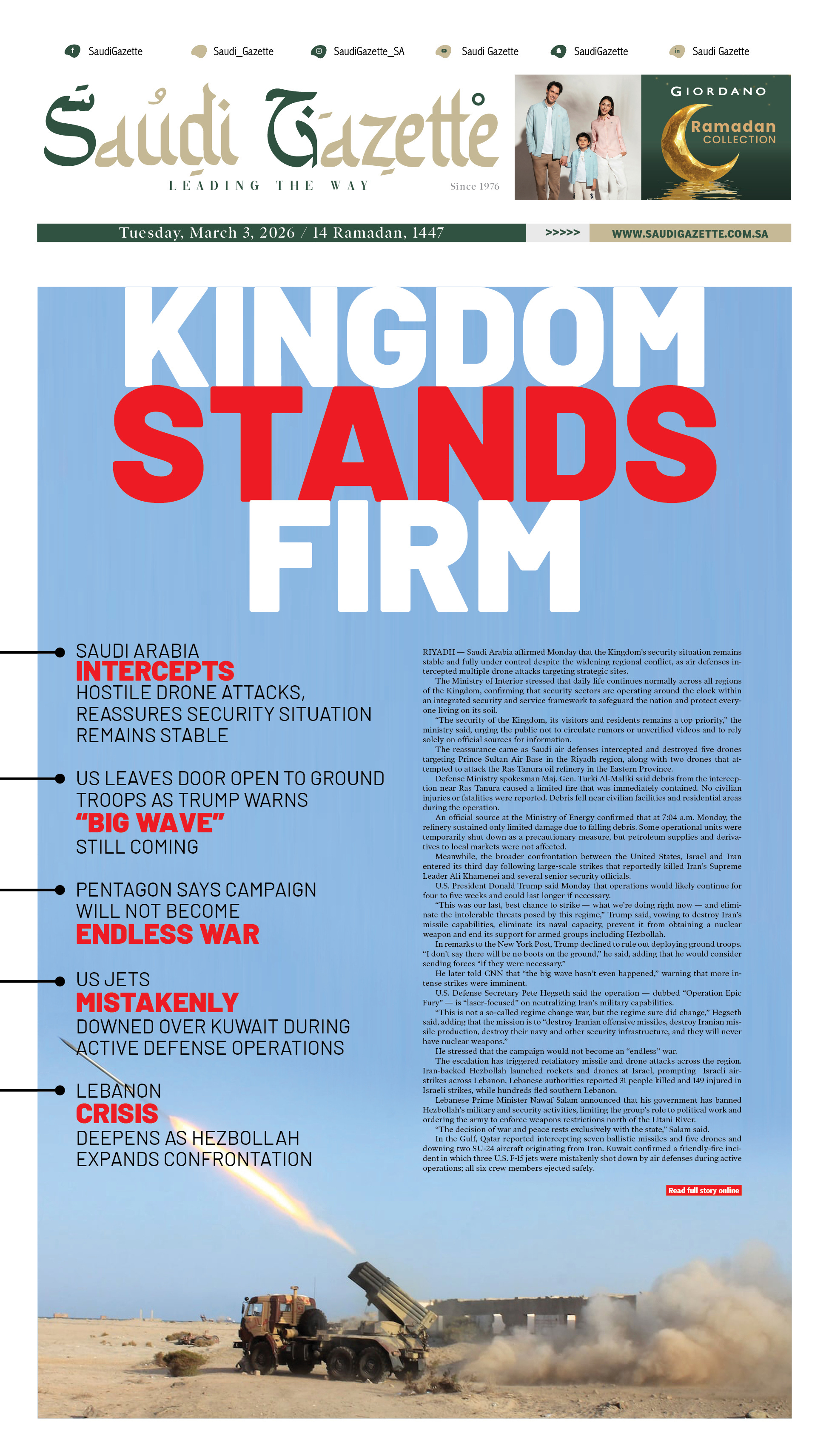
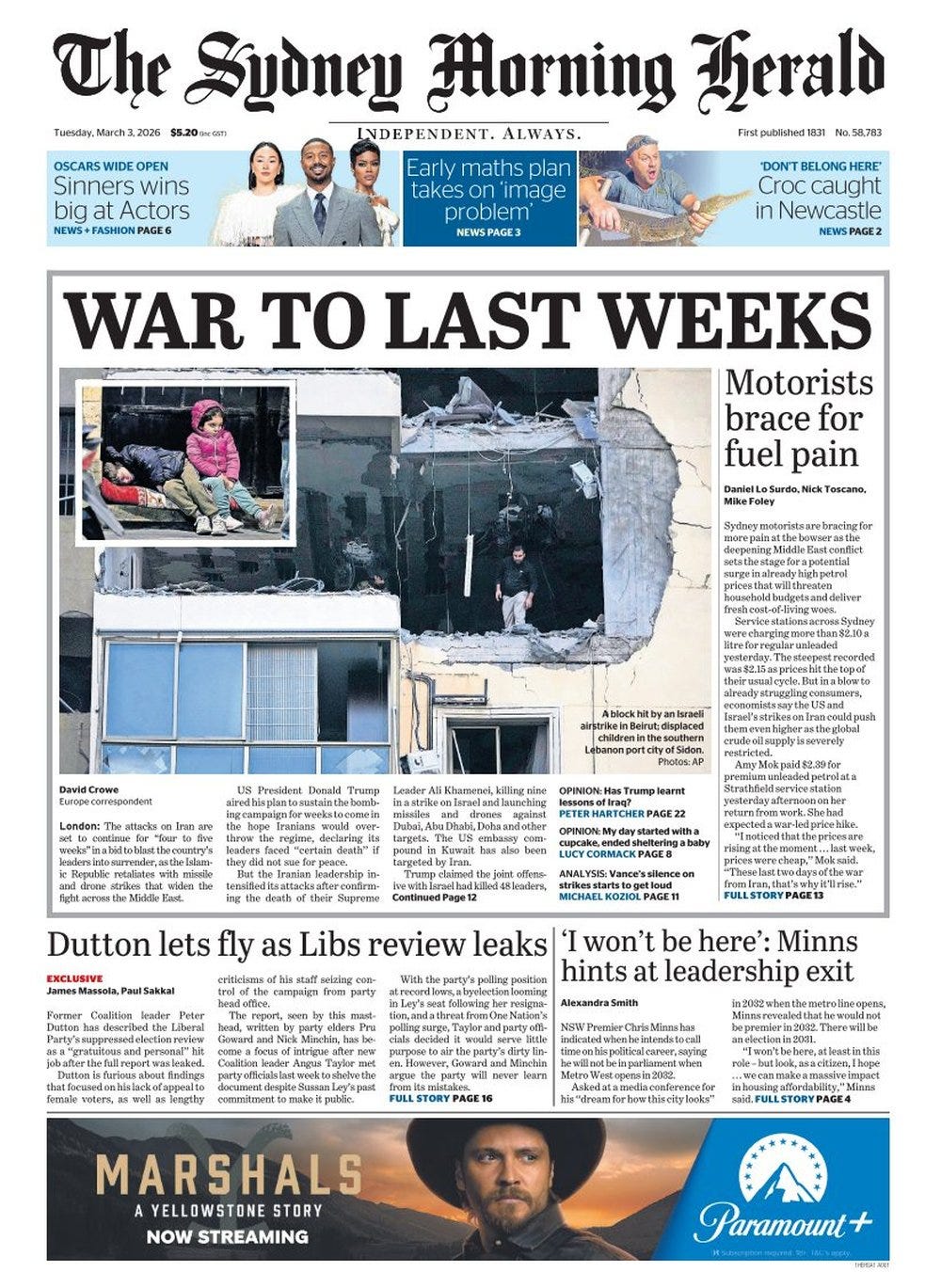
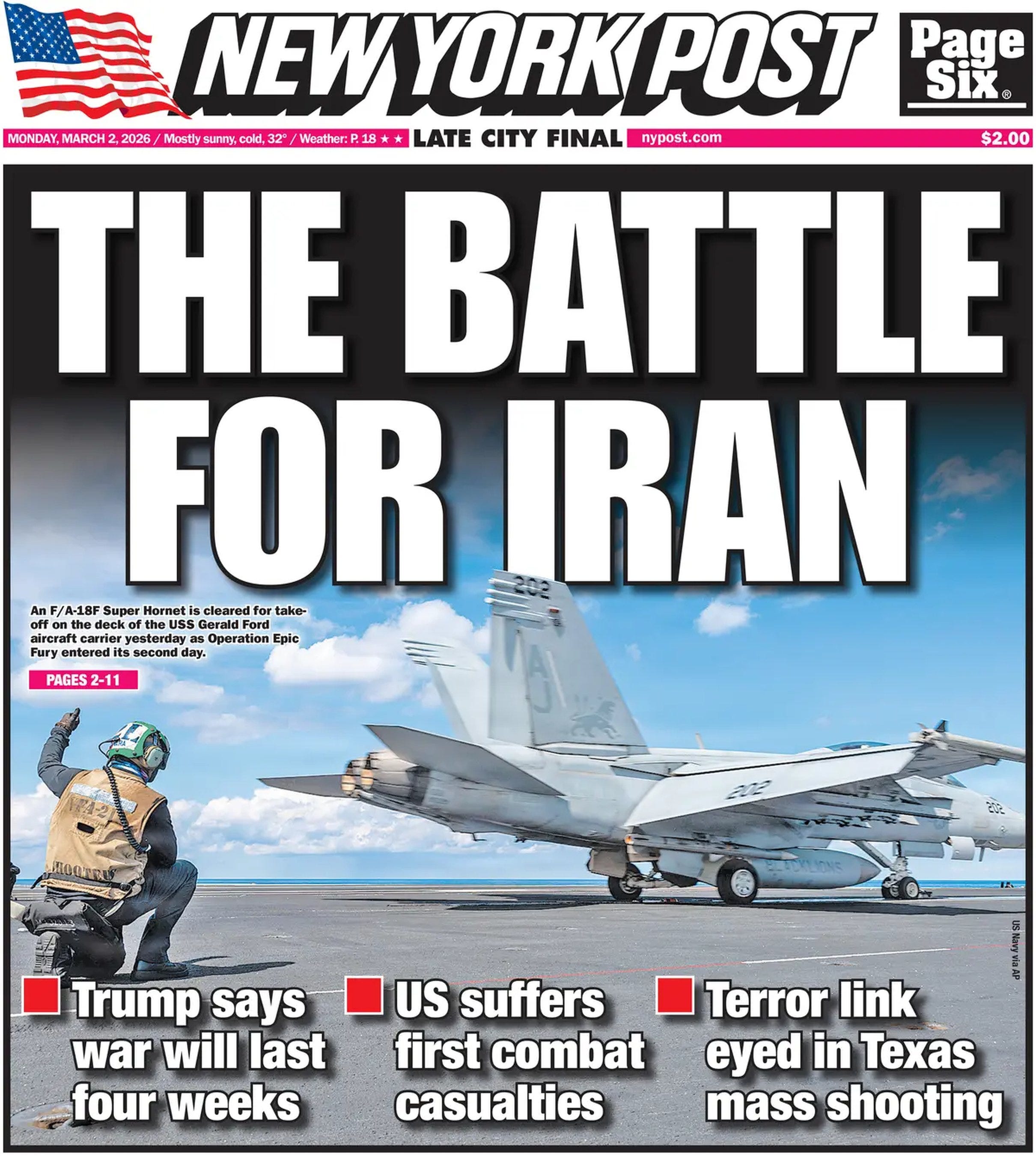
President Trump said on Monday that the United States would attack Iran for as long as it took to leave it incapable of posing a threat, and his secretary of state signaled that the military campaign would escalate, in comments that indicated that the expanding war in the Middle East could intensify and continue for weeks or more. “Whatever the time is, it’s OK, whatever it takes,” Mr. Trump said at his first public event since U.S.-Israeli airstrikes on Iran began on Saturday. “Right from the beginning we projected four to five weeks, but we have the capability to go far longer than that.” On Capitol Hill, Secretary of State Marco Rubio told reporters that “the hardest hits are yet to come from the U.S. military.” Both men’s comments underscored the administration’s murky messaging on the Iran attack. Speaking ahead of a classified briefing for congressional leaders, Mr. Rubio argued that U.S.-Israeli strikes against Iran were intended to address an “imminent threat,” but then went on to describe an attack undertaken preemptively, on the expectation that Israel would begin strikes even without the United States and that Iran would include U.S. targets in its retaliation. He said the United States would strike Iran until it had achieved its objectives, including the destruction of Iran’s ballistic missile capabilities. Listing those objectives at the White House earlier in the day, Mr. Trump said, “We’re destroying Iran’s missile capability, and we’re doing that hourly.” He said the strikes were “annihilating their navy,” and ensuring that “this sick and sinister regime” in Tehran “can never obtain a nuclear weapon” or continue to sponsor militant groups across the Middle East. The Pentagon said the death toll of U.S. service members killed in Iranian strikes had risen to six. And three U.S. jets were shot down by Kuwaiti air defenses in what the U.S. military called an “apparent friendly fire incident.” All six crew members from the planes ejected safely and were recovered, the U.S. said. The New York Post reported that the president had said in an interview on Monday: “I don’t have the yips with respect to boots on the ground — like every president says, ‘There will be no boots on the ground.’ I don’t say it.” As U.S. and Israeli planes pounded targets in Iran for the third day, the fighting expanded into Lebanon, where the Iranian-allied militia Hezbollah fired rockets into Israel, prompting Israel to bombard the militia’s strongholds outside Beirut. Early Tuesday, the Israeli military said it was attacking again in Lebanon, targeting Hezbollah command centers and weapons storage facilities in the capital, Beirut. Around the same time, the United Arab Emirates’ ministry of defense said its air defenses were “dealing with a barrage of ballistic missiles” from Iran. And within hours, the Saudi defense ministry said that U.S. Embassy in Riyadh had been attacked by two drones, resulting in a “limited fire” and minor damage. A senior Islamic Revolutionary Guards Corps official vowed on Monday that “not a single drop of oil” would pass through the Strait of Hormuz, the conduit for about one-fifth of the world’s supply. Ebrahim Jabari, an adviser to the Revolutionary Guards commander, said on Iranian state TV, that Iran would “set on fire” any ships attempting to transit the strait. Traffic through the strait has already slowed to a trickle, after the Revolutionary Guards warned ships away over the weekend, but Iran had not directly threatened them. In another sign of an expansion of attacks in the Middle East, Qatar’s ministry of defense said its air force had shot down two Su-24 bombers coming from Iran, the first report that Iran, which has fired missiles and drones at its Gulf neighbors and Israel in retaliation for the Israeli-U.S. assault, had also sent warplanes into their airspace. Iranian leaders remained defiant. The country’s top security official, Ali Larijani, denied news reports that Iran’s new leaders were seeking to negotiate with Washington, denouncing Mr. Trump for “delusional fantasies” and for plunging the Middle East “into chaos.” Iran, he said in a string of fiery social media posts on Monday, “has prepared itself for a long war.” - NYT
Americans broadly disapprove of the Trump administration’s military strikes on Iran, according to several polls conducted after the U.S. attacked Tehran early Saturday morning. Nearly six in 10 Americans said they oppose the decision to take military action against the Middle Eastern country, according to a text poll conducted by SSRS for CNN on Saturday and Sunday. A separate SSRS poll, conducted via text message for The Washington Post, found that more than half of Americans disapprove of the strikes, with 52 percent opposing and 39 percent supporting. The lack of public support for President Donald Trump’s decision to move forward with airstrikes comes as White House allies worry the move could throw the GOP’s fragile coalition into jeopardy ahead of this fall’s midterm elections. A POLITICO poll conducted in January, when the president was still weighing diplomatic and military options, found that nearly half of Americans opposed the possibility of military action in Iran. - Politico
The U.S. State Department has urged Americans to immediately leave more than a dozen Middle Eastern countries as the conflict with Iran threatens to engulf the region. U.S. Assistant Secretary of State for Consular Affairs Mora Namdar posted on X that Americans in those countries should “DEPART NOW” using commercial transportation because of “serious safety risks.” The countries cited included Bahrain, Israel, Kuwait, Saudi Arabia, Syria and the United Arab Emirates, as well as Iran and Iraq. But the advice comes amid major travel disruption across the region, including airport closures and flight cancellations, that has left many people stranded - Politico
Retired four-star General David Petraeus, a veteran of nearly four decades in the US Army and a former director of the CIA, endorses the Trump administration’s frank account of operations. In an interview with RFE/RL, Petraeus, who previously commanded US forces in Iraq and Afghanistan, noted the US openness about its substantial achievements, as well as its losses of personnel and aircraft.
He said the consequences of killing Iranian Supreme Leader Ayatollah Ali Khamenei and other senior officials are uncertain until a successor emerges, and while the stated US aim of the military action is to create conditions that might allow Iranians -- or disaffected regime elements -- to topple the Islamic republic’s leadership, he stresses it remains to be seen whether that is realistic - RFE/RL
An Iranian official says Iran will “set fire to anyone who tries to pass through” the Strait of Hormuz. The warning comes from Ebrahim Jabbari, an adviser to the Commander-in-Chief of Iran’s Islamic Revolutionary Guard Corps (IRGC), speaking on state TV. He says that the strait is closed and warned ships: “They should not come to this region. They will certainly face a serious response from us.” Jabbari also says Americans are “thirsty for the region’s oil” and that Iran will “strike their pipelines in the region and will not allow oil to be exported from this area”. The Strait of Hormuz is one of the world’s most important shipping routes and the most vital oil transit choke point. About one-fifth of the world’s oil and gas passes through the strait - BBC
Thousands more flights were cancelled on Monday as the turmoil in global air travel caused by the US-Israel war on Iran continued, with hundreds of thousands of passengers stranded. Gulf airports and airlines have suspended normal operations until at least 10.00 GMT on Tuesday. However, a limited number of special services were due to depart from the UAE on Monday evening. Airline and travel share prices fell sharply after days of disruption, with Donald Trump indicating that the US military action could last another four weeks. Major Middle Eastern airports, including Dubai – the world’s busiest international hub – closed for a third consecutive day amid the most acute aviation shock since the Covid pandemic paralysed the industry. Flights across the Middle East have been cancelled, disrupting thousands of services so far, as international carriers continued to suspend their services. By 10am, according to the analysts Cirium, at least 1,555 flights to the Middle East had been cancelled, although it warned that the figures were artificially low owing to limited data coming from Iran and the United Arab Emirates, where hundreds more flights were scheduled on Monday. Cancellations most affected the Gulf carriers, all three of which now connect passengers worldwide via their hubs. Emirates, based in Dubai, and Etihad Airways, in Abu Dhabi, said flights to and from their hubs would not operate until late Tuesday morning, while Qatar Airways has suspended operations as long as Qatari airspace remains closed. Emirates and Etihad were poised to resume selected flights on Monday evening, offering hope that wider passenger travel could resume. The UAE’s aviation authority said it would allow “special flights” across the country’s airports to operate to allow stranded passengers to depart. An Emirates spokesperson said passengers who could travel would be notified and that other flights remained suspended. Almost 2,800 flights were cancelled on Saturday, and 3,156 cancelled on Sunday, according to the tracking platform FlightAware - The Guardian
Russia’s Consulate General in Dubai published what appeared to be an AI-generated infographic on Monday that refers to Russian tourists stranded in the country as “orphans” and “anti-social people.” The image, which gives guidance to travelers unable to find a return flight home due to the ongoing Middle East conflict, was posted on the consulate’s Telegram channel. In the bottom right-hand corner of the infographic, a section labeled “extreme scenario” addresses tourists as “orphans or anti-social people with no friends or acquaintances.” For an unknown reason, that sentence is crossed out, though the words are still legible. The crossed-out sentence is then followed by instructions for those “who do not have the financial means to continue staying at a hotel” to secure “no-frills” accommodation with the consulate’s assistance. “If your hotel insists on you leaving the premises and you have absolutely no money, email us with a brief description of the situation,” the Russian consulate said in a statement.
It remains unclear why the consulate referred to stranded Russians as “orphans” and “anti-social people.” The infographic remained on its Telegram channel as of Monday evening. The Moscow Times contacted the consulate in Dubai for comment. Russia’s Foreign Ministry estimates that more than 20,000 Russian tourists are stranded in the United Arab Emirates and 500 more in other Gulf countries - Moscow Times
Ukrainian forces launched a new wave of strikes overnight targeting Russian military infrastructure in occupied Donetsk and Zaporizhzhia, including radar stations tied to S-300 and S-300V4 air defense systems, ammunition depots, fuel storage facilities, repair sites and troop positions. Kyiv also said drone control centers were hit both in occupied territory and inside Russia’s Belgorod region — part of a sustained campaign aimed at disrupting Moscow’s battlefield coordination and logistics. Footage released by the Ukrainian military appears to show drones striking Russian radar systems, highlighting how relatively low-cost technologies continue to challenge air defense platforms once marketed as among Russia’s most advanced. While damage assessments are ongoing, the repeated targeting of high-value assets reinforces a broader trend: Russian military hardware is being tested — and increasingly exposed — in real time. The strikes come at an awkward moment for Moscow. With conflict expanding across the Gulf and Russia offering limited support to partners facing existential pressure - from Syria to Venezuela and now Iran - both the reliability of Russian weapons and the credibility of its alliances are under renewed scrutiny. For many observers, the question is no longer just how Russia fights, but whether its security promises still carry weight beyond its borders.
Russia is facing fresh allegations that it has facilitated the movement of migrants into Europe through clandestine underground routes, according to reporting by The Telegraph. The investigation claims that specialist construction teams from the Middle East were quietly recruited to build concealed passageways designed to move people across sensitive border areas from Belarus into Poland. If confirmed, the operation would mark a significant escalation in what European officials have increasingly described as “hybrid warfare” the use of migration flows as a geopolitical pressure tool. Western governments have previously accused Moscow and its allies of weaponizing migration to destabilize EU states, particularly along eastern and northern borders.
A Russian businessman and former politician was found dead in a luxury Moscow apartment on Monday morning, just weeks after his name appeared in the Epstein files. Police found Umar Dzhabrailov, a businessman and former senator, lying in a pool of blood with a gunshot wound to his head around 3 a.m., Russian outlet Kommersant reported. Dzhabrailov, 67, was found with a Luger pistol near his body, and police sources called the incident a suspected suicide. Sources said he did not leave a note, but had recorded several video comments about the events in Iran shortly before his death. The former Chechen representative to the Federation Council of Russia sent an email to convicted sex trafficker Ghislaine Maxwell in May 2001, as seen in a government file. Dzhabrailov, who ran for president against Vladimir Putin in 2000 but won only 0.1 percent of the vote, was also a friend of disgraced music mogul Sean “Diddy” Combs, who is serving a 50-month sentence for transportation to engage in prostitution - The Daily Beast
The journals…