The ceasefire is dead, and Asia is paying the bill. The collapse of the US-Iran truce is battering the region’s fragile economies with surging oil, sliding currencies and zero clarity on when - or how - it all ends. The region, veteran Tokyo-based columnist William Pesek writes in Asia Times, never really left the woods: the calm around the Strait of Hormuz was less a resolution than a reprieve. That reprieve is over.
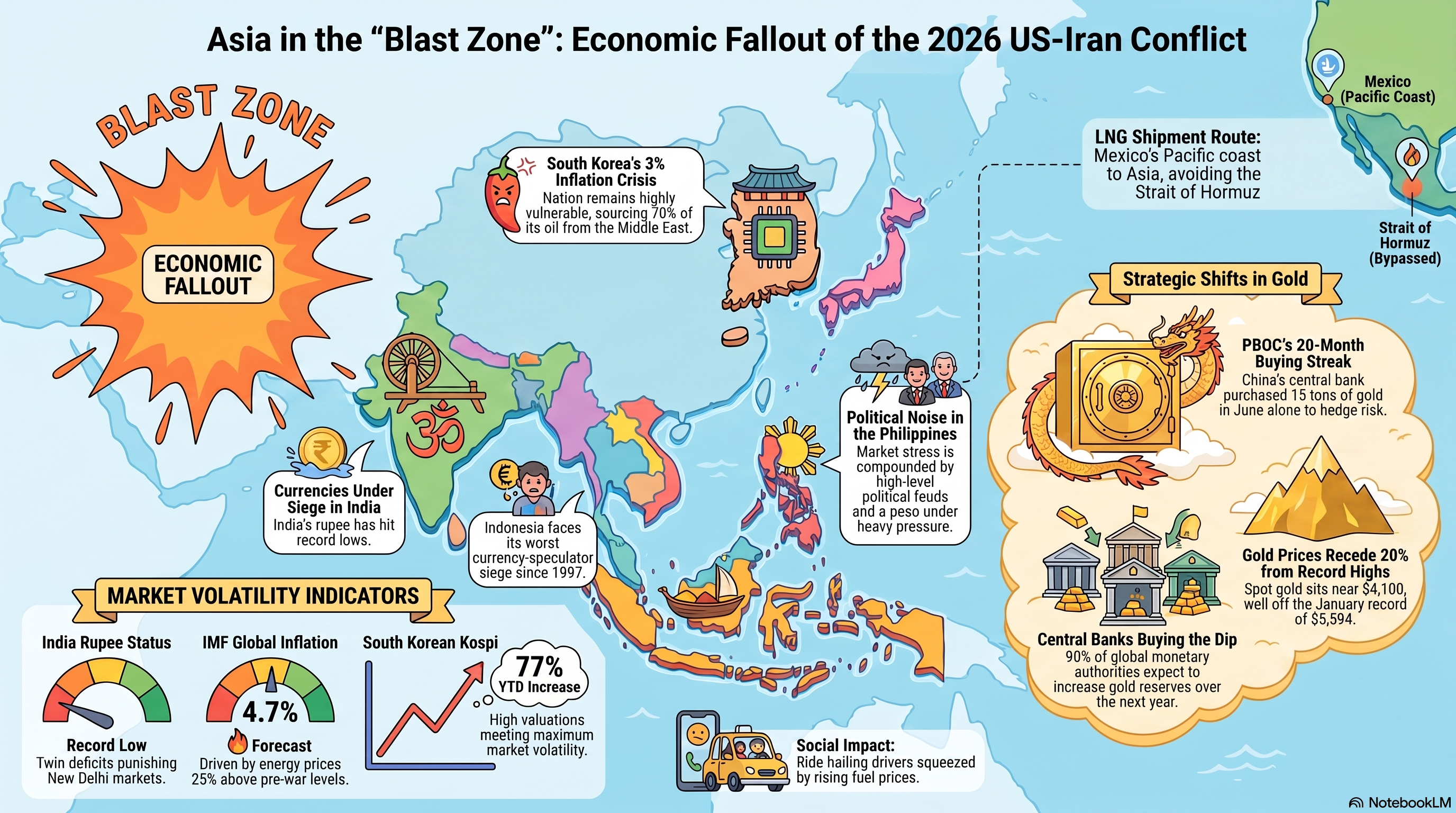
The damage map is sobering. South Korea, which sources roughly 70% of its oil from the Middle East, faces inflation the Bank of Korea sees staying above 3% even with the bombing paused. India’s rupee has fallen to record lows, Indonesia is fighting its worst currency-speculator siege since the 1997-98 Asian financial crisis, and the Philippines is propping up the peso amid the political noise of an impeachment vote against Vice President Sara Duterte. Japan’s stagflation problem is getting messier, with inflation running more than five times the 0.5% growth the Bank of Japan projects this year.
But it isn’t only leaders and central bankers fretting. Earlier in the war, World Briefing was on the ground in the Philippines, Thailand and Malaysia, documenting what these numbers mean at street level - especially for the region’s armies of ride-hailing drivers. With fuel prices doubling and platforms like Grab and Bolt refusing to trim their double-digit commissions, drivers told us they were being squeezed from both ends. In the Philippines, some were working behind the wheel up to 18 hours a day just to put food on the table. The macro charts in Seoul and Mumbai trading rooms have faces - exhausted ones.
Two forces are compounding the pain. First, a hawkish pivot at the Fed under new chair Kevin Warsh - picked by Trump as the man who would cut early and often, but boxed in by a 4.2% May inflation print - has sent “King Dollar” rampaging through Asian currencies, equities and gold, Asia Times reports. Second, the gold trade Asian central banks had piled into is unravelling: spot gold sits near $4,100 an ounce, more than 20% off January’s record - even as the People’s Bank of China notched its 20th straight month of buying.
The cruelest twist, Pesek notes, is timing: war risk is re-emerging just as AI euphoria sends Asian valuations to nosebleed levels - the Kospi up 77% this year, Taiwan 56%, and South Korean chipmaker SK Hynix launching a $26.5 billion US share sale, the largest ever by a foreign company - into maximum volatility (it priced its shares at $149, riding investor demand for AI stocks, reports Nikkei Asia).
Boom and bust, sharing a currency.
But amid the wreckage, the map itself is being redrawn. As we reported yesterday, citing Semafor, the first-ever shipment of LNG from Mexico's Pacific coast is now en route to Asia - hard evidence of a global energy trade reshaping itself in real time, as confidence wanes in the traditional arteries of Russia and the Strait of Hormuz. The cargo, loaded at the new ECA LNG terminal in Baja California and shipped by TotalEnergies, carries US Permian Basin gas to Asian markets via the shortest maritime route - no Hormuz, no Panama Canal. Asia's energy majors are moving in the same direction: Japan Petroleum Exploration (JAPEX) plans to nearly quadruple its US oil and gas production by 2035, and is weighing crude exports back to the home market in the event of a supply crunch, Nikkei Asia reports - a strategy its president says was validated by the Iran crisis reaffirming the national-security stakes of stable fuel supplies. JAPEX is putting real money behind the pivot - $7.3 billion in exploration and production over the decade Expect more of this: when chokepoints become war zones, trade routes don't wait for diplomats.
Our take: Asia hoped for a quieter second half of 2026. Instead, it got a war without a timeline, a dollar without mercy - and an unpredictable U.S. president who, asked where the conflict is headed, answered: “I don’t know.” For the region caught in the blast zone, that may be the most alarming data point of all. And as our own reporting showed, the ones absorbing the shock aren’t in the trading rooms - they’re behind the wheel at 2 a.m., on hour sixteen of a shift.
News Briefs
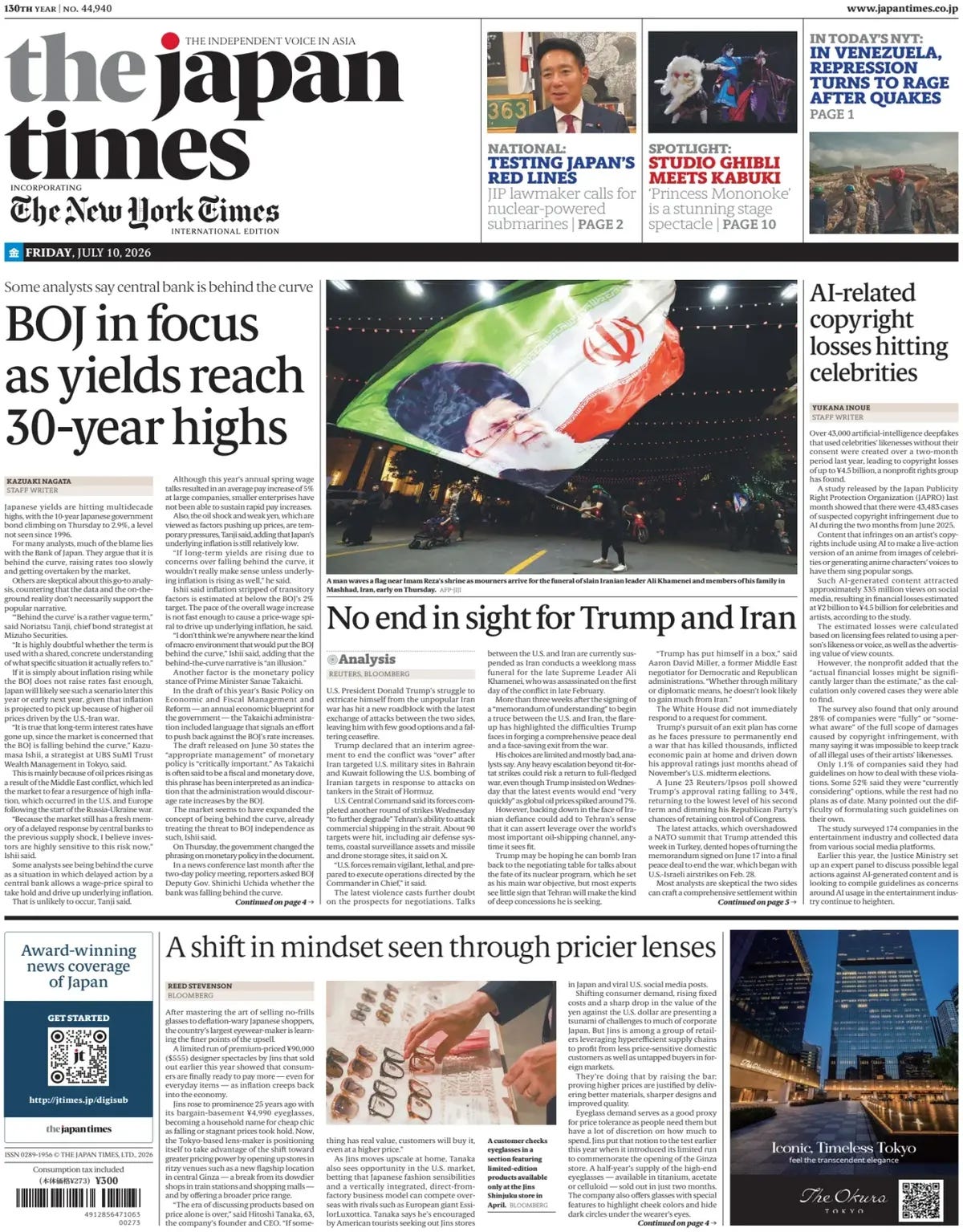
US President Donald Trump said Iran has requested that “talks” between the two countries continue, although he emphatically warned Tehran that the current cease-fire is no longer in effect amid a flurry of tit-for-tat strikes by both sides. “The Islamic Republic of Iran has asked us to continue ‘talks,’” Trump wrote on Truth Social on July 10. “We have agreed to do so, but the United States has stated to them, in no uncertain terms, that the Cease Fire is OVER!” he added. Trump has often stated that Tehran has begged to resume negotiations with Washington, although such discussions have often broken up without apparent progress. Speaking to reporters earlier this week, Trump said: “Iran called a while ago. They want to make a deal so badly. I just don’t know if they are worthy. I don’t know if they are going to honor the deal. That’s the problem.” But Trump also said at the time that he would speak to Steve Witkoff and his son-in-law, Jared Kushner -- who have been acting as lead US negotiators -- about the possibility of resuming talks. Separately, Iranian media reported that a delegation from mediator Qatar arrived in Tehran on July 10 for talks “The main purpose of the visit is reportedly to try to reinforce Qatar’s role as a mediator following events on Tuesday [July 7],” Tasnim news agency reported. Qatar has accused Iran of an attack on three tankers in the Strait of Hormuz on July 7 as hostilities in the region intensified amid what had been announced as a 60-day truce to allow full negotiations to take place between Washington and Tehran. Iran has fired on ships transiting the crucial waterway, claiming that they attempted passage without getting proper permission from Tehran - RFE/RL
Iran will respond to any attack against its infrastructure, including by striking Israel, the head of the country’s top security body said on Friday, as Tehran and Washington have resumed fighting this week. “Any attack on infrastructure will be retaliated against, and the criminal Zionist regime responsible for these atrocities will not be safe from the response of our fighters,” Mohammad Bagher Zolghadr said in a statement carried by state TV. Benjamin Netanyahu’s office announced that the Israeli prime minister spoke on Thursday with the US president, who informed him of the latest American moves in the Gulf. Later on Thursday evening, Iranian state media reported a US-Israeli attack on a military headquarters near Bushehr, where Iran’s only civilian nuclear plant is located. Israeli Defense Minister Israel Katz said Israel was prepared to resume its military campaign against Iran if needed, vowing to do so “with even greater force.” - AFP
Ousted Bangladeshi Prime Minister Sheikh Hasina says she plans to return to the country from exile in December, despite a death sentence passed during her two-year stay in India. The 78-year-old former leader told the Reuters news agency in an interview published on Friday that she plans to return to Bangladesh alongside senior officials from her Awami League to launch a challenge to the legal shuttering of the party. Her return could jolt efforts to stabilise Bangladeshi politics following the 2024 revolt against her increasingly authoritarian rule, which saw her flee after a deadly crackdown failed to quell a student-led uprising. However, it may also help to improve ties with India, which have been strained by New Delhi’s decision to offer her refuge. “They may arrest me on my return, they may even kill me,” Hasina said during the telephone interview from the Indian capital, to which she fled two years ago. “Still, I have to go. If death comes, I want it to come on my own soil.” The former prime minister said that her return is a coordinated effort to challenge the legal actions taken against her party, the Awami League, which has been banned. Hasina has urged other exiled party members, including former Home Minister Asaduzzaman Khan Kamal who also faces a death sentence, to join her. “All together, we will all surrender in court,” she said, insisting that legal proceedings against her are “farcical”. However, the current authorities have made it clear that they are in no mood to offer quarter to the former leader.
Italy and Poland cracked down on alleged spying by Russia, moves that come as analysts warned that the Kremlin may be looking to expand its use of hybrid warfare as its battlefield efforts in Ukraine stall. Rome expelled two Russian diplomats it said had carried out “serious and unacceptable acts of interference,” while Warsaw sentenced a couple for spying for Moscow. “The Italian government has decided to expel two military attaches from the embassy of the Russian Federation in Italy, involved in espionage activities uncovered by the Rome public prosecutor’s office,” Foreign Minister Antonio Tajani wrote in a post on X. The minister named the Russians as Ivan Petrovich Gorbachev and Mikhail Vasilyevich Astakhov and said they had been ordered to leave within three days. "Moscow continues to use hybrid warfare to attack the West and Italy, acts of interference that are serious and unacceptable to Italian institutions and national security," Tajani commented. Rome police said on Tuesday that one of the detained Italians, a 59-year-old former intelligence officer, had been paid by a Russian handler and “disclosed to him information of interest through six sources, including four serving military personnel assigned to posts marked by a high level of confidentiality.” Media reports said the Italians had handed over information on an Italian-French air defence system, the SAMP/T, due to be delivered to Ukraine this year, and on Aster missiles that have already been sent to Kyiv. Russian handlers had also sought details on a NATO mission in Bulgaria and the Italian company Avio that makes motors for drones and supersonic missiles. Corriere della Sera newspaper said the 59-year-old also provided the identities of Italian counter-espionage agents who were meant to monitor the Russians. Experts fear that Russian President Vladimir Putin may be looking for ways to escalate his war beyond Ukraine as he seeks to pressure Western leaders into forcing Kyiv’s hand on a ceasefire deal that he can sell as a victory. Quoting a recording of the suspect’s telephone conversations, La Stampa newspaper said the man gave “thousands” of items of information over a 12-year period. Italy’s Defence Minister Guido Crosetto said on Tuesday that the case was “just the tip of the iceberg” in Russia’s so-called “hybrid war” in Europe as it pursues its full-scale invasion of Ukraine. That leaves Ukraine and its Western backers bracing “for a dangerous summer,” the Financial Times’ chief foreign affairs commentator wrote - Euronews/Semafor
Former Canadian Prime Minister Justin Trudeau proved he continues to live rent-free in conservatives' minds after making a surprise appearance in his pop-star girlfriend's TikTok music video. MAGA is currently freaking out after the former politician made a cameo in Katy Perry's teaser for her latest single, "Watch It Burn," which she released on June 25. The singer, 41, posted a video of herself, Trudeau, and others hopping around and dancing to the boppy beat. "Ancient texts say that if you hop to this song you will get 1,000 years of good luck," Perry captioned the video - The Daily Beast
The journals…..