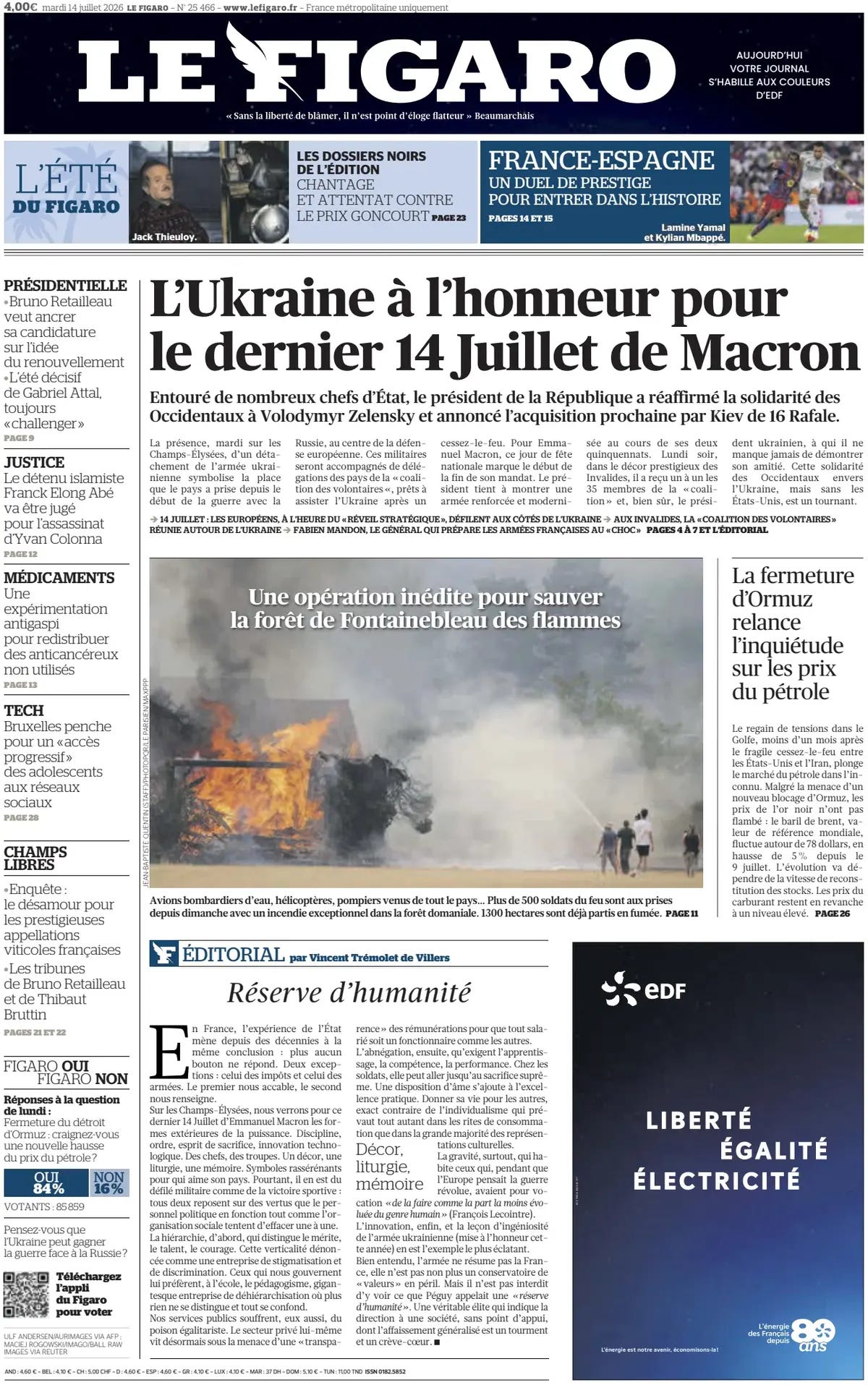
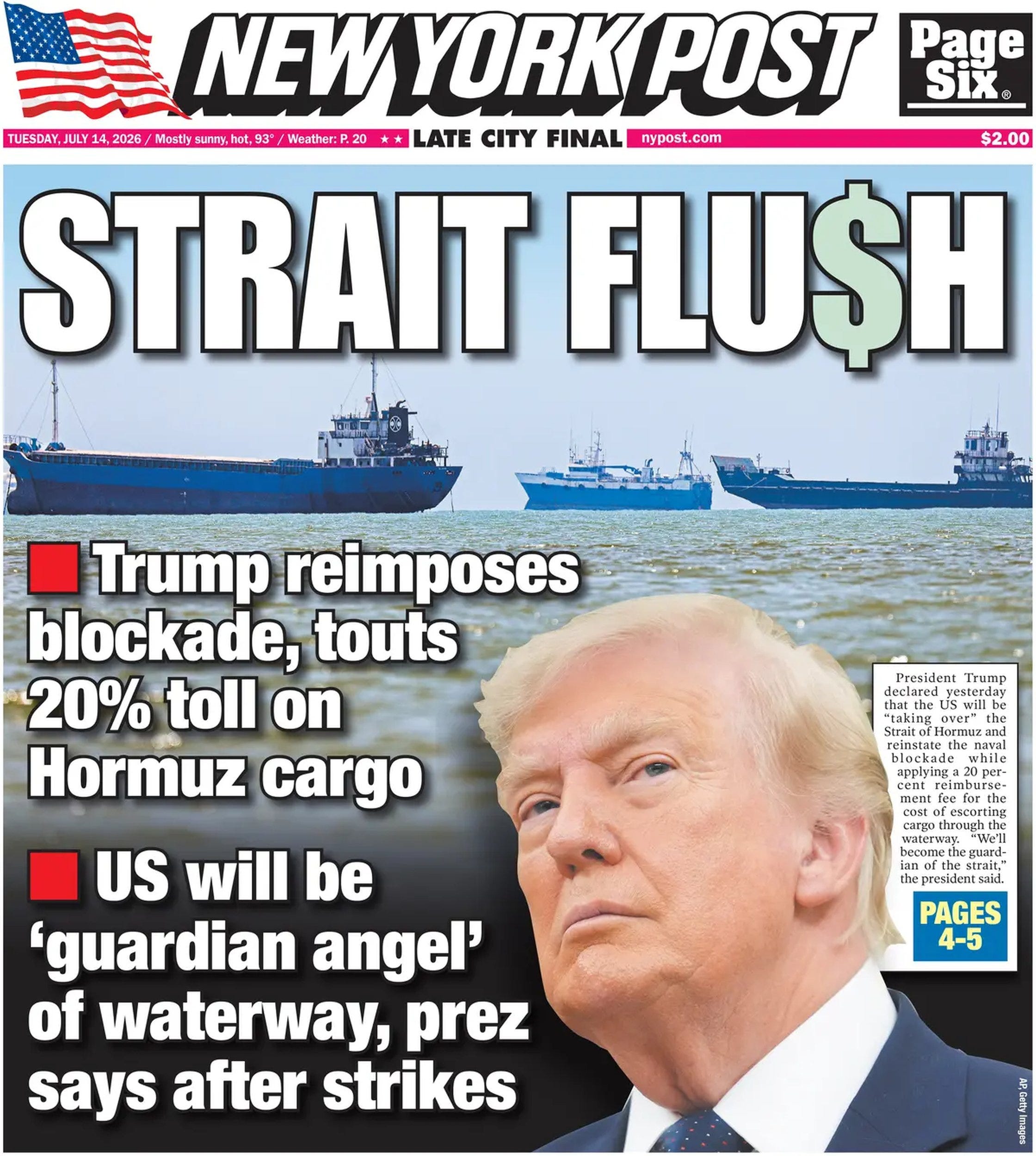
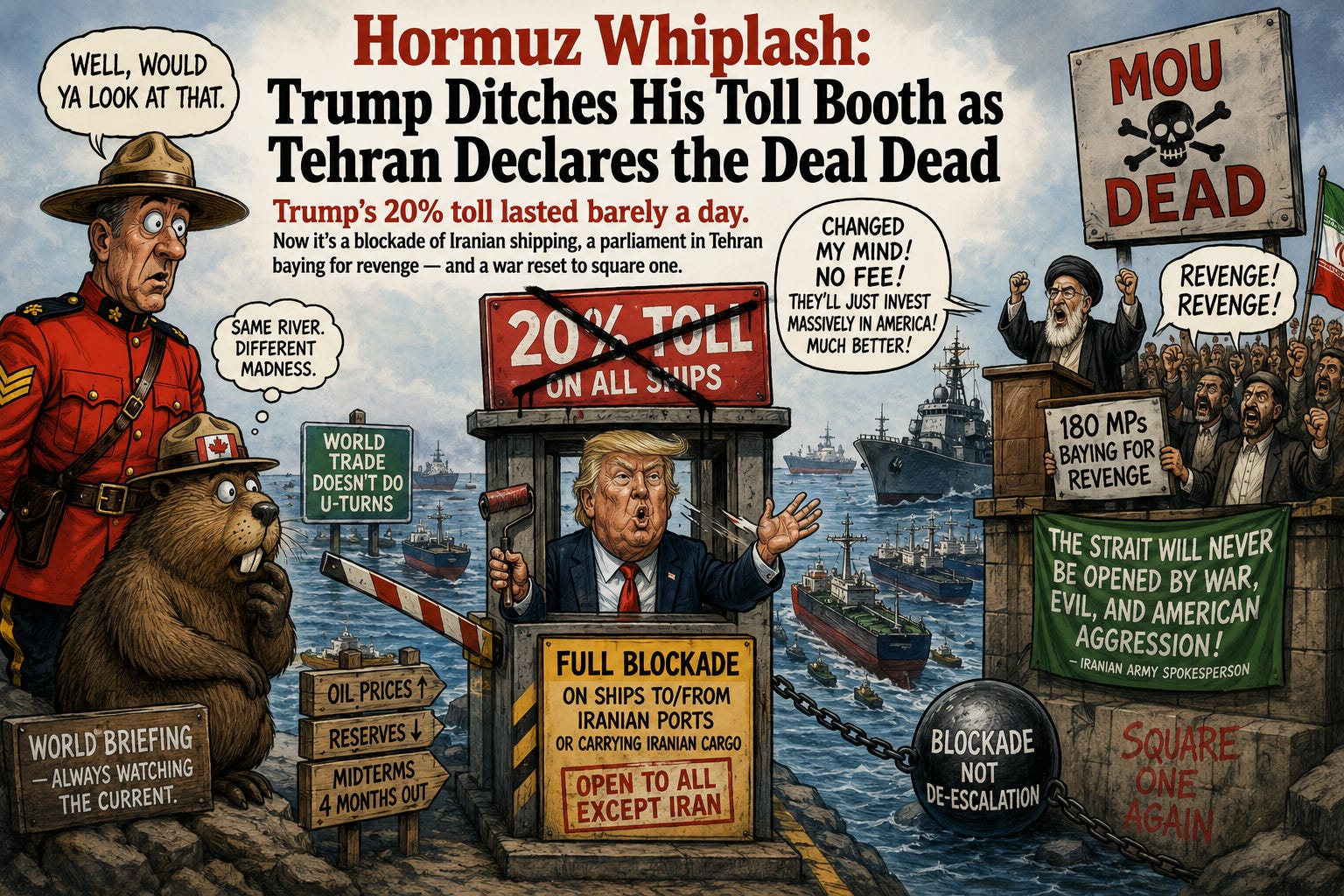
Rarely does a superpower improvise this loudly. Trump's Hormuz toll lasted barely a day before Gulf capitals talked him down to a blockade of Iranian shipping - dressed up, naturally, as "massive investments" flowing to America. But don't mistake the climbdown for de-escalation. With 180 Iranian MPs baying for revenge and the MOU officially buried in both capitals, the shooting phase is back on. And here's the inconvenient math nobody in Washington wants to run: oil reserves are thinner than in February, Iran builds missiles faster than America builds interceptors, and the midterms are four months out. Trump is refighting a war he couldn't win on better terms the first time - this time with the clock, the barrel count, and the ballot box all working against him.
News Briefs
President Donald Trump on Tuesday walked back threats to charge a 20 percent fee on all cargo ships that pass through the Strait of Hormuz, the critical waterway that has been central to the renewed U.S.-Iran conflict. In a post to Truth Social, Trump said the strait will be open to “ALL Ship traffic except for Iran” and the U.S. will implement a “FULL Blockade, but only on Ships coming to and from Iranian ports, or carrying anything have to do with Iranian cargo.” The president added that the previously announced 20 percent fee will be replaced with trade and investment deals between Gulf states and the U.S. Trump’s announcement marks a swift backtrack from his proposal to charge all ships traveling the strait a 20 percent fee, a plan he announced Monday. It triggered grumbling from international allies and even some Republicans on Capitol Hill. The president said later on Tuesday that his mind was changed when he spoke to leaders from the Gulf states, who wanted the waterway controlled a different way. Trump said he looked at charging a fee as “a reimbursement” but that he doesn’t like the idea of anybody charging a fee for the strait, despite feeling it’s unfair that the U.S. protects the waterway without compensation. “By doing in that way, there’s no fee. They’re investing and they’re getting a return on their money and its good. But, they’re going to be making massive investments into the United States and I like that much better,” Trump said. Democrats were quick to condemn the proposal. Sen. Tim Kaine (D-Va.) warned that the proposed fee would not be readily accepted - Politico
One hundred eighty members of Iran’s 290-strong parliament have issued a statement declaring the end of the memorandum of understanding with the United States. The lawmakers emphasised the necessity of “pursuing revenge”. They also called for the passing of new legislation to manage the Strait of Hormuz on Iran’s terms. Separately, the Strait of Hormuz will never be opened by “war, evil, and American aggression”, the Iranian army’s spokesperson says - Al Jazeera
The fragile US-Iran Memorandum of Understanding is, for all practical purposes, finished - and with it, the ceasefire. The two sides have slid back into open conflict over the one thing the February war never resolved: who controls the Strait of Hormuz.
In a sharp new analysis for Asia Times, the Quincy Institute’s Trita Parsi argues the collapse was less about treaty fine print than about a fundamental strategic collision. On paper, the fight turns on Paragraph 5 of the MOU - whether Iran is responsible for safe passage through the entire Strait or only its northern corridor. Beneath that, Parsi writes, Tehran was convinced Washington’s real objective was to build a southern shipping corridor through Omani waters that would gradually strip Iran of its control over the waterway - and with it, its single most important source of leverage. Trump’s earlier threat to bomb Oman unless it dropped a joint-management proposal did little to calm those suspicions.
The weekend talks in Muscat produced three competing proposals - an Iranian dual-notification scheme, a Qatari three-corridor plan, and a US-Omani split-management model that Tehran read as the formalization of exactly the corridor strategy it feared. The accounts of who torpedoed what diverge predictably: Washington says Foreign Minister Araghchi was overruled by IRGC hardliners; Tehran says Oman caved to American pressure. Either way, diplomacy is dead for now.
Parsi’s most striking claim: Iran closed the Strait not to extract concessions but because its strategists concluded war was coming anyway - Trump’s “scum” rhetoric, the ceasefire-is-over declarations, and the Lebanon-Israel deal all convinced Tehran that Washington was preparing to resume hostilities. Closing Hormuz first was, in their calculus, defensive - even if it may have made the American response inevitable.
The bottom line: Trump enters this round in a materially weaker position than in February. Global oil inventories are down some 360–370 million barrels since the war began, with barely 5% rebuilt; the US Strategic Petroleum Reserve has shrunk from roughly 415 million barrels to 337 million. And the midterms are four months out - meaning gas prices, inflation, and freight costs land squarely in the campaign window. Add Parsi’s Pentagon source, who notes Iran builds missiles faster than the US builds interceptors, and Washington’s attention split across Ukraine and Taiwan, and you get the piece’s core verdict: another round of bombing won’t change the fundamentals. It’s February all over again - except this time Trump can’t claim he didn’t know how it ends.
Earlier today I joined Times Radio's Frontline to unpack the latest from the Russia-Ukraine war - including Trump's apparent change of tune on Ukraine and President Volodymyr Zelensky. A sample above; the full clip is here.
Two very loud explosions shook the southern Ukrainian port city of Odesa at around 22:40 local time Tuesday, heard clearly by World Briefing from the city centre. Ukrainian Telegram channels report damage to city infrastructure; details are still being clarified. It caps a brutal day here. Since Tuesday morning, four people have been killed and four injured in Odesa, with Russian forces striking port infrastructure, commercial vessels in the Black Sea, and the city’s outskirts, according to state broadcaster Suspilne. Notably - and for the first time in recent memory - damage is visible at the central port bordering the city centre, most likely from Saturday morning’s strikes. That matters: this is the working heart of Ukraine’s grain corridor, within sight of the opera house and the tourist quarter. Odesa was far from alone. A snapshot of Tuesday’s toll, per Suspilne:
Kharkiv region: Two dead, at least seven injured, with strikes on Svatove, Berezivka, Mlynky, Zolote and Kharkiv city.
Kherson region: Twenty injured in shelling of Kherson and Bilozerka, including a 17-year-old girl.
Dnipropetrovsk region: At least nine injured; nearly one hundred strikes recorded on Nikopol and Kryvyi Rih, plus infrastructure in Kropyvnytskyi.
Mykolaiv region: Eight injured after an MLRS attack on Ochakiv damaged a medical facility, homes and vehicles.
Sumy: Two injured in an evening strike; information still being clarified.
Former Chinese Politburo member and Xinjiang party chief Ma Xingrui has been removed from the party and dismissed from public office following an anti-corruption investigation, the state broadcaster said on Tuesday. Ma, 67, who once headed China’s new-generation carrier rocket programme, became the third member of the Politburo – the ruling party’s elite political body – to come under investigation in the current term that began in 2022, a situation unseen in decades. Before his role in Xinjiang, Ma became deputy party secretary of the southern province of Guangdong in 2013 after a brief stint at the Ministry of Industry and Information Technology. He went on to become party secretary of Shenzhen, provincial vice-governor and then governor. The Politburo reviewed and approved the report on Ma’s cases by the Central Commission for Discipline Inspection (CCDI), the ruling party’s top disciplinary and anti-corruption body, on Jun 30, according to the state-run news agency Xinhua on Tuesday - CNA
The lives of British NHS staff and patients were put at risk in the pandemic because of a lack of adequate personal protective equipment (PPE), with almost £10bn of taxpayers’ money wasted in a scramble to buy more, the Covid inquiry has said. The chair Baroness Hallett criticised the “vast” waste in procurement, put at £9.9bn – two-thirds of the £14.9bn the government spent on PPE. The UK entered the pandemic with its stockpile of masks, gowns and gloves in a perilous state and was unprepared for the global race to secure supplies, she added. She described the controversial VIP lane, which prioritised PPE offers from those with political connections, as a misguided policy that should not be repeated. But she said there was “no evidence of cronyism or corruption” by ministers or other officials when awarding the final contracts. When the cost of home testing kits and other equipment, such as ventilators, was included, the total amount spent by the government between January 2020 and June 2022 exceeded £42bn, the inquiry found. The UK’s emergency stockpile of PPE, meant to last at least 15 weeks before being replenished, was running out by the end of March 2020 as demand from hospitals soared. Only a third of the masks in England’s pandemic stockpile were usable, the inquiry found, while Scotland had no supplies of high-grade respiratory masks used in hospitals. At the time, care homes, GP surgeries and pharmacies were all expected to source their own PPE, something the report described as a "major failure in planning". In total the UK government was forced to write off £9.9bn worth of PPE that was either unused or out of date, as well as £157m for unused healthcare equipment - BBC
The lead investor in a South Korean aluminum company that has challenged Commerce Department penalties on certain exports from South Korea to the United States made a $2 million payment last year to President Trump’s holding company. The payment by the parent company, Base Group, was revealed for the first time in Mr. Trump’s annual financial disclosure form released in late June. The document offered only a cryptic explanation for the payment, stating that it was part of a “letter of intent” and a “nonrefundable development fee.” In statements to The New York Times, the company and the Trump family said the payment relates to a still-unannounced golf course project. Base Group has spent nearly a decade courting the Trump family, exclusively selling Trump-branded wine in South Korea and, more recently, hosting Mr. Trump’s son Eric at its Seoul headquarters - NYT
Lindsey Graham‘s Washington, D.C. home has been crawling with FBI agents since he died ... and, so far, there are no signs something nefarious happened ... TMZ has learned. Sources with direct knowledge tell TMZ ... “There has been no new evidence to suggest any foul play.” Graham’s team announced late Saturday night the Senator passed away after a “brief and sudden illness.” Graham’s communications director, Taylor Reidy, later revealed he died from a tear in his aorta. The Republican Senator's sudden death came as a shock to his constituents and fellow politicians alike, as people flocked to social media to grieve. Graham was 71.
The journals…