Looking in the Wrong Direction. That’s the feeling across Europe right now - and even more so here in Ukraine, where powerful Russian drones are increasingly getting through what are usually very effective air defence systems.
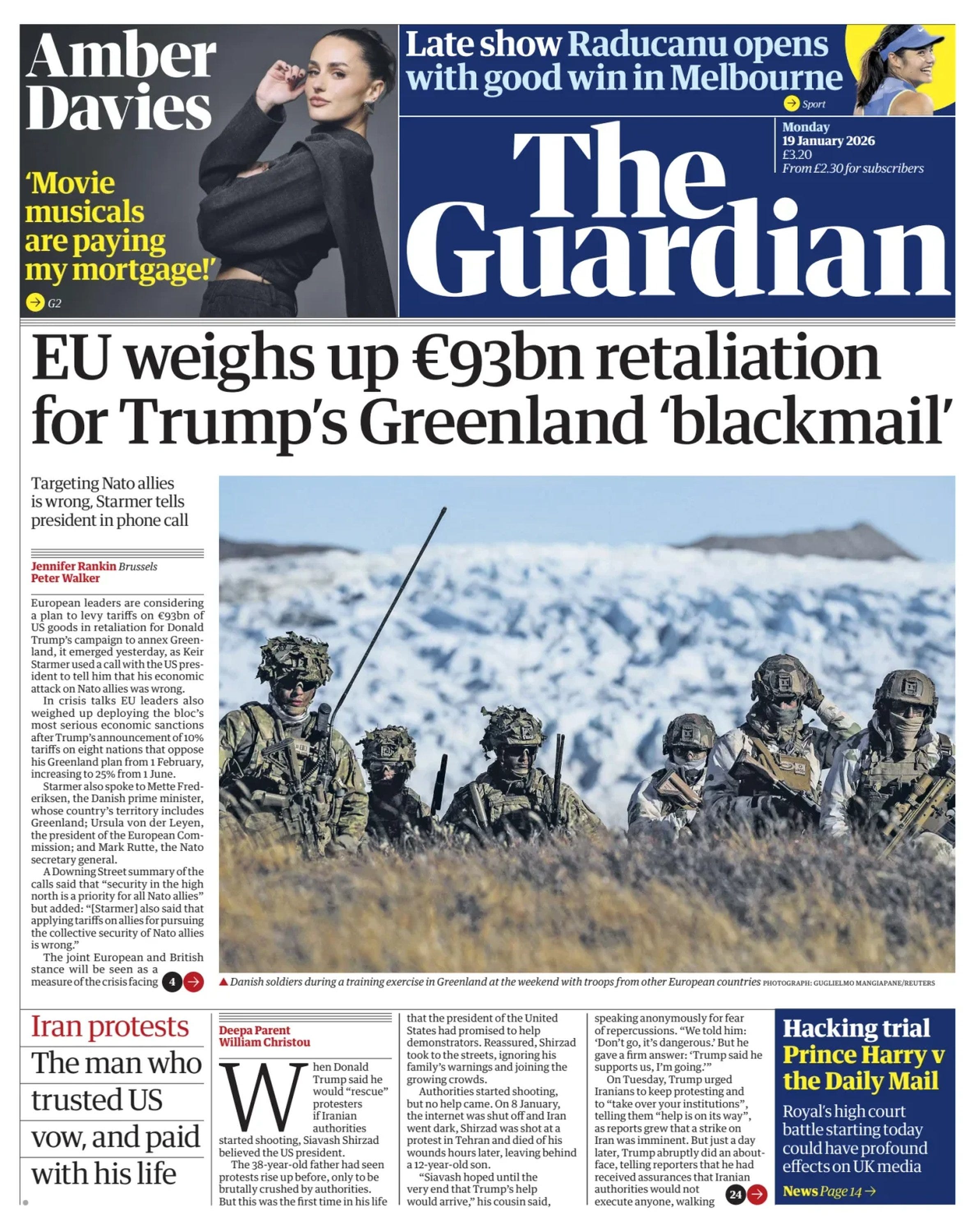
I joined Times Radio live from Odesa just hours after another major drone attack, and I said what many Ukrainians are thinking: “There is a limit to human endurance.” Yet as the pressure intensifies on the frontlines, Washington’s attention is drifting - with Donald Trump stoking theatrics over Greenland, rather than pushing Russia back from Ukraine and reinforcing NATO’s eastern flank.
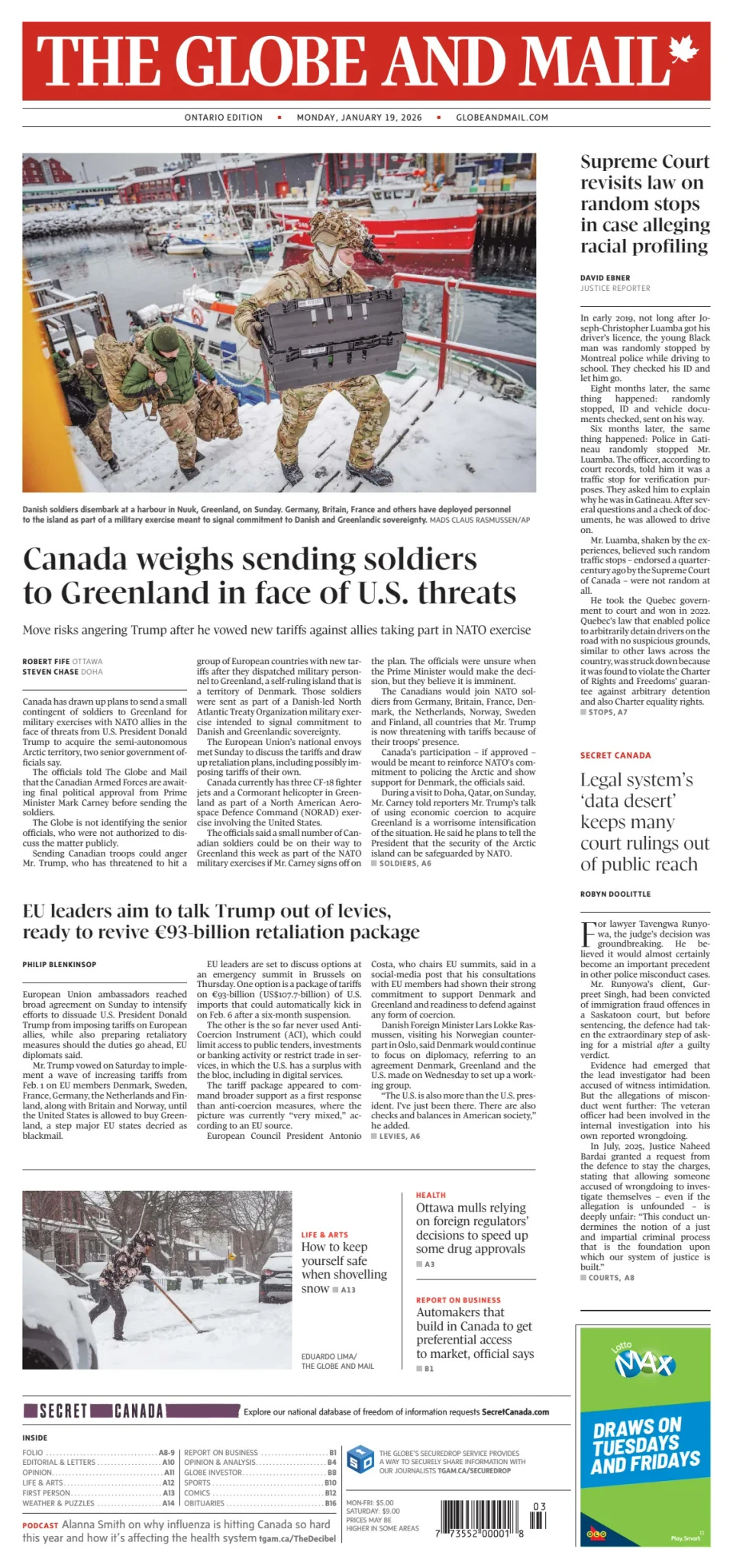
Meanwhile, Europe is scrambling to manage the fallout. German Chancellor Friedrich Merz is urging a “level-headed” approach to Trump’s latest tariff threats, warning a trade war would hit Germany’s export economy hard - while France’s Emmanuel Macron wants Brussels to reach for the EU’s Anti-Coercion Instrument, the so-called “trade bazooka.” Merz says he’ll try to meet Trump at Davos this week to cool tensions and find a way to protect Greenland without igniting a wider economic clash.
And in the most surreal subplot yet, Trump’s special envoy to Greenland - Louisiana Governor Jeff Landry - was reportedly disinvited from a traditional dog sled race, after local organizers objected to the political overtones of the visit.
🎥 Watch my Times Radio interview below — and scroll for today’s key developments.
German Chancellor Friedrich Merz on Monday sought to prevent the clash with Donald Trump over Greenland from escalating into a new trade war between Europe and the U.S., urging a “level-headed” response to the American president’s latest tariff threats. The approach signaled a tactical divide between the leaders of Germany and France over how to handle Trump’s threat to impose new tariffs on several European countries by next month. French President Emmanuel Macron on Sunday called on Brussels to activate the EU’s Anti-Coercion Instrument (ACI), the EU’s “trade bazooka,” in response to Trump’s threat to impose new tariffs on European countries as soon as next month. Merz, on the other hand, urged a less confrontational approach to Trump, acknowledging that a trade war would be especially damaging to Germany’s export-oriented economy while expressing confidence Berlin and Paris would find a common position. “France is affected by the American tariffs to a different extent than we are, and in this respect I understand that the French government and the French president want to react a little more harshly than we do,” Merz said. “Nevertheless, we are trying to adopt and will manage to find a common position” before EU leaders meet in Brussels on Thursday. German officials have often expressed frustration that Macron has been willing to take a more combative approach to Trump, but hasn’t moved as aggressively to increase Europe’s autonomy from the U.S. by striking additional trade deals with other parts of the world. French opposition, for instance, has long held up Europe’s deal with the Mercosur trade bloc in South America. Merz said he intended to try to meet with Trump at Davos on Wednesday to try to reduce tensions and change the president’s mind about tariffs, saying he thought a joint solution to protect Greenland and avert a trade war remained within reach. “We know from the experience of the last 12 months that Trump repeatedly threatens to impose tariffs,” said Merz. “He often does so, but often enough, talks and negotiations with him lead him to refrain from doing so. And that has been my strategy for the last nine months, or the last eight months, since I took office. And I will continue to pursue it in exactly the same way.” By contrast, the French president has been far more outspoken in countering Trump’s trade threats - Politico
U.S. President Donald Trump’s special envoy to Greenland was disinvited from a traditional dog sled race on the Arctic island as a crisis escalated over the fate of the autonomous Danish territory, Politico reported. The Greenland Dog Sledding Association (KNQK) objected to the invitation for Louisiana Governor Jeff Landry and last week launched an investigation into who sent it. Trump last month tapped Landry to lead his efforts to take control of Greenland. In a statement on Facebook late Sunday, the association said the tourism company that issued the invite to Landry “has unilaterally withdrawn its invitation.” Landry, a Republican who has been in office since early 2024, said he was planning to come to the island in March.
The White House has invited Russian President Vladimir Putin to join a “Board of Peace” aimed at resolving global conflicts, the Kremlin said Monday. “President Putin received an invitation through diplomatic channels to become a member of this Board of Peace,” top spokesman Dmitry Peskov told reporters during a press briefing. “At the moment, we’re looking at all the details of this proposal, and we hope to discuss all of the nuances with the Americans,” Peskov added. On Friday, the Trump administration announced the formation of a “Board of Peace,” conceived to oversee the rebuilding of Gaza after more than two years of heavy Israeli bombardment. The board’s members include U.S. Secretary of State Marco Rubio, Trump’s son-in-law Jared Kushner and Ajay Banga, head of the World Bank. The board would be chaired for life by Trump and would start by addressing the conflict in Gaza, Reuters reported, citing a draft charter. The initiative would then be expanded to deal with other conflicts as a new international peacekeeping body. Invitations to join the “Board of Peace” were sent to around 60 countries this weekend, but only Hungary, whose Prime Minister Viktor Orban is a close Trump ally, has officially signed up for the initiative. The U.S. is inviting countries to join as permanent members if they pay $1 billion within the first year of joining, Reuters reported - Moscow Times

Russian attacks on Ukraine’s energy sector continued overnight- with Russian strikes hitting the Odesa region early Monday in a massive drone attack, damaging energy and gas infrastructure, with at least one person being injured, regional authorities reported. The head of the Odesa Regional Military Administration, Oleh Kiper, added that a drone struck a multi-story residential building in Odesa. DTEK, Ukraine’s largest private energy company, said a power facility in the southern city of Odesa was “substantially” damaged in the attack, leaving almost 40,000 households without electricity. In Ukraine’s second-biggest city of Kharkiv, Russia attacked a critical infrastructure facility with four missiles, causing significant damage, Mayor Ihor Terekhov said on January 19. In Kyiv, utility workers continue working to restore heat to buildings that were left without heating after the January 9 attack on the capital. Kyiv Mayor Vitaliy Klitschko said the situation remains challenging as severe frost persists, with temperatures reaching minus 20 degrees Celsius. Emergency power outages continue, and the Ukrainian capital is operating under a state of emergency, he added. Ukrainian Energy Minister Denys Shmyhal stated on January 19 that Ukraine will work on improving electricity transmission from the western part of the country to its power-hungry eastern regions amid the ongoing Russian attack on its energy infrastructure - RFE/RL
Venezuelan interim President Delcy Rodríguez moved to tighten her grip on power, installing loyalists in top positions to insulate herself from internal threats. Rodríguez has replaced the head of the central bank and the leader of a feared intelligence agency amid worries that a military faction or militia group could attempt to oust her. One key figure helping Rodríguez maintain her grip on power is Venezuela’s powerful interior minister, who has reportedly been in touch with US officials keen to keep him on side in order to maintain relative stability, Reuters reported. Meanwhile, Rodríguez has vowed to continue working with the US, calling for a pragmatic approach as both Caracas and Washington look to boost Venezuela’s moribund oil industry - Semafor
Syria’s army and the Syrian Democratic Forces (SDF) report gun battles are underway a day after both signed a ceasefire to end weeks of deadly fighting that displaced tens of thousands of people. Syrian President Ahmed al-Sharaa plans to meet SDF chief Mazloum Abdi on Monday after the Kurdish commander missed a sit-down a day earlier because of “bad weather”. The SDF is now expected to fully integrate its fighters into the regular army as well as place public infrastructure and services into the hands of the federal government. Syrian troops have seized control over the crucial al-Omar and al-Tanak oilfields in the eastern Deir Az Zor countryside – a key point in a March 10, 2025 agreement between Damascus and the SDF - Al Jazeera
A postponed 13-minute CBS “60 Minutes” report which featured the stories of Venezuelan men deported by the Trump administration to a brutal Salvadoran prison and shelved hours before it was set to air by its new editor in chief, Bari Weiss, finally aired on Sunday’s episode. It aired without any changes to the version that the correspondent, Sharyn Alfonsi, originally finished last month. (That version was accidentally streamed by a Canadian broadcaster, and then circulated widely online.) But CBS News added two short segments, at the beginning and the end of the report, that included new comments from the Trump administration and additional details about the criminal backgrounds of the Venezuelan men who were sent to the prison, addressing two concerns that Ms. Weiss had previously expressed. The decision by CBS to air the segment came after days of tense discussions among top personnel. Ms. Weiss wanted to make changes within the piece that was originally scheduled to run last month; Ms. Alfonsi refused, arguing that it would set a poor precedent for the program’s editorial independence, according to two people briefed on internal discussions. In a statement on Sunday, CBS News said that its “leadership has always been committed” to airing Ms. Alfonsi’s segment. “Tonight, viewers get to see it, along with other important stories, all of which speak to CBS News’s independence and the power of our storytelling,” the network said. You can watch the segment here
The journals….