🔥 Hot-Take Analysis | World Briefing
What has unfolded over the past week is no longer a policy debate - it is a doctrine in motion.
The U.S. seizure of a Russian-flagged oil tanker in the North Atlantic, following a trans-ocean chase from Venezuela and carried out with helicopters, Coast Guard boarding teams, and NATO surveillance aircraft, marks a dramatic escalation. Washington is no longer merely sanctioning illicit energy flows - it is physically enforcing a global blockade, far from its shores, under the banner of law enforcement.
The message was made explicit by Defense Secretary Pete Hegseth: the blockade of sanctioned Venezuelan oil applies “anywhere in the world.”
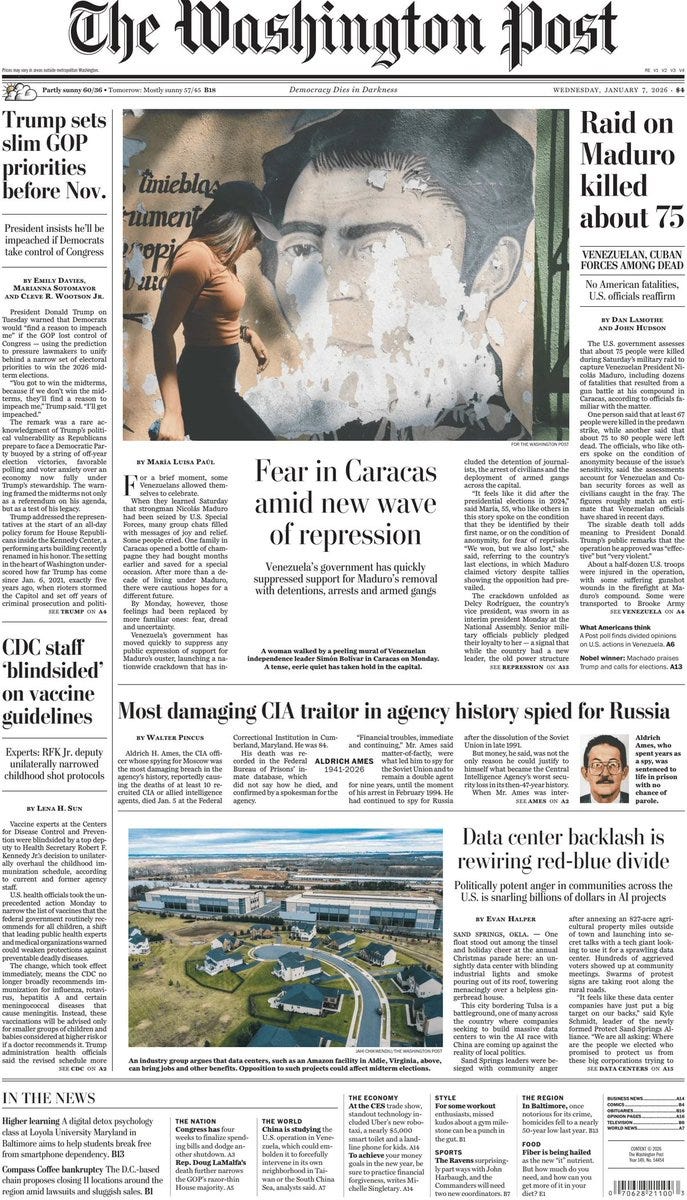
That matters - because it coincides with the most aggressive use of American military power in the Western Hemisphere in decades: the seizure of Venezuelan leader Nicolás Maduro, the imposition of de facto control over Venezuelan oil exports, and now the demand for “total access” to the country’s energy sector while expelling Chinese, Russian, and Cuban advisers.
This is coercive statecraft, enforced at sea and by force - and it does not stop at adversaries.
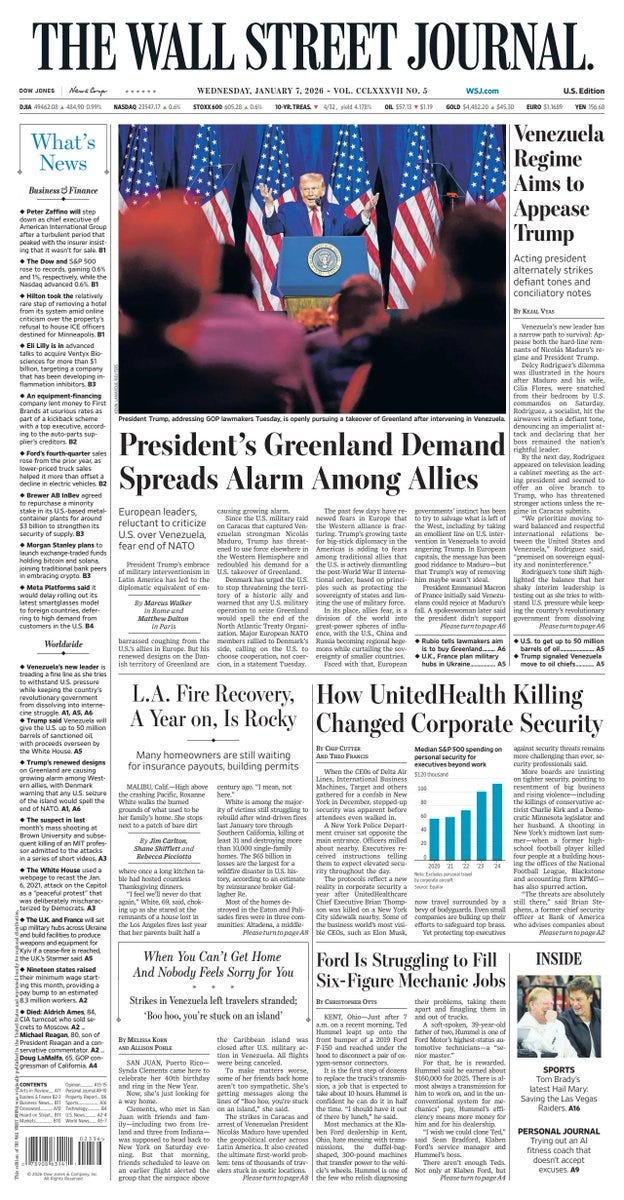
Almost simultaneously, the Trump administration has doubled down on its claim that acquiring Greenland is a U.S. national security priority - with the White House openly stating that military force remains an option. That threat alone has detonated alarm bells across Europe and the Americas - including Ottawa, because Greenland is not disputed territory. It belongs to Denmark, a NATO ally under the alliance’s collective defense umbrella.
Danish Prime Minister Mette Frederiksen was blunt: a U.S. move on Greenland would mean the end of NATO as we know it.
She is not wrong.
An alliance cannot function if its anchor member reserves the right to coerce - or seize territory from - another member. The moment Washington treats allied land as a strategic asset to be acquired rather than defended, Article 5 becomes a legal fiction.
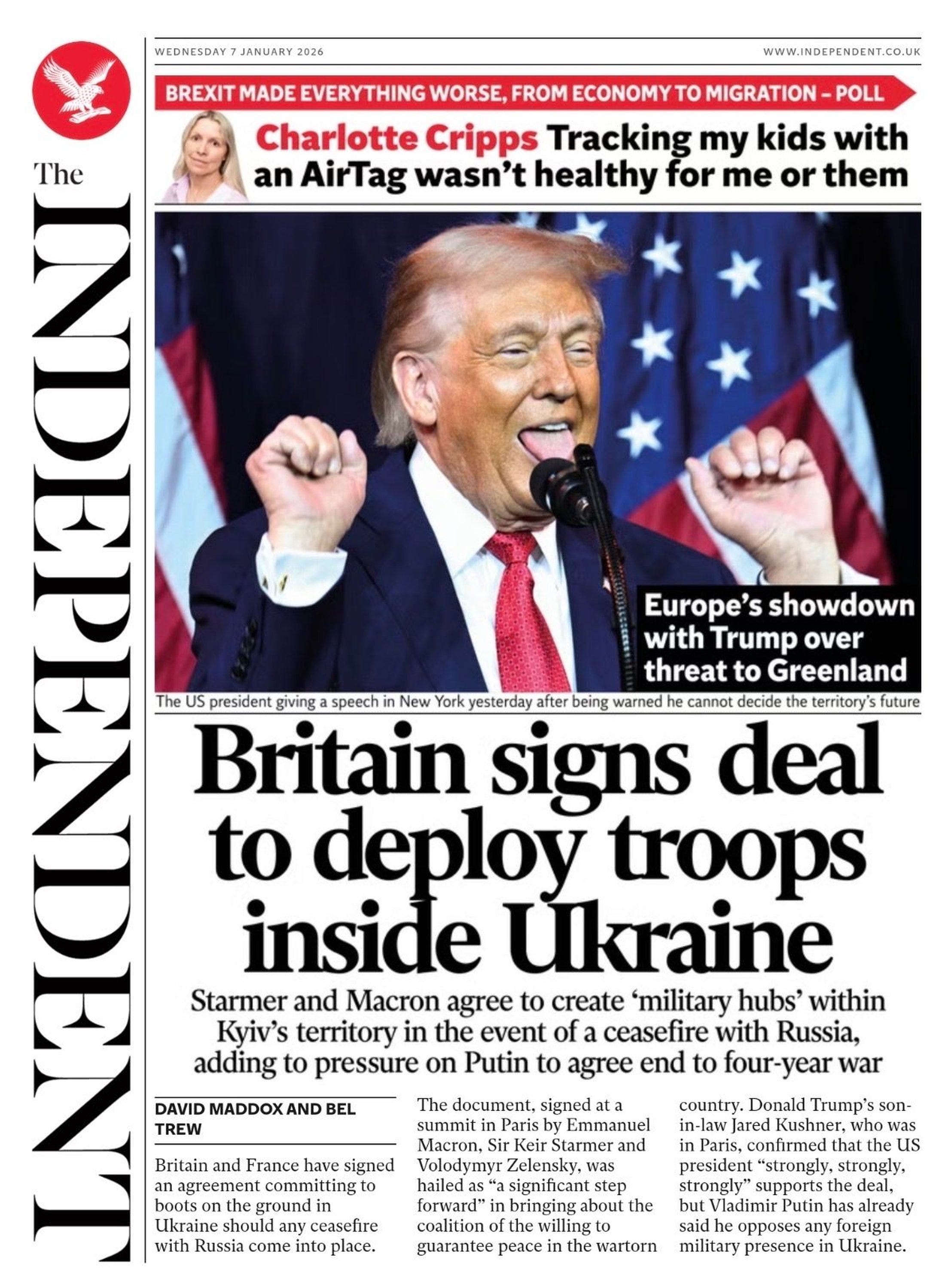
European leaders understand this, even if they avoid saying it publicly. At this week’s Paris meeting of the “coalition of the willing,” leaders advanced security guarantees for Ukraine, with Britain and France pledging troops (and with some notable exceptions - such as Italy and Germany) - but only after a ceasefire. Yet hanging over the room was an unspoken question: what are U.S. guarantees worth if they are now selective, transactional, and à la carte?
This isn’t just foreign capitals taking note. Even Megyn Kelly, a reliably pro-MAGA voice and former Fox News star, has voiced unease over Venezuela - a yellow light, she says - while Fox News barrels ahead with cheerleading. It’s a small but telling sign that the colour-blind, resource-hungry doctrine may be straining parts of its own base.
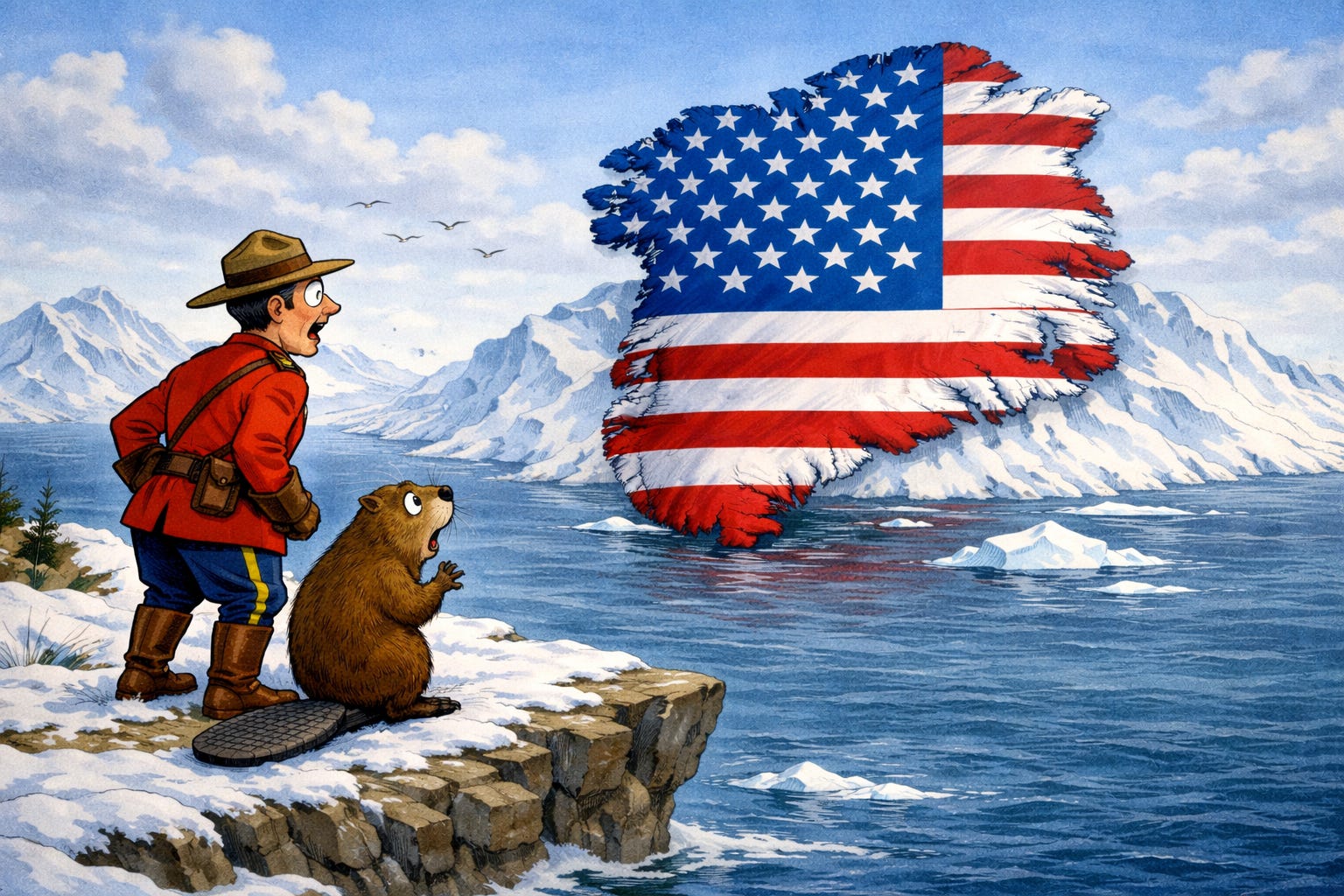
If Venezuela represents the southern test case of America’s new hemispheric enforcement, and Greenland the Arctic one, then Canada sits in a deeply uncomfortable position. Vast, resource-rich, strategically indispensable - and increasingly exposed, I explained at length to a major Canadian daily yesterday.
The pressure would not come in the form of invasion. It would arrive incrementally: energy displacement if Venezuelan heavy crude is restored at scale; treaty “modernization” over water; quiet leverage over trade, autos, and border regimes; symbolic ruptures that redefine proximity without crossing a line.
Water, not oil, may prove decisive. As climate stress intensifies, Canada’s freshwater abundance - especially under Great Lakes and Columbia River agreements - is already being used by Trump as strategic leverage. Aside from swinging his tariff baton, administration officials have raised all sort of threats - including removing U.S. pre-clearance teams from Canadian airports.
Washington is demonstrating that it is willing to project force globally, enforce embargoes unilaterally, and override political sensitivities - even when NATO allies are directly implicated.
This is the real shift: power no longer flows through alliances; alliances are now subordinate to power.
The post-war order was built on restraint backed by strength. What we are now seeing is strength untethered from restraint. As in, might is right.
And that changes everything — from Caracas, to Nuuk, to Ottawa, to Nunavut, Brussels.
The United States seized a Russian-flagged oil tanker in the North Atlantic on Wednesday, after chasing the vessel across the ocean as it headed toward Europe from Venezuela, one U.S. and one European official confirmed to POLITICO. The seizure of the tanker Wednesday morning, originally known as the Bella-1, comes more than a week after it maneuvered through a U.S. Navy blockade of sanctioned tankers leaving port in Venezuela. The ship switched its registration to a Russian-flagged vessel during the chase, setting up a possible diplomatic row with Moscow. American helicopters and a Coast Guard vessel were being used to board the tanker under law enforcement authority granted to the Coast Guard, while American and British submarine-hunting P-8 surveillance planes — and at least three smaller American surveillance aircraft — circled the area near British waters, according to plane tracking websites. The U.S. sanctioned the Bella-1 in 2024 after American officials alleged it was carrying black market Iranian oil. On Tuesday, the Russian Foreign Ministry told TASS, the Russian state media agency, that “for reasons unknown to us, the Russian vessel is getting excessive attention from the US and NATO militaries, clearly disproportionate to its peaceful status.” The Trump administration continued to strike a defiant tone after the seizure Wednesday. “The blockade of sanctioned and illicit Venezuelan oil remains in FULL EFFECT — anywhere in the world,” Defense Secretary Pete Hegseth posted on social media just as U.S. European Command conducted the operation, which was coordinated with the Justice and Homeland Security departments. Following the capture of Venezuelan leader Nicolás Maduro in a U.S. military operation last week, the seizure of the Bella is a clear sign that the administration plans to keep the pressure on Venezuela. The administration has been working to impose an embargo on sanctioned vessels as a central part of the pressure campaign since the U.S. Coast Guard boarded the Russian-flagged Skipper last month. The seizure took place with President Donald Trump taking on a far more active role in South American diplomacy in recent months. The administration’s greatest show of force to date came Saturday, when the U.S. military apprehended Maduro in his palace in Caracas to stand trial on narco-trafficking and corruption charges. Trump has since suggested that Colombia could be next on his agenda for regime change. Cuba, too, is on the president’s mind, and Secretary of State Marco Rubio has long pushed for the overthrow of the Communist government in Havana- Politico
The events of the last few days — in particular, Trump’s renewed threats on Greenland in the aftermath of the Venezuela raid — left real doubts in Europe about whether the transatlantic alliance still exists. A senior Trump adviser acknowledged there’s deep concern in Europe about Greenland but stressed the administration’s plans and discussions on this issue are in the very early stages. “In any case the security guarantees to Ukraine and Greenland are two separate things,” the Trump adviser said. European officials are treating them as such, in public at least, whatever their private doubts about whether an à la carte security alliance with Washington is sustainable. “Of course it’s weird, but we have to play with the cards we have. The Greenland issue does make everything even more complicated,” a senior European diplomat said. Danish Prime Minister Mette Frederiksen has said a U.S. move on Greenland would mean the end of the NATO alliance, a fear that has rippled across the continent. Leaders from the 30-strong “coalition of the willing” met in Paris on Tuesday to discuss security guarantees for Ukraine. Hanging over the proceedings was Trump’s renewed interest in taking Greenland from Denmark, a NATO member. Shortly before the meeting began, several of the leaders present had released a joint statement saying it was “for Denmark and Greenland, and them only, to decide on matters concerning Denmark and Greenland.” Denmark has realized in recent weeks that its strategy of quiet ally-to-ally persuasion on Greenland had failed to move Trump, a Danish official told Axios. “This is why it is such a serious situation. This is also why our allies and partners come out publicly against it and sound the alarm.” The Paris meeting itself was successful, with Ukraine, its European backers and the U.S. converging more closely than ever on security guarantees. At its conclusion, British Prime Minister Keir Starmer and French President Emmanuel Macron even signed a declaration alongside Ukrainian President Volodymyr Zelensky pledging to send troops to Ukraine as part of a post-war deterrence force. White House envoys Steve Witkoff and Jared Kushner were bullish afterwards in a press conference alongside Zelensky and the European leaders. Things got awkward when a reporter asked Starmer if such commitments meant anything when Trump was currently musing about seizing the territory of an ally, Denmark, that the U.S. has also pledged to defend. Starmer gave a brief non-answer. Later on Tuesday, White House Press Secretary Karoline Leavitt reiterated that Trump intends to acquire Greenland one way or the other, and “the U.S. military is always an option at the commander-in-chief’s disposal.” “President Trump has made it well known that acquiring Greenland is a national security priority of the U.S., and it’s vital to deter our adversaries in the Arctic region. The President and his team are discussing a range of options to pursue this important foreign policy goal,” Leavitt said - Axios
President Trump said on Tuesday night that Venezuela would begin sending oil to the United States, in what would be a significant concession by Venezuela’s new leaders after American forces captured President Nicolás Maduro. The Venezuelan government has not commented on Mr. Trump’s announcement that 30 to 50 million barrels of oil — about two months’ worth of production — would be transferred. If confirmed, the move would be the start of the president’s plan to exploit Venezuela’s vast oil reserves. Mr. Trump said he would control the profits “to benefit the people of Venezuela and the United States.” Based on his claim and at current market prices, Venezuela would be handing over between $1.8 and $3 billion worth of oil. It is unclear if it would receive anything in return. A partial blockade by the United States has curtailed Venezuela’s energy exports, a vital source of revenue. China, a major buyer of Venezuelan oil, strongly criticized Mr. Trump’s claim. In a briefing on Wednesday, Mao Ning, a spokeswoman for China’s foreign ministry, described American demands as “a classic act of bullying.” U.S. forces captured Mr. Maduro on Saturday and flew him to the United States in an operation that has been condemned by many Latin American countries, as well as staunch American allies at the United Nations Security Council. But the Trump administration has maintained its pressure on Venezuela’s government, now led by Delcy Rodríguez, the interim president. Mr. Trump has said he wants Ms. Rodríguez to give the U.S. “total access” to Venezuela’s oil industry. The American demands also include the expulsion of advisers from China, Russia and Cuba from Venezuela. Though Ms. Rodríguez has raised the prospect of dialogue with the U.S., she has also struck a defiant tone. “The government of Venezuela runs our country,” she said. “No one else. There is no external agent governing Venezuela.” - NYT
A US immigration officer fatally shot a woman in Minneapolis, officials say. The Department of Homeland Security (DHS) says the shooting happened as a “violent rioter” allegedly attempted to run over an immigration officer. Kristi Noem, the homeland security secretary, says the officer “defensively shot to protect himself.” Minneapolis Mayor Jacob Frey disputes federal officials’ account of the shooting, and demands ICE agents leave the city. Protesters are at the scene of the shooting – the mayor urges them to “show up with peace” and “do not give them what they want.” It comes during a major immigration enforcement operation in Minneapolis – more than 2,000 agents have been deployed between there and nearby St Paul - BBC
Iran’s parliament has held a closed-door session on the economy amid ongoing protests sparked by inflation and a currency collapse. RFE/RL’s Radio Farda has so far verified the deaths of 20 protesters. Some human rights sources say at least 30 protesters have been killed in the unrest, including teenagers. The Hengaw rights group said over 1,000 people have been arrested. Amnesty International said in a statement on January 6 that the Iranian security forces’ attack on a hospital in Ilam over the weekend “violates international law.” Following comments by US President Donald Trump, who has twice explicitly warned that Washington would deliver a severe blow to Tehran if it killed peaceful protesters, Iran’s Defense Council warned the Islamic republic would not confine itself to responding after an attack by its adversaries.
Protesters in Iran have seized two cities, according to unconfirmed sources. Residents of Abdanan and Malekshahi have pushed out security forces and are celebrating their victory.
Pantea Bahram, a well-known Iranian actress who ran foul of the authorities after removing her hijab in support of protesters during the Women, Life, Freedom demonstrations two years ago has posted a message of support for the protesters on her Instagram account. "Because of you, I have been waiting for the light, in my homeland," she said. As a result of her head scarf protest in 2023, Bahram was banned from any professional activity and says she is not even allowed to teach. Another prominent actress, Katayoun Riahi has also posted a message of support for demonstrators, saying 'Brave women, brave men, the light is near."
Power was being restored to thousands of households in Berlin on Wednesday that had been without electricity in freezing temperatures for four days following a suspected far-left attack on high-voltage lines, authorities said. It was the longest blackout in the city since the end of World War II. About 45,000 households and 2,200 businesses lost their supply on Saturday morning after a fire on a bridge that carries high-voltage cables over the Teltow Canal, in the southwest of the German capital, affecting an estimated 100,000 people. Authorities were able gradually to reconnect many to the network but several days of work were required to repair the damage. Some 25,500 households and 1,200 businesses were still without power on Tuesday, largely in the prosperous Zehlendorf district. Investigators have focused on a written claim of responsibility by a far-left group, headlined “Turning off the juice to the rulers,” which said a gas-fired power plant in Berlin’s Lichterfelde district had been “successfully sabotaged.” It claimed that the aim of the action was to strike the fossil-fuel energy industry, not to cause power outages. Germany’s domestic intelligence agency said self-styled “Volcano Groups” have been carrying out attacks on infrastructure in Berlin and the surrounding state of Brandenburg since 2011 - Euronews
Copper futures surged to a record high, driving revenues for African producers in particular. The Democratic Republic of Congo, which has tripled output in the last decade to become the world’s second-largest copper supplier after Chile, has seen its currency leap 28% against the dollar over the last year, while Zambia, also racing to boost copper mining, saw similar gains. Copper is vital for new technologies, from data centers to electric vehicles, and supply growth is slow, because opening mines can take decades. Copper is key to African growth, Business Insider Africa reported, but the continent faces a familiar, and regularly unmet, challenge of ensuring that populations share the proceeds - Semafor
Tony Dokoupil made his official debut as CBS Evening News anchor on Monday, but it didn’t entirely go to plan. While transitioning topics from Maduro to Sen. Mark Kelly, Dokoupil got caught between stories and without words. It was the teleprompter’s fault, The Hollywood Reporter is told — queue up your favorite Anchorman meme — the rolling virtual cue card device basically got stuck and discontinued its scroll. Dokoupil thought he was next headed to a story about former VP nominee Tim Walz, but the lineup in the prompter had another idea — as did the graphics prompt, evidently. Despite the confusion and a few long seconds of silence, Dokoupil stayed pretty cool in the moment. The moment could serve as a bit of a metaphor for the fresh start for CBS News under its new regime. In addition to a mass exodus of news talent that followed when David Ellison bought and merged Paramount with his Skydance company, new editor-in-chief Bari Weiss has made headlines for yanking a 60 Minutes story about the experiences of Venezuelans deported to an El Salvador prison by the Trump administration. Ellison and Weiss both lean right of center — or are at least right curious — whereas the former CBS News (like almost any mainstream media organization not named Fox News) slanted left - Hollywood Reporter
The journals….