Reporting from southern Ukraine
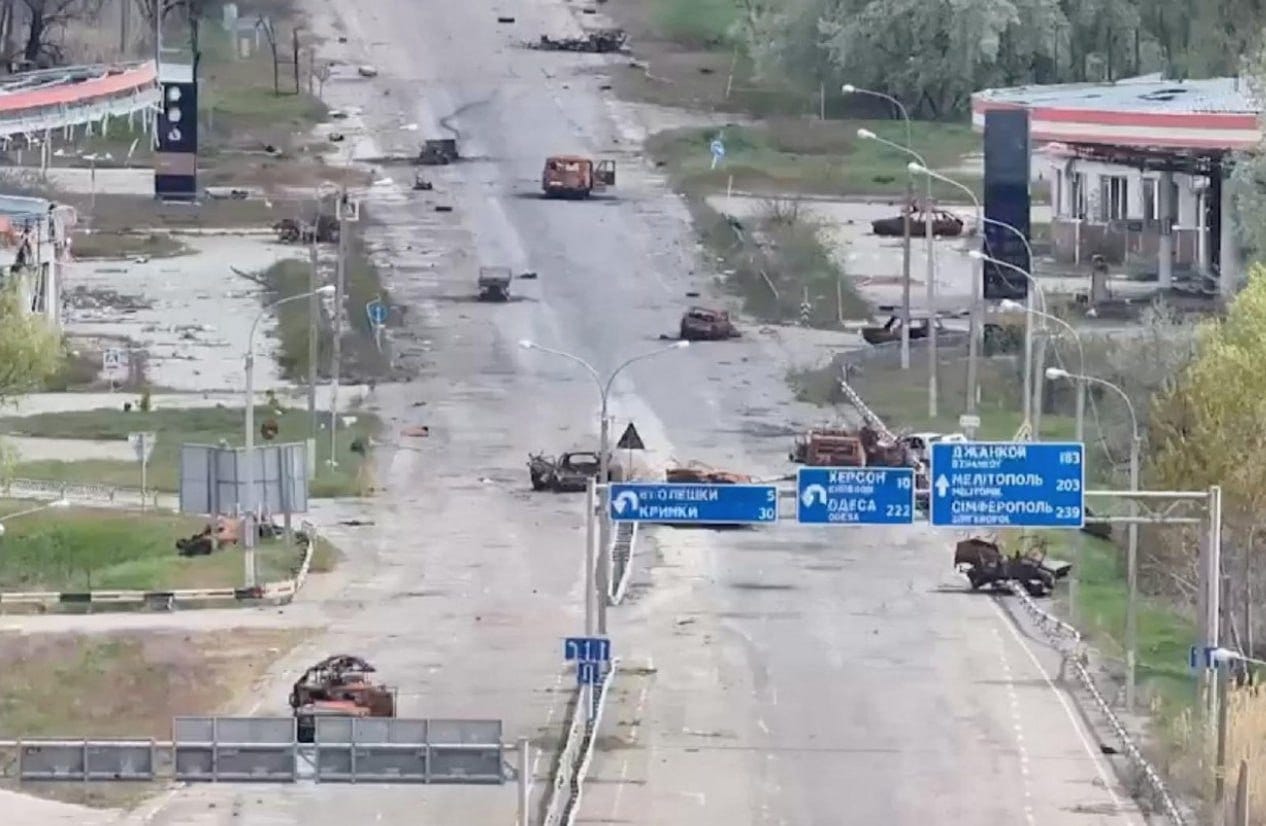
For the first time in a long while, the guns have fallen silent somewhere in Ukraine. Around Russian-occupied Oleshky, on the left bank of the Dnipro, a localized ceasefire has held for more than 30 hours without an incident, according to Ukraine’s human rights ombudsman Dmytro Lubinets. He credits his constant line to Russia’s ombudsman, Yana Lantratova. The plan is to clear mines first, then deliver aid, then evacuate civilians who want to leave.
Across the river, there are reports of a rare calm in Kherson city. Municipal crews are out clearing streets, and residents are moving around more freely. But nobody should overstate the scale of this truce. Oleshky is ground zero. Russia has declared a “quiet period” across the Kherson sector, but the occupied left bank is where Russian forces have been shelling Kherson from. The city sits within artillery and FPV drone range of those positions, and the land approaches are thick with mines. One silent week does not make that threat go away. This is a pause, not peace.
Now look at the rest of the map. The same night the Oleshky truce took effect, Russia fired 16 ballistic missiles and more than 280 drones at Ukraine, with Kyiv the main target. Air defences stopped only two of the ballistic missiles. A missile left a crater in Kyiv’s Pivdennyi Bridge. Students and staff were among those injured when a university campus was hit. A night earlier, three people were killed and 29 injured in Kyiv, seven of them children. Over a single week, Zelensky counts nearly 1,200 attack drones, more than 1,360 guided bombs and over 50 missiles. A quiet zone in one corner of Kherson does nothing to stop that.
Melania Trump deserves some credit for the truce, and Lubinets has thanked her. But the ball started rolling earlier. On 16 October, Pope Leo XIV phoned Vladimir Putin from his hospital bed, days after lung cancer surgery, and pleaded for a truce in the besieged town. The Vatican’s secretary of state said the call was the Pope’s own initiative.
“A temporary ceasefire in Oleshky to please the First Lady, Melania Trump.”
— Le Figaro editorial, 28 October
Where will they go?
The question nobody in Washington is asking is where the evacuees end up. The FT reports that people who agree to leave would be taken to Crimea or Russia before they can return to Ukraine. Zelensky is blunter. He warns Moscow will try to steer them toward Russia and keep them there, then present it as thousands fleeing Ukrainian “fascists.”
Moscow’s script was ready before the truce began. On 26 October, Yana Lantratova, declared Oleshky Russian territory where Ukrainian law has no force. She rejected Kyiv’s call for families with children to be evacuated, insisting any departure be strictly voluntary. She also claimed few residents want to leave anyway, since those who did had already gone “voluntarily.” Ukrainian drones and mines, in her telling, are the real threat. Russian soldiers and medics are the humanitarians. Note the order of priorities, too: aid first, evacuation second.
Who is watching? Not the International Committee of the Red Cross. In a statement to World Briefing, the ICRC said its teams “have not currently been requested” to support the Oleshky operation. It says it is in contact with both Moscow and Kyiv and stands ready to help, within its mandate, if asked. So an evacuation that may route civilians through Crimea and Russia is going ahead without the neutral intermediary that normally helps make sure such movements are genuinely voluntary.
Kherson has its own worry. In an interview with Radio NV on 26 October, Serhiy Nikitenko, editor of the Kherson news site Most, said there is neither the political will nor the physical means to evacuate anyone to Ukrainian-held Kherson. The road bridge is gone, the embankment is mined, and the river channels are mined by both sides. Short of helicopters, the only way out runs through Crimea or Russia. Ukraine’s military, he says, privately sees the aid convoys as the greatest danger of all: a chance for Russia to bring in drones and ammunition, and to put back drone crews pushed out of Oleshky at great cost. If that happens, he warns, Kherson could return to the spring, when it faced up to a thousand drones a day. He also says Russian forces shelter among civilians, and that only a few hundred residents have so far signed up to leave. He cautions that reports of outright famine are overstated: food gets in, but at ruinous prices. And he has read that an American media organization will run or oversee the evacuation. “Something for show,” he suspects. Le Figaro, too, reports MAGA influencers positioned on the Russian side.
I have seen this film before. With the OSCE monitoring mission in 2014 and 2015, and again during the evacuation of Mariupol in 2022, I watched humanitarian corridors and agreed red lines violated again and again. Calling Oleshky a confidence-building measure is a stretch. At best it sits alongside a prisoner swap. Russia, meanwhile, gets to play humanitarian, with no neutral witness in the room.
Meanwhile, the bad cop
On the same day the truce began, the New York Times reported that the Trump administration is weighing sanctions relief for the Russian Direct Investment Fund. RDIF is the Kremlin’s flagship sovereign fund, which the US Treasury branded a Putin “slush fund” in 2022. Moscow wants the relief as part of talks on the fund’s role in shipping Russian diesel to the United States. A US official confirmed the application is under review, framing it as a way to improve relations and end the war. The same official praised the fund’s chief, Kirill Dmitriev, as “a helpful envoy.”
RDIF is only the latest item on a growing list. In recent weeks, Trump’s envoys and Putin have discussed selling part of a Russian oil giant to a well-connected investor group. They have also discussed an Alaska gas venture, which several executives quit over concerns about hidden Russian financing, and a plan to boost Russian gas exports to Europe that has stunned European capitals. Lifting sanctions on RDIF would undo years of US economic pressure on Moscow. Ask what any of this has to do with peace. Very little, it seems. The Kremlin is using the diplomacy to do business.
And on the battlefield side of the ledger:
Air defence. Zelensky says Ukraine receives only 12 Patriot interceptors a month in 2026, the volume Pete Hegseth signed off on. This month alone, Ukraine used 35 against Russian ballistic missiles and had to find 23 more from other countries. He says there is also a serious shortage of NASAMS.
Sanctions. On 16 October, Trump suspended the “sanctions from hell” in the Graham Act, which he himself signed into law on 19 September.
Diesel. On 9 October, a deal let Russia sell 5 million tonnes of diesel. Several outlets report that Russian diesel is already en route to an East Coast port in the US.
Satellites and intelligence. SpaceX throttled Starlink and Starshield for Ukrainian forces in mid-October. Kyiv also reported a days-long pause in US missile-launch intelligence, which Washington denies.
Ukraine is still fighting for its survival, while its biggest backer holds back the very kit it needs.
News Briefs
Le Figaro led today’s front page with a striking verdict: Putin’s manoeuvres to make Ukraine bend. The paper argues that the Kremlin is accepting a localized ceasefire in Oleshky as a counterpoint to massive drone and missile strikes. Putin’s real bet, it says, is that Trump will abandon Kyiv and Europe will run out of steam. In an editorial titled “Ukraine, Trump’s choice,” Philippe Gélie lists Moscow’s recent gains from the White House. They include sanctions relief for oil, a truce staged partly to please the First Lady, and MAGA influencers positioned on the Russian side, ready to showcase the Kremlin’s “humanitarian” generosity. Gélie says Putin looks more inflexible than ever. He also flags talk of a possible US–China–Russia summit in mid-November, a new “Yalta” that could be struck over Ukrainians’ heads. Trump has a choice, Gélie concludes: give Putin the best chance to crush Ukraine, or press him to accept Trump’s own ceasefire on the current front line. The paper also reports that the Kremlin says it is ready to resume US-mediated talks with Kyiv around 10 November.
Rival satellite companies are moving to loosen Elon Musk’s grip on battlefield communications, Axios reports. The push follows SpaceX’s restrictions on Starlink service in Ukraine, which briefly disrupted drone operations and rattled officials in Europe and Washington. The gap is enormous. SpaceX operates more than 11,000 satellites. Its nearest rival, France’s Eutelsat, has just over 600, so European governments have struggled to build any real independence from Musk’s network. Non-US firms are now pitching with fresh urgency. Last week, Finland’s ICEYE and Nokia signed an agreement with Ukraine’s defence ministry to explore sovereign satellite communications for the country. Ukraine has learned this the hard way: a military that depends on a single company is exposed to that company’s decisions. For Kyiv, and for Europe, the Starlink episode reads as one more warning about the unreliable ally.
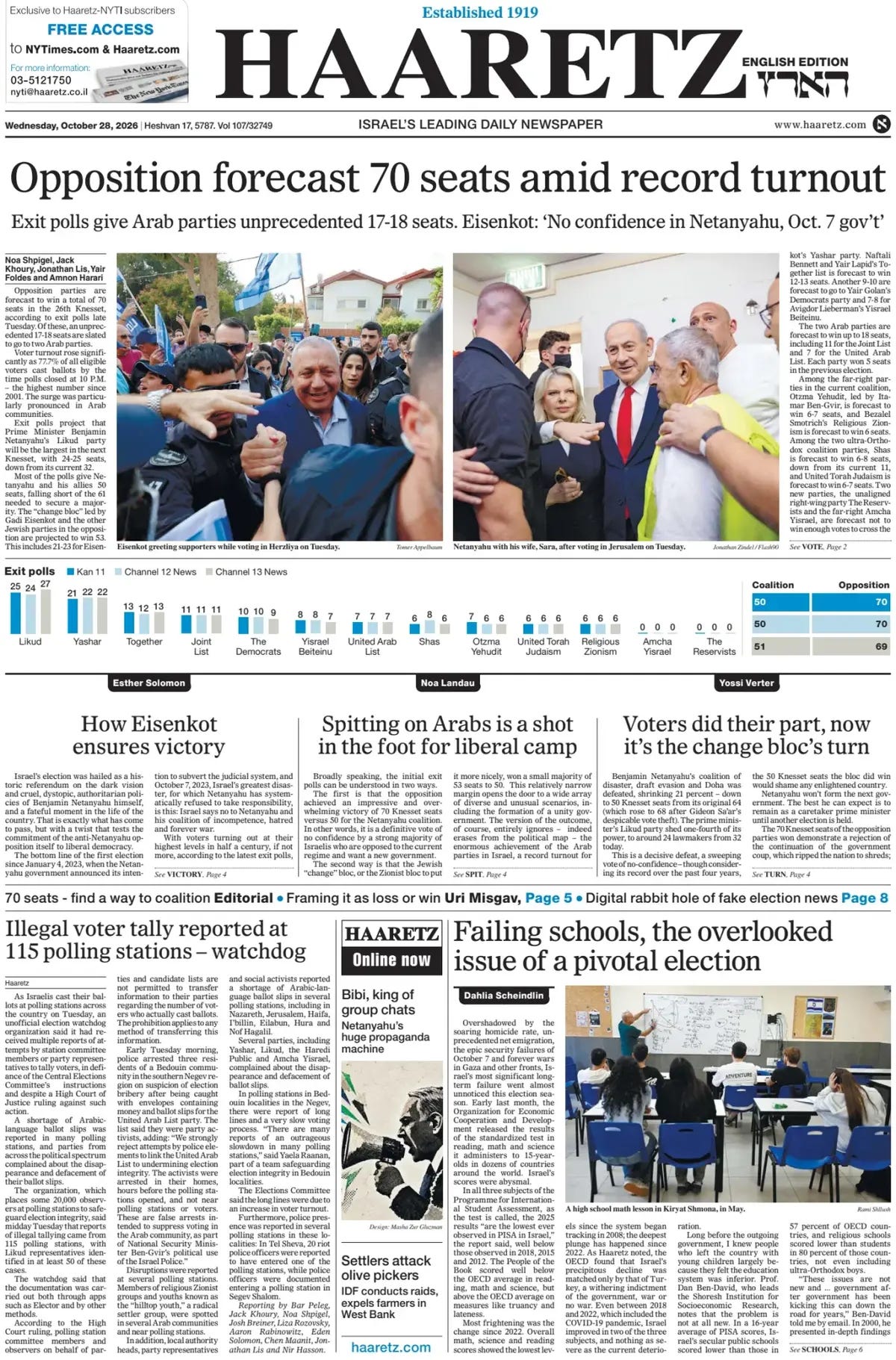
Anxious Israelis watched as election results took shape on Wednesday after many voters delivered a rebuke to Prime Minister Benjamin Netanyahu ’s far-right government, with the highest turnout in over a quarter-century. Exit polls suggested there was no clear winner and that weeks of negotiating could lie ahead. Arab-led parties appear to have made a historic showing, but it’s not clear if other opponents of Netanyahu’s government would form a coalition with them for a majority in the next parliament. Issues around the Palestinians and their descendants remain incredibly sensitive in Israel. Netanyahu was defiant early Wednesday as he seeks to remain the country’s longest-serving prime minister. He dismissed the idea of a partnership with Arab parties — whose constituents make up 20% of Israel’s population — as treasonous. His top challenger, centrist former military chief Gadi Eisenkot, has left the door open to partnering with Arab parties under certain conditions, including their recognition of Israel as a Jewish state and of Hamas as an extremist group. Some likely partners, however, have ruled that out. Whether they will change their minds to force Netanyahu from office remains to be seen. With 66% of votes counted, Netanyahu’s Likud party has 21% and Eisenkot’s Yashar party has 16.1%. Either would need to form a coalition. Election turnout was at 77.7% of eligible voters, the highest since 1999 - AP
Prime Minister Benjamin Netanyahu’s bloc is currently expected to enter the Knesset with 54 seats, the Central Elections Committee (CEC) announced on Wednesday morning after over four million votes were counted. Netanyahu’s Likud is projected to enter with 27 seats, while United Torah Judaism is expected to enter with 7, Shas is expected to enter with seven, Otzma Yehudit is expected to enter with seven, and the Religious Zionist Party is expected to enter with six.
The opposition bloc, comprising Yashar, B’Yachad, Yisrael Beytenu, and the Democrats, is expected to enter the Knesset with 47 seats, according to data from the CEC. The prospect of a unity government involving Netanyahu and Eisenkot has appeared unlikely, as Eisenkot has rejected serving under Netanyahu, including in a rotation government. Other opposition leaders have also ruled out joining a coalition led by the prime minister - Jerusalem Post
The U.S. is warning Middle Eastern allies to brace for conflict as Donald Trump prepares to launch a fresh round of attacks on Iran after next week’s midterms, according to a report. The warning to surrounding Gulf Arab nations was sent via diplomatic and military channels and is the latest indication that the 80-year-old president is plotting to escalate the fighting in an attempt to force an end to the deeply unpopular conflict, which has dragged on for eight months with no end in sight. The U.S. has been restocking its munitions in the region to prepare for a short, intense bombardment of Iran, while bomber aircraft and fighter jets are preparing for strikes, officials told The Wall Street Journal. The U.S. is sending another Patriot missile defense system to Israel to provide additional support, while U.S. troops are also being moved away from American bases around the Middle East in anticipation of an Iranian retaliation. Sources previously told CNN that it is now a question of when, not if, Trump will carry out post-midterm airstrikes against the Middle Eastern country. The strikes are expected to target Iran’s infrastructure and nuclear sites - The Daily Beast
Defeated presidential candidate Flávio Bolsonaro has left Brazil for the United States following a stunning loss to incumbent President Luiz Inácio Lula da Silva in Sunday’s election, according to multiple media reports. Bolsonaro’s brother, Eduardo Bolsonaro, who lives in Texas, had publicly encouraged him to leave Brazil if he lost the election. Bolsonaro has touted his relationship with U.S. President Donald Trump and visited the White House in May. The family connections go deeper: His brother Eduardo Bolsonaro was convicted in absentia in June of illegally lobbying the Trump administration and sentenced to four years in prison. A warrant was recently issued for his arrest. Bolsonaro’s decision to leave Brazil came as a deadline for him to surrender his regular and diplomatic passports expired at noon Tuesday. It remained unclear whether he had complied. Bolsonaro, 45, was served with the order to surrender his passports Monday, a day after his stunning loss to President Luiz Inácio Lula da Silva. Bolsonaro said he received it outside the home where his father, former President Jair Bolsonaro, is serving a 27-year sentence under house arrest for attempting a coup following his 2022 election loss to Lula. The sealed Supreme Court order, viewed by The Associated Press, was issued Sunday. Bolsonaro has refused to concede defeat and has made unsubstantiated allegations of election fraud - AP
Quebec’s new separatist government accused Ottawa on Tuesday of barring the province from this week’s EU-Canada summit in Montreal and warned it would have the last word on any deals struck there that concern its powers. The dispute erupted Tuesday morning when Quebec Justice Minister Marie-Claude Sarrazin said in a statement that Ottawa had refused Premier Paul St-Pierre Plamondon’s request to address the summit, which opens Thursday. St-Pierre Plamondon said in a post on X that the decision revealed a “serious lack of respect,” adding that Ottawa would rather he “serve shrimp cocktail” at a function rather than address one. Ottawa also turned down a September request from the previous Quebec government to host a reception on the sidelines of the summit, Sarrazin noted. Prime Minister Mark Carney hit back, saying St-Pierre Plamondon had himself turned down an invitation to the Thursday night summit dinner. “It’s his decision to leave an empty chair again,” Carney told reporters in French. The tiff threatens to overshadow an international gathering that Carney, Commission President Ursula von der Leyen and European Council President António Costa have billed as a step change in mutual relations, driven by U.S. President Donald Trump’s aggressive tariffs and scorn for the postwar Western consensus. Early drafts of the joint declaration include a digital trade deal and a pact that lets the European Investment Bank finance Canadian critical minerals projects. Many of those deliverables fall under provincial jurisdiction, such as natural resources. “’When you’re not at the table, you’re on the menu,’ Prime Minister Carney told us,” Sarrazin said in her statement. “The federal government has chosen to prevent Quebec from having a say on its own territory.” Whatever agreements are signed at the summit, “Quebec is sovereign in its fields of jurisdiction internationally, so it will have the last word,” Sarrazin warned. - Politico
President Trump applauded Quebec's new separatist premier Tuesday, continuing to jab at Ottawa despite fragile trade talks that seemed to be gaining momentum. On Tuesday, October 27, Trump posted on Truth Social: “Congratulations to Paul St-Pierre Plamondon on his WIN!” — more than three weeks after the Parti Québécois won Quebec’s October 5 election. But here’s the interesting part: Trump also shared an article describing the separatists’ victory as a “blow to Mark Carney,” making the message look like more than just a routine congratulations. The Parti Québécois won 59 of Quebec’s 127 seats and wants to hold another independence referendum, although Plamondon has said he would wait until Trump leaves office.
An Egyptian court has convicted Lina Attalah, editor-in-chief of independent outlet Mada Masr, of running an unlicensed website and ordered the newsroom shut. The New Cairo Misdemeanour Court on Tuesday fined Attalah 3 million Egyptian pounds (about US$54,000) and ordered Mada Masr closed and its equipment seized. She is in custody until the fine is paid. The charge is circular: Mada Masr has repeatedly applied for a licence, only to be rejected or ignored. Journalists were reportedly ejected from the courtroom at key moments, and the defence was barred from submitting documents or calling witnesses. The Committee to Protect Journalists called it “a devastating blow to press freedom in Egypt.” The ruling follows this month’s detention of Matsadaash’s entire six-person newsroom. Egypt now jails 25 journalists, the most since 2021. Why it matters: Mada Masr is one of the last independent newsrooms inside Egypt. Turning an unanswered licence application into a conviction tells every remaining reporter that paperwork is now a weapon.
Growing reports indicate that the iPhone Duo, Apple’s new foldable phone, is not living up to expectations — specifically, some units are developing cracks where they should not. Apple says it will make good on what some online posters are calling “Crackgate.” While most people interviewed report that their iPhone Duos are working just fine and they are happy with the new product, at least a handful of users say the phones, which start at $2,000, are not ready for prime time. Reports of the phone's inner screen cracking under strain have led some to dub the controversy "Crackgate." - NBC News
The journals…