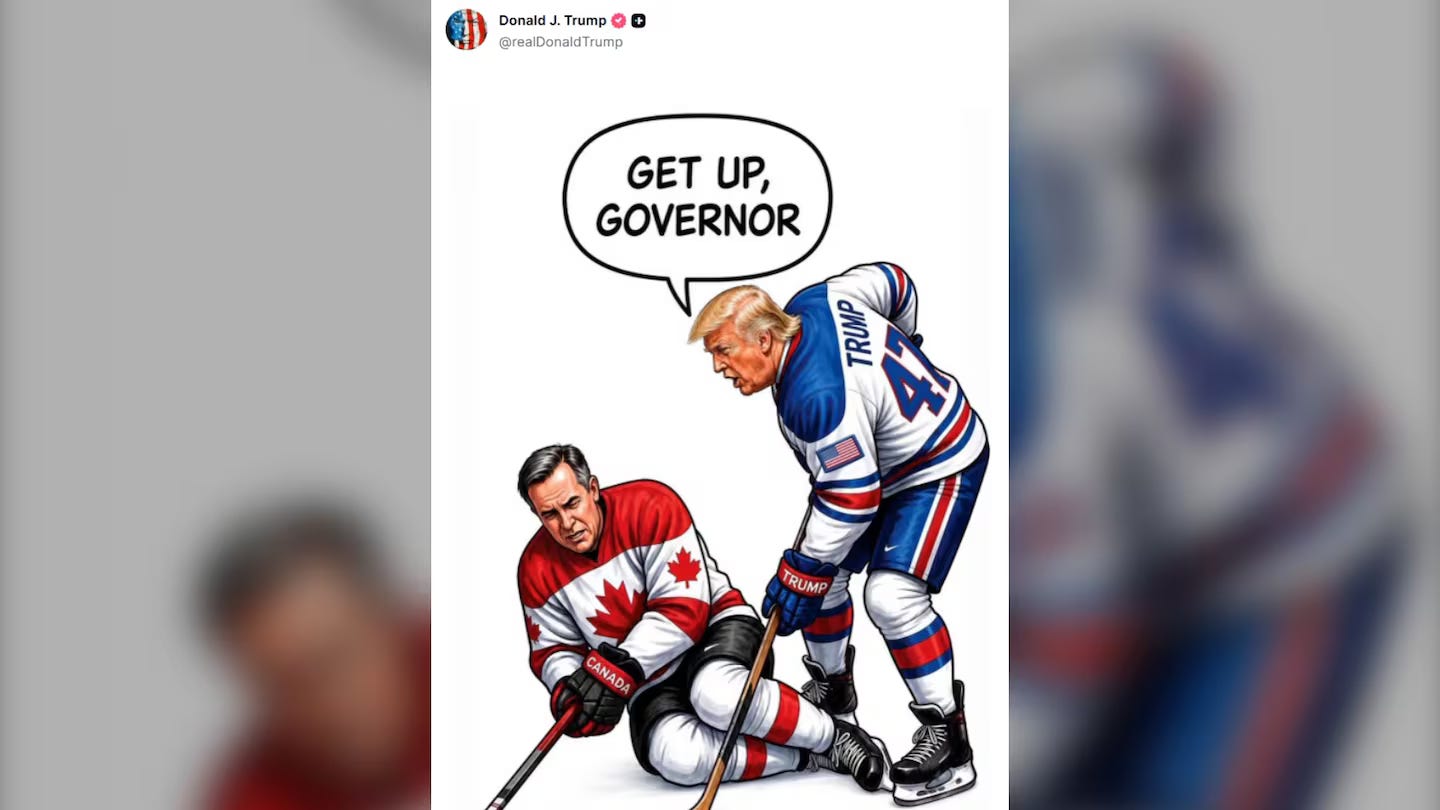
Of all the things that could mark the worst week in modern Canada–U.S. relations, a cartoon was not on my list.
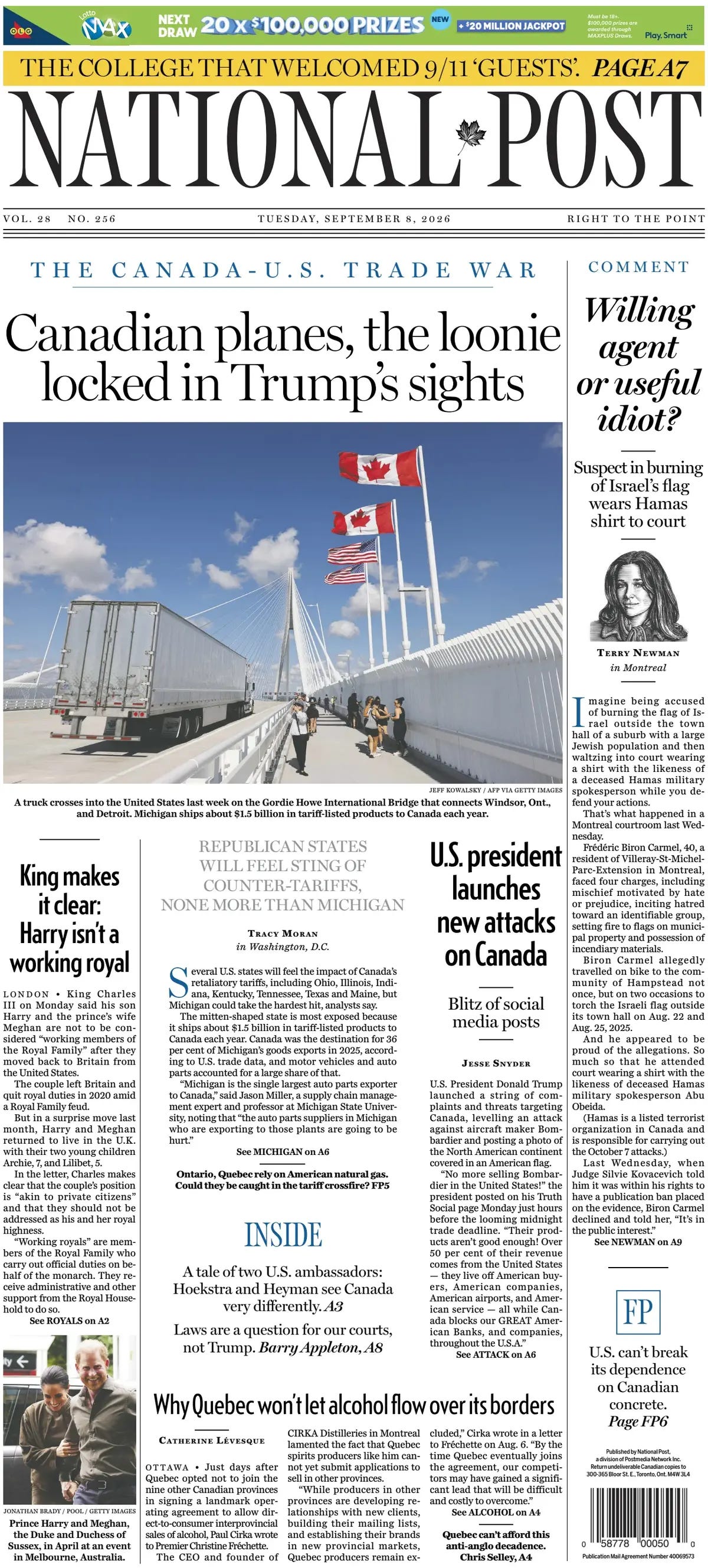
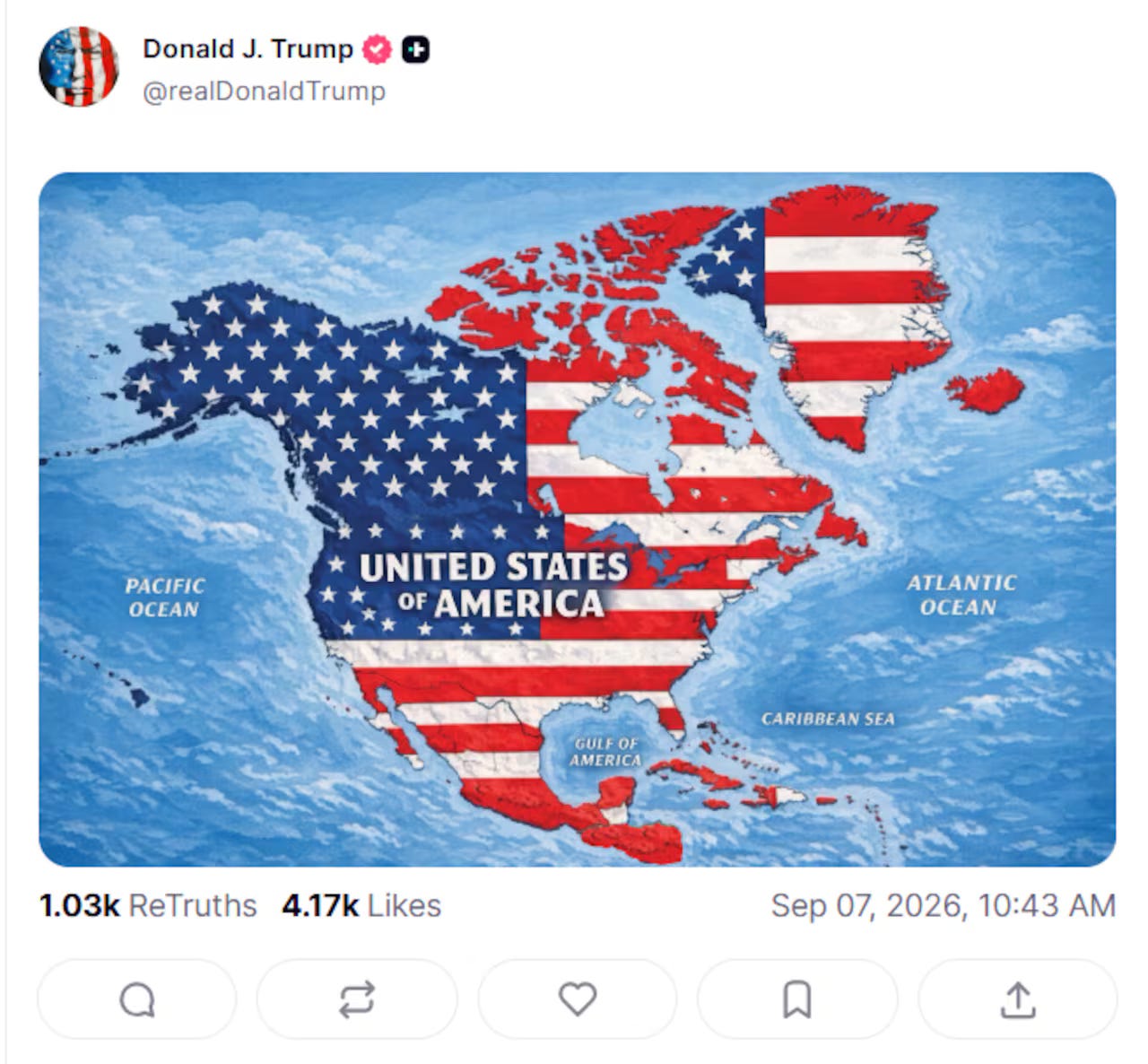
Hours before Canada’s counter-tariffs were due to bite, Donald Trump posted an image to Truth Social of himself in a USA Hockey jersey, standing over a sprawled Mark Carney in a Hockey Canada sweater. The caption: “Get up, governor.” Earlier the same day he had declared the Canadian dollar’s exchange rate “unacceptable.” By Monday afternoon he was demanding a boycott of a Canadian aerospace company, Bombardier.
Canadians woke up to all of it, and I suspect a great many of us needed a Tim Hortons double-double in hand before we could accept it wasn’t a nightmare.
An animated version is now circulating — the same cartoon, moving, in which Trump cross-checks the prime minister to the ice and beats him with his stick. Whether that clip came from the president or from one of the accounts that launders his output is, at the time of writing, unresolved. Nobody in the White House has bothered to disown it. Nor would it be out of character: in February, after the U.S. beat Canada for Olympic gold in Milan, Trump posted an AI video of himself punching Canadian players on his way to the winning goal.
I try to be careful with the word unhinged. But there is no honest alternative for a head of state taunting his closest neighbour — a treaty ally and founding NATO member — with a humiliation meme, on the eve of a rupture that will cost workers on both sides their jobs. The “governor” line is not a joke. It is the 51st-state fantasy in cartoon form, and Canadians read it exactly that way. That we now have to spend a morning establishing which version of our own humiliation the president personally endorsed is itself the point.
Then the tariffs landed. At 12:01 a.m. Eastern Tuesday, Ottawa’s retaliation took effect: roughly C$27.6 billion — about US$20 billion — of American goods, hundreds of product lines, duties from 15 to 50 per cent. Steel and aluminum doubled to match Washington’s rate. Furniture, appliances, farm equipment, dairy, electronics. Cotton T-shirts. The language is “dollar for dollar,” and that is the point: not a bargaining posture, a mirror.
Economists are right that this will raise prices at the till, and that most of it won’t bite until contracts roll over next year. They are also missing the larger story. This was never about the price of a sofa.
The Bombardier tell
“NO MORE SELLING BOMBARDIER IN THE UNITED STATES!” Trump wrote, unless the company builds its aircraft on American soil. Set aside that its business jets are among the most reliable flying, and used across the U.S. corporate fleet. Set aside that Bombardier’s own reply was to note it already operates in ten states, and that the wings, engines and avionics are largely American-supplied. Banning Bombardier means taxing Wichita and Fort Lauderdale.
For Canadians the company is not an abstraction. It began as a snowmobile maker in rural Quebec and became a global aerospace player. It is one of the things we point to. Threatening it is not an economic argument; it is a poke in the eye, and it will be received as one.
The potash slap shot
That is the loud version. The quiet one I wrote about here months ago, and it tells you none of this was improvised. Canada is the world’s largest potash producer, most of it from Saskatchewan, and the overwhelming share of what goes into American soil comes from us. There is no quick substitute — on paper, one of the strongest cards Ottawa holds. So watch what Washington did with it. In December the administration lifted sanctions on Belarus’s potash sector in exchange for 123 political prisoners, and eased them further in March. Then in May the State Department circulated a paper to Lithuania, Poland and Ukraine, obtained by RFE/RL, asking all three to permit transit: American firms wanted to buy and ship Belarusian potash, and avoiding Russian ports meant a route through their territory. All three refused.
The stated rationale was prying Lukashenko from Putin. Judge it on its merits. But if you intend to put a 50 per cent wall around Canadian trade, you would want an alternative source of the one commodity your farm belt cannot do without, lined up in advance. I can’t prove intent. I can point out the pattern: the noise is on Truth Social, and the manoeuvre happened six months earlier in a document nobody was meant to read.
The levers we haven’t pulled
Here is what Washington appears not to have priced in: Canada has barely started. What has been announced is conventional. The unconventional sits untouched — electricity flowing to millions of American households, oil moving south, uranium, critical minerals, potash. Ottawa has been disciplined about not reaching for any of it, and there is a case for keeping that discipline. But the option exists, public opinion increasingly supports using it, and every meme makes it likelier. The potash episode is also a warning: those levers are worth less every month Washington spends quietly building around them.
Because that is the real effect of Sunday night. Polls already showed most Canadians backing retaliation knowing it will cost them; humiliation content doesn’t soften that, it hardens it. Carney, whose position now rests entirely on not blinking, has been handed a gift he didn’t need. Meanwhile the trade map is being redrawn — not north–south, the way it has run since the 1965 Auto Pact, but east–west inside the country and outward, to Europe, to the Indo-Pacific. That is no longer rhetoric. It is procurement policy.
What Singapore sees
I write this from Singapore, and it is worth stepping out of the North American frame.
Thailand is a U.S. treaty ally. So are the Philippines, currently absorbing the most consequential maritime pressure in the region. Singapore isn’t one formally, but it is about as close as a country gets without the paperwork — hosting American naval logistics, quietly underwriting the U.S. presence here for decades. All of them are watching Washington take a hockey stick to its closest friend, largest trading partner and the country that shares its air defence. The lesson is not subtle: alliance with the United States is no protection from the United States. That is a tactical problem for planners in Manila and Bangkok. It is also an ethical one, and the ethical version travels faster — through Seoul, through Copenhagen, where the Greenland obsession has not gone away, and through every European capital recalculating what an American guarantee is worth.
We are in uncharted waters, and I don’t say that for effect. In modern history there has been no period in which the United States treated its allies as adversaries and its adversaries as peers, simultaneously and on purpose. Canada has become the test case the rest of the world is studying.
Which brings me to the part hardest to convey to people who don’t know the country. Canadians are not built for this. We are, by long habit, the ones who apologise first and split the difference. Staying in a fight with our largest partner, knowing it will cost us, runs against much about how we behave. That is exactly why it matters that we’re doing it anyway — and why nobody in Washington should mistake the politeness for softness.
We sing about the true north, strong and free. The free part we have always taken as given. It is the middle word being asked for now.
I fly to Canada on Friday to report this from the ground, before UN high-level week. I suspect the mood I find will be angrier, and steadier, than Washington expects.
More from the road this week for World Briefing Plus subscribers.
Israeli Foreign minister Gideon Saar says Israel will close the British consulate in Jerusalem - one of four “counter-measures” against the UK. Israel is also banning 11 MPs from entering the country, including Zarah Sultana, Jeremy Corbyn, and Diane Abbott. The move comes after UK Foreign Secretary Ed Miliband told Parliament the UK would ban the import of goods from Israeli settlements in the illegally occupied West Bank. Miliband said “ethnic cleansing” was being carried out by “settler terrorists” and accused the Israeli government of turning a “blind eye.” Eleven countries - including France, Canada, Spain and Poland - will implement the same sanctions on Jewish settlements in the West Bank, which are illegal under international law. Israel has been planning to develop 1,200 new homes in the occupied West Bank and there has been a rise in settler attacks on Palestinians this year - BBC
A Chinese state-owned firm has supplied Russia with the materials required to build hundreds of kamikaze drones, according to internal Russian company shipping documents obtained by POLITICO. The records, which have been reviewed by Western governments, provide the clearest evidence yet of a Chinese-state corporation continuing to aid a sanctioned company in the Kremlin’s military industrial complex. The shipping and customs documents reveal the Chinese firm disguised the shipment of 46 tons of carbon-fiber chemicals to a subsidiary of Russia’s Rosatom earlier this year. The corporation develops the key components of the kamikaze drones Moscow said to have been used to attack a shopping mall in central Ukraine in August, killing at least 16 people. Chinese components have long been retrieved from Russian drones following strikes on Ukraine. Yet the documents gathered from Russian sources by the Ukrainian Security and Cooperation Centre — a Kyiv-based think tank close to the Ukrainian government — detail for the first time how a Chinese state firm exported crucial drone-making components directly to Russia. The USCC has shared the documents with the U.K. and U.S. governments. These revelations “would allow the [U.S.] State Department to sanction” the Chinese supplier, because they “establish” shipments to Rosatom’s subsidiary after it was sanctioned by much of the West, said David Albright, founder and president of the Washington-based Institute for Science and International Security think tank. The shipment, he points out, is disguised with a customs code for exports like nylon and polyester. The U.S. House Select Committee on China has reviewed the documents and determined they are “legitimate,” according to a U.S. government official familiar with their contents. The Ukrainian government has also reviewed the documents and confirmed their authenticity, a Ukrainian official said. Both officials were granted anonymity as they were not authorized to speak on the record. The Chinese government has consistently denied providing weapons to support Russia’s war on Ukraine. “We would not add fuel to the fire, and above all we would not profiteer” from the conflict, Chinese leader Xi said in 2023. The scale of the shipments and the military importance of the Russian company receiving them, however, suggest Chinese officials are either turning a blind eye to that assistance or are actively facilitating it, said multiple U.S. weapons experts, former intelligence officials and diplomats.
Russia hammered the Ukrainian capital with ballistic missiles, killing at least two people in a major attack hours after White House envoys left Kyiv amid a renewed push for peace negotiations. The September 8 attack followed a lull in near daily attacks that underscored Russia’s intent to press forward in its nearly 4 1/2-year war on Ukraine despite astronomical casualties. Emergency workers pulled bodies from the rubble in one district of Kyiv while firefighters battled to put out fires from the attack, which also included jet-powered drones -- a powerful weapon that Ukraine has struggled to defend against. At least 10 people were wounded, emergency officials reported. The Russian attack included dozens of ballistic and cruise missiles along with more than 160 drones overnight, Ukraine’s military said. Over the past week, Russia has hit Ukraine in near daily attacks. Ukraine’s ability to defend against the assaults has been severely constrained by a lack of missile interceptors, above all US-built Patriots. The attack came hours after US envoys Steve Witkoff and Jared Kushner departed Kyiv following meetings with Ukrainian President Volodymyr Zelenskyy and other officials. Prior to Kyiv, the pair visited Moscow for talks with President Vladimir Putin - RFE/RL
A British MP has referred Andrew and Tristan Tate to Counter Terrorism Policing over a 40-minute video the brothers filmed themselves — riding a T-80 tank, lobbing grenades and firing a flamethrower on a Russian military range during a June trip to Moscow. Writing in The Moscow Times, Kateryna Shenheliia reports that Conservative MP Alicia Kearns, former chair of the Foreign Affairs Select Committee, made the referral in late August. The question is whether the pair should have registered under the Foreign Influence Registration Scheme; undeclared work for a specified foreign power carries up to five years. No evidence has surfaced that Moscow paid or directed them. Their representative calls the trip private and personal. Shenheliia’s argument is that the access — including an officer joking about a medal from the defense minister — is not something you can simply buy, and that’s exactly what the law was written to expose. Charges look unlikely on this front. The brothers are in Miami awaiting extradition on sex and trafficking charges — material prosecutors find far more workable.
The journals…