


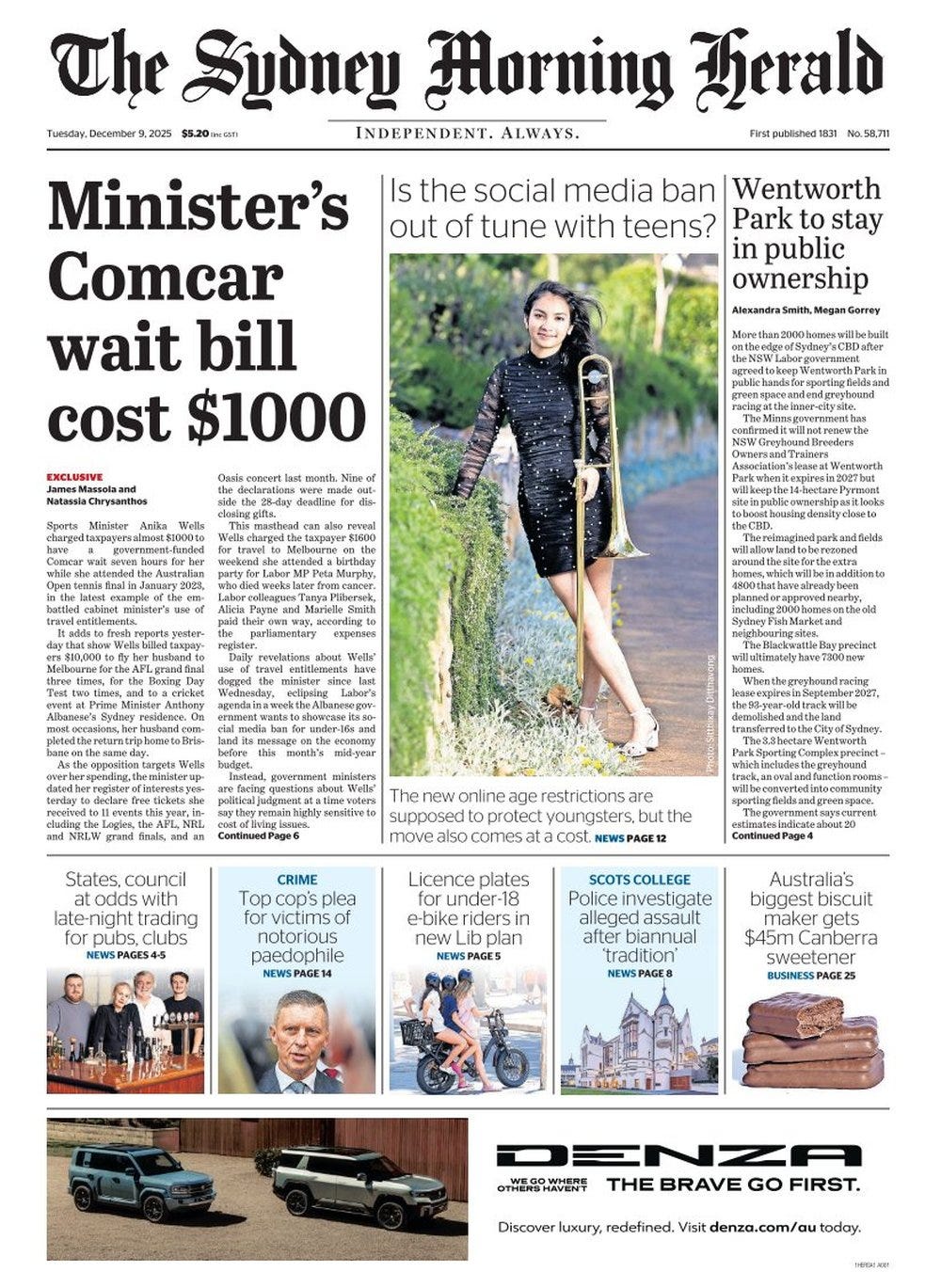
Australia has just flipped the global switch on Big Tech.
From today, anyone under the age of 16 is officially locked out of the world’s biggest social media platforms — from Facebook and Instagram to TikTok, Snapchat, YouTube, Reddit, Threads, Twitch and X. Platforms have been ordered to delete existing youth accounts and block new registrations. Fail to comply, and they face fines of up to $49.5 million.
Supporters are calling it bold. Critics call it unrealistic. Teenagers, predictably, are already plotting workarounds.
But Australia is now the world’s first real-world test case for a question every parent, teacher and policymaker has been quietly asking for years: Can society finally put hard limits on platform power over children’s minds?
During the pandemic, I saw the best of what tech could do. In researching my book Digital Pandemic: How Tech Went From Bad to Good, I watched how social platforms kept isolated families connected - kids talking to grandparents in care homes, students staying afloat through remote learning, friendships surviving lockdowns.
But long before COVID, I was researching smartphone and social media addiction - and what I saw on the other side was far darker. I visited a rehabilitation center near Seattle where teenagers arrived barely able to communicate face-to-face after years of compulsive screen use. I documented a phone-free school near Silicon Valley where students thrived socially and academically once devices were physically removed. And I spoke to a former algorithm designer who later admitted his job had been to engineer addiction — before switching sides to build tools that now encourage people to pause before opening toxic apps.
One of the most stunning discoveries of my book research was one of the saddest — at least as far as humanity is concerned. Strolling after class one day at California State University, Dominguez Hills, Larry Rosen, a research psychologist and professor emeritus, told me that humans are the only species on the planet with the ability to daydream with creative thoughts — something he calls “slack time.” But excessive screen time is diminishing that skill. “If you don’t use it, you lose it. And we’re losing something that’s uniquely human,” Rosen said.
This is not about nostalgia. It is about neurology, behavior, public health and profit - and who really pays the price.
Australia’s Prime Minister Anthony Albanese offered simple advice to the newly disconnected under-16s: Start a new sport. Learn an instrument. Read that book on your shelf. Most importantly — spend real, face-to-face time with friends and family.
It sounds quaint. It may also be revolutionary.
This ban is an experiment — and the platforms will fight it ferociously. But one thing is already clear: for the first time, a major democracy has decided that children’s wellbeing matters more than Big Tech’s growth metrics.
The world is now watching.
“The average American teenager got their first smartphone before entering their teens, at roughly 10-years-old. They spend about five hours a day on their phones – not including talking and texting – while the healthy maximum is said to be one to two” - Michael Bociurkiw, CNN Opinion
Australia has enacted a world-first ban on social media for users aged under 16, causing millions of children and teenagers to lose access to their accounts. Facebook, Instagram, Threads, X, YouTube, Snapchat, Reddit, Kick, Twitch and TikTok are expected to have taken steps from Wednesday to remove accounts held by users under 16 years of age in Australia, and prevent those teens from registering new accounts. Platforms that do not comply risk fines of up to $49.5m. There have been some teething problems with the ban’s implementation. Guardian Australia has received several reports of those under 16 passing the facial age assurance tests, but the government has flagged it is not expecting the ban will be perfect from day one. All listed platforms apart from X had confirmed by Tuesday they would comply with the ban. The eSafety commissioner, Julie Inman Grant, said it had recently had a conversation with X about how it would comply, but the company had not communicated its policy to users. Bluesky, an X alternative, announced on Tuesday it would also ban under-16s, despite eSafety assessing the platform as “low risk” due to its small user base of 50,000 in Australia. Children had spent the past few weeks undertaking age assurance checks, swapping phone numbers and preparing for their accounts to be deactivated. The Australian chief executive and co-founder of the age assurance service k-ID, Kieran Donovan, said his service had conducted hundreds of thousands of age checks in the past few weeks. The k-ID service was being used by Snapchat among others. Parents of children affected by the ban shared a spectrum of views on the policy. One parent told the Guardian their 15-year-old daughter was “very distressed” because “all her 14 to 15-year-old friends have been age verified as 18 by Snapchat”. Since she had been identified as under 16, they feared “her friends will keep using Snapchat to talk and organise social events and she will be left out”. - The Guardian
Australian Prime Minister Anthony Albanese has told under-16s blocked from social media to “make the most” of the upcoming school holidays and has suggested some alternative activities. “Start a new sport, learn a new instrument, or read that book that has been sitting there on your shelf for some time,” he says in a video message recorded ahead of the ban. “Importantly, spend quality time with your friends and your family, face to face,” Albanese also says. Young people “know better than anyone” of the pressure that comes from engaging with social media, he continues, adding the government has banned its use for under-16s to support them - BBC
Ezra Sholl, 15, from Melbourne, is quadriplegic and says social media has given him access to a community of like-minded people. Ezra was diagnosed with Hodgkin’s lymphoma, which triggered a rare nerve condition that has paralysed him. “I follow the NBA, Australian rules football, I follow movie accounts and music accounts,” he says ahead of the ban coming into effect. “Banning social media will make my world smaller,” he said via Facebook messenger. Social media accounts connect him with his friends, he says. “As a young person with a disability, taking away access to social media has the potential to cause harm as well.” He agrees that social media can cause harm to young people, but “social media companies owe a duty to make their platforms safe. The ban itself is a band aid solution that doesn’t actually fix the issues” - BBC
“From photos posted online to medical records stored in the cloud, many children have a digital footprint before they can even walk or talk” - UNICEF, State of the World’s Children Report, 2017
President Donald Trump denounced Europe as a “decaying” group of nations led by “weak” people in an interview with POLITICO, belittling the traditional U.S. allies for failing to control migration and end the Russia-Ukraine war, and signaling that he would endorse European political candidates aligned with his own vision for the continent. The broadside attack against European political leadership represents the president’s most virulent denunciation to date of these Western democracies, threatening a decisive rupture with countries like France and Germany that already have deeply strained relations with the Trump administration. “I think they’re weak,” Trump said of Europe’s political leaders. “But I also think that they want to be so politically correct….I think they don’t know what to do,” he added. “Europe doesn’t know what to do.” Trump’s comments about Europe come at an especially precarious moment in the negotiations to end Russia’s war in Ukraine, as European leaders express intensifying alarm that Trump may abandon Ukraine and its continental allies to Russian aggression. In the interview, Trump offered no reassurance to Europeans on that score and declared that Russia was obviously in a stronger position than Ukraine.
The president of the European Council, António Costa, on Monday rebuked the Trump administration for the national security document and urged the White House to respect Europe’s sovereignty and right to self-government. “Allies do not threaten to interfere in the democratic life or the domestic political choices of these allies,” Costa said. “They respect them.”
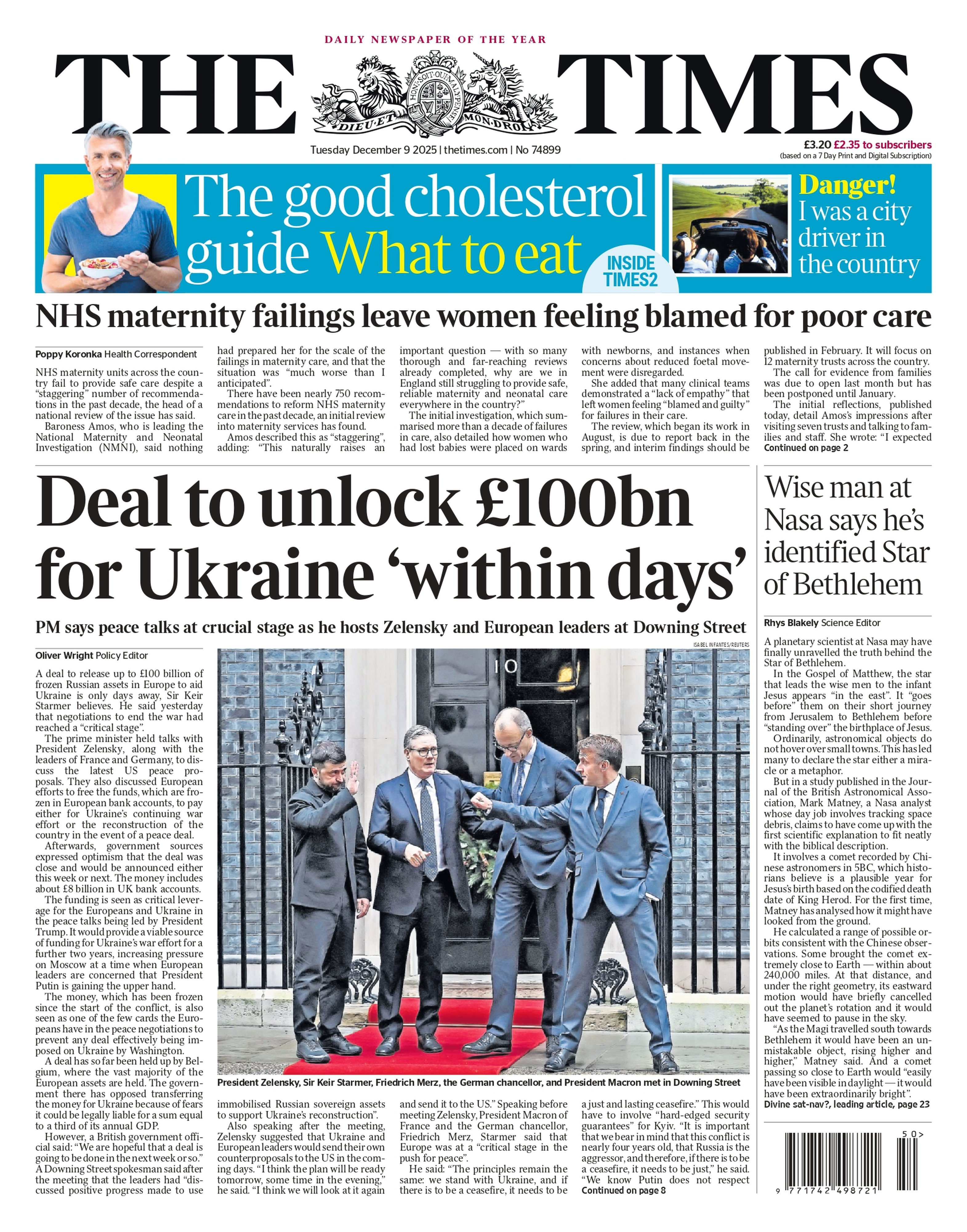
Pope Leo XIV welcomed Ukrainian President Volodymyr Zelensky at the papal residence in Castel Gandolfo on Tuesday morning. The Holy See Press Office issued a statement describing the cordial meeting, saying discussions centered mainly on the war in Ukraine. During their talks, the Pope reiterated the importance of ongoing dialogue and once again stressed his “urgent hope that ongoing diplomatic efforts will lead to a just and lasting peace.” The two heads of state also spoke about the issue of prisoners of war, calling for ensuring the safe return of Ukrainian children to their families. The Holy Father had also reiterated the Vatican’s willingness to host both Ukraine and Russia for potential negotiations. Following the meeting, President Zelensky addressed journalists in English, expressing his gratitude for the audience and the Pope’s support especially regarding the return of Ukrainian children—calling it “a very important question.” On Monday, Zelensky held talks in London with UK Prime Minister Keir Starmer, French President Emmanuel Macron and German Chancellor Friedrich Merz to discuss the latest version of a US-proposed peace plan to end Russia’s all-out invasion, now well into its fourth year. On Monday evening, Zelensky met European Commission President Ursula von der Leyen, European Council President Antonio Costa and NATO Secretary General Mark Rutte in Brussels for dinner. Following talks in Geneva, Moscow and Miami over the past couple of weeks, the initial 28-point peace plan presented to Kyiv by US negotiators has been revised down to 20 points, Zelensky said on Monday. The Trump administration’s proposal includes a demand that Ukraine surrender the Donbas region in eastern Ukraine, where Russia has occupied parts of but not all of the territory. Ukraine and its European allies have firmly rejected any ceding of land. Trump has suggested that Russia retains the “upper hand” militarily and that Putin is “fine” with the proposal. However, the Kremlin has insisted it wants all of the Donbas, not just the territory it currently occupies. Trump has also called for Ukraine to hold presidential elections, even though martial law does not permit them - Vatican News/Euronews
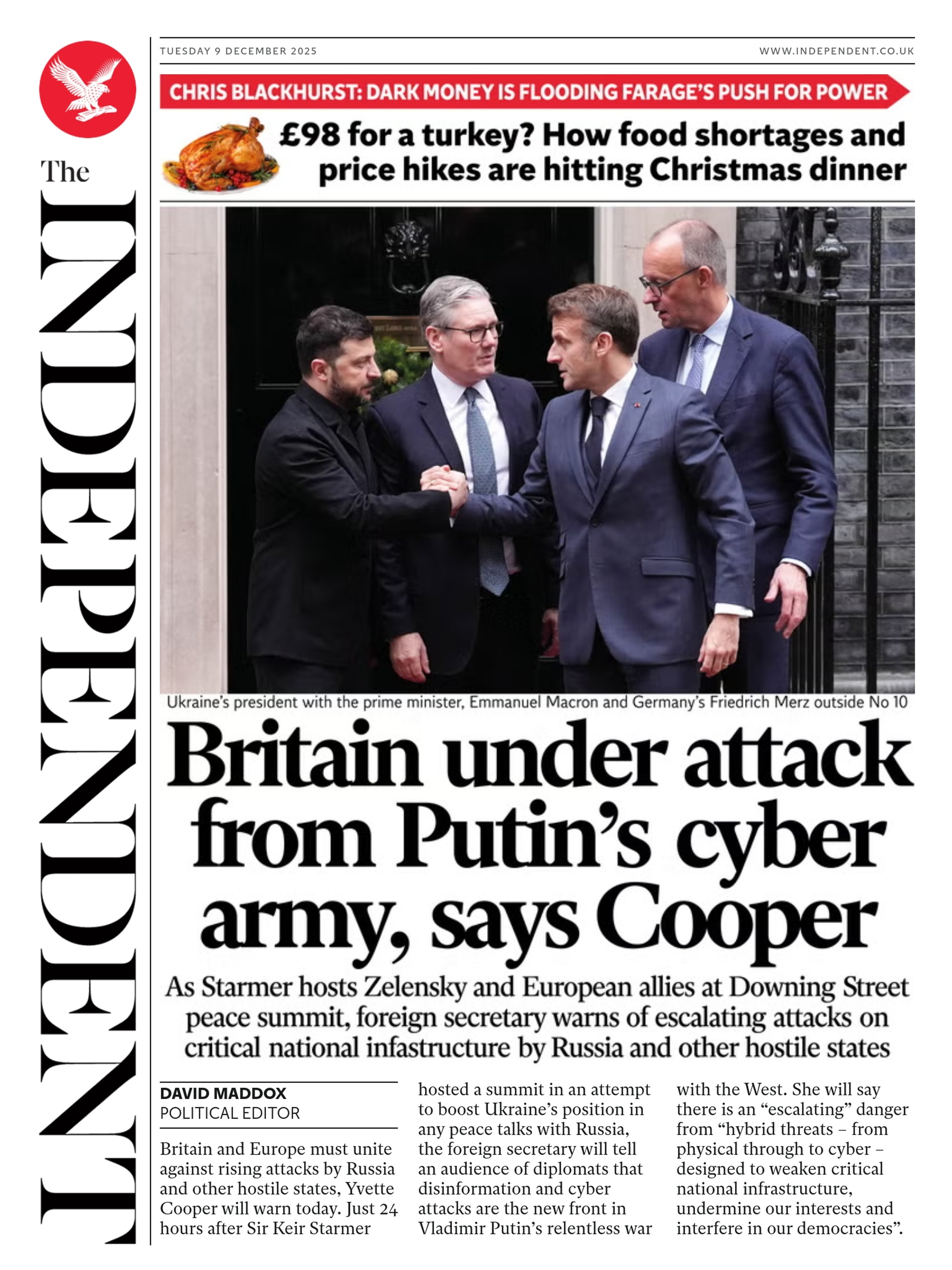
Britain and Europe must urgently unite to fight back against escalating attacks by Russia and other hostile states, Yvette Cooper, the UK foreign secretary, warned on Tuesday in a major speech. Just 24 hours after Sir Keir Starmer led a mini summit to try to prevent Ukraine being forced into a humiliating deal to get peace with Russia, the foreign secretary said that ongoing cyber attacks and disinformation are the new front in the war against Vladimir Putin. Ms Cooper told an audience of diplomats that there is an “escalating” danger to the UK and Europe, adding: “Across Europe we are witnessing an escalation in hybrid threats – from physical through to cyber – designed to weaken critical national infrastructure, undermine our interests and interfere in our democracies all for the advantage of malign foreign states. “By flooding social media with generative AI and manipulated videos, they can gradually undermine support for our major allies like Ukraine with lies – hitting our collective resolve to support Ukraine’s resistance to Russia’s illegal invasion.” - The Independent
Fighting between Thailand and Cambodia spread on Tuesday (Dec 9) to new parts of their contested border as the death toll rose to 10 and more than 140,000 civilians fled the violence. The two countries have blamed each other for the renewed clashes over their century-old border dispute, which saw Thailand launch air strikes and use tanks against its neighbour on Monday. Cambodia’s influential former leader Hun Sen said his country had retaliated against Thailand after Phnom Penh denied firing back for two days. This week’s clashes are the most deadly since the neighbouring nations engaged in five days of intense combat in July that killed dozens of people and displaced around 300,000 before a truce took effect. Tens of thousands of people have evacuated from border regions since the fresh fighting began on Sunday, officials said - CNA
FIFA president Gianni Infantino’s public support for Donald Trump and a peace prize awarded to the U.S. president are the subjects of formal complaints to the global soccer body’s ethics investigators. FairSquare, a London-based human rights nonprofit, said Tuesday it filed requests for investigations into Infantino’s alleged breaches of FIFA’s statutory duty to be politically neutral. FIFA said its ethics committee does not comment on potential ongoing cases, and could not confirm receiving the complaint. FIFA’s ethics code calls for a ban from soccer of up to two years for violating the duty of neutrality, though it is unclear if the case will be taken up. The FIFA-appointed current ethics investigators and judges are seen by some observers to operate with less independence than their predecessors a decade ago when then-president Sepp Blatter was removed from office. Infantino has expressed views this year backing Trump and his policies, including suggesting the U.S. president deserved to get the Nobel Peace Prize which he did not win. The FIFA leader also has closely aligned soccer with the United States government ahead of the men’s 2026 World Cup being co-hosted with Canada and Mexico. The tournament should earn more than $10 billion for FIFA - AP
The journals….
Hello Michael. Your piece on the the Australian Age Delay for social media was encouraging to read. I’ve been surprised at how much writers and the media are piling on the criticism. “but will it work” etc. It’s obvious something needs be done and your piece drew attention to the core topic - who gets to make major decisions about children’s welfare, government or corporate? Ultimately it’s parents and that, I think, is the purpose of the ban, to backup the parents who already are trying to protect their kids from the harms of social media. My partner, Kirra Pendergast (also on sub-stack) has been helping schools, parents, teachers and the odd top tier sports clubs manage the harms of social media.