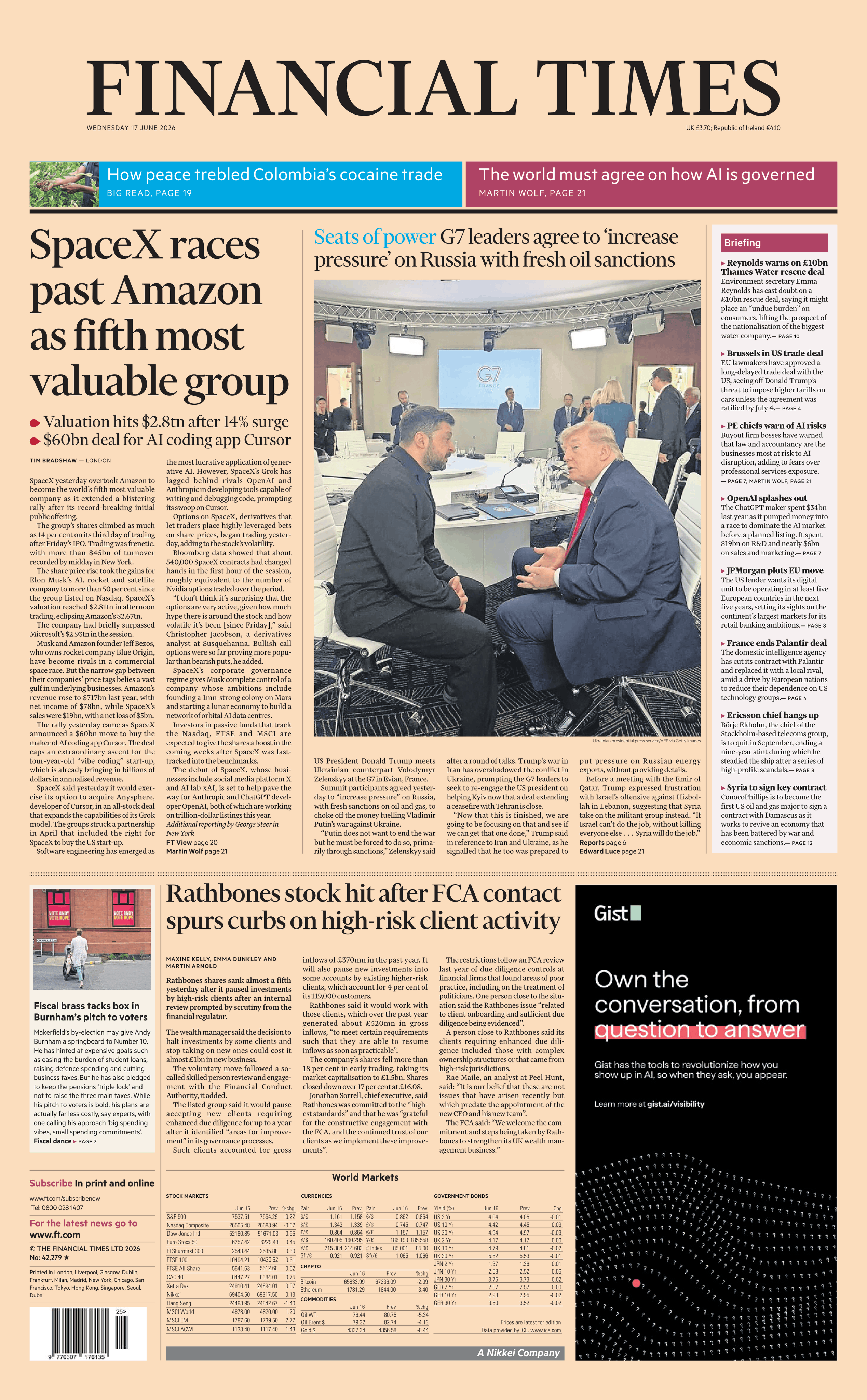
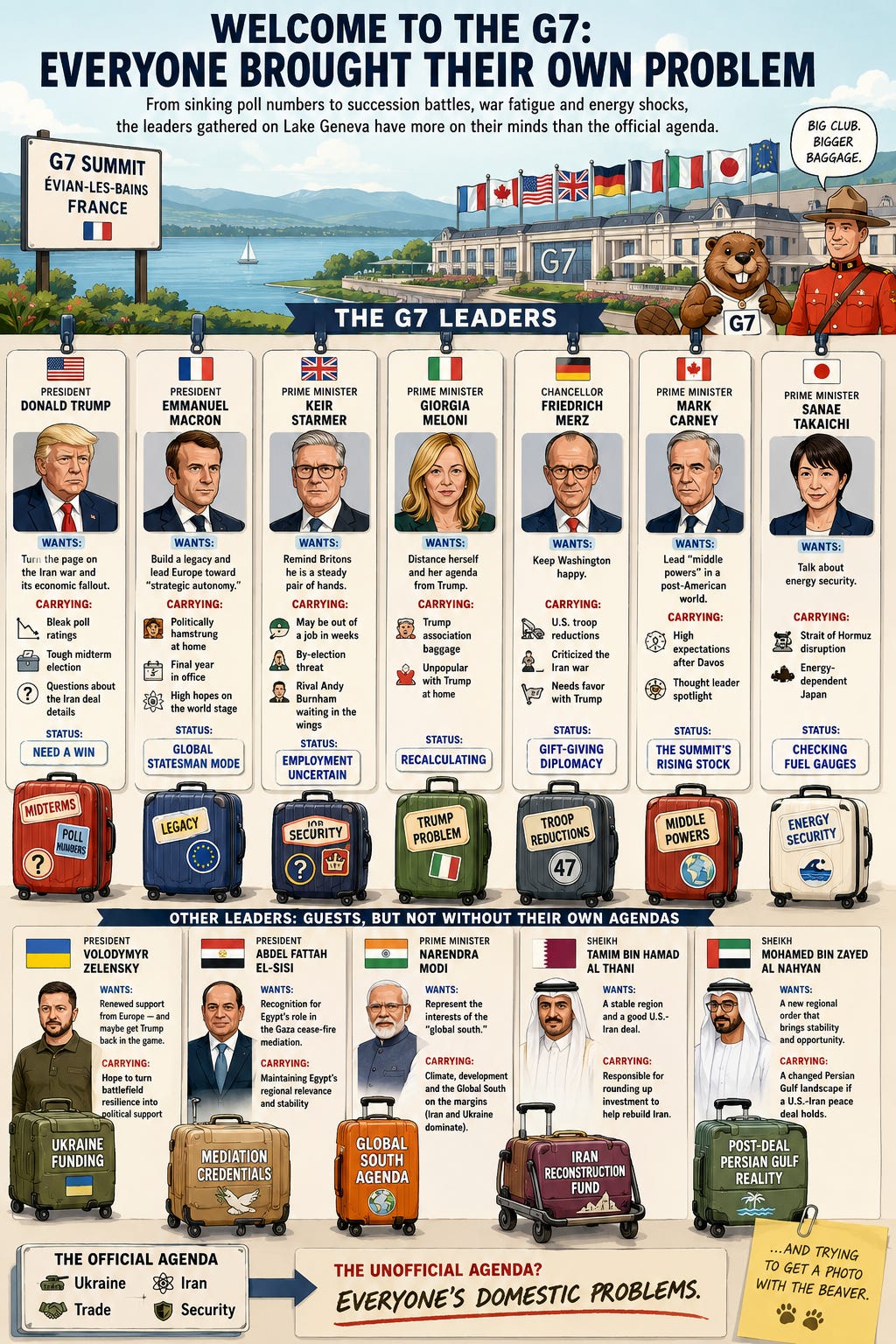
G7 leaders did what G7 leaders do: they agreed, in Evian-les-Bains, to tighten the screws on Russian oil and gas, and patted themselves on the back for a “dynamic on the ground that benefits Ukraine,” according to a French diplomatic source. Trump, fresh off a sit-down with Zelensky, declared the war “ridiculous” and said Russia should make a deal. Tantrum diplomacy, mercifully, took the day off.
But don’t mistake the absence of a tantrum for the presence of a strategy. Trump has no fixed ideology on this war and not much patience for the map underneath it. What he responds to is incentive. There’s the Nobel Peace Prize, which he would very plausibly trade half his foreign policy for if someone convinced him it was on the table for “solving” Ukraine. There’s spectacle - the cameras, the summit photo-op, the deal-of-the-century framing. And there’s money: a slice of Ukraine’s reconstruction bill that’s creeping toward a trillion dollars, or access to its rare earth minerals, the same template now playing out in Iran. Watch which of those three actually moves him before you read too much into the sanctions language.
G7 leaders agreed Tuesday to intensify pressure on Russia to end its war against Ukraine, with U.S. President Donald Trump saying that Moscow should “make a deal.” Ukrainian President Volodymyr Zelensky joined the world leaders at the summit in the French resort of Evian-les-Bains. The meeting brought Zelensky face-to-face with Trump, who has sought to reach out to Russian President Vladimir Putin but has also shown recent signs of losing patience with Moscow. “Leaders decided today to increase the pressure on Russia through sanctions on gas and oil,” a French diplomatic source told AFP after the talks, adding that the leaders agreed there “is a dynamic on the ground that benefits Ukraine.” The war has now lasted longer than World War I, and while Ukraine is seen as holding up well on the battlefield, its cities remain the target of deadly Russian strikes. French President Emmanuel Macron invited Zelensky to stay until the conclusion of the three-day summit on Wednesday to continue meeting with Trump and other G7 leaders. “Russia should make a deal” to end the war against Ukraine, Trump said after meeting with Zelensky, pointing to the high casualties on both sides of the conflict. “The whole thing is ridiculous. So, yeah, I’m going to do whatever I can.” Zelensky wrote in a post on X following the meetings that Ukraine’s priorities are “clear,” including increasing its stockpile of air defense missiles, securing a “winter support package” and “cranking up pressure on Russia.” “It’s great that everybody understands that Russia is not winning, and we have to push Putin to end this war,” Zelensky said during a meeting with Canadian Prime Minister Mark Carney. On Monday, Zelensky had urged a “decisive and substantive” response from G7 leaders following a wave of Russian strikes that killed at least 11 people and ignited a fire at a historic cathedral in Kyiv - AFP
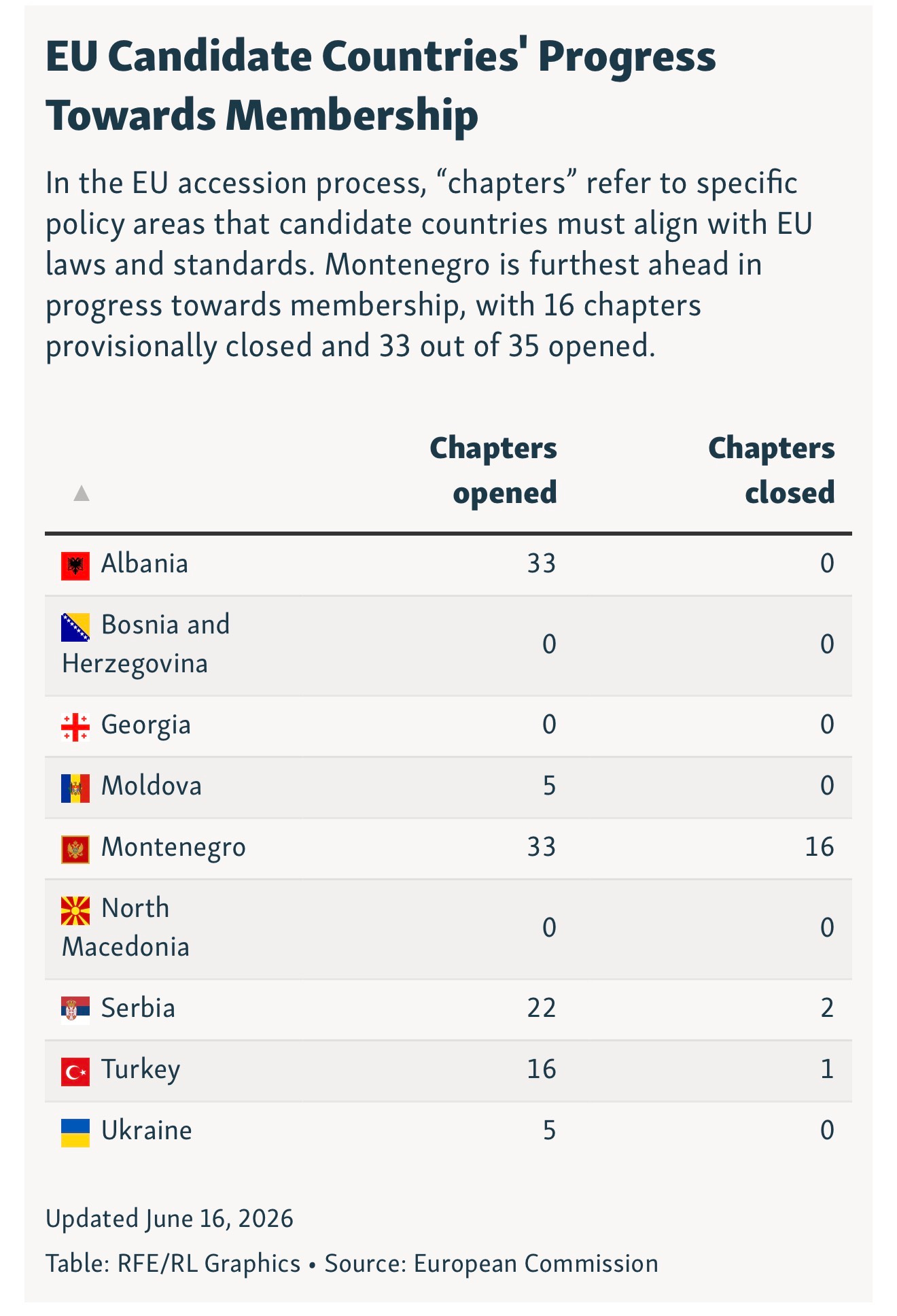
The European Union opened accession talks with Ukraine and Moldova on June 15 after the election of a new government in Hungary removed the final hurdle to moving the process of joining the 27-member bloc. What follows may prove just as tough as the countries make the legal and policy changes necessary to become actual EU members. The EU enlargement process consists of 33 policy chapters -- from foreign policy to agriculture and fisheries -- and the candidate countries must adopt all the EU laws and regulations in each of those chapters. These chapters are divided into six clusters, and on June 15 Moldova and Ukraine opened up Cluster 1, known as “the fundamentals,” which consist of five chapters dealing mainly with rule of law issues. These are always opened first and closed last, meaning a candidate country has fulfilled all of Brussels’ conditions. Ukraine and Moldova have to date started talks on five out of the 33 policy chapters - RFE/RL
The European Commission has begun sketching a plan to keep a failing mega-bank alive long enough to survive a crisis weekend, according to a confidential 16-page document obtained by POLITICO and dated June 1. The paper warns that gaps in the EU’s crisis-management framework are eroding trust and creating risk for national budgets - three years after Swiss authorities scrambled to engineer UBS’s takeover of Credit Suisse rather than let it collapse. The core problem: even a bank stabilized through the EU’s existing “resolution” process - bail-in buffers, industry-funded safety nets - can still run out of cash if spooked depositors and skittish lenders pull back en masse. The Single Resolution Board’s €81 billion fund and years of post-2008 rule-making don’t solve a liquidity crunch on the Monday after a rescue. The Commission’s proposed fix, per POLITICO‘s reporting, is a layered “waterfall”: the European Central Bank would lend against a special bond, the Resolution Board would guarantee it, the industry-funded safety net would repay the ECB if the bond goes bad, and the eurozone’s bailout fund (the ESM) would serve as a last-resort backstop - contingent on Italy ratifying the ESM’s reform treaty. If all that still falls short, the national government behind the bank would be on the hook, with the ESM offering it a credit line. The plan drew input from the ECB, the Resolution Board and the ESM, but talks remain technical and aren’t expected to reach EU finance ministers this year. Deputy finance ministers have discussed it, and it’s a stated priority of the current U.S. presidency of the G20; the topic is expected to resurface in the fall alongside the Commission’s broader banking-competitiveness report. All four institutions declined to comment on the leaked document.
The Obama Foundation announced a star-studded lineup for the opening of the Obama Presidential Center on Thursday, just days after President Donald Trump failed to attract A-listers to his UFC fight at the White House. Among those taking part in the June 18 opening ceremony are at least a dozen artists, including Grammy, Oscar, Emmy, Tony, and Golden Globe winners as well as Hall of Famers ranging from Stevie Wonder and Bruce Springsteen to U2’s Bono and The Edge. The Roots, Christina Aguilera, Jennifer Hudson, John Legend, Eddie Vedder from Pearl Jam, Marc Anthony, Common, Tems, and actress Marsai Martin are also on the list of those set to attend. It’s a stark reminder that former President Barack Obama, with his historic presidency, can still draw a starry crowd more than 10 years after he left office. The grand opening ceremony on Thursday kicks off a series of events at the center in Chicago’s South Side, which will continue into the weekend. Obama Foundation CEO Valerie Jarrett claimed the grand opening, with its music lineup, will be unlike any other. “The Grand Opening Ceremony will reflect a spirit of inspiration and joy, with a big boost from the performers who are sharing their talent with us. We hope to inspire people everywhere to believe in their power to bring change home,” Jarrett said in a statement. The gathering of A-listers in Chicago comes after the president’s UFC birthday bash at the White House on Sunday failed to draw a star-studded crowd - The Daily Beast
The journals…..