

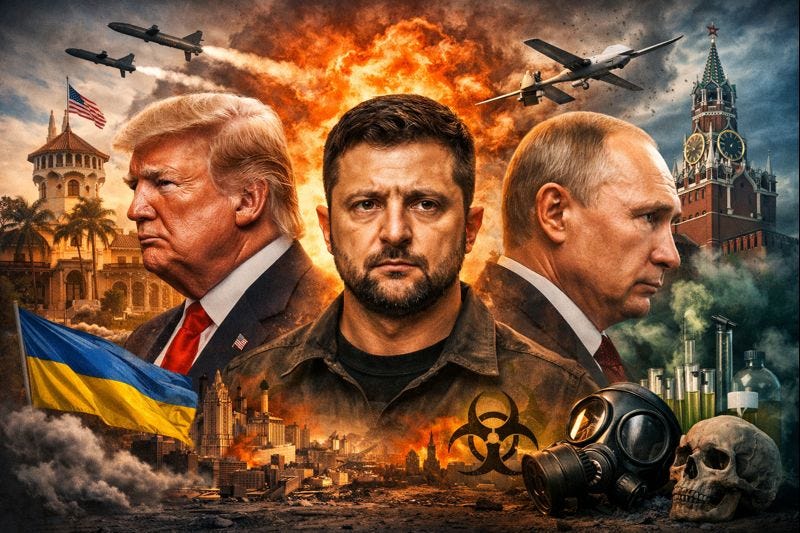
Russian Foreign Minister Sergei Lavrov claimed Ukraine targeted one of President Vladimir Putin’s residences and said Moscow will retaliate and review its stance in negotiations seeking an end to its ongoing full-scale invasion of Ukraine. Ukrainian President Volodymyr Zelenskyy called the claim that Kyiv targeted the residence in the Novgorod region northwest of Moscow a “lie.” He asserted that Russia was seeking to undermine US-Ukraine talks on the war and “preparing the ground to carry out strikes -- most likely on the [Ukrainian] capital and on government buildings.” In a statement posted on Telegram on December 29, Lavrov claimed that Ukraine used 91 drones in what he called a “terrorist attack,” but that all of them were shot down and there were no reports of damage so far. Lavrov said that Russia would not leave the attack unanswered and has selected “targets and timing” for retaliatory strikes. Asked about Moscow’s allegations, US President Donald Trump said he learned about it from Putin himself and it made him “very angry.” “It’s a very delicate time,” Trump said to journalists referring to Ukraine peace talks as he welcomed Israeli Prime Minister Benjamin Netanyahu at his private residence in Mar-a-Lago, Florida, on December 29. Trump pointed out that he had refused to provide Ukraine with the Tomahawk missiles that Kyiv was asking for to hit Russian military targets and disable Russian armed forces’ capacity for ground and air attacks. “It’s one thing to be offensive, because they’re offensive. It’s another thing to attack his house. It’s not the right time to do any of that,” the US president added. The Russian allegation came one day after Zelenskyy and Trump touted what they said was progress at a meeting in Florida, with the US president -- who spoke by phone to Putin hours before the meeting -- saying a peace deal to end the nearly four-year full-scale invasion could be “closer than ever.” Moscow has signaled it is not prepared to make substantial concessions - RFE/RL
Russia may be developing new nerve agents which could be even more deadly than the military-grade Novichok it has used to kill opponents, and would help avoid detection of their use in any future attacks, experts fear. Senior defence figures are also concerned that Russia’s alleged illegal use of toxic gas in Ukraine could escalate into full-blown chemical war, using substances that could kill thousands. Moscow claims it destroyed its last stockpile of chemical weapons in 2017 and has previously denied any suggestion of continued work on them. Yet a scientist who helped create Novichok nerve agents in the 1980s told The i Paper in a major interview that he believes Moscow might be creating new poisons. Dr Vil Mirzayanov, who worked on the covert Soviet programme but later became a whistleblower, suspects Russia is “still developing” nerve agents. Mirzayanov believes a new variety may have been used to kill the Russian opposition leader Alexei Navalny in prison last year “because they don’t want any scandals… connected to this violation”. The Kremlin says that Navalny died of natural causes, and US intelligence analysts have reportedly concluded that Putin did not order his murder while in jail. However, Mirzayanov speculated that a carbamate compound could have been used as a poison to kill Navalny. Soviet and American scientists experimented with carbamates, some of which are used as pesticides, during the Cold War. Hamish de Bretton-Gordon, the British Army’s former head of defences against chemical attacks, agrees with Mirzayanov that Moscow is probably still developing toxic substances. “It seems pretty clear, from the people I talk to and others, that the Russians still have an extant chemical weapons programme,” he said.
On Monday evening Pacific time—roughly a day after U.S. President Donald Trump met with Ukrainian President Volodymyr Zelensky—I appeared on CBC News to dissect the shifting goalposts and mounting risks on the tortuous road toward peace in Ukraine.
Paid subscribers: scroll down ⬇️ for your exclusive video, where I offer deeper insight into the evolving Ukraine peace plan, along with brief but important reflections on developments along the Thai–Cambodian border.
China kicked off a second day of live-fire drills around Taiwan on Tuesday, aimed at simulating a blockade of the self-ruled island’s key ports and assaults on maritime targets. The two-day war games, code-named “Justice Mission 2025”, started on Monday and were slammed by Taipei as “military intimidation” by Beijing.China claims Taiwan as part of its sovereign territory and has refused to rule out using military action to seize the island democracy.AFP journalists in Pingtan -- a Chinese island that is the closest point to Taiwan’s main island -- saw a volley of rockets blasting into the air on Tuesday morning at around 9:00 am (0100 GMT), leaving trails of white smoke. At least 10 rockets were launched, seconds apart from one another, each sending a booming sound reverberating throughout Pingtan as they soared across the sky. Tourists rushed towards wooden barricades overlooking the sea, whipping out their phones to snap photos and videos of the rockets. Shortly after, the People’s Liberation Army (PLA) said in a statement: “At 9:00 am, December 30, the ground forces of the PLA Eastern Theater Command conducted long-range live fire drills in the waters to the north of the Taiwan Island and achieved desired effects.” The latest show of force follows a bumper round of arms sales to Taipei by the United States -- Taiwan’s main security backer -- and comments from Japan’s prime minister that the use of force against Taiwan could warrant a military response from Tokyo. Beijing warned on Monday that “external forces” arming Taipei would “push the Taiwan Strait into a perilous situation of imminent war”, but did not mention any countries by name - France 24
Plummeting cocaine prices are forcing drug traffickers to reuse their submarines, Spanish police said. Where submersibles smuggling narcotics from South America to Europe would once have been scuttled — joining a “narco-sub graveyard” between the Azores and the Canary Islands — a production glut has halved cocaine prices in recent years, and submersibles are now refueling at sea to make as many trips as possible, The Guardian reported. The US government believes only a tiny fraction of such ships, which are shielded from radar and can travel as far as Africa and Australia without refueling, are interdicted globally. Last year, the US Marine Corps unveiled plans for autonomous vessels modeled on narco-subs to aid with forward deployment of critical supplies - Semafor
Airbnb hosts in World Cup cities in North America are set to score big during the June and July matches. Rates are up over 40% compared to 2025 in some cities with matches, per short-term rental data firm AirDNA. And that’s just for the early group stage games. Airbnb itself says U.S. hosts could earn $4,000 on average by renting out their homes during the tournament. Hosts in New York and New Jersey could see $6,000 in average earnings from games at MetLife Stadium in New Jersey, including the July 19 final. About 2.1 million tourists will visit the 11 U.S. host cities next year — including an estimated 232,000 Airbnb guests, per a study commissioned by the company. Homeowners should review local short-term rental rules before renting out their spaces. Tourism is the main moneymaker for World Cup cities, Andrew Zimbalist, a professor emeritus of economics at Smith College in Massachusetts, tells Axios. While local businesses (and short-term rental hosts) may see a boom, economists say the tournament’s impact is more complicated than organizers project. The first U.S. match — USA vs. Paraguay — kicks off June 12 in Los Angeles. Bookings for that date already average $387, AirDNA says — up 20% year over year
