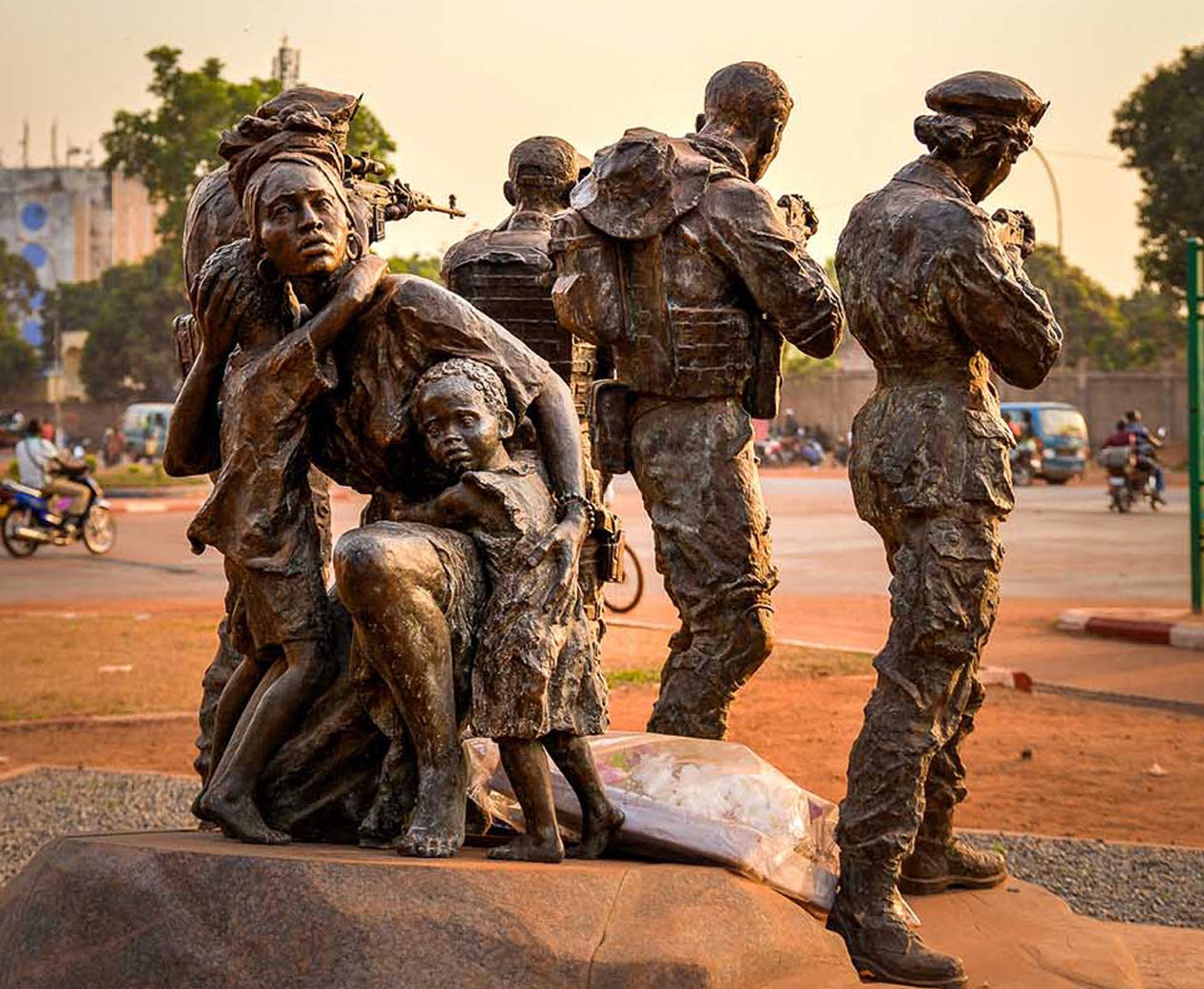
Russia’s Africa strategy is no longer operating in the shadows. What began as a deniable mercenary footprint under Wagner has evolved into something broader and more overt: a state-directed campaign blending military muscle, mineral concessions, media influence and missionary expansion. From Mali’s rewritten mining code to Niger’s uranium ambitions, from junta protection packages to a rapidly expanding Russian Orthodox Church presence across 34 countries (described by its clergy as potentially the most significant in its history), Moscow is building leverage where it cannot compete in trade or investment. The Kremlin’s post-Wagner Africa play is not just about gold or guns - it is about shaping regimes, narratives and loyalties across a continent increasingly central to global power politics.
News Briefs
New documents obtained by a consortium of media outlets and civil society groups hosted by The Continent reveal the influence of Russian operatives has near-seamlessly continued since the collapse of the Yevgeny Prigozhin’s Wagner Group in 2023. They spent more than $7.2-million for narrative influence operations in Africa and Latin America in 2024. Twenty-two of the 30 countries targeted were in Africa. Central African Republic (CAR), Mali, South Africa, Niger, and Angola were the top priorities, going by the budgets allocated to them. In the leaked documents, the former Wagner operatives, who regrouped under a company called StratConsult, report having spent more than $150,000 in CAR in February 2024. More than a third of that spending was directed towards orchestrating a “CAR for Trump” rally and similar activities. To the casual observer, the “CAR for Trump” rally was a genuine – if odd – demonstration of a convoy of at least 50 motorcycles riding through the capital, Bangui, to picket the US embassy on 10 February 2024. That event was featured in at least 48 media articles, from as far afield as South Africa. But the leaked internal reports suggest much of that coverage in various media outlets in Kenya, Chad, Ghana, South Africa, among others, was paid for. Similarly, in Burkina Faso the operatives set out to “launch a series of anti-French rallies” to bolster interim President Ibrahim Traoré’s campaign for African sovereignty, which has seen him become a social media sensation. The influence operation may have extended beyond the staged rallies and engineered media coverage to the highest levels of policy and governance. The Russian operatives took credit for drafting Mali’s new mining code, which was unveiled in 2023. The code seeks to expand state ownership of mines to at least 35% from 20%. In South Africa, during 2024 talks to form a government of national unity, Russian operatives targeted the Democratic Alliance, their internal reports claim. They argued that if DA members took key ministries such as foreign affairs or justice, it could harm Russia’s political and defence ties with South Africa. The StratConsult staff appear to have inherited their former boss’ relationships in Russian intelligence. The documents repeatedly mention Russia’s Foreign Intelligence Service, SVR, as a partner to “the company”, stating it could supply intelligence and defend the group’s operations from the scrutiny of Russia’s defence ministry.
* The Continent is a weekly newspaper produced by African reporters, photographers, illustrators and editors. It is designed to be read and shared on WhatsApp (and other social messaging platforms), and has become the continent’s most widely distributed newspaper.
Bloomberg is reporting this week details a dramatic expansion of the Russian Orthodox Church (ROC) across Africa, growing from a presence in just one sub-Saharan country before 2022 to at least 34 by 2025, with more than 350 parishes and 270 clergy now on the continent. In an apparent swap of cash for crosses, the missionary push is occurring off the back of a dispute with the Greek branch of the religion over the recognition of Ukraine’s church ruptured relations in 2021. The expansion — described by church officials as potentially the most significant in its history — is part of a broader Kremlin push to extend influence in Africa through religion, culture, education and media, areas where Moscow can compete more easily than in trade or investment. Since the invasion of Ukraine, Russia has opened new “Russian Houses,” expanded Russian-language instruction, increased scholarships for African students to study in Russia, and launched cultural initiatives tied to figures close to President Vladimir Putin. At the same time, Sputnik is expanding its African media footprint, while recruitment programs such as “Alabuga Start” have drawn scrutiny over allegations that young African women are being funneled into drone-manufacturing jobs in Russia (official investigations into these recruitment efforts are said to be already underway in South Africa, Kenya, and Botswana). Alongside symbolic grain deliveries and humanitarian outreach, Moscow remains Africa’s leading arms supplier, with military agreements in place with 43 of 54 UN member states and paramilitary forces linked to the former Wagner Group active on the continent — underscoring a multi-layered strategy to deepen Russian influence far beyond the battlefield in Ukraine.
In every country in which it operates, Wagner was reported to have secured valuable natural resources using these to not only cover costs, but also extract significant revenue, BBC reported in 2024. Russia has extracted $2.5bn (£2bn) worth of gold from Africa in the past two years, which is likely to have helped fund its war in Ukraine, according to the Blood Gold Report. In February, 2024, Russian fighters - formerly Wagner mercenaries - took control of Mali’s Intahaka gold mine, close to the border with Burkina Faso. The artisanal mine, the largest in northern Mali, had been disputed for many years by various armed groups active in the region. But there is something else, with potential geopolitical significance. “We are now observing the Russians attempting to strategically displace Western control of access to critical minerals and resources,” said Jack Watling, land warfare specialist at the Royal United Services Institute (Rusi) and one of the report's authors. According to Dr Watling, “there was a meeting in the Kremlin fairly shortly after Prigozhin’s mutiny, in which it was decided that Wagner’s Africa operations would fall directly under the control of Russian military intelligence, the GRU”. Control was to be handed to Gen Andrey Averyanov, head of Unit 29155, a secretive operation specialising in targeting killings and destabilising foreign governments. While lithium and gold mines are clearly important, according to Dr Watling there is possibly an even greater strategic headache around the corner: "In Niger the Russians are endeavouring to gain a similar set of concessions that would strip French access to the uranium mines in the country."
There have been multiple claims that Wagner forces carried out human rights abuses on the African continent, as well as in Ukraine and Syria, where Prigozhin’s organisation previously held a commanding presence. One of the most well-documented incidents took place in the central Malian town of Moura where, according to a UN report, at least 500 people are believed to have been summarily executed by Malian troops and “armed white men”, who eyewitnesses described as speaking an “unknown language.” Following the full-scale invasion of Ukraine, many in the Western security apparatus say that Russia’s mask has slipped. “What they are looking to do is to exacerbate our crises internationally. They are trying to start fires elsewhere, and expand those that already exist, making a less safe world,” Dr Watling.- BBC
US Special Envoy Witkoff said the first day of the latest round of US-brokered peace talks between Ukraine and Russia had “brought about meaningful progress” in stopping the war. The delegations of the two countries were set to continue talks in Geneva, Switzerland, in working groups on February 18. Writing on X, Witkoff added that “both parties agreed to update their respective leaders and continue working towards a deal.” Discussions focused on practical issues and the mechanics of possible solutions,” Ukrainian chief negotiator Rustem Umerov said in a social media post. Russian media quoted a source in the Russian delegation saying the talks went on for six hours and were “very tense.” The Russian delegation attending the new talks includes Vladimir Medinsky, a revisionist historian and former culture minister whose views Ukraine has derided as “pseudo-historical.” Ahead of the talks, the leader of the Ukrainian delegation, Kyrylo Budanov, appeared to take a jab at Medinsky, saying, “We will discuss the lessons of our history with our colleagues and look for the right conclusions.” Sources in Washington told RFE/RL that national-security advisers from Britain, France, Germany, and Italy were observing the talks, which came hours after another round of Russian strikes on targets across Ukraine with hundreds of drones and missiles - RFE/RL
The European Union will not "shy away" from adopting a full ban on maritime services for Russian oil tankers if G7 allies fail to reach a deal, Valdis Dombrovskis, the European Commissioner for the Economy, has said as negotiations continue between member states on a fresh round of economic sanctions against the Kremlin. Brussels wants the 20th package of sanctions to be approved by the time the full-scale invasion of Ukraine reaches its grim fourth anniversary on 24 February. If the proposed ban on maritime services is enacted, the price cap on Russian oil that the G7 has been operating since December 2022 will come to an end within the EU’s jurisdiction because all EU companies would be prohibited from servicing Russian tankers, regardless of the price at which they sell their Urals crude. The cap was last adjusted to $44.10 per barrel. Negotiations among EU ambassadors are set to continue throughout the week to ensure the package of sanctions is approved either before or on 24 February. The deadline might slip if more time is required to achieve an ambitious outcome.
Greece, a country with a powerful maritime industry, has raised concerns about the full ban on maritime services, according to diplomats. Athens believes the prohibition risks increasing competition from India and China, empowering Russia’s “shadow fleet” and further encouraging the removal of vessels from their national registry, a deceptive practice known as “deflagging”. - Euronews
Four Years of War: The Civilian Toll Is Rising, Not Receding
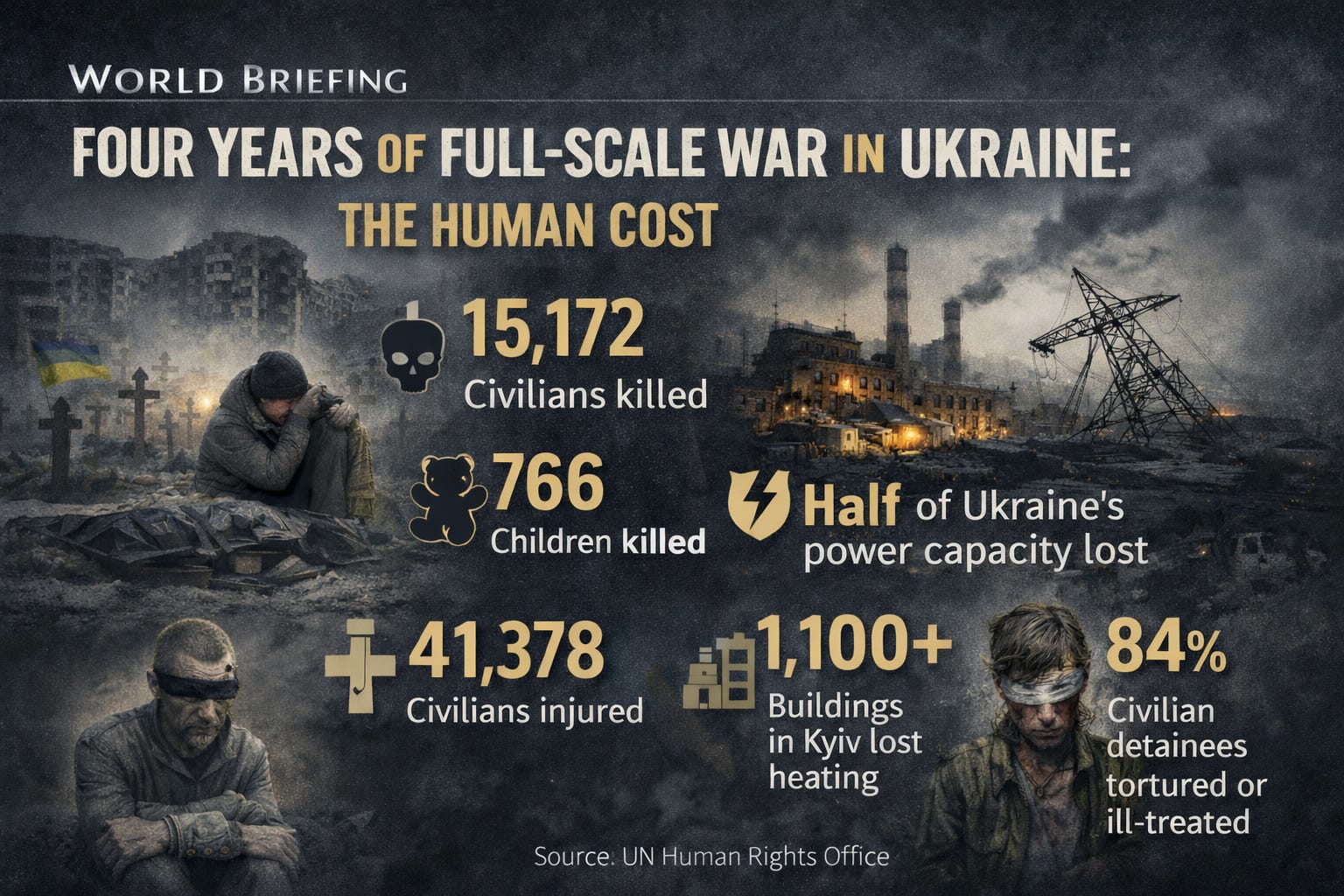
Four years after Russia’s full-scale invasion of Ukraine, the civilian cost is not stabilizing - it is worsening. According to the UN Human Rights Monitoring Mission, at least 15,172 civilians have been killed and 41,378 injured since February 2022, including 766 children killed. Alarmingly, 2025 saw a sharp escalation: civilian casualties rose 31% compared to 2024 and 70% compared to 2023, driven by increased use of long-range missiles and loitering munitions, as well as a surge in short-range drone attacks along the front lines.
Energy infrastructure has become a central target. By January 2026, Ukraine had lost more than half of its pre-war electricity generation capacity, leaving civilians enduring prolonged blackouts during one of the coldest winters of the war. In Kyiv alone, over 1,100 residential buildings were left without central heating after January strikes. For many Ukrainians, war now means not only shelling - but darkness, cold, and water shortages.
The UN also documents widespread violations of international humanitarian law. Ninety-six percent of released Ukrainian POWs interviewed reported torture or ill-treatment in Russian captivity, with executions of captured soldiers increasing in 2024–2025. Hundreds of civilians and detainees have reported abuse, including sexual violence.
Four years in, the data paint a grim picture: the methods of war are evolving, but the human cost continues to climb.
US President Donald Trump has suggested he was discussing future Taiwan weapons sales with Chinese leader Xi Jinping, which would signal a stunning reversal of decades-long US policy. Previous administrations, including Trump’s, have refused to consult with Beijing ahead of arms sales to Taiwan, leading analysts to seek clarity on Trump’s ambiguous statement. From Beijing’s perspective, trends in Taiwan are moving in a positive direction, and while US lawmakers warned Taipei that the threat from China “has never been greater,” some experts think Xi is satisfied with mere momentum toward his goal of Taiwan “reunification.” Meanwhile, the US is beefing up its regional military presence, deploying more advanced missile systems in the Philippines to deter Chinese aggression in the South China Sea - Semafor
Germany is moving to fortify its foreign intelligence agency with sweeping new powers in preparation for a potential divorce from the United States. The plan comes as German and other European leaders grow increasingly concerned that U.S. President Donald Trump could move to halt the American intelligence sharing Europe largely relies on — or exploit that dependence for leverage. Just as European countries must radically bolster their militaries to gain more autonomy, officials in Berlin argue, so too must Germany’s intelligence apparatus grow far more capable. “We want to continue working closely with the Americans,” Marc Henrichmann, the chairman of a special committee in Germany’s Bundestag that oversees the country’s intelligence services, told POLITICO. “But if a [U.S.] president, whoever that may be, decides in the future to go it alone without the Europeans … then we must be able to stand on our own two feet.” German leaders believe the need is especially urgent in their country, where the foreign intelligence service, or BND, is far more legally constrained than intelligence agencies elsewhere. Those restraints stem from intentional protections put in place after World War II to prevent a repeat of the abuses perpetrated by the Nazi spy apparatus. But those restraints have had the side effect of making Germany particularly dependent on the U.S. for intelligence gathering, and this is now seen as a potential danger. “The intelligence business is one where the question always arises: What do you offer me, what do I offer you?” Henrichmann said. “And of course, if Germany is only a taker, the risk is simply too great.” - Politico

Click here to avail of this special Year of the Fire Horse offer!
The journals…..