I said on the BBC today - and earlier on ABC Australia - that I’ve rarely felt as anxious about Ukraine’s future as I do right now, and I don’t say that lightly after covering this war from the ground since the beginning. A ballistic missile arrived here at seven this morning: it, along with others this week killing a handful of people and leaving major destruction. Hours later, a new cabinet was sworn in - and the country erupted.
The new prime minister, the former Naftogaz CEO with a genuinely strong private-sector record, is arguably the right operator to harden Ukraine’s grid ahead of a winter forecast to be worse than the last. That’s the good news, and it ends there.
The story is Mykhailo Fedorov - the 35-year-old tech executive who was grafting Silicon Valley methodology onto the carcass of a sprawling, slow, corrupt military establishment. In a few short months he initiated a full (and now unfinished) organizational shift to NATO standards, built a reward system incentivizing drone and missile intercepts, and - via his personal relationship with Elon Musk- negotiated the geofencing of Starlink terminals illegally obtained by Russian forces, effectively blacking out the command-and-control of frontline Russian units. This is the man Zelensky just fired, apparently to appease army chief Syrskyi, establishment generals, and procurement firms locked out of selling their outdated hardware.
In a rare admission, Zelensky conceded that the army and the Defense Ministry had communicated only through him: “The problem lies not only with the parties, but with me as well.” He would “very much like to see unity” between them, he said. On that, at least, we agree - but what I see is a president who blinked before the old guard, and who may not recover.
I’ve seen this movie before. When Canada seconded me into Ukraine’s Ministry of Health, our young, tech-savvy reform team hit the wall of entrenched bureaucracy at every step. Force any legacy institution to move from ships to chips and the antibodies attack. The difference is that this time the patient is a country at war.
The protests now filling squares nationwide - including here in Odesa - are reminiscent of last year’s uproar over the gutting of the anti-corruption bodies, a decision Zelensky ultimately reversed. Perhaps this too is an orchestrated sack-protest-reinstate maneuver. That’s a generous read, and I’m not feeling generous.
As we go to publication, Zelensky has moved to fill the vacuum, appointing Yevhenii Khmara - currently acting head of the powerful SBU security service - as acting defense minister, citing his experience running long-range strike operations and commanding the elite Alpha special forces unit. Khmara, a major general best known for leading the operation to liberate Snake Island, has largely stayed out of the public eye. Parliamentary approval for a permanent appointment will be sought soon. Note what this signals: Fedorov, the disruptor from the tech world, is replaced by a man from the heart of the security establishment. The old guard didn’t just win - they installed one of their own.
The legality questions are not academic. Under Ukrainian law, Khmara cannot simultaneously serve in uniform and as defense minister - the civilian-control principle Ukraine adopted on its path toward NATO. Politico reports he is expected to retire from military service in the coming days, clearing the way for Zelensky to formally ask parliament to confirm him. Let’s be clear about what that is: a paperwork conversion. A general who sheds his uniform on the way to the minister’s office satisfies the letter of civilian control while gutting its spirit - the whole point of the principle is a defense ministry independent of the uniformed establishment, not one run by a freshly retired member of it. Add the procedural shortcut: under normal succession, First Deputy Minister Oleksii Vyskub would have stepped up while the Rada - now in recess until August 18 - voted on a permanent minister. Instead, the president simply instructed a general to run the ministry and left the formalities for later. And the dominoes keep falling: Khmara’s move hands the SBU to his deputy Oleksandr Poklad, the man anti-corruption activists accuse of leading the 2025 assault on NABU. The reshuffle meant to steady the ship keeps rewarding the old guard.
Meanwhile, the skies offer no respite. Overnight strikes killed and injured civilians here in Odesa and Zaporizhzhia, and in Kyiv, social media is thick with confusion - people who feel they are being encouraged to temporarily evacuate the capital, with no government support to help them do it.
And if you doubt who’s celebrating, The Moscow Times has helpfully compiled the evidence: pro-Kremlin military bloggers spent the day toasting Fedorov’s exit, with one calling him far too smart and effective an enemy and predicting, in commentator Aleksei Zhivov’s words, that “things should get easier now.” Another prominent channel forecast a purge of Fedorov’s people from the ministry. Most telling is the analysis offered on a pro-war channel with 316,000 subscribers: that Zelensky saw a repeat of the Zaluzhny affair - battlefield success breeding a potential rival - and moved to eliminate the threat. When Moscow’s war propagandists understand your president’s motives better than his own communications team can explain them, you have a problem. Fedorov, for his part, went down swinging - declining an offer to stay on as an adviser and publicly accusing Syrskyi of blocking his initiatives.
The foreign ministry post also sits empty. The only capital celebrating tonight is Moscow - and they’re not even hiding it. Fedorov himself said it best: protest, but don’t hand Russia an opening.
📺 Watch my full analysis
I joined the BBC’s Matthew Amroliwala live from Odesa within hours of the decision to break down what this upheaval means for Ukraine - and who benefits. Watch the full segment below.


News Briefs
Ukrainian President Volodymyr Zelenskyy said Thursday that the head of the country’s security services, Yevhenii Khmara, will be appointed as acting defense minister. Khmara was appointed the acting head of the Security Service of Ukraine at the beginning of this year and, under Ukrainian law, cannot simultaneously serve as defense minister. He is expected to retire from military service in the coming days, allowing Zelenskyy to request that parliament appoint him as defense minister formally. Zelenskyy dismissed former Defense Minister Mykhailo Fedorov on Wednesday as part of a cabinet reshuffle. The 35-year-old had held the post for only six months. While reforming the military’s technology, Fedorov also clashed with top generals, who said they found him difficult to work with - Politico
Russian military bloggers praised the dismissal of Ukraine’s Defense Minister Mykhailo Fedorov, who has been credited with cutting bureaucracy and boosting drone warfare against Russia, saying the shake-up would only benefit Moscow.
Fedorov, 35, was dismissed Thursday after being on the job for just six months. His dismissal, which sparked rare wartime protests in Kyiv and other Ukrainian cities, comes as Ukraine has significantly intensified strikes on Russia’s oil infrastructure and military logistics, targeting key components of Moscow’s war engine. Yet Ukrainian forces are still facing grinding Russian advances in the east amid a critical shortage of ground troops. Pro-Kremlin military bloggers called Fedorov “far too smart and effective an enemy,” arguing that his removal would make it much easier for the Russian army to fight against Ukraine.
“Overall, it’s very good that [Ukrainian President Volodymyr] Zelensky removed him from command of the army…Things should get easier now,” Russian military commentator Aleksei Zhivov said on social media. “The fact that Zelensky removed such a prolific and dangerous — for Russia — figure from a leadership position is very good [for Moscow] especially considering that his resignation will most likely also lead to a purge of Fedorov’s people from the structure of Ukraine’s Defense Ministry,” said Informant, a pro-war Telegram channel with 94,000 subscribers. Military blogger Svyatoslav Golikov said the “achievements of Fedorov’s team” at Ukraine’s Defense Ministry had had a “significant impact” on Russia’s Armed Forces. The Telegram channel Voenny Osvedomitel (Military Informant) told its 612,000 subscribers that Fedorov was “responsible for expanding digitalization in the Ukrainian Armed Forces and the use of drones.” - Moscow Times

Dubai authorities have denied reports of explosions in the city on Thursday evening, after initial information claimed booms were heard due to missile interceptions, Euronews journalists in Dubai reported. Dubai Media Office has issued a statement clarifying that the explosions did not occur in downtown Dubai and urging residents to rely on official communications from the authorities. While the United Arab Emirates was targeted by Iran after the war broke out in February, Tehran has ceased its strikes following the US-Iran ceasefire and the signing of the framework deal to end the war in mid-June. After the hostilities between the two sides resumed last week, Iran has targeted a number of neighbouring countries, including Kuwait, Bahrain and Jordan.
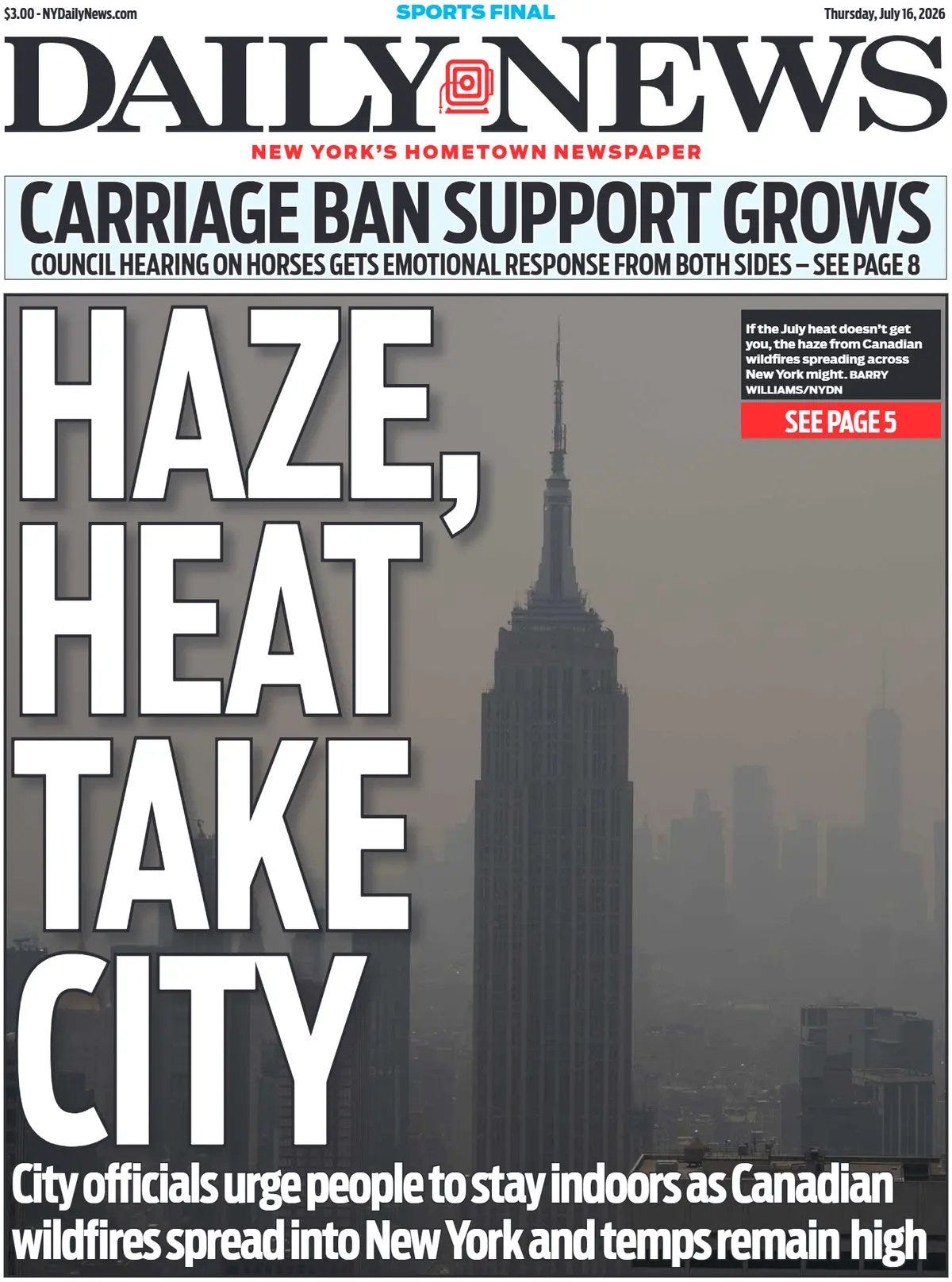
A plume of dense smoke from scores of raging wildfires stretched across much of the northeastern United States and southern Canada on Thursday, prompting officials and health experts in some of the region’s most populated cities to urge residents to avoid spending too much time in the polluted air. Air quality readings in Chicago, Cleveland, Detroit, Minneapolis and Toronto surged to levels so dangerous that one public health expert said “nobody should spend time outside.” Conditions were forecast to worsen throughout the day as skylines and tall buildings disappeared from view under a suffocating haze, and dozens of new and existing fires continued to rage. By midday, sensors in the Upper Midwest and southern Ontario, where the smoke was at its most dense, were recording the worst air quality in North America. Readings in Washington, Philadelphia and New York City were all at unhealthy levels. Mayor Zohran Mamdani of New York urged the eight million residents of the nation’s largest city to stay indoors. “At unhealthy levels, everyone — not just people with asthma and heart conditions, not just older adults — everyone may feel health effects,” he said. Meanwhile, Republican lawmakers from states affected by the smoke threatened punitive action against Canada, accusing the country of mismanaging the wildfires. Senator Bernie Moreno, Republican of Ohio, said he would introduce a bill next week to penalize Canada “for this atrocity.” - NYT
China’s planned restrictions on rare earth exports could put $6.5 trillion in downstream production at risk, the International Energy Agency said, underscoring Beijing’s chokehold over an industry critical to the global economy. Last October, China decided to expand export controls in response to tariffs imposed by Washington, though Beijing later postponed implementation by a year. While the US and other Western countries have vowed to reduce their reliance on China’s rare earths, experts say the shift could take years to play out. “China built its leverage by making the world believe it was the sole supplier,” a senior White House economic advisor wrote. “America’s task is to work with our free-world allies to make sure there is an alternative.” - Semafor
US President Donald Trump's administration finalised rules Thursday that impose stricter limits on how long foreign students and journalists can stay in the United States, the latest bid to tighten legal immigration in the country. Under a change that could be implemented as soon as September, foreigners on student visas would be admitted for the length of their academic programme up to a maximum of four years. Foreign journalists would be limited to stays of just 240 days, or around eight months, although they could apply to extend by 240-day periods, except for Chinese journalists who would get just 90 days. The move forms part of a broader immigration crackdown that Trump has made a centrepiece of his presidency, spanning aggressive enforcement operations in major cities as well as new restrictions on legal pathways to citizenship. Media organisations and international stakeholders, including the Embassy of Japan, urged DHS to allow admission periods of two to five years for correspondents posted to US bureaus. The department rejected the proposals, along with requests for expedited processing and capped fees for journalists - AFP
MAGA physician Dr. Drew Pinsky has called BS on Mitch McConnell's claims that he's on the mend. The Kentucky senator's health has been a subject of speculation since he began freezing during news conferences and falling at work. Chatter intensified after McConnell was found "unconscious" at his home last month.In the immediate aftermath, his team remained tight-lipped, creating a vacuum in which conspiracies formed. Then, on Sunday, the Trump ally emerged with a proof-of-life photograph from his hospital bed. “He’s not been forthcoming about what’s happening with him,” Pinsky said.
The journals…