

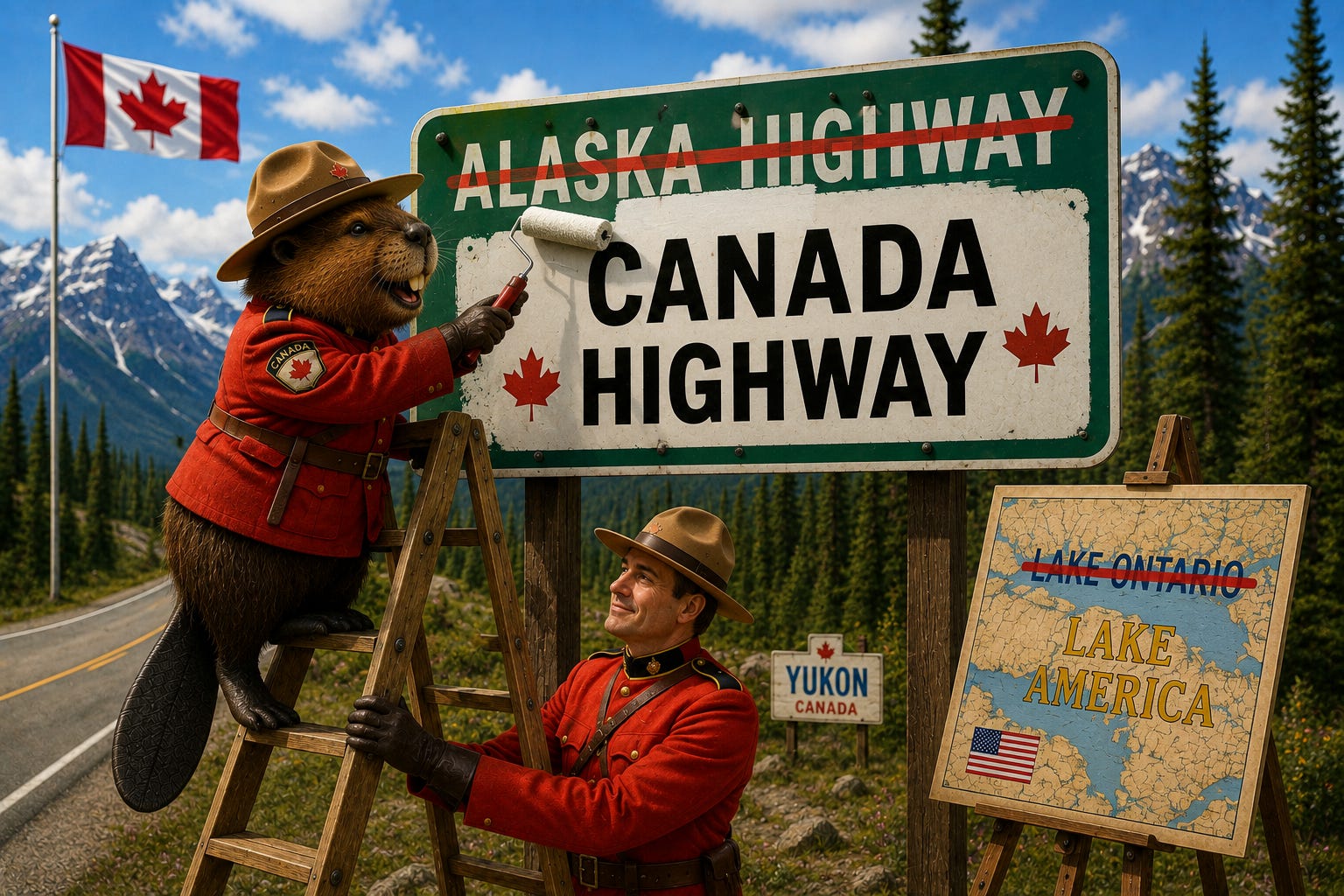
On Tuesday morning, the President of the United States announced that he is giving “serious consideration” to renaming Lake Ontario. It is to be called Lake America. The reasoning - his, not mine - that Washington does not expect to be doing much business with Ontario any longer.
He then posted a map with the old name crossed out and the new one in gold lettering beside an American flag, because of course he did.
Mélanie Joly’s reply was the correct one: we will always call it Lake Ontario. Doug Ford called it rhetoric. Dominic LeBlanc declined to engage at all, which is federal policy now and probably wise.
But let us suspend wisdom for a moment.
Because if we are opening the map and reaching for the marker, Canada has options. Quite a lot of them, actually.
Mount Kennedy is safe
The obvious target sits 4,238 metres above sea level in the St. Elias Mountains of Yukon.
Mount Kennedy is spectacular, remote and entirely Canadian: the ground, the park, the jurisdiction, all of it. If the new rule is that governments may rename whatever geography they happen to control, we could have the paperwork started by lunch.
Except we won’t. Because we’re grown-ups.
Canada named that previously unnamed peak for John F. Kennedy in 1965, as an act of mourning for a murdered friend. That March, Robert Kennedy climbed it, becoming the first person to stand atop a mountain bearing his brother’s name. It remains one of the most genuinely moving gestures in the history of Canada–US relations.
And Canadians adore Kennedy. Camelot. He came to Ottawa early in his presidency and spoke of two countries bound by more than a shared continent.
The relationship was never as warm as the speech. Kennedy had little patience for John Diefenbaker, and the feeling was returned with interest. Which is rather the point: two governments that genuinely disliked each other still managed a gesture like this one.
Trump treats names as assertions of ownership. Mount Kennedy was named for almost the opposite reason: affection.
So Mount Kennedy stays. You’re welcome, America.
“Geography has made us neighbours. History has made us friends. Economics has made us partners. And necessity has made us allies” - John F. Kennedy in Ottawa on May 17, 1961
The Alaska Highway, however
Sorry, this one we can no longer live with.
The highway stretches 2,450 kilometres from Dawson Creek, British Columbia, to Delta Junction, Alaska. The US Army built it during the Second World War as a strategic supply route after Pearl Harbor.
Fair enough. Thank you for the road.
Though the Americans did not find their own way through. Local First Nations guided the engineers along routes they already knew, and Ottawa now attaches Indigenous Benefit Plans to much of the work it does on the road.
But 1,900 kilometres of it - almost 80 per cent - run through British Columbia and Yukon. The US Army handed the Canadian sections over in 1946, and civilian traffic started rolling two years later. That was eighty years ago.
Which raises a question. Why is 1,900 kilometres of Canadian highway still advertising an American state?
Under the new Lake America doctrine, this is clearly untenable.
So, regrettably, we have no choice.
The Canadian portion shall henceforth be known as the Canada Highway.
This will require British Columbia, Yukon and Ottawa to agree, since the federal government owns only 835 kilometres of it.
Signs will need changing. Google Maps will catch up eventually. Alaska may retain its own stretch once motorists cross the border, because we respect American sovereignty.
We are not unreasonable people.
There are other candidates
Consider Boston Bar, British Columbia. The name comes from the Chinook trading jargon of the Fraser Canyon, in which Americans were “Boston men,” after the ships that carried them. The name does not merely honour Americans. The name means Americans. It has sat there, unmolested, for a century and a half.
There is Roosevelt Campobello International Park in New Brunswick. It was Franklin Roosevelt’s beloved summer home, sitting on a Canadian island and jointly administered by both countries. Safe. Lovely place.
Then there is British Columbia itself, the deep cut. “Columbia” derives from the Columbia River, named for an American trading vessel. Queen Victoria bolted “British” onto the front in 1858 precisely to distinguish the territory from the American side.
The entire province is named after a naming dispute we won. We’re keeping that too.
This is what restraint looks like.
What renaming can actually be for
There is a version of this that Canada does properly, and it is worth the contrast.
In 2021, the W̱SÁNEĆ Leadership Council and Gulf Islands National Park Reserve changed McDonald Campground, near Sidney, B.C., to SMONEĆTEN. Parks Canada does not call this a renaming. It calls it a name reclamation, which is the whole point. SMONEĆTEN is SENĆOŦEN for “place of pitch” - the spot where W̱SÁNEĆ people gathered sap from Douglas firs for fire-starting, for patching wounds, for sealing canoes.
Nobody invented that name to win an argument. It was there first, and it was put back.
Lake Ontario is the same case, which is the irony Trump has not noticed. The name is Iroquoian and it predates both countries. It was never his to rename. For that matter, it was never ours either.
We have form
Canadians who think even the Canada Highway sounds unserious should know their own history.
In 1946, Mackenzie King renamed Banff’s Castle Mountain in honour of Dwight Eisenhower. The change rippled outward - the family bungalow camp at Castle Junction, in business since 1939, spent the next three decades trading as Castle Eisenhower. Albertans never really accepted it. In 1979, after thirty-three years of grumbling, Castle Mountain got its name back, and Eisenhower was left with a single tower on the eastern end as a sort of geopolitical severance package.
At the base of that same mountain sit the remains of the Castle Mountain Internment Camp, where between 1914 and 1920 Canada confined its own residents as enemy aliens, most of them Ukrainian, and did not formally acknowledge it until 2005.
So Canada has un-named an American general before. It took a generation, but we got there.
We are also capable of stopping ourselves. In 2000, Ottawa floated renaming Mount Logan after the late Pierre Trudeau. Surveyors, scientists and Yukoners killed the idea almost immediately.
Canadians will tolerate a great deal. Apparently we draw the line at mountains.
The part where we admit we already won
There is also an awkward detail in all of this.
Trump Tower Toronto opened in 2012. The Trump name came off in 2017. The building became the Adelaide and subsequently the St. Regis.
Trump International Hotel & Tower Vancouver opened in 2017. The hotel closed in 2020; the Trump branding disappeared and the property eventually reopened as the Paradox.
Both disappeared for the most Canadian of reasons: not an executive order, not a presidential proclamation and not a map in gold lettering, but ownership changes, contracts and commercial reality.
Quietly.
Without a single post.
That is the Canadian method.
We removed Trump’s name from his buildings and left Kennedy’s name on his mountain.
Wab Kinew put it better this week. Canada’s response, the Manitoba premier said, has shown the rest of the world “that you don’t have to take a knee, you don’t have to bow down.”
Nor, it turns out, do you have to shout.
The serious bit, briefly
Renaming is cheap, which is precisely why politicians do it.
It costs nothing to type, generates a day of headlines. And it leaves the underlying tariffs exactly where they were - 50 per cent on roughly US$20 billion of Canadian goods, with Ottawa’s retaliation landing September 8.
But something more valuable is being spent.
Mount Kennedy exists because in 1965 Canada wanted to say something to a grieving ally that words could not carry, and reached for a mountain.
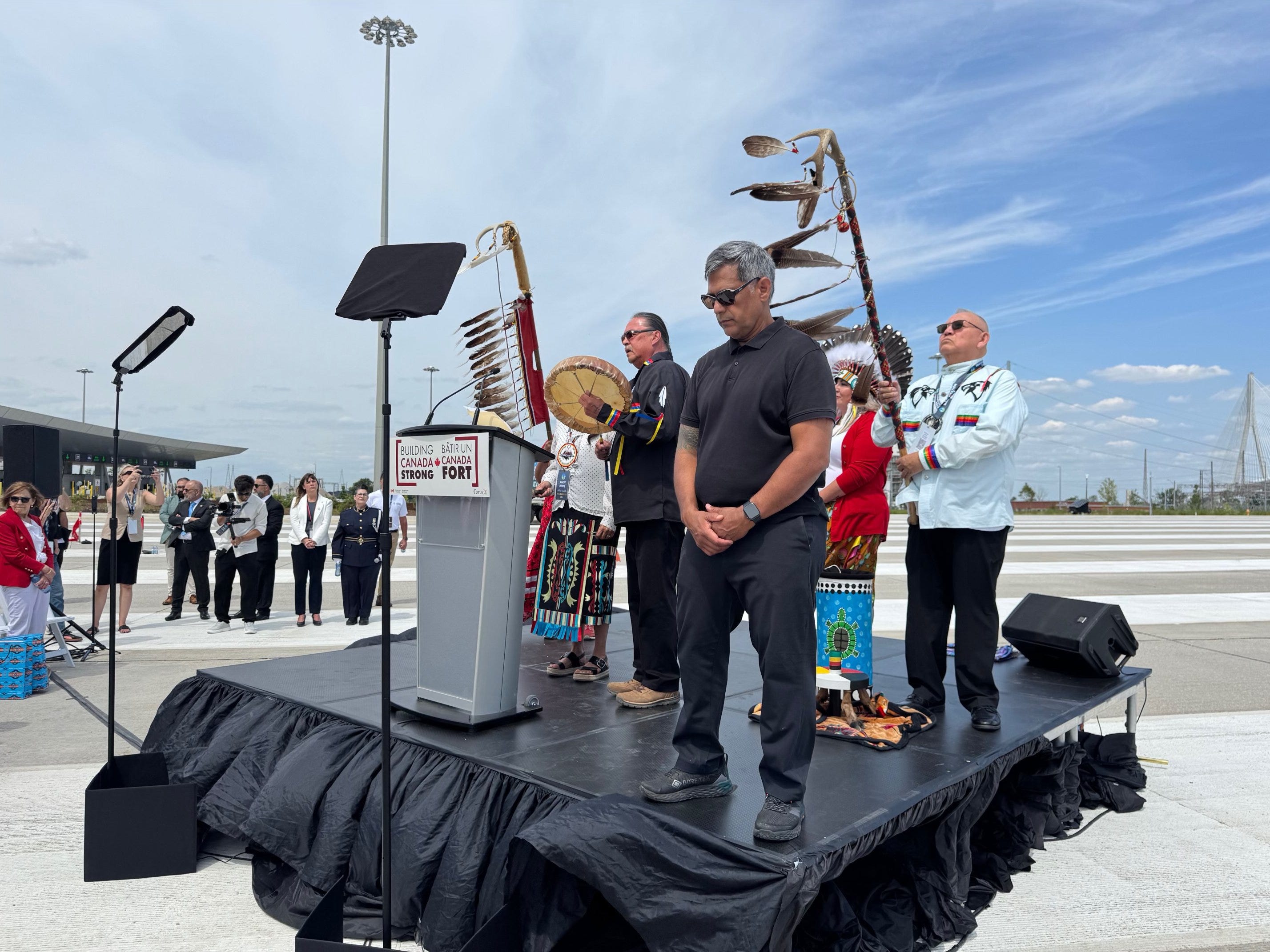
The Gordie Howe Bridge exists because two countries decided to build something together and name it after a man both could claim. Trump spent this year trying to stop it opening, demanding half of it, and Canada held the ribbon-cutting without him. Murray Howe, standing there, said only that he wished everyone could have come.
Those names are remnants of something far harder to construct than a tariff wall, and far easier to destroy: goodwill.
That is why Mount Kennedy should stay Mount Kennedy.
The tragedy isn’t that Canada could rename it.
It’s that a gesture like naming it feels almost unimaginable today.
The Alaska Highway, though? Welcome to the Canada Highway.
News Briefs
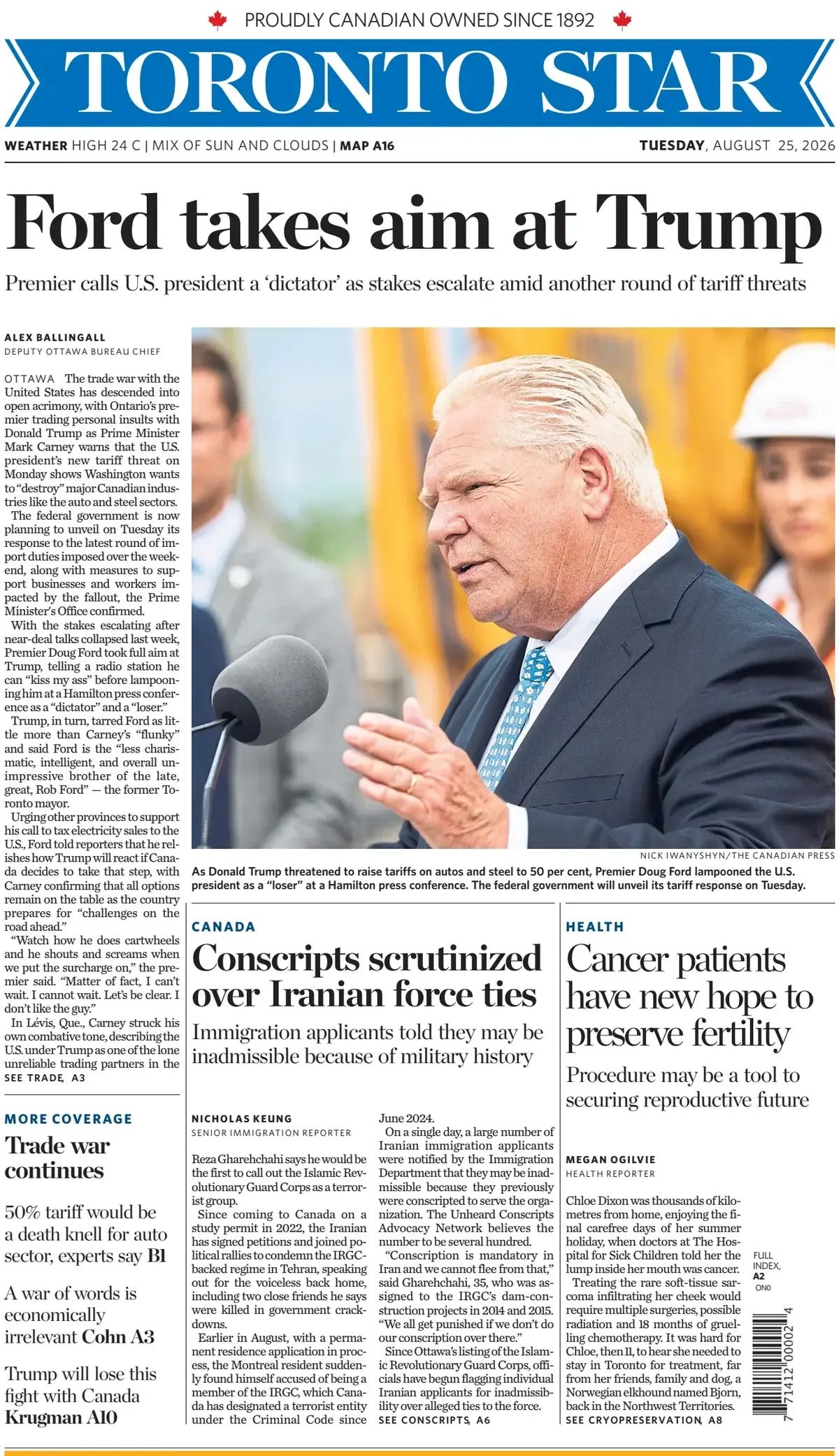
The Canadian government has announced its plan to hit the United States with dollar-for-dollar counter-tariffs on hundreds of American products after U.S. President Donald Trump’s 50 per cent tariffs on roughly C$28 billion worth of Canadian goods came into effect. On Tuesday, the White House released a statement that outlined what it claimed were a “record of Canadian abuse,” including restrictions on U.S. products and retaliatory measures. Trump shared several posts on Tuesday where he openly considered renaming Lake Ontario to “Lake America.” In response, a candidate in the Toronto mayoral election proposed renaming New York state “the province of New York.” Meanwhile, several premiers spoke on the trade war between the two countries, including Ontario’s Doug Ford, who told U.S. media that he told Prime Minister Mark Carney to reject the Trump administration’s latest offer.
California Gov. Gavin Newsom says he believes Trump will change course on his new tariffs on Canada soon, as he faces increasing political pressure back home. “Imagine the phone calls Donald Trump’s receiving from members of his party, not from those condemning him from my party,” Newsom said in an interview with CTV News’ chief political correspondent Vassy Kapelos on Tuesday. “I think it’s a matter of days, if not weeks, the latest, where he completely flips on this and then tries to save face.”
CIA director John Ratcliffe visited Moscow on Tuesday for talks with Russian officials, two U.S. officials cited by Axios said. This was Ratcliffe’s first trip to Moscow since he took office and the highest-level visit by a Trump administration official to Russia since January. Ahead of Ratcliffe’s trip, the U.S. told Ukraine that a senior delegation was traveling to Moscow and asked it to suspend strikes until it leaves, according to a source with knowledge of the matter. Ratcliffe departed Washington on Sunday and traveled on a U.S. government plane to Latvia. Several social media posts reported he had spent only a short time on the ground in Moscow. The nature of the journey suggested the stakes were high, Glen Howard, a Russia expert who is chairman of the Saratoga Foundation, a US-based think tank, told RFE/RL. CIA directors don’t go to Moscow unless it is to ask something,” Howard said, adding that they do not “travel all the way to Russia unless it is important.” “Burns went there in November 2021 before the Russian invasion to warn them not to invade Ukraine,” he said. At that meeting, former Director William Burns met with Nikolai Patrushev, who was then serving as secretary of Russia’s Security Council.
Vladimir Putin has stepped up efforts to recruit women into the war against Ukraine, as Kyiv’s summer drone offensive piles unprecedented pressure on the Kremlin. Women can sign military contracts in any Russian region after a Spring rule change, with recruiters advertising positions on Telegram channels, according to Polish investigative publication Vot Tak. Russian women have increasingly reported unsolicited outreach. A resident of Kaliningrad named Nadezhda said she received a call offering a $35,000 contract immediately after enrolling her child in kindergarten; she declined, and recruiters never called again. Another woman, the mother of a seven-year-old, recalled her reaction to a similar pitch: “As soon as they told me, ‘Would you like to sign a contract to defend the motherland? We’re calling and offering it to girls, too,’ I said, ‘Are you f---ing nuts?’” Mediazona reported that even a pregnant woman received a military summons - The Daily Beast
Oklahoma Republican Sen. James Lankford came away from a visit to Kyiv on Tuesday acknowledging that he couldn’t promise President Volodymyr Zelensky that Congress would approve long-awaited sanctions against Russia anytime soon. “My best understanding I could pass on to him was that the House plans to take this up in September. But obviously, I don’t set the schedule on that,” Lankford said, noting that Zelensky urged for it to come soon. “He’s very interested in additional economic pressure on Russia, knowing that every dollar that they get, they use to be able to buy a weapon to be able to kill Ukrainians.” Lankford spoke to POLITICO from Poland, following his two-day trip to Kyiv over the country’s independence day. He said he spoke to Zelensky for about 20 minutes alongside his colleague Sen. Richard Blumenthal (D-Conn.) backstage at a prayer breakfast. Lankford appears to be the most prominent sitting elected Republican to make the trip to Kyiv for the annual event — particularly noteworthy after the death last month of Sen. Lindsey Graham, a staunch Ukraine advocate. Graham had been working with Blumenthal on the sanctions package the Senate passed in early August and which the House has yet to clear. Lankford, a longtime Ukraine supporter, pushed for the sanctions bill after Graham’s death, urging his colleagues to “finish what he started.” - POLITICO
Malaysia and Indonesia have agreed to step up measures to tackle transboundary haze as Putrajaya gears up for National Day celebrations amid unhealthy air quality levels linked to fires in neighbouring Indonesia. Sixteen areas in Malaysia had “unhealthy” Air Pollutant Index (API) readings as at 9am on Wednesday (Aug 26), local media reported. They included parts of Sarawak and Peninsular Malaysia. A day earlier, about 30 areas had unhealthy air quality. Malaysia’s 69th National Day celebration is set to take place at Dataran Putrajaya on Aug 31 while the Malaysia Day celebration will be held in Kuching, Sarawak on Sep 16. Malaysia’s Natural Resources and Environmental Sustainability (NRES) Minister Arthur Joseph Kurup said the commitment to ramp up measures with Indonesia was reached during a phone call on Monday with his counterpart Jumhur Hidayat, news agency Bernama reported. “With the El Nino phenomenon expected to intensify towards October 2026, coinciding with the Southwest Monsoon, both nations are fully committed to stepping up prevention and early suppression measures,” Arthur said in a statement. He also expressed the Malaysian government’s appreciation to Indonesia for granting official clearance for cloud seeding operations to cross its airspace, targeting areas along their shared border. Sarawak, which borders Indonesia’s Kalimantan on Borneo island, has been worst hit by the haze - CNA
The journals….
Good one Michael! 👏🏽👏🏽👍🏼 Like Taylor Swift sings.."Play stupid games, win stupid prizes." 🤷🏽♀️
That's hilarious Michael, very witty. If you ever tire of Journalism, you could have a career in stand-up-comedy.