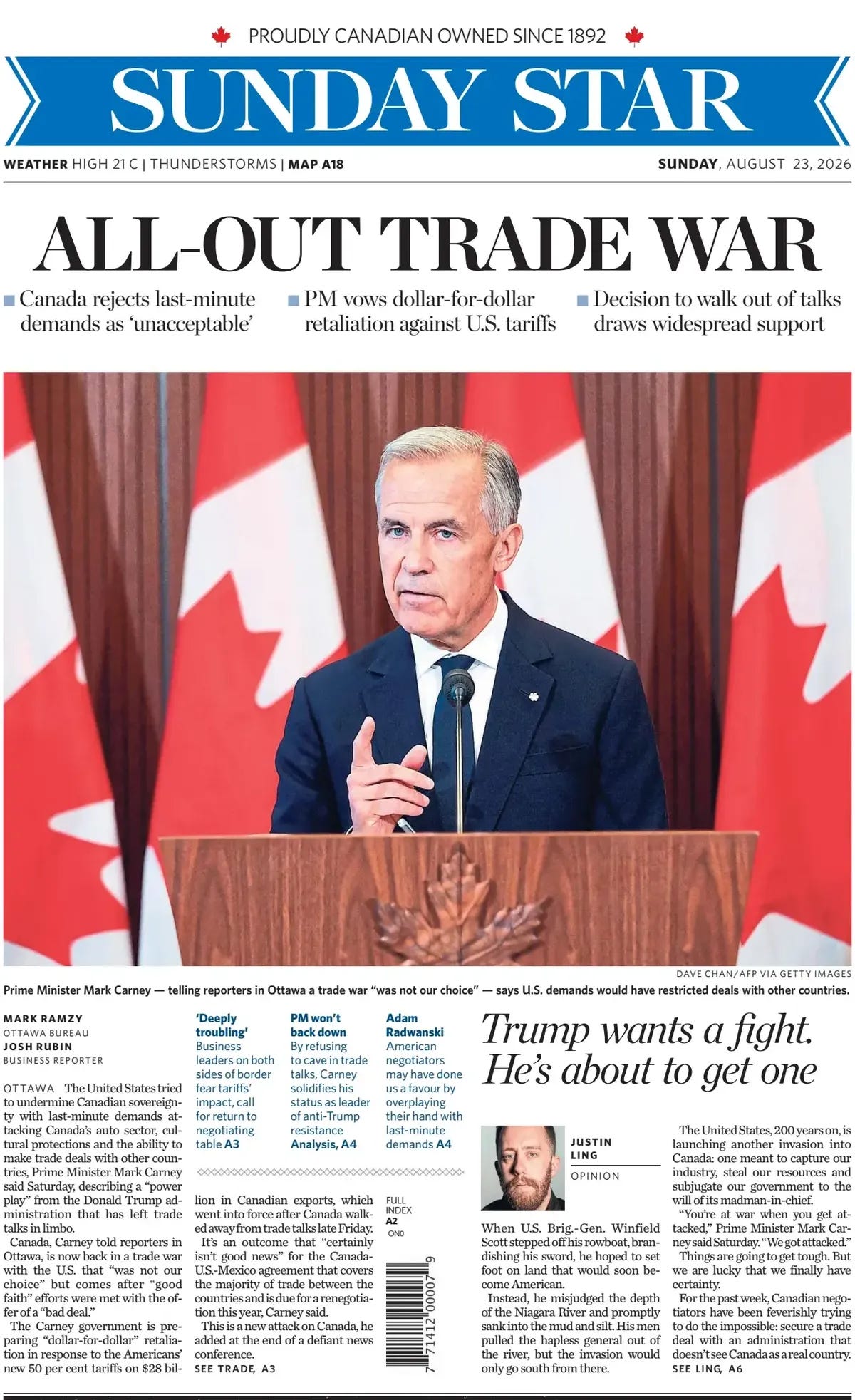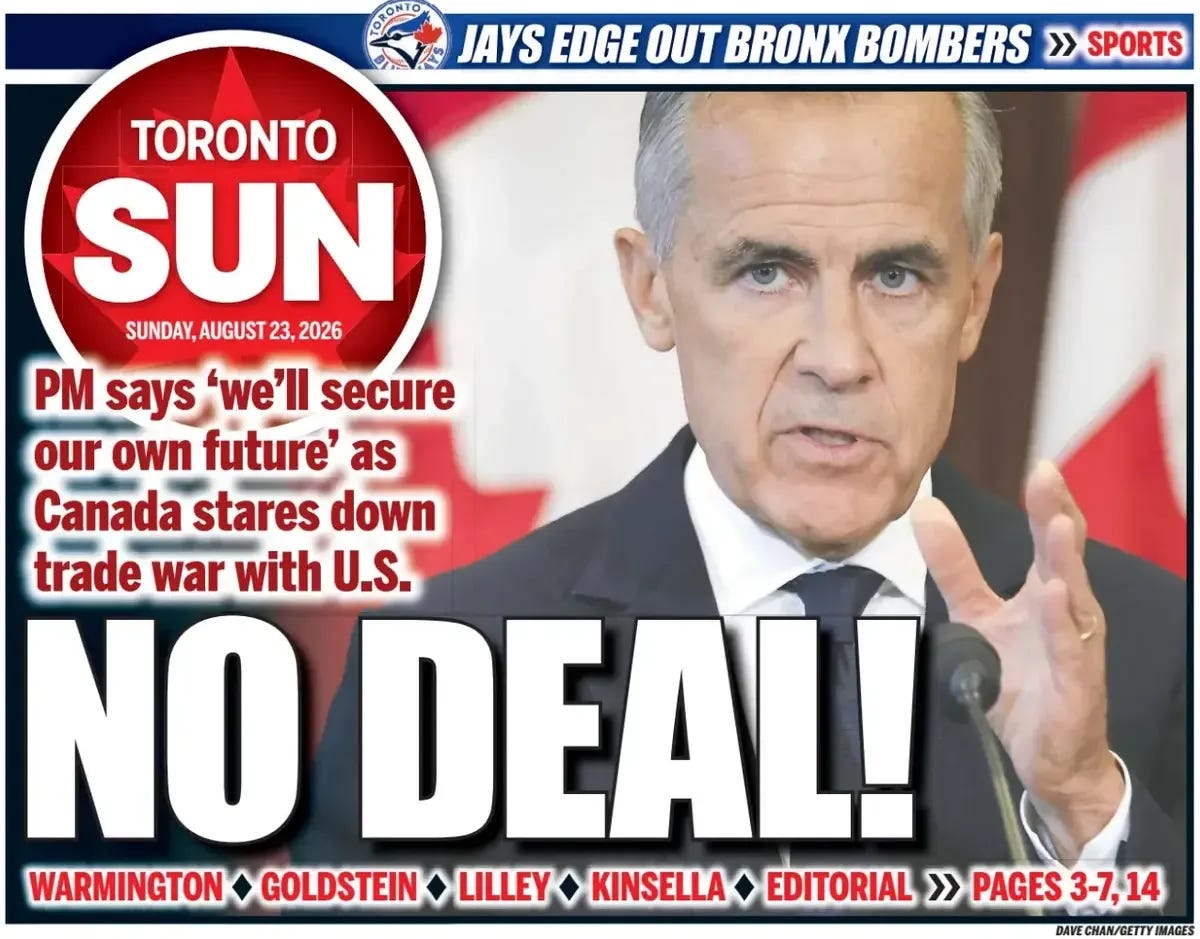
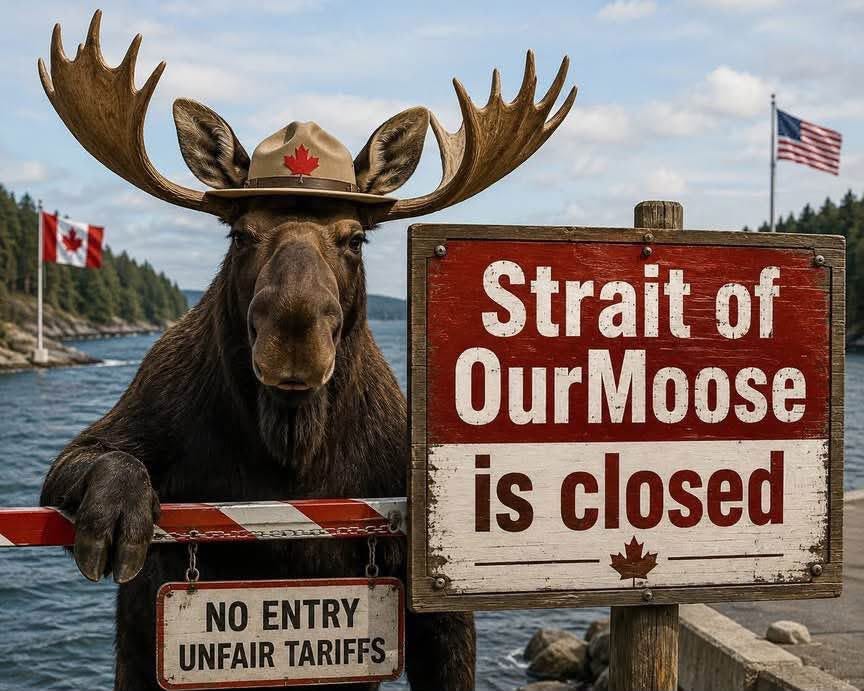
The Verdict: Ottawa walked. Trump had signalled a deal was at hand on Tuesday and paused the tariffs to let it be finished; by Friday midnight there was no deal. Carney says the trade war was not Canada's choice but that good-faith efforts were met with a bad offer. Fifty per cent duties on US$20-billion (about C$28-billion) of Canadian goods took effect Saturday. Canada retaliates Sept. 8.
What Scuttled It: Not softwood, not dairy - trucks. Washington offered to cut tariffs on Canadian cars from 25 to 15 per cent, then clarified late in the process that the relief covered light vehicles only. That leaves out the F-350s and F-450s Ford is retooling its Oakville, Ontario plant to build - a $5-billion commitment a Globe and Mail source says is now in question - and the Silverados coming off GM's Oshawa line. Carney says no rationale was given. A source with knowledge of the talks told the Globe that Canadian negotiators learned of the exclusion only late in the process. The second fight was over parts: Ottawa wanted Canadian content treated the way American content already is. Washington balked. Without that, even 15 per cent wasn't the win it looked like.
And The Part That Isn’t About Cars: Carney cited American language that would have constrained Canada’s ability to negotiate with third countries - a sovereignty clause dressed as a trade term. Quebec’s red lines were cultural: bilingual labelling and French-language policy. Premier Christine Fréchette says language isn’t negotiable.
Washington’s Version: The USTR says Canada walked from the best terms offered any major exporter and blames Ottawa for late demands and reversals - a precise inversion of Carney’s account. Both capitals accuse the other of moving the goalposts. Then Trump, posting Sunday morning after the tariffs landed: Canada wants the benefits of statehood without the statehood. The annexation line never really left the room; it just goes quiet while a deal looks possible.
The Tell: Both capitals agree trucks killed the deal. Neither agrees who put them on the table. US officials tell POLITICO Ottawa made a late ask on heavy trucks; Carney says Washington carved trucks out after the auto framework was settled. POLITICO reports that Greer ran the talks while the concessions in play - autos, steel, aluminum - sat with Lutnick at Commerce, which felt the framework was sprung on it.
If that’s right, nobody moved the goalposts. There were two sets. And that’s worse than bad faith, which is at least a position you can negotiate against. This is a counterparty that can’t bind itself.
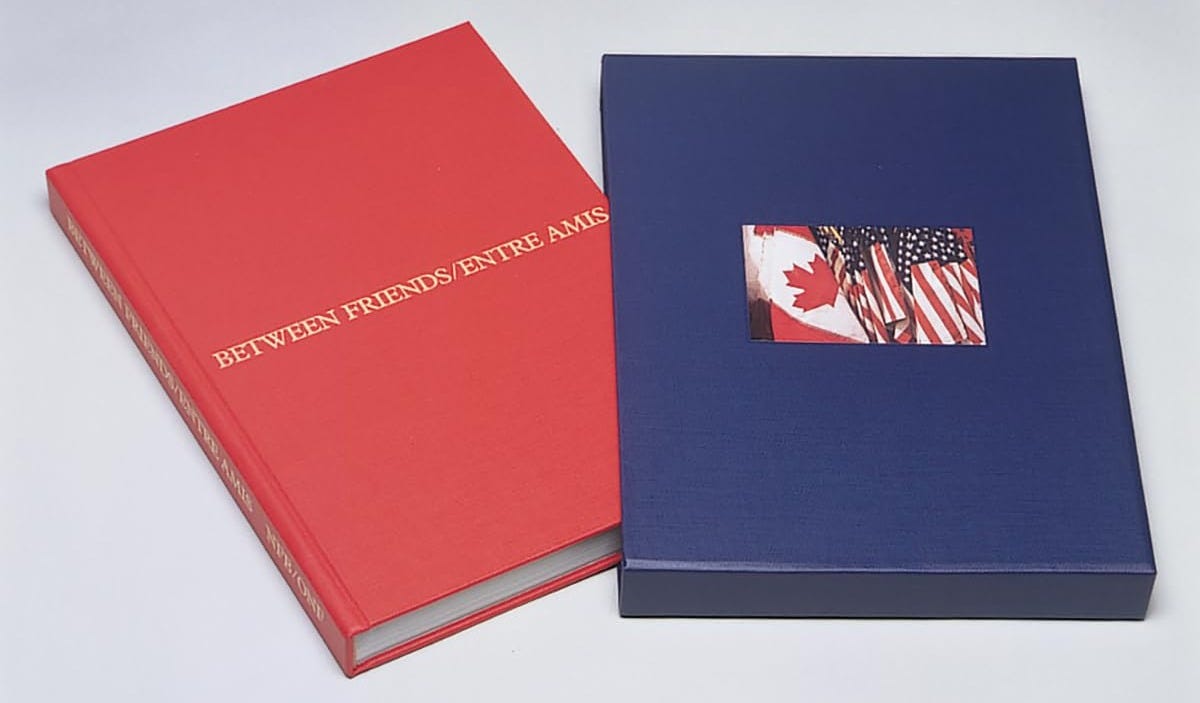
Pretty Much Seeing Eye-to-Eye: Which in Canada is the real story. Poilievre, Blanchet, Lewis and Doug Ford all backed the walkaway. A Léger poll released Monday had 56 per cent of Canadians demanding no further concessions. Fifty years ago, Canada gave America a book celebrating what it called the "unique friendship between two countries." This weekend Carney read the newer room. He also used a word Canadian prime ministers do not casually apply to Washington: "attacked."
In retrospect, perhaps a comfortable Canada-US partnership under Trump was always a bridge too far. The warning was there when he delayed the opening of the multibillion-dollar Gordie Howe International Bridge - itself a symbol of the enduring partnership he was already putting under strain.
Watch: The treaty, not the tariffs. Carney noted Saturday that the tariffs are bad news for the USMCA agreement covering most North American trade, which is up for renegotiation this year. That’s the real board. Greer says there are no further talks scheduled; Washington is instead preparing measures answering Canadian retaliation. Watch whether Ford’s Oakville commitment survives the fourth quarter - and whether Mexico gets caught in the crossfire of a dispute it isn’t party to. In the meantime, listen for the sound of California zinfandel, Oregon pinot noir and Kentucky bourbon going down the drain in the provinces that still have some to pour.
The Uncomfortable Part, Oh Canada: There’s a case to be made that this is good for Canada, and it isn’t the one about resilience.
We are victims of our own geography: ninety per cent of us live within a couple hours of the border, and we built an economy around the assumption that the easy market would remain easy. It didn't. We should have looked east and west decades ago and mostly didn’t, because south was closer.
What we lack isn’t capacity. It’s appetite.
At a Canadian business event in Singapore this year I listened to people complain about the fifteen-hour flight and the jet lag, and hedge about opening a permanent presence in Asia. Lee Kuan Yew once described the same problem to me from the other end: the Singaporean who won’t get on the plane to China because home is comfortable. Dare I say it? We are a much larger version of that, with much less excuse.
If it takes a trade war to get Canadians off the couch - to make snowbirds reconsider the Florida condo, to make a company stop treating Asia as an unaffordable business trip - then perhaps the tariffs will have bought us something after all. Not militancy. A footing.
We are going to have to become more aggressive than we find comfortable. We should have started years ago.
Ukrainian President Volodymyr Zelensky has “questions to answer” about corruption in his government, his sacked defence minister Mykhailo Fedorov has told the BBC. Fedorov, a popular minister who modernised the armed forces and pioneered drone warfare, was fired last month after reportedly falling out with the head of Ukraine’s armed forces. He told the BBC a money laundering investigation announced last week raised questions about Zelensky’s awareness of potential corruption in his inner circle. Fedorov also reiterated that “democracy should not be the hostage of Putin” - but stopped short of declaring his own political ambitions days after he posted a video calling for elections in Ukraine. Fedorov said it was his “moral right” to start the conversation about elections. “We should not be afraid of discussing it. That’s what democracy is all about. If I cannot share my ideas and be open about them with my own society, then what are we fighting for?” If elections were never held, he said, “then we are no longer a democracy”. He shied away from criticising the president directly and declined to answer whether he backs Zelensky to win any election - BBC
Volodymyr Zelensky has rejected calls for wartime elections to be held in the country, calling them “a tsunami” that would “split Ukraine” at a time when Russia is increasings its deadly attacks. Speaking to journalists in Kyiv on August 22, Zelensky said: “Elections right now are a tsunami for the state that will split Ukraine. Therefore, my strategy is to bring the country to the end of the war and preserve an independent and sovereign state,” Zelensky said. He made the comments as Kyiv hosted the NB8-Ukraine summit on August 23, bringing Nordic and Baltic leaders together with Zelensky on the eve of Ukraine’s Independence Day. Leaders from Denmark, Estonia, Finland, Latvia, Lithuania, and Norway convened in the capital, according to Ukrainian Foreign Minister Andriy Sybiha. Other senior representatives from partner countries were also in attendance - RFE/RL
Russian President Vladimir Putin said in comments published on Saturday that Kyiv had opened “Pandora’s box” with its strikes on Russian economic targets, saying that Russia would hit back at Ukraine’s “most sensitive economic sectors.” Ukraine has this summer escalated a campaign of drone strikes targeting Russian economic infrastructure, including oil refineries and online retailers’ warehouses, seeking to destroy infrastructure it says is central to Russia’s war effort. Russia has responded with strikes against Ukrainian economic infrastructure, including Ukrainian grain exports via the Black Sea. “The Kyiv regime set out to damage our economy. What did it do? It opened this Pandora’s box itself. Well then, expect a response targeting your most sensitive economic sectors,” Putin said in comments to a Russian state television journalist. He said that the strikes, which have jeopardized Ukraine’s agricultural exports, would not cause global food shortages, because Russia would be able to replace Ukrainian exports, even as Kyiv has targeted Russian grain export infrastructure. “We do face challenges regarding the shipment of our goods, but we will resolve these issues. Consequently, there will be no shortage on the global market,” Putin said. Russia and Ukraine had previously adhered to a Turkish-brokered deal to protect grain exports on the Black Sea. But Russia exited the deal in 2023. The Russian leader also restated his position that Moscow is open to peace talks, but only on the basis of “realities on the ground,” rather than what he called “exotic” proposals that he said had been made by Ukraine via intermediaries - Moscow Times
Europe continues to struggle with the consequences of extreme weather, with Serbia, Bosnia, Spain, and Poland all facing severe conditions. In Serbia, the EU has sent helicopters and firefighters to support local crews battling a blaze that has engulfed more than 1,600 hectares of vegetation in the Deliblatska Pescara nature reserve, 60 kilometres east of Belgrade. The effort is also being assisted by a Russian Ilyushin Il-76 water bomber deployed since Thursday, alongside several Serbian army helicopters. Meanwhile, Spain has faced a weekend of contrasting weather extremes. Torrential rain and flooding in Tarragona left 11 people injured and disrupted road and rail services after more than 145 mm fell in some areas. Further strong thunderstorms are forecast across eastern and northeastern Spain, while an unusually powerful Atlantic low is bringing heavy rain to Galicia.Further north, severe weather has also struck Poland. Since Friday, storms have wreaked havoc across the country, with firefighters responding to more than 6,500 incidents - Euronews
The journals…