

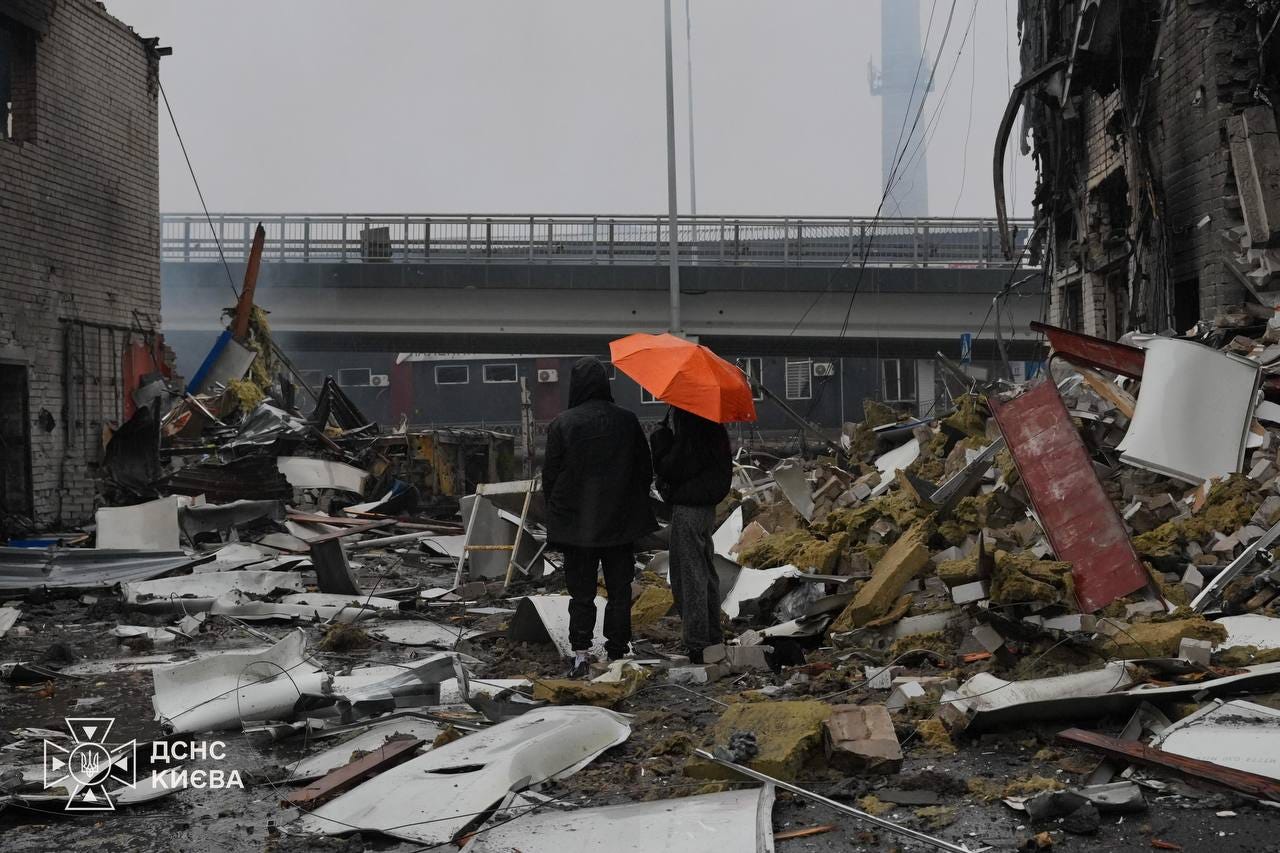
In about 12 hours, Donald Trump showed Ukraine exactly where it stands.
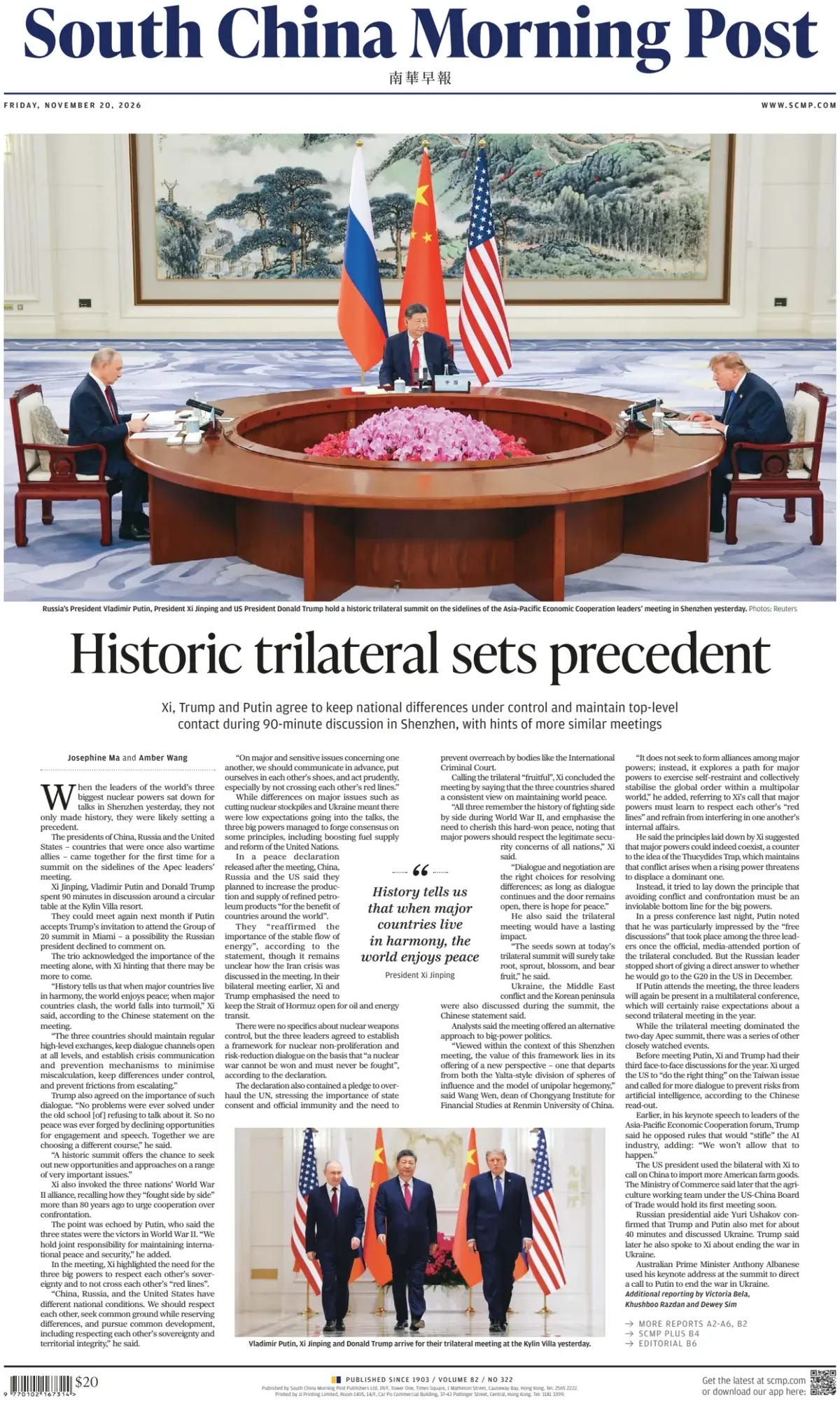
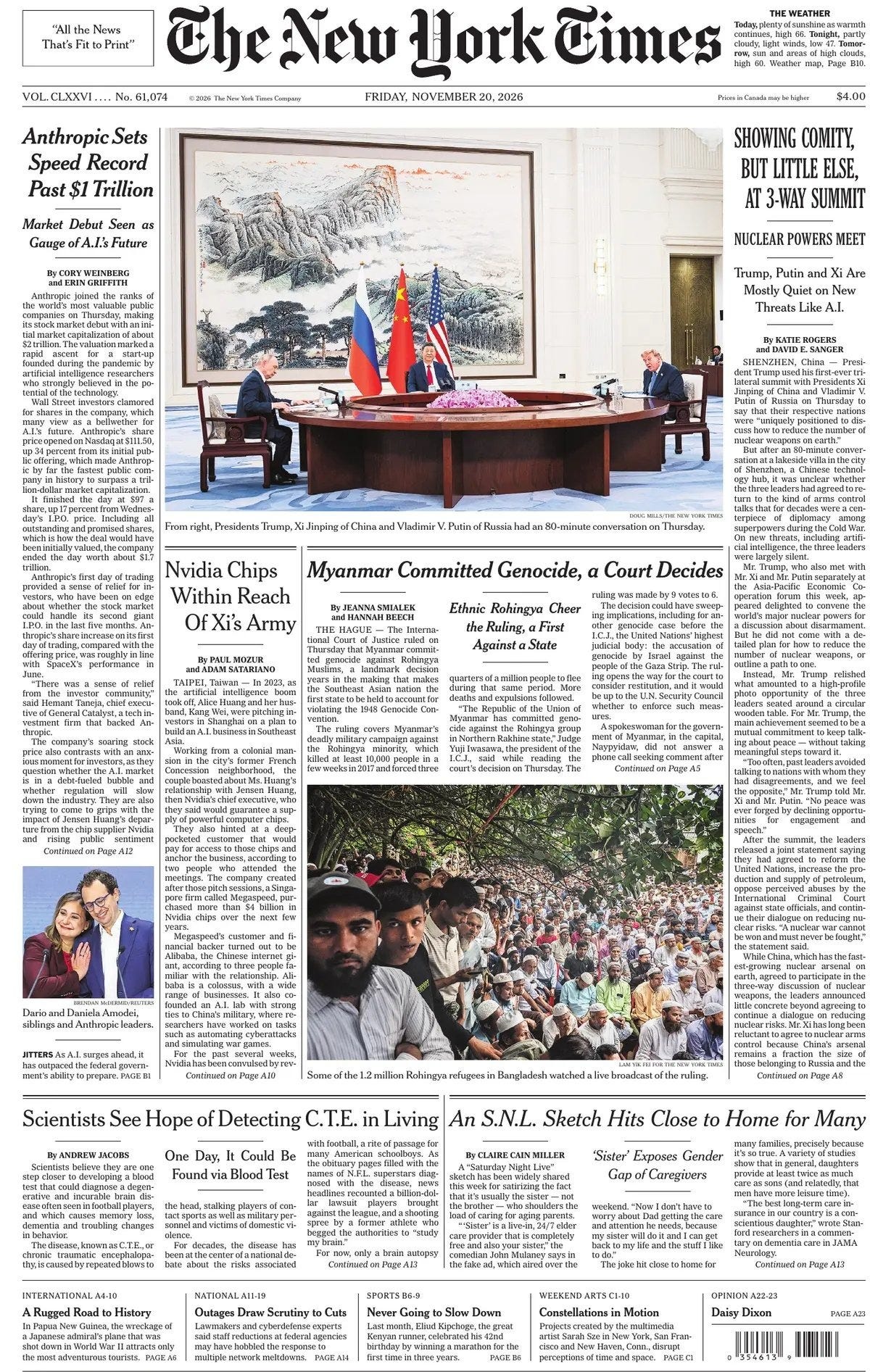
On Thursday in Shenzhen, Trump, Xi Jinping and Vladimir Putin sat around an oversized round table at a secluded lakeside resort and cast themselves as the joint guardians of global security. It was the first summit ever between the three powers. The pictures were striking, but the substance was incredibly thin. After about 80 minutes, they put out a four-point statement that, as the New York Times noted, didn’t mention Ukraine or Iran.
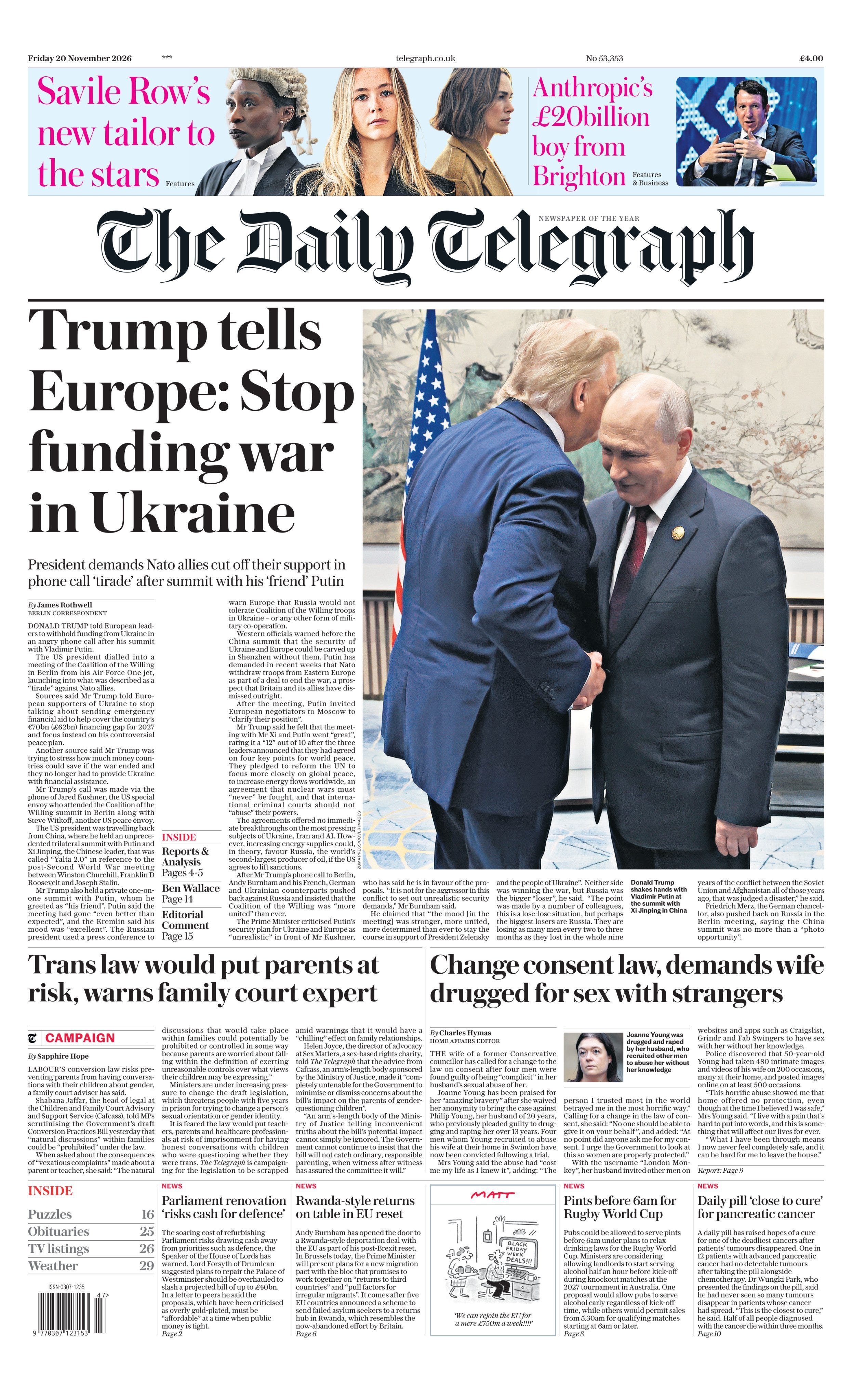
Each man got what he came for. Putin was presented as the equal of the United States and China. Xi played host to the world’s most powerful leaders. Trump got his photos and a hug from Xi, and he greeted Putin as “my friend.” Trump rated the summit “12” out of 10, the Telegraph reported. Germany’s Friedrich Merz called it a “photo opportunity.”
Trump had called nuclear weapons his top priority. On that, the three agreed only to talk about reducing risks and preventing proliferation. Nothing in the statement limits China’s fast-growing arsenal.
On Ukraine, Putin gave up nothing. At his press conference, he ruled out limited ceasefires and pointed to recent attacks on the Crimea bridge as the reason. He also cast doubt on bringing Europeans into peace talks, offering instead to have their envoys come to Moscow to “clarify their positions” first.
For Beijing, the real business was the meeting between Xi and Trump alone. According to China’s readout, the two agreed to draw up an “action plan” for what Beijing calls strategic stability between the two powers. The three-way declaration, meanwhile, found room to warn international courts not to “abuse their jurisdiction” - this from three leaders, one of whom faces an International Criminal Court arrest warrant. It found no room for Ukraine, in either the Chinese version or the one the White House handed reporters today. Nor did China make the White House’s list of “historic deals” from the trip. That honour went to the Philippines and Thailand.
On the flight home, Trump called into the coalition of the willing meeting in Berlin on the phone of his envoy Jared Kushner. According to the Telegraph and Politico, he lectured Ukraine’s European backers: stop talking about emergency aid to plug Ukraine’s €70bn financing gap for 2027, and think how much money you’ll save once the war ends.
Overnight, Putin delivered what he had promised. After Ukraine’s strike on the Crimea bridge earlier in the week, the bridge he cited in Shenzhen to rule out ceasefires, he reportedly vowed “much more painful” retaliation. Missiles and drones killed six people in Kyiv, including workers at the city's water utility. Three bridges across the Dnipro were damaged, half of five districts lost power, and residents of Pecherskyi were warned their taps could run dry. Russia also hit the Western Ukrainian 750-kV substation, said to be Europe’s largest. Lutsk, Lviv and Kryvyi Rih reported problems with water supply. In Odesa, where I am usually based, trams and trolleybuses stopped and tens of thousands of customers lost power.
For most of this war, my message on air has been not to panic about Ukraine. Ukrainians are resilient, and the country has held. If there was ever a time to change that message, it is now.
Overnight showed what I’ve been warning about, as recently as yesterday: Putin’s strikes are pushing Kyiv into the “red zone.” That means no power, combined with no heating, water or sanitation, or all of them at once.
That is not a criticism of Ukrainians. Few other societies would have held up this well under the same bombardment. But resilience has limits. As the weather turns, Kyiv could become unliveable sooner rather than later. If that happens, millions will be pushed west, first into western oblasts that are already overstretched, and then into Europe.
I don’t think Europe sees this coming.
Washington doesn't seem to see it either. A piece in The Dispatch this week calls the Witkoff–Kushner approach "the ultimate form of diplomatic malpractice." The envoys appear to believe the promise of US–Russian business can satisfy a Kremlin determined to extinguish Ukraine's independence. According to the piece, intelligence briefings have been ignored, Russia experts sidelined and even Putin's interpreter used in place of an American one.
Within a day, Moscow made the point for it. In Berlin on Thursday, Kushner said he and Witkoff had gotten the Russians comfortable with security guarantees for Ukraine modelled on NATO’s Article 5. On Friday, Deputy Foreign Minister Sergei Ryabkov dismissed any NATO “quasi-membership” for Kyiv as unacceptable. Ukraine must first accept it will never join NATO, he said, and only then can guarantees be discussed.
And the clock isn’t only ticking on the weather. France, the EU’s only nuclear power and co-leader of the coalition that met in Berlin, may soon be a less reliable backer. Politico reports that polls increasingly show far-right front-runner Marine Le Pen and far-left Jean-Luc Mélenchon heading for next spring’s runoff to succeed Emmanuel Macron. Both are NATO critics. Le Pen says France can no longer afford financial aid to Kyiv, and Mélenchon opposes Ukrainian strikes deep inside Russia.
Trump told Europe it could save money by ending the war. At a talk here in London on Wednesday night, I was asked about Belgium’s refusal to release frozen Russian assets for Ukraine. My answer: keep the money frozen if you like, but you’ll pay far more later, building bomb shelters in kindergartens in Belgium and across Europe. If Kyiv goes dark this winter, and Paris wavers next spring, that bill comes due sooner. And last night was another reminder that the man who could end this war tomorrow has no intention of doing so.
“I think Putin’s a thug. I think he’s killing babies and people in Ukraine. I think it’s despicable what he’s done,” Sen. Rick Scott (R-Fla.) said Thursday, after Trump called Putin “a friend” in Shenzhen.
“One important thing Mr Trump does not understand is that strong alliances are a force multiplier. They’re a steel wall against a very aggressive Russia. Right now, Moscow doesn’t see a steel wall. It sees a rickety fence it can easily get through.” I said it’s time to “turn on the flashing red light to the world,” as Russian strikes push Kyiv towards the “red zone” and Russia reportedly moves submarines in the Black Sea. Speaking to Kate McCann and Stig Abell on Times Radio Breakfast.
News briefs
While many leaders flew into Shenzhen for the APEC summit on private or presidential jets, Mexico’s President Claudia Sheinbaum flew commercial, the New York Times reports. She sat in economy, in seat 33B on China Southern flight CZ8032 from Tijuana, according to AFP and fellow passengers. Her trip took her from Mexico City to Tijuana on a three-hour domestic flight, then roughly 15 hours across the Pacific. Before leaving, she posted a video from the departure gate in Mexico City showing her greeting travellers and posing for photos with fans. “It’s practically a two-day flight, and on top of that, there’s the time change,” she told the Spanish news agency EFE. When she landed on Monday, she took a shuttle bus to the red carpet, where Chinese officials and dancers were waiting. Posts about her arrival on Weibo, China’s version of X, drew more than 10 million views. It isn’t a one-off. Sheinbaum also flew commercial to the G20 in Brazil in 2024 and to last year’s G7 in Canada, citing her government’s commitment to austerity. The practice began under her predecessor, Andrés Manuel López Obrador, who called Mexico’s presidential Boeing 787-8 Dreamliner an “insult to the people.” He refused to use it and eventually sold it to Tajikistan in 2023 for $92 million. The contrast with Donald Trump, who arrived on the Qatari-donated 747 now serving as Air Force One, was hard to miss. So was the contrast with Sheinbaum’s neighbour to the north. Canada’s Mark Carney, who has been telling Canadians to brace for a long economic transformation away from the US, travelled to Shenzhen on the government jet, the final leg of a four-country swing.
Vladimir Putin did not commit to accepting Trump’s invitation to attend the Group of 20 leadership summit in Miami in December, in what would be his first in-person appearance at the annual gathering since 2019. “I have to take into account, first and foremost, what is happening in the country; traveling abroad too frequently isn’t always comfortable for me,” Putin told a post-summit news conference, noting that regardless “a Russian delegation will be present, and it will be represented at a high level.”
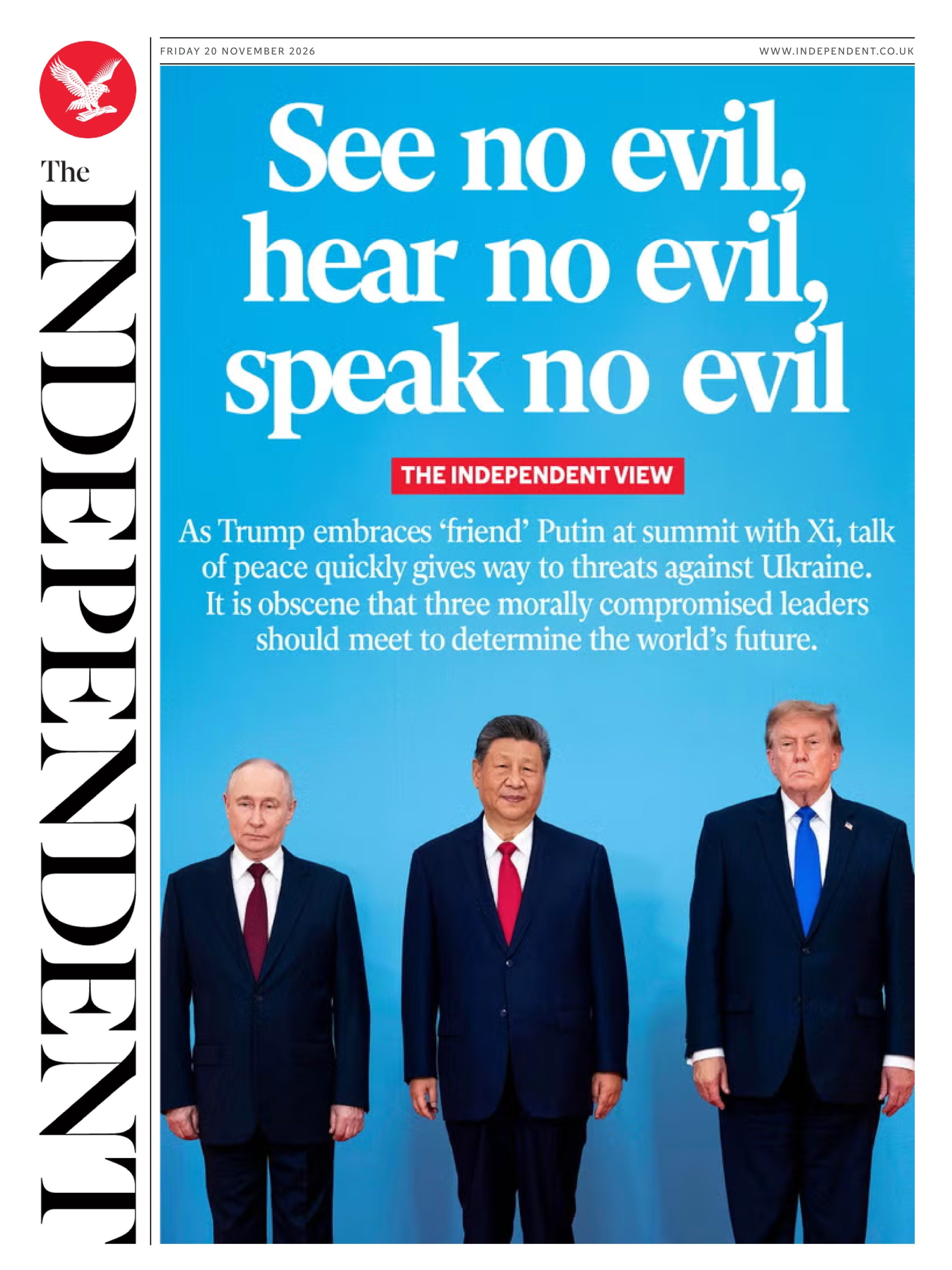
Beijing got the front pages it wanted. On Friday morning, China’s state media presented Thursday’s three-way summit as a turning point for world politics, with Xi Jinping at the centre of it. The English-language Global Times led with “China, Russia, US hold groundbreaking summit,” and a strapline saying the meeting “charts a new course for major-power relations.” Its main photo shows Xi seated in the middle of the giant round table between the Russian and Chinese flags and the American flag, with Putin on one side and Trump on the other. It also promotes the “China-Russia-US Heads of State Declaration toward Peace.” China Daily’s APEC section ran under “Steering Ship of APEC,” a reference to Xi’s favourite metaphor. Its “leaders’ insights” panel was headed by Vladimir Putin praising the Asia-Pacific as a “locomotive” of global growth. People’s Daily ordered its front page differently. The top slot went to Xi’s instructions on caring for China’s ageing population. The main headline was Xi chairing the APEC leaders’ meeting. The trilateral and Xi’s meeting with Trump ran below as two equal stories, both carrying Xi’s name. In Hong Kong, the South China Morning Post was the most measured. It led with “Historic trilateral sets precedent” and noted that the three leaders agreed to keep differences “under control” and stay in contact at the top, with Xi hinting at more such meetings. The paper also covered what state media left out. There were no specifics on nuclear arms control. Putin wouldn’t say whether he’ll attend the G20 in Miami. And Australia’s Anthony Albanese used his APEC speech to call on Putin to end the war in Ukraine.
Myanmar has been found guilty of committing genocide against its Rohingya minority by the International Court of Justice (ICJ). The verdict marks the first time a state has ever been found to have committed genocide by an international court. Yuji Iwasawa, president of the UN’s top court, said Myanmar had the “intention to destroy” a substantial part of the Rohingya population and engaged in “extensive destruction of evidence” to hide its crimes. A military crackdown in 2017 killed thousands of Rohingya and forced more than 700,000 to flee Buddhist-majority Myanmar, formerly known as Burma. Myanmar denied the claims against it, saying its forces had responded to attacks by armed groups. The court found on Thursday that “genocidal intent is the only reasonable inference that can be drawn from the evidence” it had seen. The verdict was reached by a majority of nine votes to six among a panel of judges from around the world. The ICJ also found in favour by majority that Myanmar had violated several other parts of the 1948 Genocide Convention - BBC
Azerbaijan has spent about $15 billion rebuilding Nagorno-Karabakh, but few people have come to live there, RFE/RL reports. Satellite images analysed by the media outlet show apartment blocks in Jabrayil and Fuzuli on sites that were ruins a few years ago. In Aghdam, a city of 28,000 before the first Karabakh war, a development several kilometres long now covers the old town. Baku says it has also built 1,500 km of new roads. People haven’t followed. Baku’s “Great Return” programme aims to resettle 140,000 displaced Azerbaijanis by the end of this year. It says 41,000 have returned, a figure RFE/RL could not verify independently. Only about 22% of the recaptured land has been cleared of mines. Many displaced Azerbaijanis have built lives in Baku and other cities over three decades, and some who did return are leaving again because there are no jobs. Some of the rebuilding is also erasing the Armenian past. In Khankendi, which Armenians call Stepanakert, the Holy Mother of God Cathedral was demolished in April. Baku insists it protects religious and historical monuments as state policy. Almost all of the region’s roughly 100,000 ethnic Armenians fled to Armenia after Azerbaijan’s offensive in September 2023.
New York Mayor Zohran Mamdani has a new date for closing Rikers Island: the end of 2032. Euronews reports that this pushes back the August 2027 deadline set by City Council legislation in 2019, and moving it will require changing that law. The notorious jail is to be replaced by four borough-based jails in the Bronx, Brooklyn, Manhattan and Queens, with the Brooklyn facility scheduled to open in 2029. The plan also aims to reduce the jail population from about 6,600 people to no more than 4,100 by the end of 2032, partly by reducing pretrial detention and case delays, and sets aside $146 million for supports that help break cycles of incarceration. “It is time to finally close Rikers Island,” Mamdani said. It’s the second time in a matter of weeks that Mamdani has gone after a long-standing New York institution. He has backed Romanch’s Law, which would end horse-drawn carriage operations by June 2028. The law is named after 18-year-old Indian tourist Romanch Mahajan, who suffered fatal injuries when a horse bolted and a carriage overturned in Central Park. Mayors have tried and failed to ban the carriages since 2010. The drivers’ union has said it will sue over the ban.
Katie Zacharia lasted five days as Donald Trump’s press secretary. Her legal troubles may last longer. In a letter to the watchdog group Campaign for Accountability on Thursday, the State Bar of California said it is investigating claims that she repeatedly presented herself as a lawyer without ever being licensed. The complaint cites at least 18 TV appearances. Zacharia once said she passed the bar “when I moved to China,” but later admitted she never had. In California, practising law without a licence can carry up to a year in jail. No wrongdoing has been established.
The journals…
Michael, do you have a theory about why Trump is so beholden to Putin? Is it just admiration? The fear the fake bully often has of the real one? Or do you believe the whispers about Kompromat?