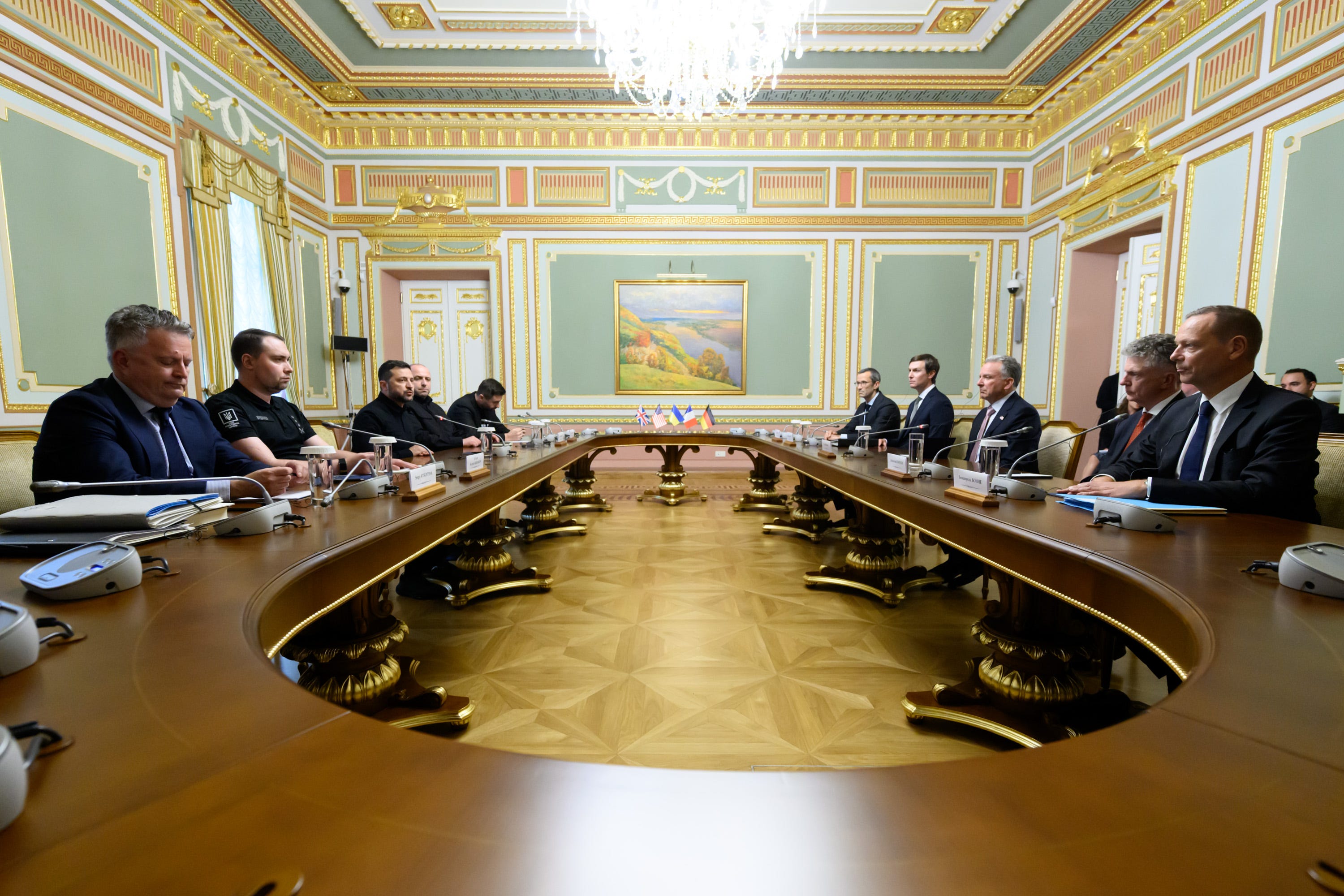
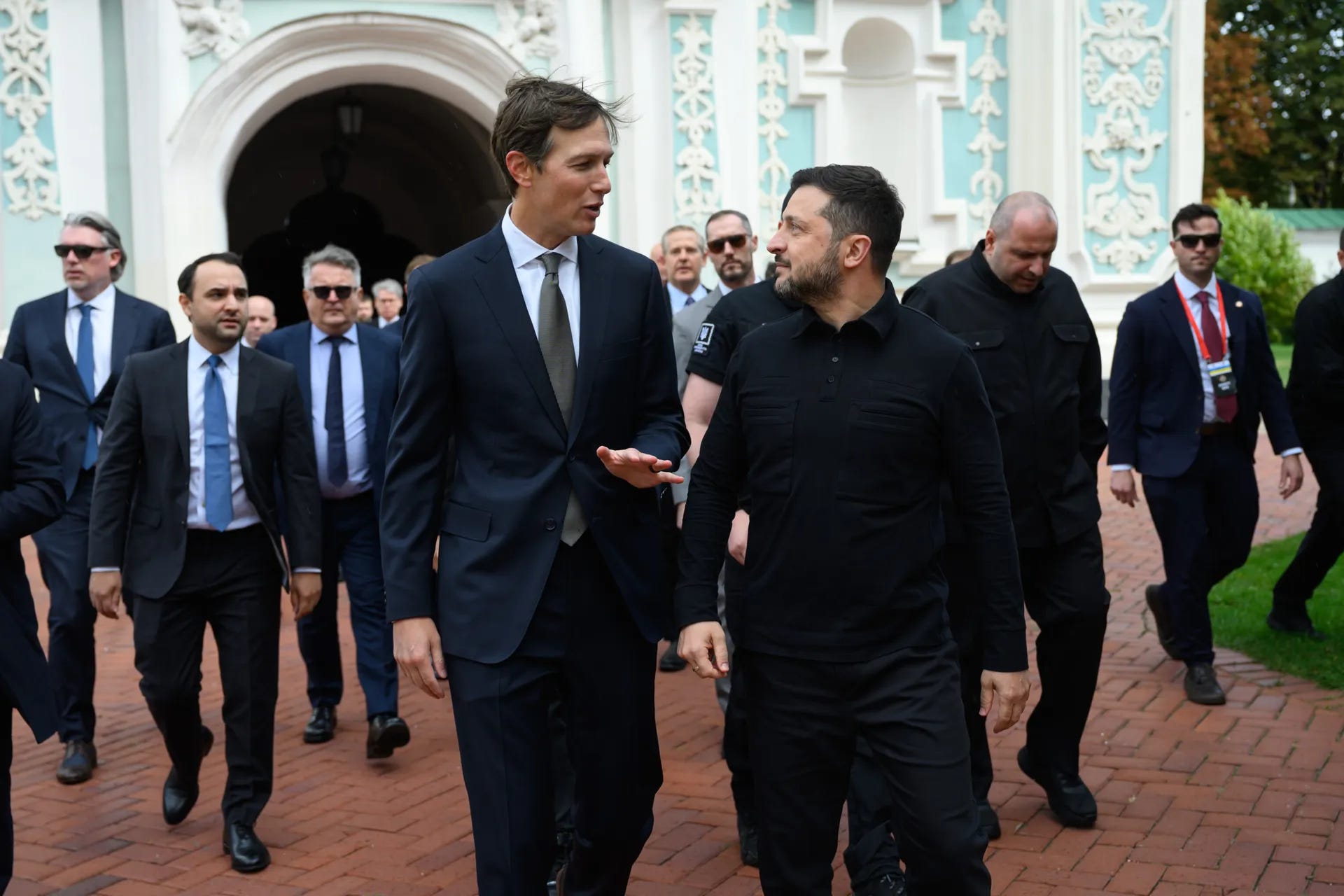
Steve Witkoff and Jared Kushner arrived in Kyiv by train on Sunday, their first visit to the Ukrainian capital since Russia’s full-scale invasion in February 2022. Volodymyr Zelensky met them near St Sophia’s Cathedral, a UNESCO site whose windows and frames were reportedly damaged on Friday when a Russian strike hit the headquarters of Ukraine’s SBU security service. Twelve people were injured in that strike, according to Kyiv Mayor Vitali Klitschko. The envoys were walked past the damage before the talking started.
They came from Moscow, where they had spent three hours with Vladimir Putin on Saturday, followed by dinner. That sequence is the most revealing thing about the day. The party being asked to concede was briefed second.
What emerged afterwards was thin. Witkoff told reporters in Kyiv the US side was “very encouraged” by a discussion he called “substantive, important.” Kushner said Trump’s interest was not only in ending the current war but in building the conditions for a durable peace. They said finding peace matters greatly to the president. They thanked their hosts for their hospitality. They noted that Putin had asked a great many questions in Moscow. On territory, on security guarantees, on sanctions relief, on a timeline - nothing. A White House official said next steps would be announced in the coming weeks.
At the press conference Kushner set out the framework. From President Putin's perspective, he said, there are certain objectives, but also different aspirations he has for his country that can be achieved once this is concluded. Then the method: Trump comes from the business world, where you think in terms of win-win, of creating opportunities for both sides to do what's in their interest. War is negative sum; peace is positive sum. Zelensky sat two chairs away. Win-win presupposes two parties with legitimate competing interests to reconcile. This was an invasion. The day before, Putin told the same envoys he expects Russia to meet its goals and wants the root causes of the war resolved.
The economic upside also has to land somewhere. The same morning, The New York Times published classified Ukrainian audits showing $1.2 billion lost to fraud, waste and mismanagement in 2024 alone, and contracts routed to suppliers under criminal investigation.
The one concrete item was the trilateral format, which the envoys said they welcomed the return of. This deserves more scrutiny than it has received, because “trilateral” has meant two different things over the past thirteen months and only one of them is plausible here.
The leaders’ version - Trump, Putin and Zelensky in a room - has been promised since Alaska in August 2025, when Trump announced arrangements were underway. It never happened. CIA Director John Ratcliffe raised it again during an unannounced Moscow trip in late August. Dmitry Peskov shut it down in public within days: a trilateral is possible only to formalise agreements, and no agreements exist. That was ten days ago.
The delegation version is the one that actually took place. Ukraine, the United States and Russia met in Abu Dhabi in January, the first time all three sat down together since 2022. Zelensky announced it from Davos. Witkoff and Kushner went to Moscow first, then on to the UAE. Then it collapsed, and Washington’s attention went to the war with Iran for six months.
So the envoys are almost certainly proposing to restart Abu Dhabi, not to convene a summit. Worth saying plainly, because a returning format that already failed once is a different proposition from a breakthrough, and the two are being reported as though they were the same thing.
Why now
The timing is not a mystery. Americans vote on 3 November. Diesel hit a record $5.88 a gallon on Saturday, according to AAA. Gasoline is running near $4.12 nationally, up roughly a dollar year on year, against $2.98 before the president started his war with Iran. Republican internal polling, per Axios, shows voters assigning the blame for that to the White House. One GOP operative’s assessment of the problem: “We can’t message that away.”
Here is where it connects to Kyiv. The administration has spent the past week distributing that blame outward, and part of it has landed on Ukraine. Treasury Secretary Scott Bessent went on Fox on 2 September and pointed to Ukrainian strikes on Russian energy assets and refined products as a source of upward price pressure worldwide. Transportation Secretary Sean Duffy, on the same network on Saturday, said that to understand diesel you have to look at Russia and Ukraine. Energy Secretary Chris Wright has tried Joe Biden.
The mechanism they are pointing at is real, and it is not small. Ukraine’s long-range campaign against Russian refineries and export terminals has been the most consequential thing to happen to oil supply outside the Gulf. Reuters this year put roughly 40 per cent of Russia’s oil export capacity offline - around two million barrels a day - and called it the most severe supply disruption in modern Russian history. Bloomberg has reported Russian refining running at a 24-year low. Ukraine’s own General Staff claims strikes have disabled close to 43 per cent of designed refining capacity. Take even the conservative reading and this is genuine supply removed from a market already tight because of Hormuz.
What makes the blame awkward is the next fact. In July, according to Ukrainian officials cited, American intelligence has reportedly been helping guide those strikes - plotting drone routes, mapping the gaps in Russian air defence. Washington is now attributing the price at its own pumps to a campaign its own agencies helped make possible. And Republicans’ internal polling, according to Axios, still lands the blame on Iran regardless.
So the argument is not baseless. It is selective. And it is being made, loudly, by cabinet secretaries, eight weeks before an election. Then two envoys boarded a train to Kyiv.
There is a question worth putting to the White House, and it is not rhetorical: is one of the American asks that Ukraine stop hitting Russian oil infrastructure? Because Ukraine’s deep-strike campaign against refineries and tankers is among the very few forms of leverage Kyiv currently has. Also, on the administration’s own telling, a driver of the price at an American pump eight weeks before a midterm. Nobody put that to the envoys on camera.
The winter
The three-day pause that made the visit possible is not a ceasefire. Both capitals announced it as a limited arrangement scoped to the envoys' travel. It expires. Putin said Moscow would do its utmost to provide for the safety of the negotiations - a formulation about the negotiators, not about Ukraine. And it did not hold outside the two capitals in any case: drone strikes killed a 74-year-old man in Zaporizhzhia and wounded three others on Sunday, while a drone damaged an apartment building in the Khmelnytskyi region, wounding seven.
Earlier, Ukraine’s Air Force reported that Russia attacked Ukraine with 108 long-range drones and small cruise missiles, the BBC reported. Kyiv’s air defences downed 82 drones and six missiles, but 11 locations were hit, with debris falling at a further seven sites.
Still, the two sides spared each other's capitals, and that is not nothing. In diplomacy this gets called a confidence-building measure. It was closer to a security detail.
Ukrainians go into this winter short of air-defence interceptors, with a grid that has been hit repeatedly, and food warehouses being repeatedly struck. Not to mention with Russia now flying fast, jet-powered drones that give less warning. The envoys will leave. The pause has an expiry date written into it. That is not a forecast; it is the terms of the arrangement.
The third round of talks on Sunday evening brought in national security advisers from Britain, France and Germany. Kremlin aide Yuri Ushakov called the Moscow leg frank and constructive. Kirill Dmitriev called it an important peacemaking visit. Nobody has said what is actually in the proposal.
After the talks Zelensky said he expects the war will continue, and that Ukraine is counting on American energy and air defence support through the winter. That is the assessment of the man the proposal was brought to.
The Alternative for Germany party has a strong lead in a regional election, but it is unclear whether it will be able to form the country’s first far-right state government since World War II, exit polls indicated Sunday. Alternative for Germany, or AfD, went into the vote in the eastern state of Saxony-Anhalt seeking an absolute majority in the state legislature to govern on its own. That would overcome the so-called “firewall” of mainstream parties’ refusal to work with AfD. A first state government would be the biggest prize in the party’s 13-year history, at a time of widespread discontent with an unpopular national government that has yet to persuade voters it can get the country’s sluggish economy moving. It would be at least a symbolic blow to Chancellor Friedrich Merz, whose center-right party has led Saxony-Anhalt for 24 years. The polls for ARD and ZDF public television put AfD on around 44% of the vote, more than double its showing five years ago in the region of 2.1 million people west of Berlin. That was far ahead of the Christian Democratic Union, the center-right party of Chancellor Friedrich Merz that currently leads the state, which was seen polling 18.5% and losing about half its support. The exit polls put AfD at least marginally short of an absolute majority. Franziska Hoppermann, the national general secretary of Merz’s CDU, said that it was “a very difficult result for us” - AP
🌋 Ash Cloud Grounds Jakarta: 170,000 Stranded
Around 170,000 passengers have been left stranded after ash from the erupting Anak Krakatau forced Indonesian authorities to suspend operations at eight airports, the BBC reports. Jakarta’s Soekarno-Hatta International - more than 150km from the volcano - was the first to close on Sunday morning, after ash was detected in nearby airspace. The transport ministry put the number of delayed flights at 1,558, with airports shut until midnight.
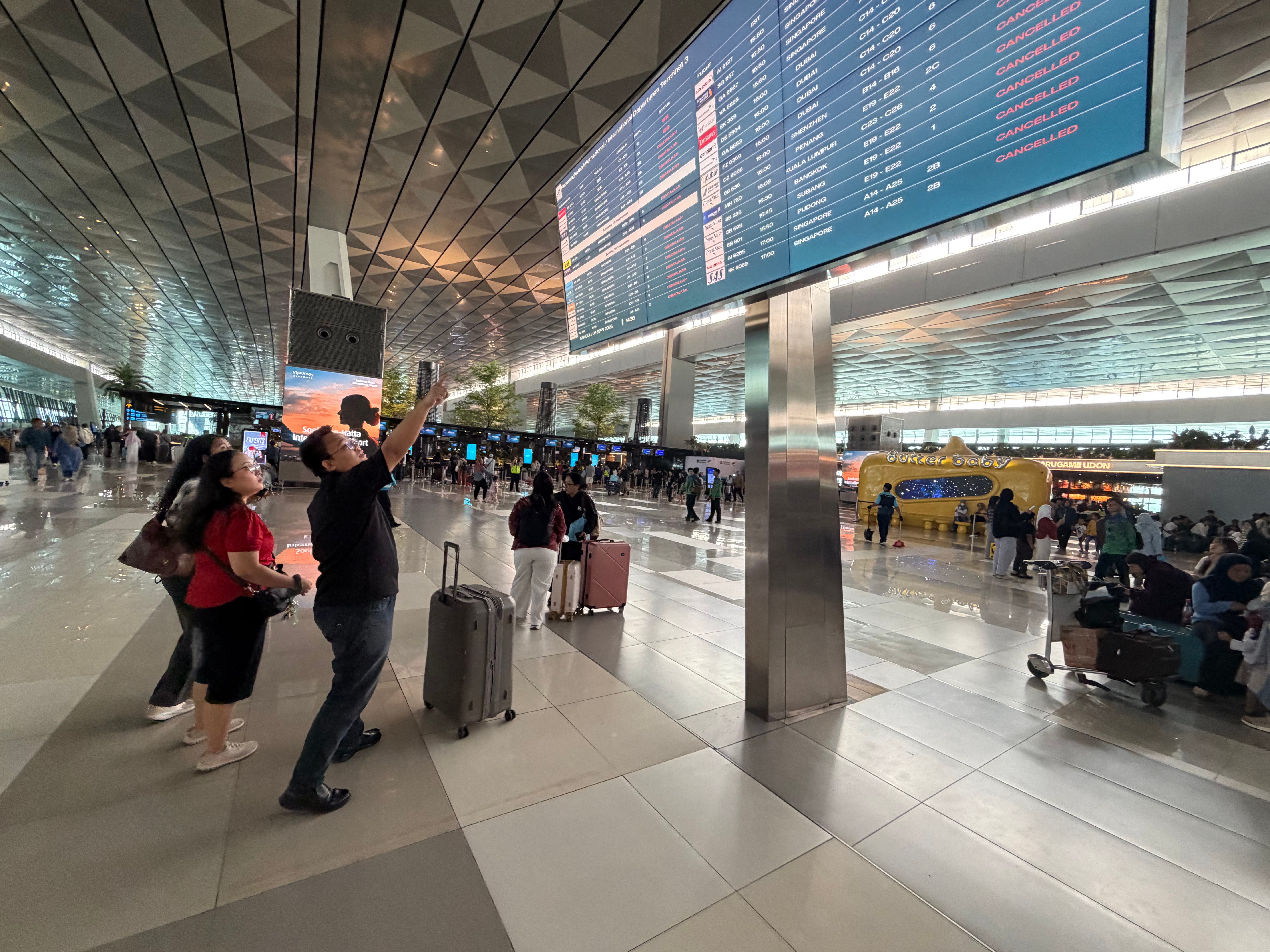
Airport operator Angkasa Pura gave a narrower count for Soekarno-Hatta itself, telling Reuters that 301 flights were affected, 58 of them international. By 14:28 on Sunday, the Terminal 3 international departures board was a single column of red: Singapore, Kuala Lumpur, Bangkok, Penang, Shenzhen, Pudong, Incheon, Colombo, Taipei, Subang - cancelled, cancelled, cancelled. Only the late-afternoon Emirates flight to Dubai was still holding at "delayed." Singapore Airlines dropped its Jakarta flights for the remainder of the day.
The board told the story in four languages at once - dibatalkan in Indonesian, متأخرة in Arabic, 取消 in Chinese - a rough map of who was stuck: Gulf, Chinese and Southeast Asian traffic grounded in the same hour.
Transport Minister Dudy Purwagandhi named the eight affected airports as Soekarno-Hatta, Halim Perdanakusuma, Radin Inten II, Husein Sastranegara in Bandung, Budiarto Curug, Pondok Cabe, Taufik Kiemas and Atung Bungsu, according to Aerotime; six had been closed earlier in the day, with two more added after the wind shifted. Semarang and Surabaya were readied as alternate landing fields. Purwagandhi was blunt about the sliding deadlines: as he told reporters, no airport reopens while ash remains in the air and the paper tests keep coming back positive.
The volcano began erupting late Friday. Indonesia’s volcanology agency PVMBG, quoted by the state news agency Antara, timed the first eruption at 23:07 on 4 September, with two more on Sunday. Lava fountains and booming sounds carried as far as 700km, and the BMKG weather agency tracked ash drifting east at 20,000 feet and west at 50,000 feet. Purwagandhi said the decision to close the additional airports followed tests showing ash had reached West Java.
The atmosphere at Soekarno-Hatta was surprisingly calm, with airline and airport staff directing stranded passengers to re-booking counters and desks stocked with bottled water and snacks. Hotels near the airport were said to be at capacity, and a quick scan of airline sites showed no availability to key destinations such as Kuala Lumpur, Singapore and Bangkok. My own late Sunday afternoon flight to Kuala Lumpur on an Indonesian carrier was cancelled; I was re-booked onto the same service on Tuesday. It was my second major disruption from volcanic activity in as many years, after Mt. Etna in Sicily.

Support independent reporting that goes beyond the headlines. Upgrade now and get 30% off a paid World Briefing subscription — and help keep me reporting, travelling and connecting the geopolitical dots so that you don’t have to.
👉 Upgrade now — 30% off. Click here
Surface waters across the Mediterranean Sea reached an average temperature of 28.54ºC on 13 August, the highest recorded since at least 1940, Spain’s State Meteorological Agency reported on Sunday. Aemet itself noted on social media that throughout almost the whole of August the sea was breaking daily temperature records, one after another, with barely any respite. The warning comes just weeks after Mercator Ocean International, which implements the Copernicus marine service, confirmed that July had already been the hottest month ever measured in the Mediterranean. The average that month was 27.07ºC, with a margin of uncertainty of ±0.27ºC, beating the previous maximum, set in July 2025 (26.68ºC), by four tenths of a degree. Mercator Ocean’s comparison series begins in 1993, meaning that both bodies, despite using different methods and reference periods, concur in describing a sea that has entered a thermal regime not seen before. Data from late June were already pointing that way. Aemet (source in Spanish) warned at the time that Mediterranean temperatures had reached levels more typical of the second half of August, when the sea is usually at its warmest. At the start of the summer, temperatures rose to 2.6ºC above normal, to the point that the sea exceeded the average usually seen in mid-August while it was still June, an anomaly the agency itself described as exceptional - Euronews
The journals…