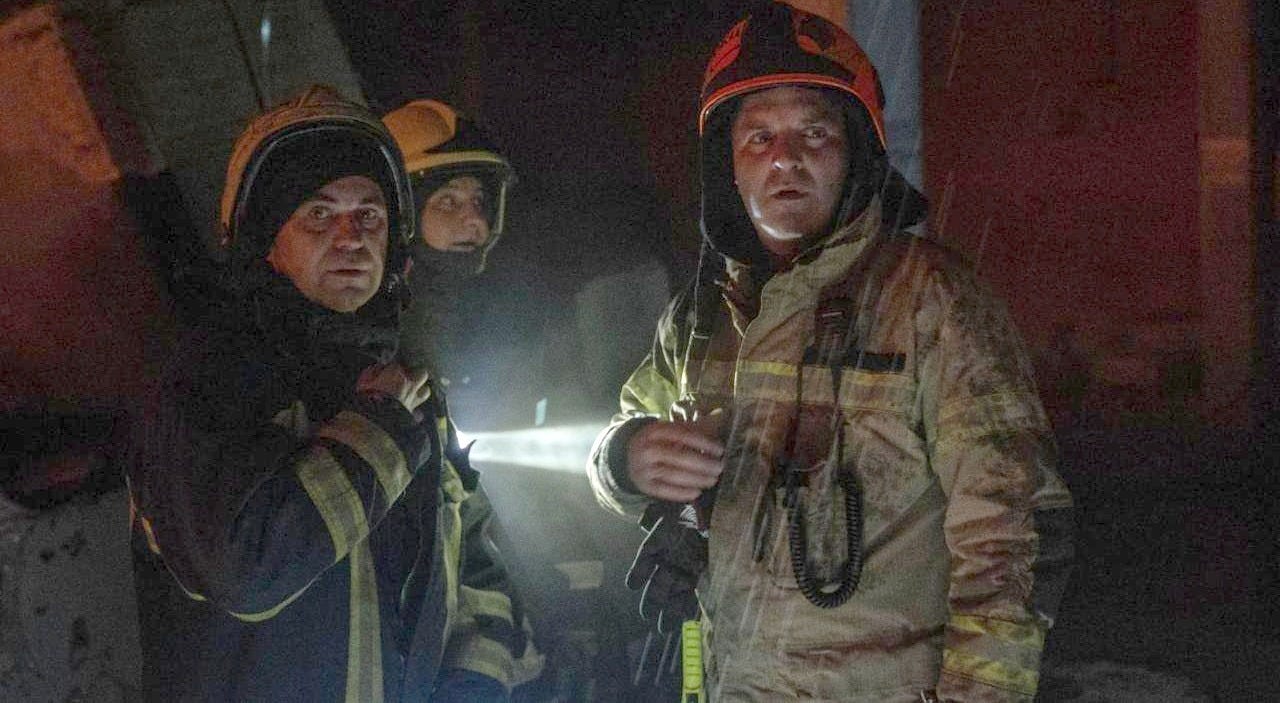
For months I told audiences not to panic about Ukraine. Now is the time to panic. Today the CEO of the Kyiv-based NGO I've been citing told me the capital is on the edge of the "red zone," the point where blackouts come with no heat or no water or no sanitation - or all of that combined. For now, critical supplies are holding. But the CEO expects things to get worse: Russia is planning a series of massive strikes, reportedly boosted by fresh North Korean missiles, and conditions could become desperate by mid-December.
Ukrainian President Volodymyr Zelensky has warned over the past 24 hours that another massive strike could come at any time. If Kyiv tips into red, millions could feel compelled to move west, into oblasts that are already full and overpriced, and into a Europe that doesn't see it coming.
And look at what the people who could prevent it are doing. In Brussels, EU leaders spent a night of political theatre fighting over their own budget, and Ukraine's €45 billion lifeline got pushed aside. A budget deal needs all 27 to agree, and as I told CNN, this EU is so divided it probably couldn't agree on what to serve at its own Christmas banquet. Europe's window is closing, too. Spain votes this Sunday, then France, Greece and Italy follow next year, and in each the far right, which tends to be cool on Ukraine, could make big gains.
In Washington, Jared Kushner tells us Putin is interested in peace. That is buffoonery on an epic scale. And as our Lukoil story shows, people in Trump's orbit seem more interested in what they can make from the Kremlin than in what Kyiv is about to lose. Europe has until 17 December to show it understands what's at stake. Kyiv may not have that long.
News Briefs
EU leaders' budget summit in Brussels broke down overnight, and the countries pushing for a smaller budget walked out on European Council President António Costa. Politico reports that the leaders were trying to break the deadlock over the EU's next seven-year budget, due to take effect in January 2028. The Commission started at about €2 trillion, and Costa proposed cutting €204 billion. Austria, Belgium, Denmark and Sweden belong to the self-styled "Sensible Seven," the governments demanding a smaller budget. After hours of talks, those four quit his small-group sessions, calling them an attempt to split and buy off the camp. On the other side are the big spenders, such as Spain and Italy. Giorgia Meloni brushed off any deadline: "I don't have a deadline, I have conditions." Emmanuel Macron called Costa's cuts a strategic mistake and insisted on a deal by year's end, with Marine Le Pen favoured in April's French presidential election. That earned him a nickname from one EU diplomat: "Monsieur Chantage" (Mr Blackmail). Costa cut his 1 a.m. press conference to 11 minutes, cancelled the second day, and is preparing a new proposal with even deeper cuts. Most of those would come out of competitiveness and foreign aid, not farms or poorer regions. Leaders try again on 17 December. Lost in the noise was a €45 billion support loan for Ukraine, which faces a growing wartime deficit. It was due for discussion but got sidelined, Euronews reports. Call it tantrum diplomacy.
Watch: I joined CNN in London this morning to unpack the summit and the fight over money for Ukraine. I looked at what the stalemate could mean for Kyiv and made the case that European leaders must set aside funding for Ukraine's struggling independent media, because there can be no proper reconstruction without it.
Canada is sending Haitian mothers back to Trump’s deportation machine and calling it a choice. Its border officers are splitting up families fleeing the United States, and some parents end up in American detention cells while their toddlers go on to Montreal without them, The New York Times reports. Between 1 January and 16 November, more than 1,300 people, many of them Haitian, were turned away at the northern border under the Canada–U.S. Safe Third Country Agreement. That treaty still treats the United States as a safe place to claim asylum, even as Washington has ended protected status for more than 300,000 Haitians, suspended asylum at its southern border and pushed to deport a million people a year. The treaty makes an exception for people with close family in Canada, but in-laws don’t count. So when Keyla François tried to cross at Lacolle, Quebec, in August with her husband and their children, aged 1 and 2, officers admitted the husband and children, who have relatives in Montreal, and turned her back. She has since been held in four U.S. detention centres and is now in New Mexico, about 2,000 miles from her family. Another mother, Jules’s wife, was refused entry and has since been deported to Haiti, a country Canada itself won’t deport people to. Quebec child welfare officials report a rise in unaccompanied minors crossing the border. The Canada Border Services Agency insists it “does not separate families,” because families can always go back to the U.S. together. In the current climate, that means going back to ICE. A legal challenge in Federal Court is testing whether the U.S. can still count as a safe third country.
Nvidia has halted chip shipments to Southeast Asia, as Washington curbs China’s access to American compute. Orders have been frozen for buyers in Malaysia, Singapore, Thailand, and Indonesia, countries that have boomed by giving Chinese hyperscalers legal access to export-controlled Nvidia chips. The holdup threatens not only Nvidia’s lucrative business in the region — its Singapore arm booked $104 billion in 2025 — but also the AI buildout in one of the world’s fastest-growing data center markets. Amid scrutiny over the Nvidia CEO’s affair with a Singapore-based executive, the US is cracking down on chip exports and smuggling, moves that The Wall Street Journal argued, “suddenly put America in the driver’s seat of the most consequential technological race of the superpower rivalry.” - Semafor
World Health Organization chief Tedros Adhanom Ghebreyesus has called for the immediate lifting of the US fuel blockade on Cuba, warning that it is putting children’s lives at risk, Reuters reports. “The intensification of fuel restrictions and sanctions is causing direct harm to the Cuban people, especially the most vulnerable,” Tedros said during a visit to Havana that included tours of several health facilities. Coming from a UN agency chief, that is an unusually blunt rebuke of Washington. After meeting President Miguel Díaz-Canel, he said the sanctions on buying medical products are severely damaging a health system Cuban doctors have built over decades. The island has been short of fuel all year: parts of the country have faced daily power cuts of up to 20 hours, and hospitals have suspended surgeries, struggled to keep life-saving equipment running and faced severe medicine shortages. WHO is supplying medical goods and paying for medicines and vaccines, and will work with the wider UN team on urgent needs. Tedros also pledged support for Cuban researchers and the country’s drug regulator.
The Lukoil Deal Washington Can't Control
Two days after a U.S.-backed consortium signed a deal to buy Lukoil’s overseas empire, it has reached Capitol Hill. Rep. Gregory Meeks, the top Democrat on the House Foreign Affairs Committee, called it a “shameful deal.” He is demanding that the administration stop the government’s part in it, warning that it gets around congressional restrictions, strengthens Russia and undercuts Ukraine.
“Time and again, this administration demonstrates it will stop at nothing to empower Russia and undercut Ukraine. The American people deserve to know why a U.S. government agency is taking an ownership stake in a Russian oil company’s portfolio while Russia continues its war, and Congress will continue to demand answers. I call on the Administration to put an immediate stop to this shameful deal” - Rep. Gregory W. Meeks (D-NY), Ranking Member of the House Foreign Affairs Committee
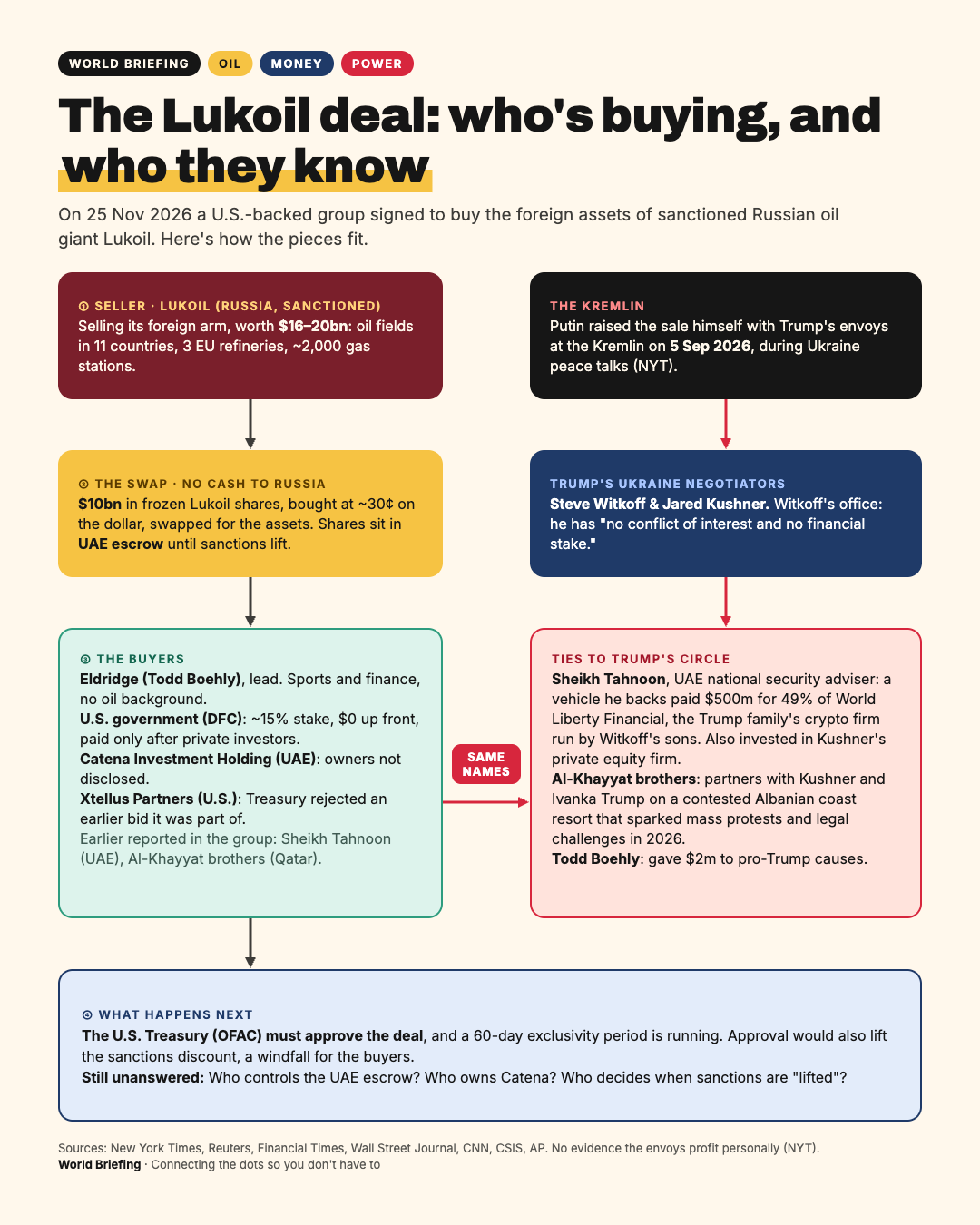
The deal is led by Todd Boehly’s investment firm Eldridge, with the U.S. International Development Finance Corporation (DFC), UAE-based Catena Investment Holding and Xtellus Partners. It swaps about $10 billion in frozen Lukoil securities for a portfolio valued at $16–20 billion:
Oil fields in 11 countries
Three European refineries
About 2,000 gas stations, including in the United States
The shares will sit in escrow in the UAE until sanctions are lifted. According to CSIS, the DFC gets a stake of about 15% without putting in any capital.
The escrow is the sticking point. Treasury’s own published conditions for a sale say money owed to Lukoil must be blocked in an account subject to U.S. control. This one is in Abu Dhabi. Reuters reports that Treasury first rejected the share-swap idea, and that it went ahead with support from the State Department.
Then there are the politics. The New York Times reported that Vladimir Putin raised the sale himself with Steve Witkoff and Jared Kushner at the Kremlin in September, during talks meant to end the war. Investors earlier reported to be in the buyer group have business ties to Kushner, Ivanka Trump and the Trump family’s crypto venture. Witkoff’s office says he has no conflict of interest, and the Times found no evidence that either envoy profits personally. Today’s graphic shows how the pieces connect.
The clock is running. Carlyle’s earlier deal expired in July when Treasury never issued a licence. The Treasury licence that allows negotiations with Lukoil runs out on 19 December, and the deal still needs final approval from OFAC.
Supporters, including analysts at RUSI, argue the sale shows sanctions working: Moscow is losing assets it spent decades building. The question is who ends up holding them, and on what terms.
Hackers have breached the US Air Force’s flagship cloud computing platform, three people familiar with the matter have said, in a development that could jeopardize a vast swathe of sensitive tactical, personnel and logistics data. The intrusion at Cloud One was discovered within the past month or so during work to upgrade the system, two of the people said, adding that the discovery has led to disruption across the platform. In a statement to Reuters, the Air Force said it “does not comment on the security posture, vulnerabilities or operational status of specific networks and systems. We continuously take prudent measures to protect Department (of the Air Force) information, systems and mission capabilities.” Initiated in 2017, Cloud One was meant to serve as a one-stop shop for the Air Force’s IT needs, combining the resources of four operators — Microsoft, Amazon, Oracle and Alphabet — to power scores of applications including ones that manage personnel data and pay or logistics and maintenance. Among them are the Air Force’s Cloud-Based Command and Control, which collates air defense radar and other data feeds from across North America, and the Theater Integrated Combat Munitions System, which tracks bombs and missiles across more than 200 US Air Force locations around the world - The Independent
A veteran CBS New York anchor has announced a shock departure from the station after almost a quarter-century with Channel 2. Tony Aiello, 63, said Thursday that he will sign off after a 41-year career in news, issuing a mandate to those who remain in the “fight”—both in a hostile media environment and at CBS, whose news division has undergone a tumultuous year under MAGA-coded editor-in-chief Bari Weiss. “I’ve seen a lot of change in the news business over 41 years, and the change seems to be accelerating,” the Emmy award-winning Aiello wrote on X. “The challenges are growing. To all of you who remain in the fight - stay strong. Stay focused on the mission to inform, enlighten, and serve. And stay attentive to your own mental and physical well-being, because no job is worth compromising what really matters.” His CBS colleagues, however, have had a tumultuous year. In 2025, CBS was purchased by David Ellison, the son of the Trumpy Oracle billionaire Larry Ellison. Ellison then handed control of CBS News to the MAGA-curious former opinion writer Bari Weiss, setting off chaos in the network’s news division - The Daily Beast
FIFA staff have been asked to testify before the US Congress in an investigation into football's world governing body, according to an exclusive in The Times. The headline detail: FIFA reportedly signed a seven-year lease on a suite at Trump Tower in New York for $4 million, and football journalist Toby Gilles told Times Radio the space "has sat empty ever since." The probe began in July, when Jamie Raskin, the top Democrat on the House Judiciary Committee, wrote to FIFA president Gianni Infantino about what he called mounting evidence of corruption and a potential quid pro quo with the Trump administration. Raskin is asking for visitor logs for the largely vacant Trump Tower office and wants Infantino to sit for a transcribed interview. He has also questioned the FIFA Peace Prize that Infantino created and awarded to Trump. The Telegraph has reported that Infantino could be called to testify as early as January 2027, ahead of FIFA's March 2027 leadership vote. Nothing so far has established that Infantino or FIFA acted improperly. As Gilles put it, the question Congress must answer is whether there has been any corruption.
The journals…