Kyiv’s Independence Day pageant papers over a political crisis
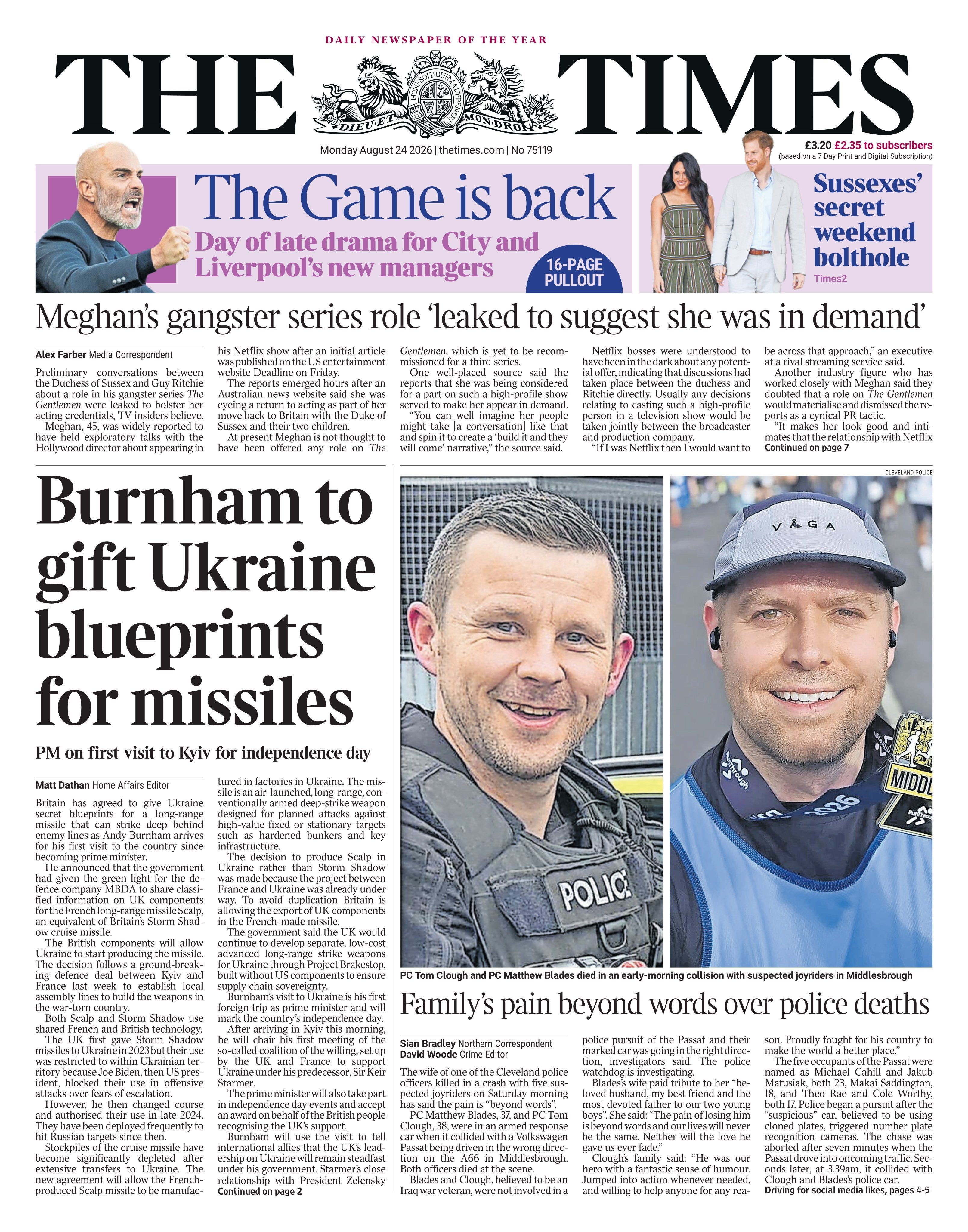
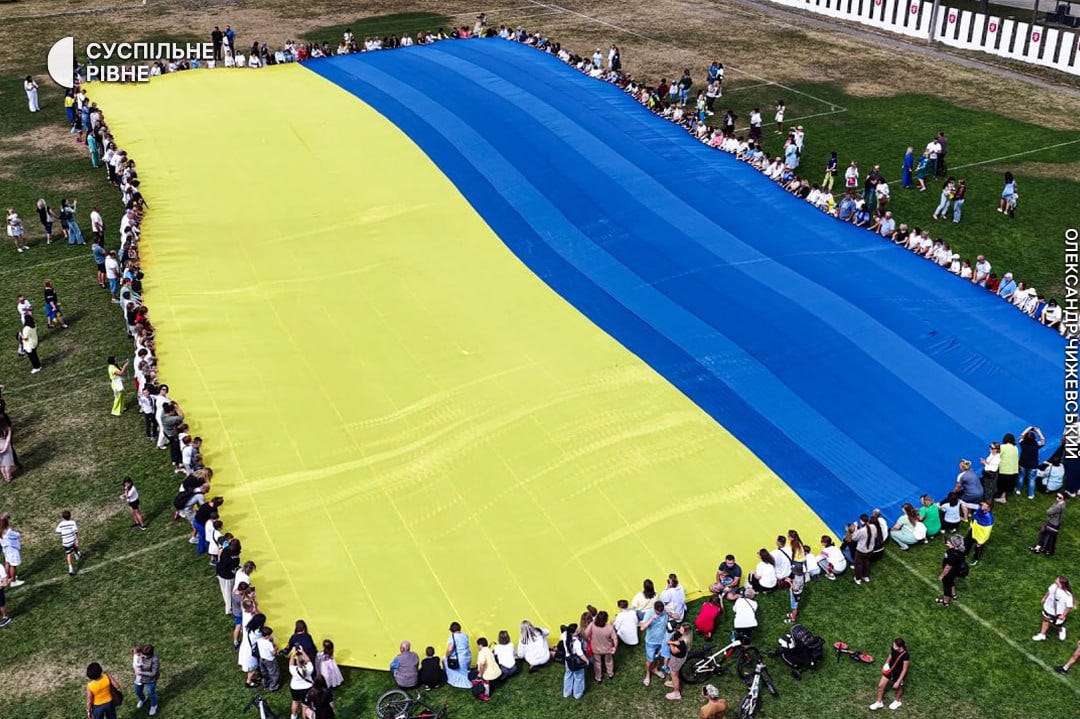
Ukraine marked 35 years of independence on Monday with U.K. Prime Minister Andy Burnham in Kyiv on his first foreign trip since taking office, co-chairing a Coalition of the Willing meeting alongside European Council President António Costa, Moldova’s Maia Sandu, Luxembourg’s Luc Frieden and Estonia’s Alar Karis. Burnham’s office said London had agreed to let the defence firm MBDA release classified information on British components in the long-range Scalp missile, the French twin of Britain’s Storm Shadow. The Associated Press counted nearly a dozen visiting leaders. A day earlier, the Nordic-Baltic Eight met President Volodymyr Zelensky in Kyiv and, in a joint declaration published by the presidency, pledged to sustain military and financial support.
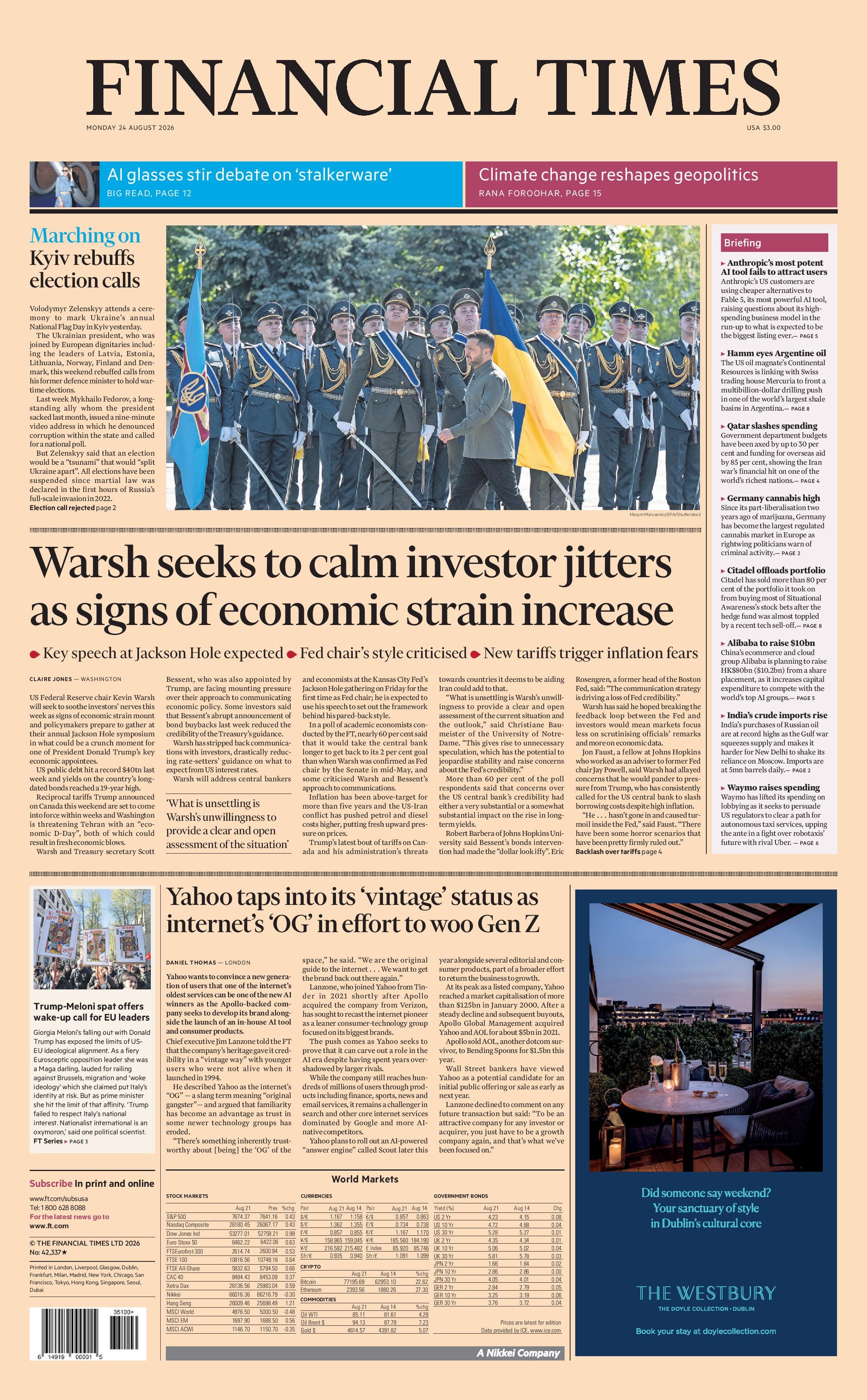
The optics buried a rough fortnight. On Aug. 18, ousted defence minister Mykhailo Fedorov broke the wartime taboo, calling in a nine-minute video address for a legal mechanism to hold elections and arguing, per CNN, that democracy cannot be held hostage by Russia.
The next day, Zelensky dismissed Iryna Mudra as deputy head of his office by decree, hours after NABU and SAPO announced an operation targeting an alleged criminal organization led by a sitting and a former MP and involving senior presidential-office officials. Ukrainska Pravda reported searches at premises linked to Mudra and MP Vadym Stolar; MP Oleksiy Honcharenko said she was detained that night.
Zelensky answered over the weekend, telling journalists an election now would be a tsunami splitting the country - and impossible while Moscow refuses any ceasefire. Time noted he also disclosed a US$27-billion defence ministry shortfall for the rest of the year.
Connecting the dots: in December, under Trump’s pressure, Zelensky said Ukraine could vote in 60 to 90 days given security guarantees, and asked his party to draft the law. Eight months on, no draft. Meanwhile KIIS finds those willing to wait until the fighting ends have fallen to 57 per cent from 69 in March. Fedorov didn’t create that mood. He read it.
When the war began, there was a feeling that it was a one-way street: Europe supporting Ukraine. But in many ways, the tide has turned. You are security providers to Europe. Your capacity to conduct modern warfare is the best that Europe has - Finnish President Alexander Stubb speaking Sunday to Volodymyr Zelensky
Russia’s second-largest retailer, Ozon, reported that four of its logistics centers across southern Russia were targeted in the overnight attacks. Ozon said a large fire broke out at its logistics hub in the town of Enem in the Krasnodar region as a result of a drone attack. It also reported a fire at one of its facilities in the republic of Dagestan following drone strikes. Multiple videos shared on social media showed multiple drones flying into the warehouse in Dagestan. early Monday morning before bursting into fireballs. Men with automatic rifles could be seen trying to shoot down the drones as they flew toward the facility. Ozon also said workers were evacuated from its warehouses in the nearby republic of Adygeya and the Stavropol region, though neither facility was damaged, it added. Shares in Ozon fell by as much as 28% on the Moscow Exchange following news of the attacks, while shares in its major shareholder, private equity firm AFK Sistema, fell by more than 13%. Ukraine began attacking Ozon warehouses this weekend after more than a month of strikes against facilities owned by its biggest competitor Wildberries. Officials in Kyiv have accused Wildberries of supplying the Russian military with drone parts and other equipment. Ozon suspended operations at its logistics center in the Samara region after it was hit by Ukrainian drones on Saturday - Moscow Times
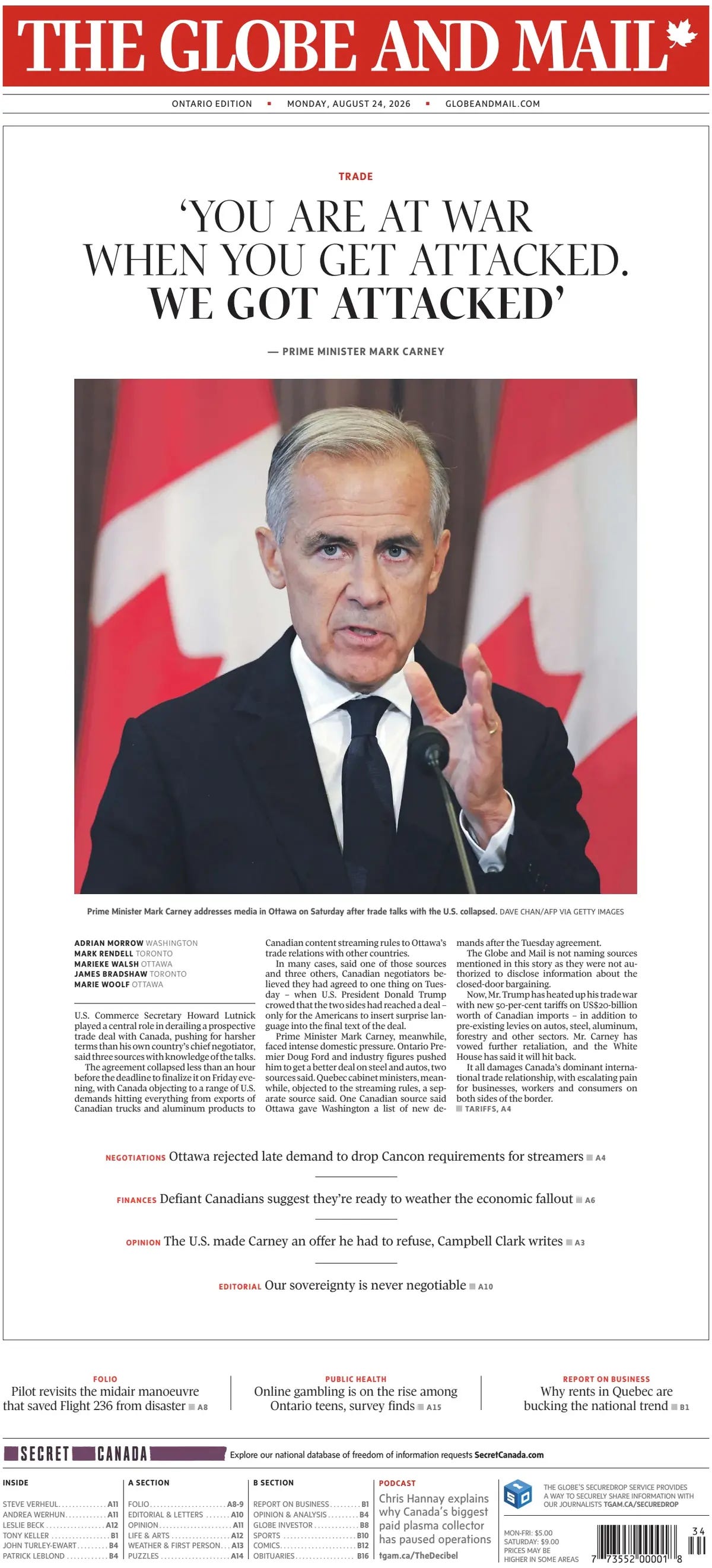
US President Donald Trump said Monday that he would double tariffs on Canadian vehicles beginning in 2027, as the neighbouring countries spiral towards an escalating trade war. “On January First, 2027, Tariffs on all Cars, Trucks, both large and small, Automotive Parts, and Steel, will be increased to 50%,” he wrote on his Truth Social platform. The current US tariff on autos stands at 25% for non-US content, while imported steel to the United States generally faces a 50% duty. Trump’s latest threat comes after the North American neighbours failed Friday to reach a deal to avert new 50% tariffs imposed by the Trump administration on select Canadian goods. The White House had alleged “discriminatory treatment” by Canada against US alcohol, automobile and dairy products in rolling out the duties. Trump delayed their implementation by three days last week as Washington and Ottawa stepped up negotiations towards a trade pact. Canadian Prime Minister Mark Carney on Monday said Canada has been “pragmatic, patient and persevering” in an effort to reach an agreement with the US, but his priority was to get the best deal for his country, not a deal “at any price or any time frame”. “The goal of our trade negotiations with the United States has always been to get the best deal for Canadians, never a deal at any price or on any time frame,” Carney said. Following the collapse of trade talks, Carney announced retaliatory tariffs on the US. Carney accused Washington of using “economic integration as a weapon” and said “its signature was written in pencil” - France 24
Ontario Premier Doug Ford said Canada should be prepared to cut off electricity and critical minerals to the U.S.: ‘You won’t get a grain of sand out of Ontario,’ he said. Meanwhile, Conservative Leader Pierre Poilievre is calling for Carney to reconvene Parliament to get details on the proposed U.S. trade deal he rejected. Carney has said he will brief opposition leaders early this week - CBC
Carney said at an event in Lévis, Quebec that he did not rule out a return to the negotiating table with the Americans. However, that would need to be preceded by an attitude that Canada is “not a subsidiary of the U.S., that Canadian industry will not be disadvantaged, that Canadian industry will not be subject to “constant headwinds.” He concluded: “Thats not something we will accept.”
President Donald Trump heads into the second half of his term with key vacancies among his senior White House staff. That means whoever comes off the bench must contend with the possibility of a Democratic-controlled Congress, a slew of subpoenas, a lingering war in the Middle East and an open Republican presidential primary. James Braid, the top liaison to Congress, this week announced his exit. Press secretary Karoline Leavitt said she would depart the week before. Replacements for either have not been announced. Though it’s not unusual for staff to depart around the midterms, Trump’s desire to run the country through a handful of close, fiercely loyal aides means each loss is more impactful than in a White House where power and responsibility are more diffuse. Trump announced Friday that his pardon attorney and longtime ally Ed Martin would leave for the private sector, coming on the heels of a similar announcement regarding White House counsel David Warrington. Before these departures, Trump’s second term was notable for most aides staying in their posts and faithfully executing Trump’s desires — largely without infighting or distractions - POLITICO
China hosted Iran’s deputy foreign minister for talks last week related to the US-Iran war, Beijing announced Sunday, disclosing the previously unreported meeting one day before Washington is expected to unveil “the toughest sanctions in history” against Tehran. The Trump administration has warned of an “Economic D-Day” for Iran and its trading partners, including China, a major importer of Iranian oil. Beijing has moved to insulate itself economically, slashing crude imports nearly 50% since the war started, according to The Wall Street Journal, and bolstering domestic energy. Experts warn that Beijing’s resilience could complicate Washington’s strategy. China, writes Shanghai Institutes for International Studies’ Zhao Long, is adept at “containing spillover, reducing risks, diversifying dependencies, [and] avoiding strategic entanglement.” - Semafor
The Trump administration on Monday announced an effort intended to cut Tehran off from the global economy. But after days of framing the plans as an “economic D-Day,” Treasury Secretary Scott Bessent announced more of a warning shot: Without naming names, he said countries that continue to do business with Tehran would face U.S. sanctions. It was not clear what the United States could do to further disrupt Iran’s flailing economy without inflaming tensions with China, the world’s largest buyer of Iranian oil - NYT
A law signed by President Shavkat Mirziyoev on August 14 expands the powers of the Presidential Administration, headed by his 41-year-old eldest daughter Saida Mirziyoeva, making its chief the deputy chair of the Security Council — the body overseeing Uzbekistan’s security, law enforcement and military structures. She will also coordinate the council’s members. London-based Central Asia analyst Alisher Ilhomov told RFE/RL she was already the de facto number two, but without a firm legal basis; the new law gives her one, letting her consolidate authority over the security agencies. Mirziyoeva joined government in 2019 with no political background, and was named to head the restored post of administration chief in June 2025, after taking the Uzbek co-chair seat on the American-Uzbek Business and Investment Council that November. The law also grants some senior administration officials lifetime immunity after leaving office — five years for other managers — covering their homes, vehicles, correspondence and electronic data, and sharply limiting criminal proceedings against them. Gazeta.uz journalist Shukhrat Latipov questioned both the scope of those guarantees and the speed of passage: the lower house approved it on August 6, the Senate on August 7, and Mirziyoev signed a week later.There has been no official signal that Mirziyoeva is being groomed to succeed her father, who won a third term in 2023 with 87 percent and pushed through a constitutional overhaul letting him stay in office until 2037. Ilhomov reads the change less as a handover plan than as insurance — a trusted figure positioned to hold the state together if something unexpected removes Mirziyoev. Reporting by Farangis Najibullah and Khiromon Baqozoda for RFE/RL, August 22, 2026.
The Netherlands will not participate in next year’s Eurovision Song Contest, its broadcaster said on Monday, saying the event can “no longer be considered neutral” given divisions over the Gaza war. “It is undeniable that international conflicts are increasingly affecting the Contest, undermining its neutral character. The Eurovision Song Contest has therefore become a platform for division,” said Taco Zimmerman, Director-General of AVROTROS, in a statement from the broadcaster. The contest has recently been hit by a wave of boycotts over Israel’s participation. Earlier this month, organisers announced they were excluding any country involved in an armed conflict from hosting the competition. “However, the recently announced changes...do not provide sufficient confidence that the independent and neutral character of the Eurovision Song Contest has been restored,” said the AVROTROS statement. Israel came close to winning the competition in both 2025 and 2026, ultimately finishing second on each occasion. Next year’s event, the world’s biggest live televised music event, will take place on 15 May in Bulgaria’s Black Sea city of Burgas - Euronews
The journals…