🔥World Briefing Hot Take
A Russian drone crashing into an apartment building in Romania should have set off alarm bells across NATO. Instead, it barely registered beyond expressions of concern and a diplomatic protest.
That should worry Europeans far more than the drone itself.
For years, Vladimir Putin has been probing for weaknesses along NATO’s eastern flank. Not necessarily with tanks and infantry, but through cyberattacks, sabotage, election interference, disinformation campaigns, undersea cable incidents, GPS jamming, airspace violations, and repeated drone incursions. Each incident is a test. Each response is carefully measured in Moscow.
And the lesson Putin keeps learning is that the alliance’s threshold for action remains remarkably high.
Romania says Russian drones have entered its airspace dozens of times since the full-scale invasion of Ukraine began. This latest incident crossed another line: for the first time, a drone struck a residential building and injured civilians on NATO territory. Yet there is still uncertainty over whether Article 4 consultations will even be invoked.
The Kremlin’s strategy has never depended on a single dramatic escalation. It depends on normalizing behaviour that would once have been considered unacceptable. One drone becomes two. A border violation becomes routine. Expressions of concern become background noise.
Deterrence works only when an adversary believes there will be consequences. Concern is not a consequence. It is not a deterrent. Increasingly, it risks becoming an invitation.
The timing could hardly be better from Moscow’s perspective. The United States remains deeply distracted by domestic politics and competing global crises. President Trump has repeatedly signalled a willingness to accommodate Russia, including through discussions about sanctions relief and renewed engagement. Across Europe, political attention is fragmented, defence spending remains uneven, and economic ties to Russia continue through various back doors.
Meanwhile, Russia’s hybrid warfare campaign continues to spread across the continent, reaching far beyond Ukraine’s borders. The question is no longer whether NATO territory is being tested. It is how many tests the alliance is prepared to absorb before concluding that the pattern itself is the threat.
Some will argue that a single drone strike is not worth risking escalation with a nuclear power. Fair enough. But history suggests that confronting aggression early is usually less costly than confronting it later.
I was reminded of this recently in Johannesburg, where the British owner of a guesthouse told me she would not consider returning to the UK with her two sons. Her concern? That Europe could eventually find itself drawn into a broader confrontation with Russia. Whether that scenario ever materializes is beside the point. The point is that people far from the battlefield are already making life decisions based on where they believe this conflict could be heading.
It is far cheaper to strengthen deterrence today than to explain tomorrow why more European countries are building bomb shelters, expanding civil defence programs, or debating the return of military conscription.
The most dangerous message NATO can send is that repeated violations will be met with little more than statements of concern.
Because if that is the message being received in Moscow, the next probe is already being planned.
News Briefs
Romania has ordered the closure of the Russian consulate in the city of Constanta after a Russian drone crashed into an apartment building in the eastern part of the country and wounded two people, coming amid a broader uptick of both Russian and Ukrainian drones straying into the airspace of NATO members as the two countries continue attacks on each other. Romanian President Nicușor Dan announced the closure of the consulate on Friday afternoon and declared the Russian consul in the Black Sea port city persona non grata. Romania’s foreign ministry also summoned the Russian ambassador in Bucharest over the incident. The country’s military said that a Geran-2, the Russian version of the Iranian-designed Shahed drone, crashed into the roof of an apartment building in the city of Galati, located right across the border from southern Ukraine and Moldova. “During the night of May 28-29, the Russian Federation resumed drone attacks on civilian and infrastructure targets in Ukraine, near the river border with Romania,” the defense ministry said in a statement. “One of these drones entered Romanian airspace, was tracked by radar as far as the southern part of the city of Galati and crashed onto the roof of an apartment building, with the impact triggering a fire,” the statement added. Two people were wounded and hospitalized, the military added. Emergency services later put out the blaze. Russian President Vladimir Putin said it was too soon to say that the drone that crashed was Russian, and called for Moscow to be shown evidence. “No one can say the origin of this or that aircraft until an examination of that aircraft is conducted,” Putin told a press conference in Kazakhstan. “If they provide us with any objective data... in that case, will we assess what happened.” Russia’s Foreign Ministry vowed a response to the closure of its consulate in Constanta - Moscow Times
Sources at NATO told AFP it remained unclear whether Romania planned to invoke Article 4 of the military alliance’s treaty, a rarely used mechanism that initiates consultations with other members and can potentially lead to some form of joint decision or action on behalf of NATO. Article 4 was last invoked in September 2025 after Russian drones entered Polish airspace during an overnight attack on Ukraine. While drone incursions have been detected in Romania dozens of times since Russia invaded Ukraine in February 2022, the latest incident marks the first time a stray drone has hit a residential building. Romania’s military scrambled two F-16 fighter jets immediately after the aerial targets were detected in the country’s airspace.
Tokyo on Friday announced it would deploy four members of the Japanese military to Germany to train with NATO’s Ukraine mission. Japanese Defense Minister Shinjirō Koizumi said the soldiers from Japan’s Self-Defense Forces would be tasked with analyzing the new fighting tactics employed in the Russian invasion of Ukraine. Japan’s current government has pushed for rearmament amid heightened tensions with Russia and China. “The deployment marks a further deepening of cooperation between Japan and NATO,” Koizumi said. The Japanese personnel will be stationed at NATO’s Ukraine mission in Wiesbaden, Germany. The mission coordinates military aid for Ukraine, helps train Ukrainian soldiers and repairs equipment for the Ukrainian military. The latest deployment comes as Japan intensifies its military rearmament, including lifting restrictions for arms exports in April. On Thursday, Russia’s foreign ministry warned Japan against stationing U.S. Typhoon missile systems on its territory, saying it would “create a direct threat along our far-eastern borders.” The Japanese defense ministry said in a statement that it would “continue to advance security and defense cooperation between Japan and NATO.” - Politico
Russia, Belarus, Kazakhstan, and Kyrgyzstan have issued an ultimatum to Armenia, threatening to suspend its membership in the Moscow-led Eurasian Economic Union (EAEU) amid tensions over Armenia’s push to join the European Union. A joint declaration published on the Kremlin website claims that Armenian preparations for EU membership would endanger the “economic security” of the remaining member states. It demands that Armenia agree to hold a referendum “as soon as possible” on its plans, with the option being to either join the EU or stay in the EAEU. The move, agreed on at the EAEU summit in Astana, effectively transformed an event intended to showcase regional integration into an economic and political showdown. Armenian Prime Minister Nikol Pashinian skipped the meeting, sending a lower-level delegation led by Deputy Prime Minister Mher Grigorian. While widely interpreted by diplomats in Astana as a political boycott, Pashinian stated his absence was due to domestic campaign commitments ahead of Armenia’s June 7 parliamentary elections. Grigorian reportedly stated that Yerevan intends to maintain a constructive engagement with the EAEU but emphasized that future work must be rooted in the principles of “mutual respect, equal partnership,” and national sovereignty - RFE/RL
Not a Hypothetical": BC's $729-Million Act of Faith
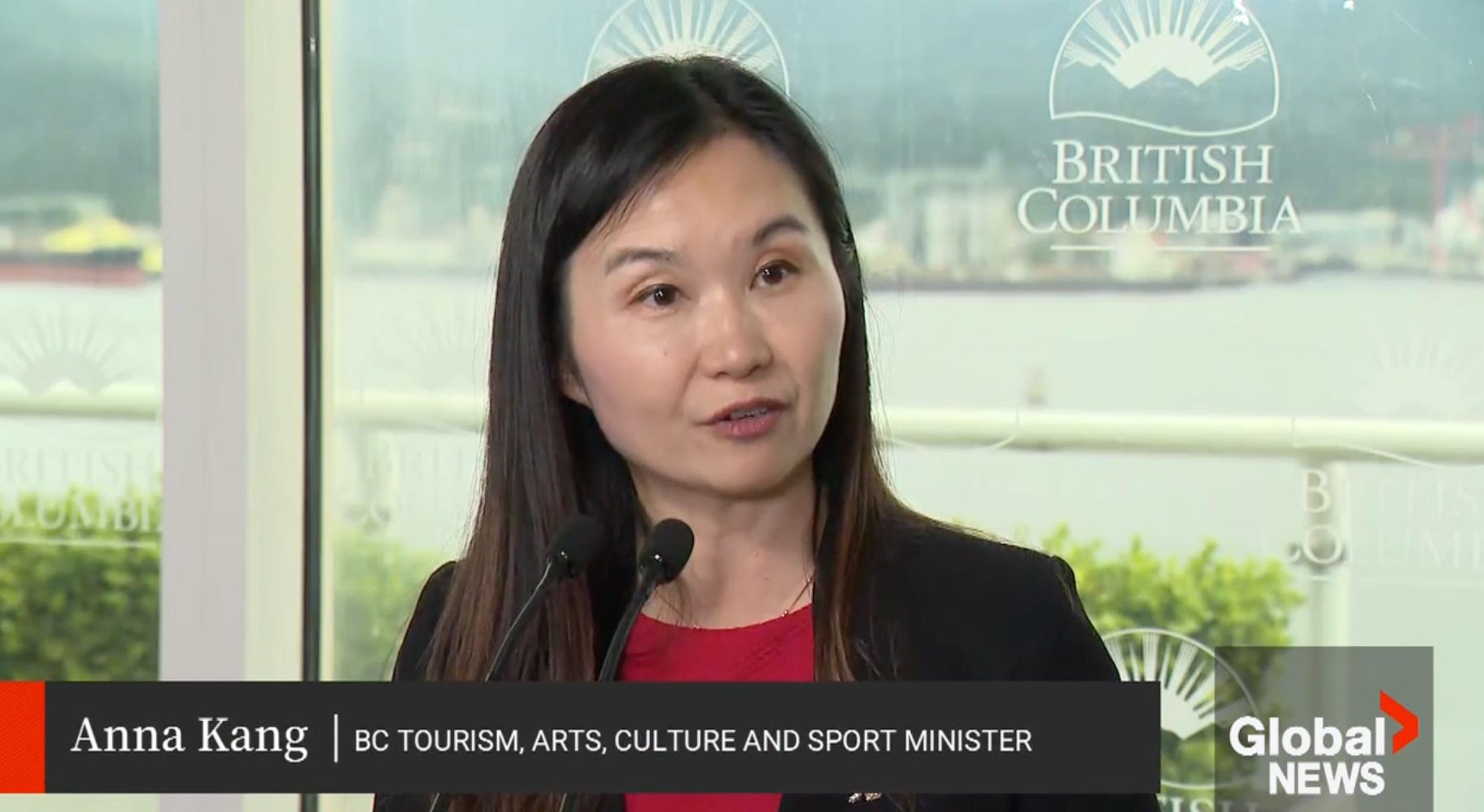
“Every jurisdiction that’s hosted a World Cup has seen the economic benefits.” That was BC Jobs Minister Ravi Kahlon today, defending a price tag now swollen to $729 million for seven matches. Clean, confident, quotable - and false.
Brazil 2014 was the most expensive World Cup ever staged; four million tourists generated revenue worth about 2.5% of its $14-billion cost, and its billion-dollar Brasília stadium now runs as a bus depot. South Africa 2010 (which I covered extensively as part of HUM News): same promises, stadiums it couldn’t fill afterward. The economists who study this have about as firm a consensus as the field allows - the lasting boom rarely shows up once you compare hosts to cities that stayed home. “Every jurisdiction” isn’t a track record. It’s a talking point.
And the boom may be thinning before the first whistle. Four days before the ministers promised a million visitors and a billion in GDP, the BC Hotel Association conceded the opposite: June hotel occupancy across Vancouver’s Lower Mainland is running nine per cent below last year, and fifteen per cent below downtown. “FIFA has not generated the broad hotel demand many expected,” they admitted - this after a mayor who called the event the equivalent of “30 to 40 Super Bowls.” The industry now blames soft demand on earlier warnings of a room shortage scaring visitors off. A simpler explanation sits in plain view: rooms listed at $1,700 and $2,300 a night, and the same association telling reporters in March it expected no meaningful drop in rates.
That’s the backdrop against which Kahlon offered his guarantee: “That’s not a hypothetical. Whether it’s $900 million, or whether it’s $1.1 billion, we are going to see that.” That is the definition of a hypothetical - and one his own hoteliers are quietly undercutting. Reporters (who deserve a few pints for the perseverance) spent the press conference trying to turn rhetoric into something concrete: which dollars, from which visitors, net of what they’d have spent anyway. They left empty-handed. Asked whether booking federal tax money as “revenue” was misleading, Tourism Minister Anne Kang answered that Canadians everywhere are chipping in. True. Not an answer. The numbers themselves landed late Friday, the day after the legislature rose for summer - the timing of something you’d rather wasn’t examined.
It was a rosy projection delivered on the exact same day Statistics Canada announced the country has officially slipped into a technical recession.
To be fair to Vancouver: the stadium already exists, so this won’t be Brazil or South Africa. But “we won’t build a billion-dollar bus depot” is a long way from “five years of prosperity” - and only one of those was on sale today. The games will be a great party. Believe the brochure on that. It’s the years after, when the brochure goes quiet - and the hotel rooms, it turns out, never filled - that bear watching.
Carney’s “MAGA” Play: PM’s New York Speech Sparks Debate Over Cross-Border Trade Strategy
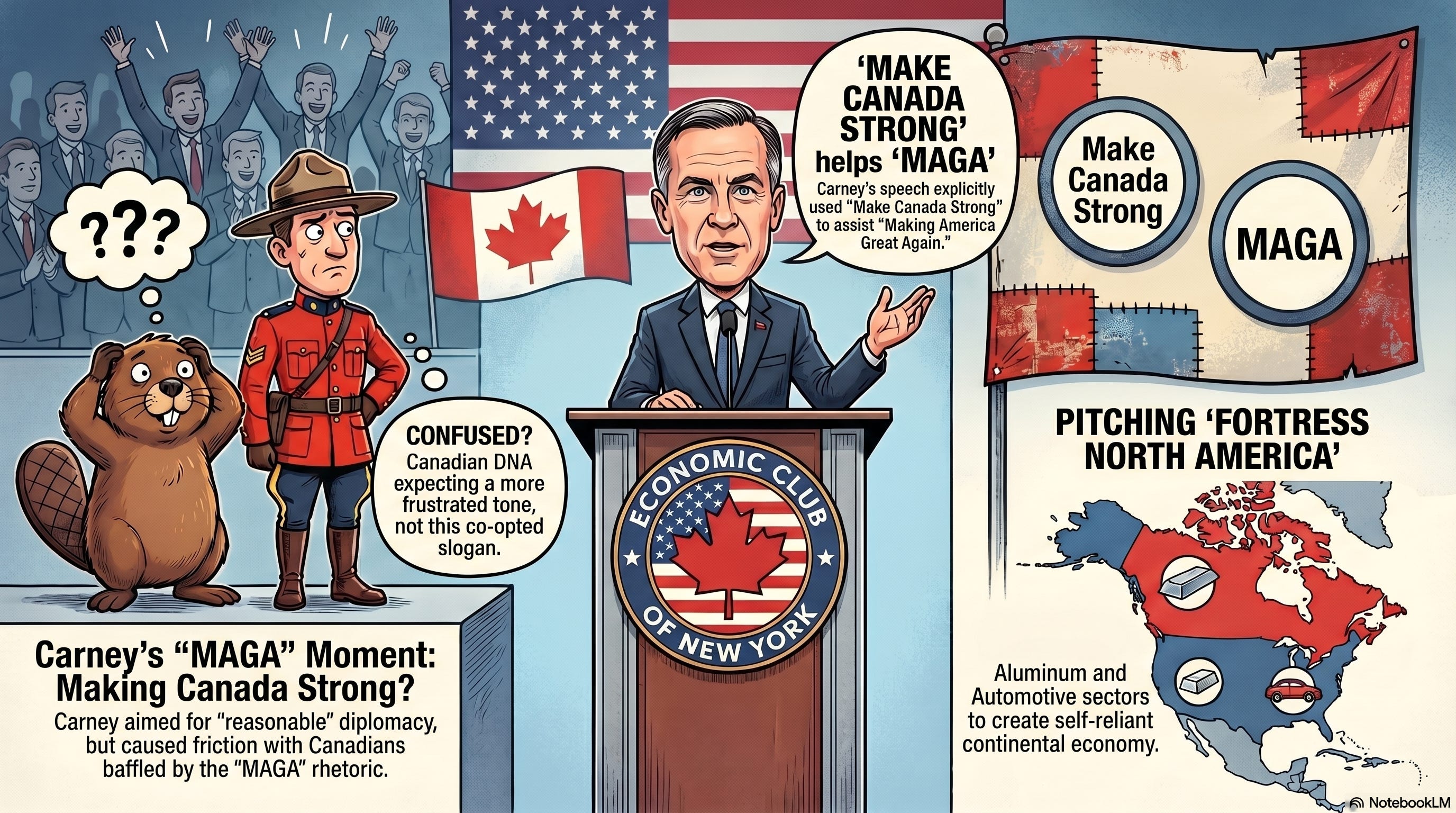
Canadian Prime Minister Mark Carney is making waves following a highly calculated address to the Economic Club of New York, where he co-opted Donald Trump’s famous political rhetoric to pitch a deeply integrated North American economy.
In his speech, Carney argued that to “Make America Great Again,” the U.S. needs to embrace “Make Canada Strong” (MCS). The strategic use of this language served as an instant media hook that grabbed headlines on both sides of the border. Political commentators note that the rhetorical shift was a deliberate attempt by the Prime Minister to break Canada out of its traditional “supplicant” role - where it is seen as simply begging the U.S. to save trade agreements - and instead position the country as an indispensable partner.
The “Fortress America” Pitch
Beyond the catchy slogans, Carney’s substance focused heavily on a “Fortress America” concept that champions North American supply chain resilience. He emphasized the critical need to keep cross-border supply chains intact, particularly in the automotive sector, so that North America can remain competitive against global rivals like China.
To highlight the practical limits of American self-reliance, Carney used a stark example regarding the aluminum trade: he pointed out that replacing the aluminum the United States currently imports from Canada would require the energy equivalent of “10 Hoover Dams”.
Reactions and Behind-the-Scenes Diplomacy
While some Canadians might instinctively prefer a more hostile or combative tone toward the Trump administration, political analysts argue that Carney’s approach is highly pragmatic. By using language that resonates with the American public and the Trump administration, Carney is ensuring that U.S. decision-makers actually pay attention to the economic realities of the bilateral relationship. The strategy appears to be landing well with some American officials, as the combative U.S. Ambassador to Canada, Pete Hoekstra, reportedly praised the speech.
This forward-looking, bridge-building exercise sets the stage for upcoming formal trade negotiations. Furthermore, despite public perceptions of a frosty relationship between the two nations, former Foreign Affairs Minister Mélanie Joly indicated that Carney and Trump actually speak frequently, suggesting a much more functional behind-the-scenes dynamic than many assume.
Vietnamese farmers are exhuming the graves of their ancestors in order to clear land for a sprawling Trump Organization complex set to include five-star hotels, upscale villas and a golf course, according to a new report. The $1.5 billion project — seen as key to relations between Hanoi and Washington — broke ground last year in Hung Yen province, but has since sparked backlash from local residents, some of whom have refused to comply with government demands, citing both sentimental and financial concerns. “The grave of my great-grandparents has been there since 1967, before the establishment of this country,” Hoang Anh Xa, who has five relatives buried in a cemetery set to be dismantled, told The Financial Times. “So why should I move them?” “It’s a spiritual thing,” Tran Minh Hai, a local farmer, added. “People don’t want to disturb the graves.” The project is expected to span roughly four square miles and impact more than 4,000 households. Vietnam’s communist-controlled government has signed off on compensation and resettlement plans, but some residents have pushed back. Due to local resistance, the luxury development — initially expected to be up and running by 2027 — has faced delays, sources told the Financial Times. During a groundbreaking ceremony in May 2025, Eric Trump called the venture “the envy of all of Asia and the entire world.” The nation’s then-Prime Minister Pham Minh Chinh described the development project, which includes local partners, as “significant to strengthening Vietnam-US relations and fostering foreign investor confidence, especially those from the US.” The ceremony came after Hanoi fast-tracked the standard approval process, skipping typical environmental reviews and truncating a public comment period, The New York Times previously reported. Some see the Vietnamese government’s actions as an effort to appease the Trump administration, which last year threatened to impose a 46 percent tariff on its goods, the Financial Times reports.
Last year, I was in Ho Chi Minh City, where the skyline may soon include a Trump Tower - and where the politics behind that are anything but straightforward. Vietnam is fighting to avoid 46 percent US tariffs on its exports. It just fast-tracked approval for a $1.5 billion Trump golf resort outside Hanoi, with a billion-dollar skyscraper here potentially next. Vietnamese officials call it investment. Critics call it a quid pro quo. The full report is above - and if you want more frontline journalism like this, a World Briefing Plus subscription is what makes it possible
A Bad Day for Trump’s America 250 Vanity Projects
Donald Trump is facing simultaneous setbacks in his efforts to personally brand the United States’ 250th anniversary celebrations, as both a major sponsored concert and a high-profile venue rebranding suffered public defeats this week, BBC reported.
The first blow came when a mass exodus of musical acts abandoned the “Freedom 250” festival, a 16-day event planned on the National Mall in Washington D.C. to celebrate the nation’s semiquincentennial. The festival’s organizing nonprofit was launched by the Trump administration last year, with Trump himself appointing its CEO, Keith Krach. Headliners including Young MC, Morris Day, the Commodores, Martina McBride, and Poison frontman Bret Michaels all dropped out, with many stating they had been misled about the political and divisive nature of the event. While acts like Vanilla Ice and C+C Music Factory are still slated to perform, the withdrawal of major artists casts a significant shadow over the administration’s celebratory plans.
In a separate but equally stinging defeat, a US federal judge ordered the immediate removal of the president’s name from the Kennedy Center for the Performing Arts. District Judge Christopher Cooper ruled that the venue cannot be renamed without congressional approval, reverting its title back to the John F. Kennedy Memorial Center. The ruling also blocked Trump’s plans to temporarily close the center for extensive renovations starting July 4, 2026, which he had explicitly framed as honoring the country’s 250th anniversary.
Trump had previously appointed himself as a trustee and chairman of the center, added his name to the facade, and subsequently faced a backlash of falling ticket sales and artist cancellations, BBC reported. Following the judge’s order, Trump lashed out on Truth Social, threatening to abandon the institution entirely and calling his involvement a “hopeless journey into ‘NEVER NEVER LAND’” unless he is given total control.
Despite these twin setbacks to his anniversary vanity projects, the White House continues to push forward with other unconventional America 250 initiatives. These include hosting a UFC fight on the South Lawn, a Grand Prix race in the capital, and releasing limited-edition commemorative passports featuring Trump’s own portrait.
The journals…..