Walking along the Pacific coast on Christmas Eve, I passed a modest, makeshift manger - a reminder of the animals that quietly inhabit the Christmas story. By Christmas morning, my thoughts had drifted thousands of miles away, back to Ukraine, and to a different, far harsher reality where animals have played an unexpectedly profound role in a modern war.
From the earliest days of Russia’s full-scale invasion, animals have been constant companions to Ukrainians living under fire - offering comfort, connection, and sometimes even survival. Watch my memorial video of journalists killed in the first years of the war, and a striking detail emerges: many are pictured holding cats. At the front line, in shattered cities, in bomb shelters, Ukrainians are often seen clutching dogs and cats as tightly as they hold onto one another.
In Odesa’s Taras Shevchenko Park, it’s now common to see people walking one, two, sometimes three dogs. When I stop to ask why, I often hear the same answer I heard during COVID lockdowns: pet ownership surged because animals brought comfort during isolation. But war has added another dimension. Dogs, people tell me, often sense incoming danger before humans do - an early-warning system of sorts, alerting their owners to rockets or drones moments before sirens wail. In a city under constant threat, that instinct can be lifesaving.
Some stories are extraordinary, even improbable. In the first weeks of the invasion, a German shepherd reportedly crossed from Russian-occupied territory into Ukrainian lines - and quickly learned to respond to commands in Ukrainian. A video of the dog being walked through his paces by his handler went viral, offering a moment of levity and pride at a time when little felt certain.
Other stories are harder to watch. Early in the war, a video circulated of a German shepherd mother panicking amid the rubble of a home just struck by a Russian missile. She had recently given birth. Ukrainian soldiers, risking their lives, searched the debris to retrieve her puppies. Once reunited, the mother carried each one away in her jaws - a small act of instinctive devotion amid devastation.
More recently in Odesa, a Russian drone struck a small horse stable run by a woman who lends her horses to comfort traumatized children and offers rides along the city’s main pedestrian street. One of her horses was killed. The loss rippled through the community - a reminder that war does not spare innocence, no matter its form.
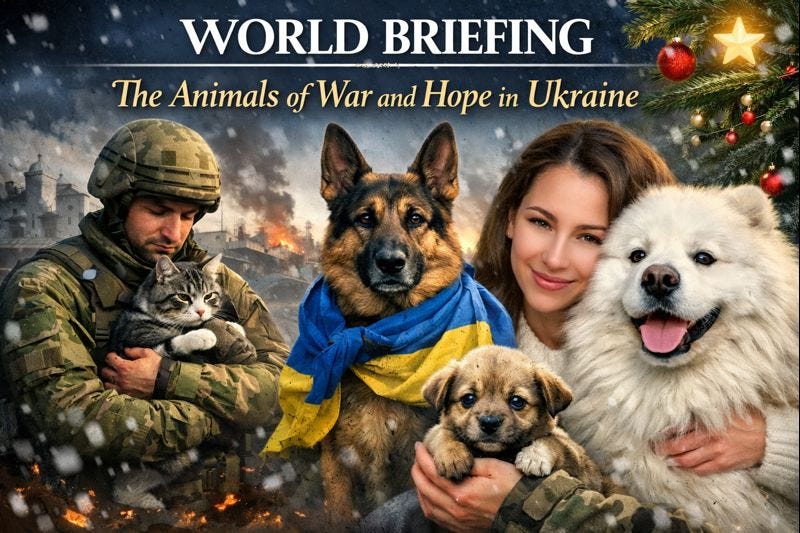
I’ve also noticed something telling in my own reporting: videos of injured, displaced, or rescued animals consistently draw enormous attention. Perhaps because animals cut through fatigue and geopolitics. They make suffering undeniable. They remind us what is at stake. Says Kyiv resident, Kateryna, owner of a large dog named Amir (pictured in the graphic above): “Lately so many military people write to me when they see Amir’s photo that their mood rises,” she told me on Christmas Day.
Across Ukraine, people often huddle in metro stations and bomb shelters with their pets as Russian attacks unfold overhead. But compassion is not always universal. In September, animal rights activists protested after a Kyiv metro staffer barred a street dog, Misha, from taking shelter during shelling.
This Christmas, it’s also worth honoring the extraordinary bravery of volunteers and animal welfare organizations who have stepped in where chaos prevailed. As millions fled Ukraine in the early months of the invasion, many were forced into impossible choices, leaving beloved pets behind. These groups entered bombed-out towns and front-line villages to rescue, rehouse, and care for animals - often at great personal risk.
Animals, too, have borne this war’s burden. They have suffered, been displaced, and killed. Yet they have also given something invaluable in return: comfort to civilians huddled in shelters, companionship to soldiers at the front, solace to journalists bearing witness to horror.
On Christmas Day - a holiday rooted in humility, vulnerability, and quiet presence - it feels right to acknowledge their role. In a war defined by destruction, animals have offered something profoundly human: connection, calm, and the stubborn will to endure.
Care to support a non-profit that provides emergency aid for animals in crisis zones, including Ukraine? Check out Animal Heroes.
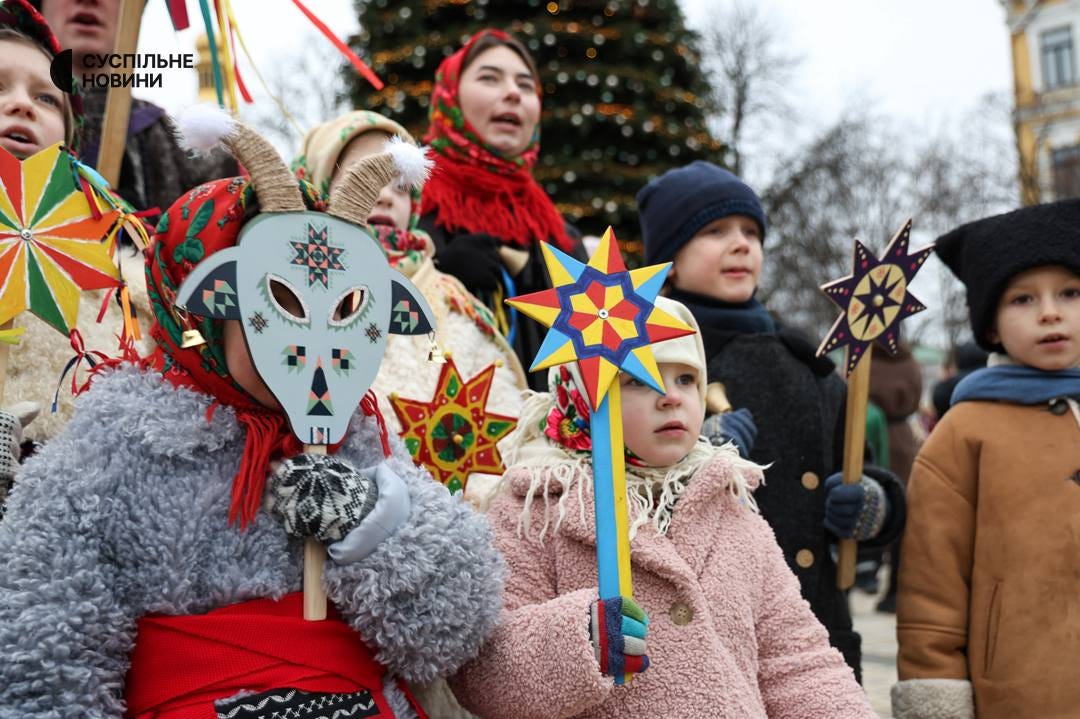
Pope Leo XIV has called for a global truce on Christmas Day, expressing “great sadness” that “apparently Russia rejected a request” for one. “I am renewing my request to all people of good will to respect a day of peace – at least on the feast of the birth of our saviour,” Leo told reporters at his residence near Rome on Tuesday. Russia has repeatedly rejected calls for a ceasefire in its war on Ukraine, saying that would only give a military advantage to Kyiv. The pope said: “Among the things that cause me great sadness is the fact that Russia has apparently rejected a request for a truce.” Referring to conflicts in general, Leo said: “I hope they will listen and there will be 24 hours of peace in the whole world.” - The Guardian
Broadcast live on BBC on Christmas Eve, I break down Ukraine’s newly revised 20-point peace plan unveiled by President Volodymyr Zelensky - and explain why, despite mounting pressure from Washington, it faces profound political, logistical, and moral obstacles. The plan controversially drops Ukraine’s NATO bid in exchange for Western security guarantees — a proposal many Ukrainians find impossible to trust given the West’s failure to uphold past commitments, most notably the Budapest Memorandum. Drawing on my experience with the OSCE Special Monitoring Mission to Ukraine, I explain why proposed demilitarized zones would be extraordinarily difficult to enforce against a Russia skilled in deception and denial. I also examine the plan’s call for a referendum, questioning how a credible vote could be held with millions of Ukrainians displaced abroad and diplomatic missions lacking the capacity to manage such a process. Add to that the explosive issue of territorial concessions, after nearly four years of devastating war, and the steep loss of public trust following a $100 million corruption scandal linked to Zelensky’s inner circle - and the political terrain becomes perilous. With the United States eager to push a deal forward and Russia showing no appetite for concessions, this interview underscores a central truth: peace cannot be rushed - and fragile agreements built on shaky foundations rarely hold.
Military officials from Thailand and Cambodia began talks Wednesday, both countries said, days after the neighbors agreed to discuss resumption of a ceasefire after 16 days of fierce border clashes that have killed at least 86 people. The talks come two days after a special meeting in Kuala Lumpur of Southeast Asian foreign ministers convened to try to salvage a truce first brokered by ASEAN chair Malaysia and U.S. President Donald Trump after a previous round of clashes in July. Thai Defense Ministry spokesman Rear Adm. Surasant Kongsiri said Wednesday’s meeting of the General Border Committee would last three days and could pave the way for an agreement. The talks were held at a border checkpoint toward the southern end of their 508-mile frontier. “If the secretariat meeting goes smoothly and leads to an agreement, then there will be a meeting between the defense ministers of the two countries on Dec. 27,” Surasant told reporters. Cambodian defense ministry spokeswoman Maly Socheata said the talks began at 4:30 p.m., led by generals from both sides. The meeting is the most significant step since fighting re-erupted and follows separate, unsuccessful efforts by Malaysia, China and the United States to bring the two countries to the table. Cambodia and Thailand have each accused the other of aggression and violations of an enhanced ceasefire reached in October in Malaysia in Trump’s presence, during which they committed to demining and withdrawing troops and heavy weapons from areas over which sovereignty has been contested bitterly for decades - NBC News
Nicolas Guillou, a French judge at the International Criminal Court (ICC), recently gave an interview to Le Monde in which he spelled out the impact of US sanctions imposed on him in August as a result of the court issuing an arrest warrant against Benjamin Netanyahu for crimes against humanity. The sanctions have changed every aspect of his daily life. Guillou explained: “All my accounts with American companies, such as Amazon, Airbnb, PayPal and others, have been closed. For example, I booked a hotel in France through Expedia, and a few hours later, the company sent me an email cancelling the reservation, citing the sanctions.” For having the temerity to uphold the basics of international humanitarian law and the value of the lives of Palestinian civilians at the international court, which deals with issues such as war crimes and genocide, Guillou said he had in effect been sent back to live in the 1990s. European banks, cowed by the threats of US Treasury officials in Washington, rushed to close his accounts. The compliance departments of European companies, acting as the valets of the US authorities, refused to provide him services. Other judges at the ICC, the UN body that deals with intergovernmental disputes, have had to take evasive action to prevent their assets being seized - The Guardian
“We are living in an age of disgusting impunity that is taking us back hundreds of years. We are reduced to giving concession after concession not to stop acts of aggression, but to ask those responsible to kill fewer people, destroy fewer neighbourhoods. We do not even ask them to have respect for international law, but ask to take a step back from going 100 miles away from international law.” - Majed al-Ansari, the foreign policy adviser to Qatar’s prime minister
Multiple drones struck the Russian port city of Temryuk in the Krasnodar region overnight, igniting large fuel storage tanks and damaging industrial facilities, regional authorities and Russian media reported early on December 25. The strike came as Russian forces launched a massive wave of nighttime drone attacks across Ukraine, hitting energy infrastructure and residential areas in several regions, Ukrainian officials said. According to the Krasnodar regional operational headquarters, two oil product reservoirs caught fire following the attack on the port on the Sea of Azov in southern Russia. The blaze spread over an estimated 2,000 square meters, and preliminary reports indicated no casualties. Footage published by local outlets showed flames rising from what appeared to be a refinery area near the shoreline. Speaking to Reuters, an official with Ukraine’s Security Service (SBU) attributed the fire to a Ukrainian long-range drone strike, though Kyiv has not publicly claimed the attack.
The Kremlin on Thursday said it was in contact with the French authorities over the fate of a French political scholar serving a three-year sentence in Russia and reportedly facing new charges of espionage. Kremlin spokesman Dmitry Peskov told reporters that Russia has made “an offer to the French” regarding Laurent Vinatier, arrested in Moscow last year and convicted of collecting military information, and that “the ball is now in France’s court.” He refused to provide details, citing the sensitivity of the matter. The French Foreign Ministry said Thursday it had no comment. Peskov’s remarks come after journalist Jérôme Garro of the French TF1 TV channel asked President Vladimir Putin during his annual news conference on Dec. 19 whether Vinatier’s family could hope for a presidential pardon or his release in a prisoner exchange. Putin said he knew “nothing” about the case, but promised to look into it - AP
A senior U.S. envoy used a discussion about a weight-loss drug during a boozy dinner to help advance a diplomatic effort with a self-proclaimed dictator.
The encounter took place during negotiations with Belarusian leader Alexander Lukashenko, whom the U.S. envoy, John P. Coale, described meeting while pressing for sanctions relief and other concessions. Coale, a veteran litigator who has represented President Donald Trump in lawsuits against social media companies, said Lukashenko asked him whether he had lost weight during the talks, according to The Wall Street Journal. Coale replied that he had, crediting his use of Zepbound, an injectable drug approved for obesity, and handed the leader a brochure from the manufacturer, Eli Lilly. The exchange unfolded as Lukashenko sought relief from U.S. sanctions on major Belarusian companies and help in repairing his presidential jet. In return, he signaled a willingness to release political prisoners, a resource the Belarusian leader controls in abundance.
Coale said the effort reflected President Trump’s personal approach to diplomacy. “I don’t care who we talk to,” he said in the interview with the Journal. “This really is Trumpesque. The hell with who you’re talking to, if this person can deliver what you want, that’s all that counts.” The initiative has produced tangible results. Lukashenko recently released 123 prisoners, including Nobel laureate Ales Bialiatski and opposition figure Maria Kalesnikava - The Daily Beast
The journals……