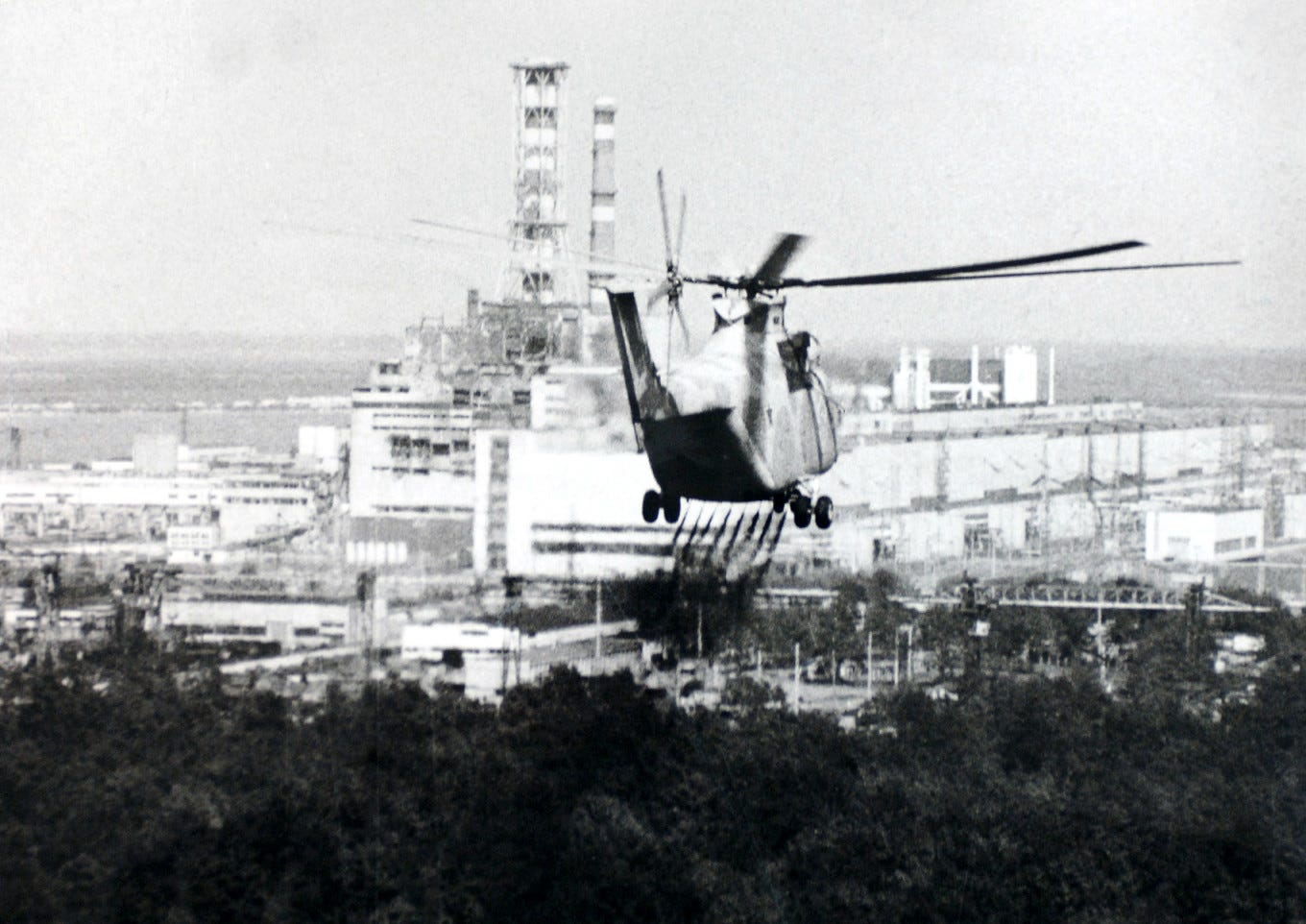
Forty years ago today, at 1:23 a.m. on April 26, 1986, Reactor No. 4 at the Chornobyl Nuclear Power Plant exploded during a failed safety test, sending radioactive fallout across Ukraine, Belarus, Russia and much of Europe.
The Soviet Union’s response was marked by secrecy and delay. Residents of nearby Pripyat were not immediately informed, and evacuation only began the following day. More than 100,000 people were eventually removed from the surrounding exclusion zone, much of which remains largely uninhabited.
The Kremlin’s official death toll of 31 has long been disputed. Many experts say the true human cost was far higher, with thousands exposed to dangerous radiation and increased rates of illnesses including thyroid cancer in the years that followed. Former Soviet leader Mikhail Gorbachev later said the catastrophe helped accelerate the collapse of the Soviet Union.
For Ukraine, Chornobyl is not only history - it is a present danger. During Russia’s full-scale invasion in 2022, Russian troops occupied the site, reportedly disturbing contaminated soil, damaging facilities and digging trenches in the highly radioactive Red Forest. Then, in February 2025, a drone strike damaged the vast New Safe Confinement structure that covers the destroyed reactor.
As Ukrainians mark four decades since the world’s worst nuclear accident, the anniversary comes with an unsettling reminder: even now, Chornobyl is not fully in the past. And with the Zaporizhzhia Nuclear Power Plant — Europe’s largest nuclear power station — still under Russian control, Moscow’s carelessness and disdain for basic norms pose an even more real threat to humanity.
For the past 40 years, the wastes of the Chernobyl site have stood as a monument to human arrogance, the danger of secrets, the plodding ineptitude of repressive regimes, and the catastrophes that occur when they all intersect - Moscow Times
Forty years after the disaster at the Chornobyl Nuclear Power Plant, I reflect on covering it as a young reporter with the English-language The Ukrainian Weekly, when early evidence pointed to a death toll far beyond absurd Soviet claims. In this video, I also draw clear parallels between the Soviet cover-up of Chornobyl and China’s early handling of the COVID-19 crisis - themes I explored in my book Digital Pandemic: How Tech Went From Bad to Good. Today, with Zaporizhzhia Nuclear Power Plant - Europe’s largest nuclear station and among the Top Ten globally - under Russian control, the danger of secrecy, denial and authoritarian negligence remains very real. Watch the video above
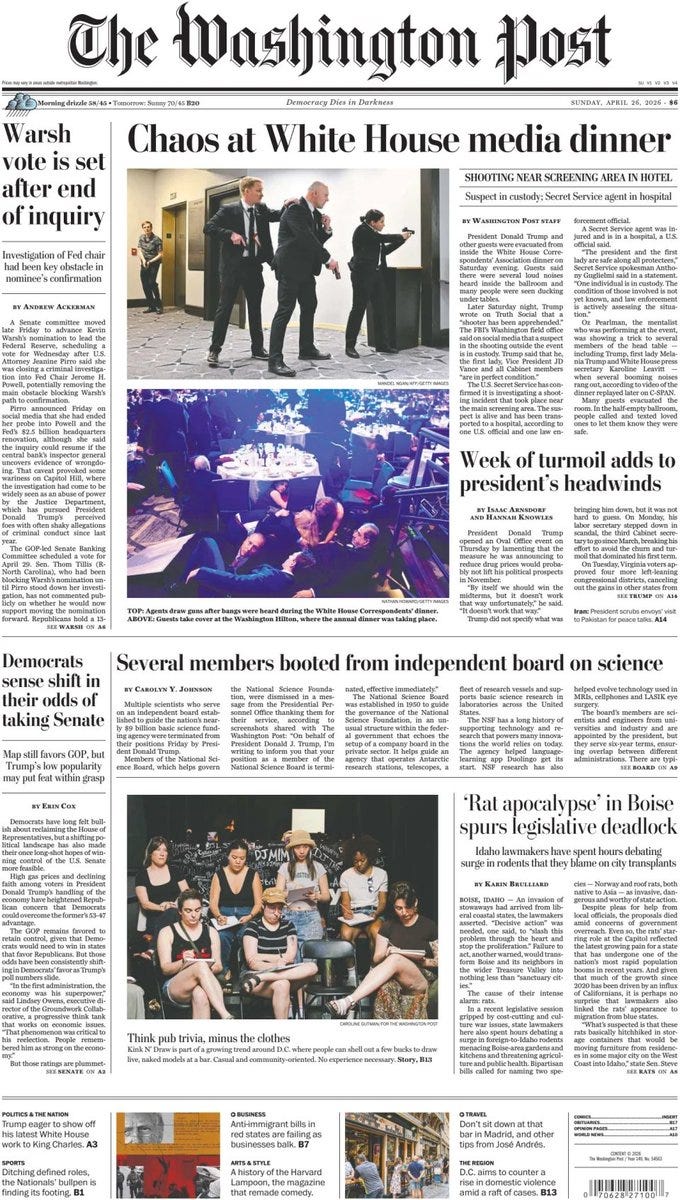
US President Donald Trump was evacuated from the White House Correspondents’ Dinner on Saturday, after witnesses heard multiple loud bangs in the ballroom of the Hilton Hotel in Washington, DC. The US Secret Service said it was investigating a shooting incident and that one individual was in custody. “The president and first lady are safe along all protectees,” it said. Trump said he believed the shooter was a “lone wolf” and that he didn’t reach the ballroom doors because he was apprehended by law enforcement. Washington police said it believed the alleged shooter was a guest at the hotel. Officers tackled the man after he charged a checkpoint with a shotgun in his hand as he attempted to run into the ballroom, they said. Officials declined to release his name and said the shooter’s motivation and targets were unclear. There did not immediately appear to be any injuries. Videos of the event appeared to show attendees ducking under dining tables as law enforcement came on the main stage. White House Correspondents Association Chair Weijia Jiang originally said the group would resume the program, but later took the stage to explain that law enforcement has requested attendees leave the premises. The president “insists we reschedule the event in the next 30 days and that he wanted to do it tonight, to continue despite the news,” she said. “On a night we are thinking about the freedoms in the First Amendment, we must also think about how fragile they are.” This was the the first time Trump has attended the dinner since 2015. In a press briefing following the incident, Trump said the man was from California and had been captured. The The Associated Press later identified the alleged shooter as a 31-year-old man from Torrance, California. The defendant will be arraigned on Monday in federal district court, US Attorney Jeanine Pirro said. Trump said one officer responding to the attack was shot with a “very powerful gun” but was wearing a bullet-proof vest and “is doing great.” - Semafor
Trump on Saturday abruptly called off a planned trip by two senior negotiators to Islamabad, signaling that Washington and Tehran remain far apart on any deal to end the war, according to The New York Times. Trump said he pulled the team shortly before departure and told Iran it could negotiate instead by phone. The delegation had been due to include special envoy Steve Witkoff and Jared Kushner, while Pakistani officials continue trying to mediate between the two sides. Core disputes remain unresolved, including Iran’s enriched uranium stockpile, its nuclear program, and control of the Strait of Hormuz, through which roughly a fifth of global oil supply normally passes. Trump said Iran had submitted an offer that was “much better” than an earlier proposal but still failed to meet U.S. demands. He also complained the Iranian officials expected at the talks were not senior enough. Meanwhile, Iranian President Masoud Pezeshkian said Tehran would not return to negotiations while the U.S. naval blockade of Iranian ports remains in place. The developments underscore a widening contest of endurance: Washington appears to be betting that economic pressure will weaken Iran, while Tehran may be calculating that Trump is reluctant to reignite a costly war ahead of U.S. midterm elections. Despite heavy U.S. strikes, Iran’s leadership remains in power and continues to exert leverage over shipping through Hormuz, rattling energy markets and the wider global economy.
Iran’s foreign minister departed Islamabad for Moscow on Sunday, his ministry said, ping-ponging from capital to capital as mediators hoped to keep peace talks between Tehran and the United States alive. Abbas Araghchi sandwiched a visit to Oman’s Muscat in between trips to the Pakistani capital, and was set to meet Russian President Vladimir Putin in Moscow on Monday, according to the Iranian ambassador, but there remained no indication that direct US-Iranian talks would resume. Pressure to end the war has intensified as the Strait of Hormuz remains closed. But Iran’s Islamic Revolutionary Guard Corps (IRGC) said it had no intention of lifting their blockade, which has roiled energy markets. “Controlling the Strait of Hormuz and maintaining the shadow of its deterrent effects over America and the White House’s supporters in the region is the definitive strategy of Islamic Iran,” the IRGC said on its official Telegram channel - Al Arabiya
Palestinians voted in local elections on Saturday in the Israeli-occupied West Bank and in Gaza. This marked the first vote of any kind held in the Gaza Strip in two decades since Hamas won in 2006. For years, elections to choose Palestinian representatives were repeatedly postponed, and no parliamentary elections have been held since 2006, when Hamas secured a surprise victory in Gaza over Fatah, the faction led by President Mahmoud Abbas. This time around, most electoral lists are aligned with Abbas’s secular-nationalist Fatah movement or consist of independents supported by smaller factions such as the Marxist‑Leninist Popular Front for the Liberation of Palestine. A number of Palestinian factions boycotted the electoral process in protest against the Palestinian Authority’s (PA) conditions for candidates to join, which were introduced as part of an electoral reform last year. Some aspiring candidates additionally complained they were prevented from participating. Nearly 1.5 million people are registered to vote in the West Bank, as well as 70,000 people in Deir al-Balah area, according to the Ramallah-based Central Elections Commission. Foreign diplomats were visiting polling stations to monitor the process. Voter turnout remained notably low, standing at 15% by late morning and later rising to 24.53% by 1 pm, the election commission said. News agency AFP reported that many stations across parts of the West Bank remained empty. Palestinians will vote to select representatives for municipal and village councils for a four-year term. Municipal councils handle everyday services, such as overseeing water supplies, sanitation and local infrastructure. Although they do not hold legislative power, local councils have become important in that they are one of the last remaining democratic mechanisms under the Palestinian Authority, which has been widely criticised over corruption, stagnation and declining legitimacy. These elections are therefore one of the few remaining political mechanisms that allow Palestinians a limited form of political participation - Euronews
Hungarian Prime Minister Viktor Orbán, who is stepping down after his party’s landslide election defeat earlier this month, said on Saturday that he is giving up his seat in Hungary’s parliament but intends to remain leader of the Fidesz party. In a video posted on Facebook, Orbán said the decision followed a Fidesz meeting during which party officials agreed to carry out a major restructuring of the party’s parliamentary grouping after the heavy election loss, which ended Orbán’s 16-year rule. Orbán said he would seek reelection as party leader in a vote scheduled for June - Euronews
The journals…..