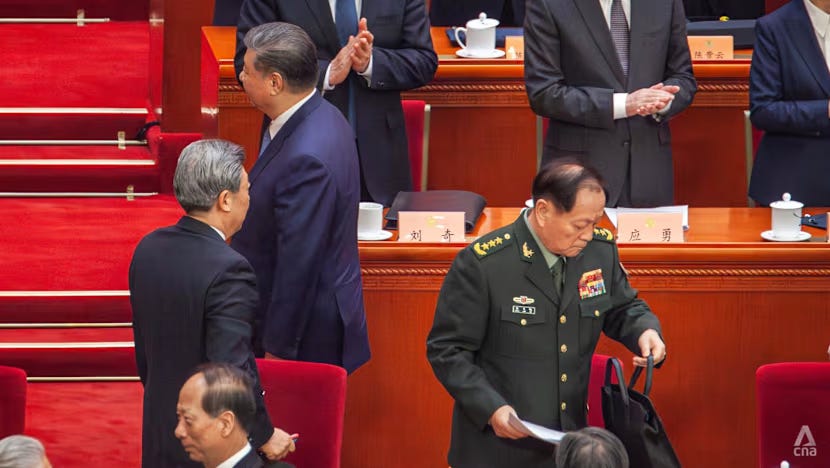
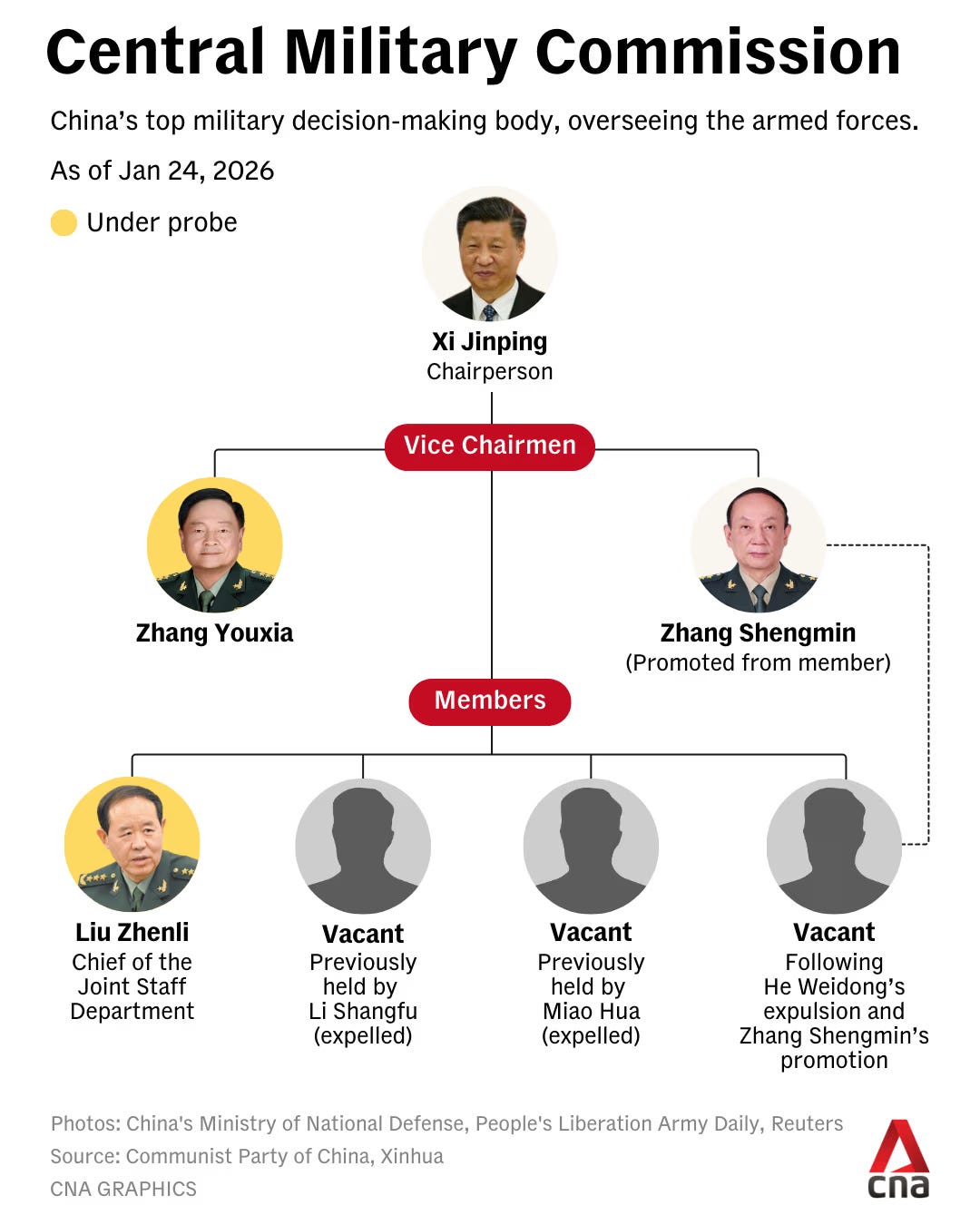
China has just launched its most consequential military shake-up in decades, placing Zhang Youxia - Xi Jinping’s closest uniformed ally and the vice-chairman of the Central Military Commission - under investigation, alongside Liu Zhenli, the PLA’s top operational planner. Their downfall “marks an unprecedented near total wipeout of the CMC formed after the 20th party congress in late 2022,” the South China Morning Post reported.
The timing is notable: Beijing is racing to modernize its forces, sharpen joint-war capabilities, and project credible power across the Taiwan Strait. But purges don’t just remove corrupt actors—they could also impact decision-making, slow procurement, and command behavior.
China’s most senior general is under investigation, China’s defence ministry said on Saturday, in the highest-profile purge to date of senior military leadership just as Beijing modernises its forces and tries to further project its might. Zhang Youxia serves as second-in-command under President Xi Jinping as vice-chairman of the Central Military Commission - the supreme command body - and has long been seen as Xi’s closest military ally. The ministry said Zhang and Liu Zhenli, chief of staff of the CMC’s Joint Staff Department, were under investigation for suspected serious violations of discipline and law. Zhang is also a member of the elite Politburo of the ruling Communist Party and is one of just a few leading officers with combat experience. The military was one of the main targets of a broad corruption crackdown ordered by Xi in 2012. That drive reached the upper echelons of the People’s Liberation Army in 2023 when the elite Rocket Force was targeted. Zhang’s removal is the second of a sitting general on the Central Military Commission since the 1966-76 Cultural Revolution. He has not been seen in public since November 20, when he held talks with Russia’s defence minister in Moscow. Zhang is the second vice chair of the CMC to fall from grace in recent months. Former CMC vice chair He Weidong was expelled from the party and PLA in October last year for corruption. He was replaced by Zhang Shengmin. Eight top generals were expelled from the Communist Party on graft charges in October 2025, including He Weidong. Two former defence ministers were also purged from the ruling party in recent years for corruption. The crackdown is slowing procurement of advanced weaponry and hitting the revenues of some of China’s biggest defence firms - Reuters
A source familiar with the situation said the party elite had been briefed about the investigation on Friday, the South China Morning Post reported. The source said Zhang was accused of corruption and of failing to rein in his close associates, family members and relatives. He was also blamed for not flagging problems to the party leadership at the first instance, according to the source, who declined to be named due to sensitivity of the issue. A second source with knowledge of the matter said Zhang was formally detained by military corruption investigators on Monday. The official PLA Daily said Zhang and Zhenli “have seriously trampled upon and undermined the CMC Chairman Responsibility System, seriously fueled political and corruption issues that affect the Party’s absolute leadership over the military and endanger the Party’s ruling foundation, seriously affected the image and prestige of the CMC leadership team, and seriously impacted the political and ideological foundation of the unity and forge-ahead spirit of all officers and soldiers.”
Analysts say Zhang’s plight may reflect a confluence of factors, such as a possible erosion of trust between him and Xi as well as the Chinese supremo’s broader effort to consolidate control over the military and reshape the CMC ahead of the 21st Party Congress in 2027. The episode underscores how no one is immune in Xi’s remaking of the PLA, not even those once regarded as trusted insiders, they further point out. “The fact that Zhang Youxia, the son of a founding general, has now been placed under investigation shows that red second-generation or military second-generation networks are not a priority for Xi,” said Lin Ying-yu, an associate professor at the Graduate Institute of International Affairs and Strategic Studies at Tamkang University in Taiwan. “For Xi now, there are no absolute relationships, no absolute friends and no absolute subordinates,” he told CNA. Turbulence at the top of the military could ripple through the chain of command, affecting readiness and operational tempo by slowing decision-making and encouraging risk aversion, at least in the short term, warned observers. Dylan Loh, an associate professor in the Public Policy and Global Affairs programme at Singapore’s Nanyang Technological University (NTU), described the move as one of the most consequential at the top of the PLA in decades - CNA
The removal of Zhang and Liu reduces the CMC to its smallest size in history, leaving as its only members Xi, who heads the body, and Zhang Shengmin, a political commissar who leads the military’s anti-corruption watchdog and was promoted to CMC vice-chair in October, the FT reported. Xi has been pushing to tighten his grip on the PLA for several years. “This is the most stunning development in Chinese politics since the early days of Xi’s rise to power when he purged the General Officer Corps of those he feared would oppose him,” said Dennis Wilder, a former head of China analysis at the CIA. “He now has only one officer remaining on the powerful CMC. This is like the US Joint Chiefs of Staff with only one general. You cannot run the PLA this way. He has to appoint successors.”
Polling stations opened on Sunday for the final stage of Myanmar’s three-phase election, a one-sided vote that has been widely derided as a sham, with politicians jailed, the main opposition party banned and conflict raging across parts of the country. Junta leader Min Aung Hlaing has defended the vote as “free and fair”, presenting it as a return to democracy and stability. The election is happening almost five years after the military seized power in a coup, ousting the elected government of Aung San Suu Kyi and triggering a fierce conflict. The 80-year-old has been detained since she was ousted, and her party has been banned. The UN, human rights experts and some western governments have rejected the election, saying it lacks legitimacy. Tom Andrews, the special rapporteur on the situation of human rights in Myanmar, said the vote had been orchestrated by the military to ensure a landslide by its political proxy, the Union Solidarity and Development party (USDP). “The junta is banking on the world’s fatigue, hoping that the international community will accept military rule dressed up in civilian clothing,” he said. Just days ahead of voting, 21 people were killed and 28 injured in a military airstrike on a village where displaced people from the northern township of Bhamo were sheltering in Kachin state, Associated Press reported. Voting is due to take place in Bhamo on Sunday. In total, 57 parties are competing, though only six are doing so nationwide, and analysts say none of the parties on the ballot paper represent anti-military sentiment. The USDP is running by far the largest number of candidates. According to election monitoring group Anfrel, 57% of the parties that ran in the 2020 general election no longer exist, even though they received more than 70% of votes and 90% of seats - The Guardian

We’re outside for a reason. The best reporting doesn’t happen in conference halls - it happens in the messy, uncertain places where decisions collide with real lives. If you believe independent journalism and sharp commentary are worth backing, please upgrade to a paid subscription to support World Briefing. Your contribution helps fund reporting, travel, verification, and the work that turns chaos into clarity. You can also support World Briefing through Patreon or PayPal.
Ukraine, Russia, and the United States, after two days of “constructive” peace talks in Abu Dhabi, are set to resume negotiations in the United Arab Emirates capital next week, even as the war itself showed no signs of letup. On January 23-24, “the United States coordinated a trilateral meeting alongside Ukraine and Russia, graciously hosted by the United Arab Emirates,” White House envoy Steve Witkoff wrote on X. “Talks were very constructive, and plans were made to continue conversations next week in Abu Dhabi. President [Donald] Trump and his entire team are dedicated to bringing peace to this war,” he added. Witkoff did not specify an exact schedule for resumption of the talks. Ukrainian President Volodymyr Zelenskyy said he was briefed by his team on the talks and also labeled the negotiations as constructive, although no details of the sessions were disclosed. The “military personnel involved in the negotiations have created a list of topics for a possible new meeting,” Zelenskyy said. Meanwhile, violence on the ground continued even amid the peace talks. Russia, following its massive air strikes on Kyiv and Kharkiv, on January 24 claimed to have captured another key village, while Ukraine reportedly struck back in Russia’s Belgorod border region - RFE/RL
A partial U.S. government shutdown on Friday is looking more likely after a second fatal shooting in Minnesota involving Immigration and Customs Enforcement. (In Saturday morning’s shooting, a 37-year-old man was shot and killed by federal agents who claimed he approached federal officers with a 9 mm gun but didn’t specify if he was holding or brandishing the weapon. Various videos of the incident appear to show the man, a U.S. citizen, holding a phone, Politico reported). Soon after the killing, some Senate Democrats who supported the bipartisan deal to reopen the government in November said they would oppose a six-bill funding package if it includes the Department of Homeland Security. That leaves the broader funding measure short of 60 votes; Minority Leader Chuck Schumer said on Saturday night that “Senate Democrats will not provide the votes to proceed to the appropriations bill if the DHS funding bill is included.” Senate Democrats will next discuss their strategy as a group on Sunday evening, with an in-person caucus meeting scheduled for Wednesday. On Friday evening, funding for large swaths of the government will run out - Semafor
A federal grand jury in Maryland has indicted a Pentagon contractor whose alleged leaking of classified documents sparked an “outrageous” FBI raid on a Washington Post reporter’s home. According to the justice department, Aurelio Luis Perez-Lugones illegally provided sensitive and secret information “related to national defense” to a reporter who it says then wrote and published at least five articles using it. The indictment was not immediately available, and a press release announcing five charges against Perez-Lugones of mishandling classified information did not identify the journalist or their employer. On 14 January, the FBI raided the Virginia home of the Post reporter Hannah Natanson in what the newspaper called a “highly unusual and aggressive” move, and seized items including two laptops, a hard drive and a recording device, her smart watch and a mobile phone - The Guardian
U.S. President Donald Trump threatened on Saturday to impose 100 per cent tariffs on Canadian goods if the country “makes a deal with China,” though Ottawa has said it is not pursuing such an agreement. Prime Minister Mark Carney later posted an ad online reiterating that the government’s response to economic threats will continue to be focusing on what it can control. Ministers on Parliament Hill today acknowledged the threat is serious, but they said it only confirms Canada needs to stay the course with its strategy to move trade dependency away from the U.S. The threat was the president’s latest swipe at Canada after Carney’s trade visit to China and his highly publicized speech in Davos, Switzerland - CBC
Emory University School of Medicine in Atlanta has announced that the daughter of senior Iranian official Ali Larijani, Fatemeh Ardeshir-Larijani, is no longer employed by the university, the student-run school newspaper reported on Saturday. Citing Emory University School of Medicine Dean Sandra Wong, the paper said an email was sent to medical school faculty on Jan. 24 announcing that a doctor who is also the daughter of a senior Iranian government official is no longer a University employee. The news came in light of Iran protests that left thousands dead and also after a protest by Iranian-American demonstrators, who gathered outside Emory’s Winship Cancer Institute to oppose the employment, the paper said. Ali Larijani is the Secretary of Iran’s Supreme National Security Council. He was sanctioned by the US on January 15 among other officials - Al Arabiya
In a move that has ignited fierce debate both domestically and internationally, South Africa abstained from a United Nations Human Rights Council (UNHRC) resolution on January 23. The resolution was aimed at extending an independent fact-finding mission to investigate Iran’s brutal suppression of anti-government protests. The 39th Special Session addressed the deteriorating human rights situation in Iran, where security forces have been accused of mass killings, arbitrary arrests, and enforced disappearances since protests erupted in late December 2025. The resolution passed with 25 votes in favor, 7 against, and 14 abstentions, mandating a probe into the crackdown that has reportedly claimed thousands of lives. Pretoria abstained, arguing it would support an independent inquiry ascertaining breaches by all parties, implying a preference for a broader, less biased probe. The decision has drawn sharp criticism. The Democratic Alliance (DA) lambasted the ANC-led government for “exposing its complicity” in Iran’s massacres, calling the abstention a failure to uphold human rights and an indictment on the country’s international standing. Online, the abstention raised questions about consistency in South Africa’s human rights advocacy. Critics have accused South Africa of hypocrisy, pointing to its vocal stance against Israel’s actions in Gaza at the International Court of Justice (ICJ), while remaining silent on Iran’s crackdown - Newsday (SA)
The journals…..