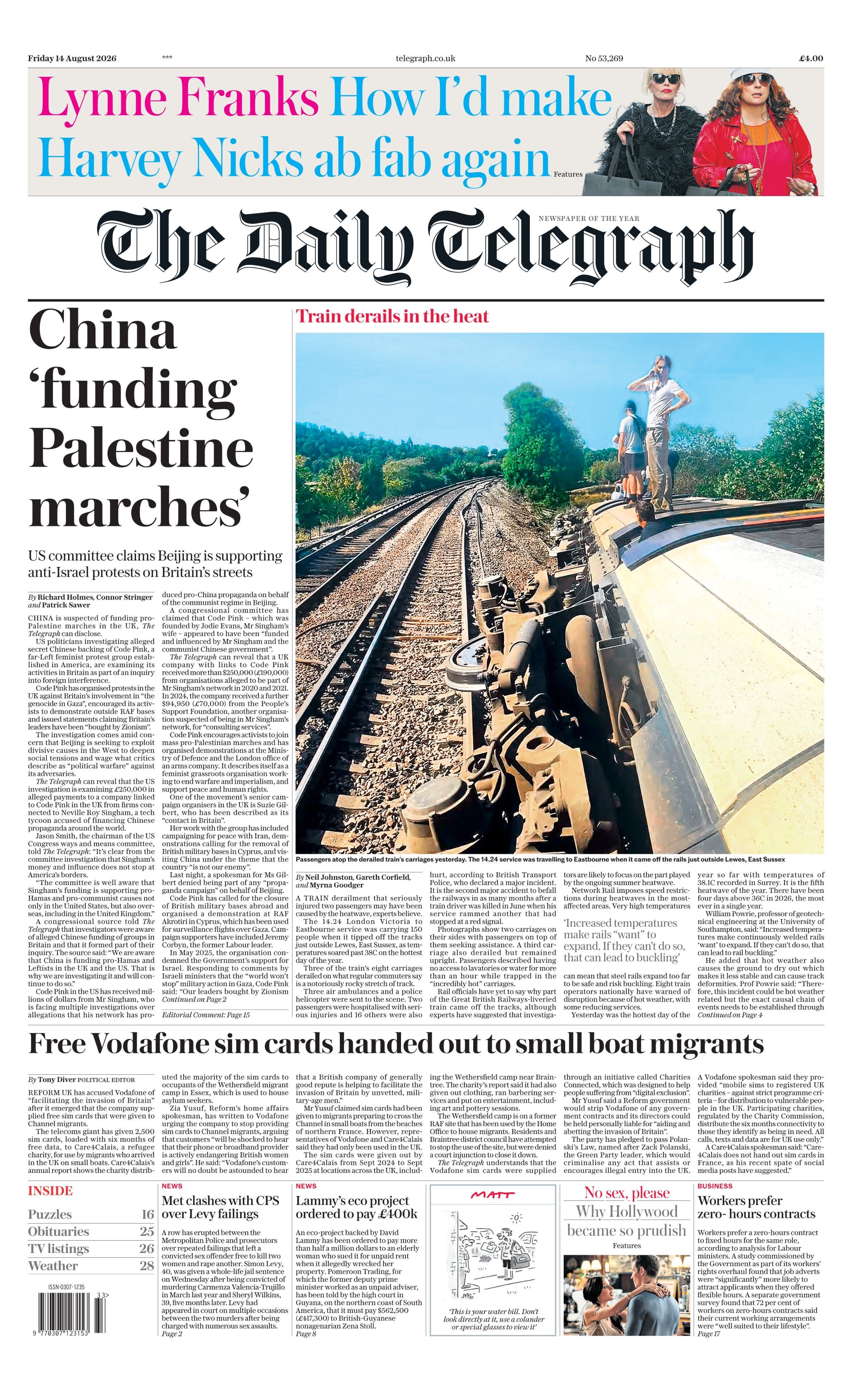
China’s National Natural Science Foundation announced its annual joint workshop programme with Iran on Monday. Among the five areas of cooperation: exploration and processing of rare earth elements. Beijing’s contribution is 30,000 yuan - about US$4,200 - per workshop.
Four thousand dollars, for a seat at the geology of a country the West has spent six months bombing and has never seriously surveyed. And with Tehran chipping in for other costs.
The tell is the category, not the money. Rare earths are the one advantage Beijing guards most jealously: China accounts for nearly 90% of global refined output. Way back in 2023, it banned the export of extraction, separation, alloy and magnet technologies outright. Putting “processing” into a programme with Tehran is a deliberate carve-out. We’ve seen the play in Malaysia - processing technology traded for resource access, restricted to state-linked firms. The Iranian version starts with scientists rather than refineries, which is what makes it cheap enough to be deniable.
A workshop cannot be sanctioned. No manifest, no bill of lading, no wire to freeze. It is the hole in the Emmental nobody looked for, because the enforcement architecture was built to stop goods moving, not knowledge.
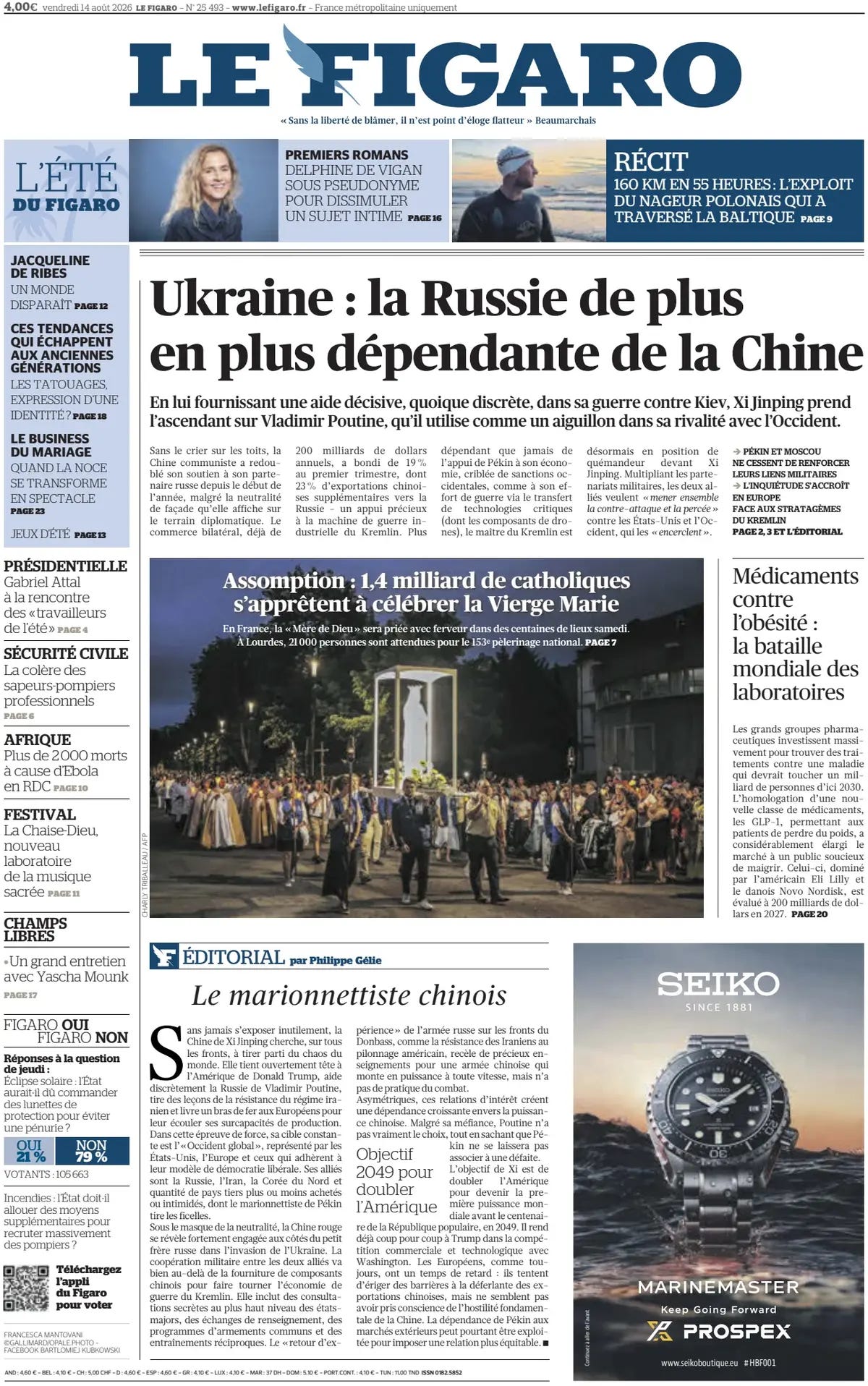
Beijing has run the deniability game in plain sight for four years. Russia’s imports of Chinese chips, optics and machine tools surged after the full-scale invasion; the EU named 14 Chinese and Hong Kong entities in its 21st sanctions package last month, and China retaliated within a day by banning dual-use exports to Rheinmetall and 13 other European firms. Not a partner to Russia’s war - merely a supplier of civilian goods. Not a partner to Iran’s reconstruction - merely a funder of academic exchange.
Don’t oversell it. Iran’s known deposits lean toward light rare earths - cerium, lanthanum, neodymium - not the scarce heavies that matter for magnets and guided weapons. No commercial reserves have been declared. The 2023 lithium claim collapsed on inspection. Near-term supply impact: zero.
It matters anyway, because China isn’t buying rare earths. It’s buying an option. It is mapping the mineralogy before committing a dollar, and before anyone else thinks to look. Whoever holds the survey when reconstruction contracts are written holds the pen.
Wang Yi meanwhile urges de-escalation and presses for Hormuz to reopen. That’s not a contradiction. Peacemaker at the podium, prospector in the field.
The damning half isn’t what Beijing is doing. It’s that nobody is bidding against it. And if things work out in the long run for Iran, it gets another source of foreign currency beyond oil.
Watch: whether a Chinese state mining SOE follows the scientists - and what the other four cooperation fields are.
US Vice President JD Vance says that Washington’s aims in the Iran war are “twofold”: to stabilise American energy prices by ensuring oil can flow through Gulf countries again, and to stop Tehran from obtaining nuclear weapons. Meanwhile, Treasury Secretary Scott Bessent says that the US is going to apply measures of “economic isolation” on Iran that have “never been seen” on a country. A senior Iranian official has said the general principles of a strategic action plan to manage the Strait of Hormuz have been agreed upon in a meeting of the Parliamentary Committee on Councils. One of the resolutions in the plan prohibits the passage of vessels and equipment owned by the US, Israel, and other “hostile countries” through the Strait of Hormuz, the report added. “This is because these countries have used the Strait of Hormuz to carry out hostile actions against our country, and have committed unjust and aggressive acts against the Iranian people,” Bayati said - Al Jazeera
Yemen’s Houthis said they attacked an Aramco refinery in Saudi Arabia’s Jazan with two drones on Thursday, the Iran-aligned movement’s Saba news agency reported. A Houthi military source said the attack was in response to what the group described as Saudi violations of Yemeni airspace and sovereignty in Saada and Hajjah provinces. There was no immediate comment on the report from Saudi Arabia - Reuters
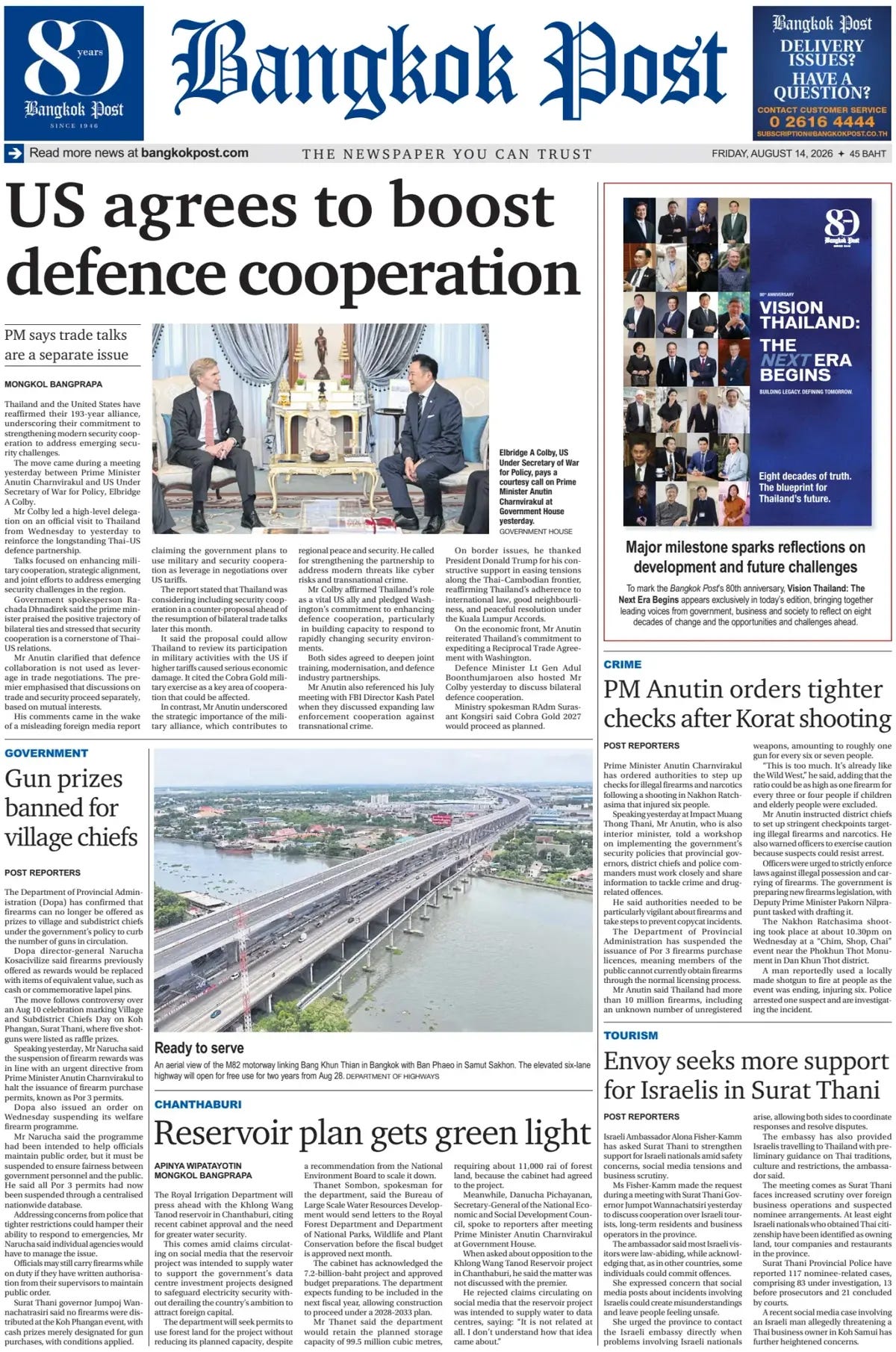
Cambodia and the United States will restart long-delayed joint military exercises next year, Prime Minister Hun Manet said on Friday, seeking to mend ties strained by Phnom Penh’s closeness to China. The announcement of the first joint drills in a decade followed a meeting between Hun Manet and the Pentagon’s top policy official, Elbridge Colby, in Phnom Penh on Friday. The resumption of military exercise Angkor Sentinel in 2027 will be “a bridge to build a close friendship between the armies of the two countries”, the Cambodian leader wrote in a Facebook post. He hailed “positive progress in Cambodia-US relations including the national defence sector”. The United States and Cambodia staged joint exercises for seven years before Phnom Penh scrapped them in early 2017, just months after holding its first Golden Dragon drills with the Chinese military. Cambodia and China held their largest-ever joint military exercises last year, involving advanced Chinese military hardware including artillery, warships and robot battle dogs. Phnom Penh has long been one of Beijing’s staunchest allies in Southeast Asia, receiving billions of dollars in investments. In recent years, the United States has voiced concerns about the Chinese-funded renovation of Cambodia’s Ream Naval Base, located off its southern coast in the Gulf of Thailand. Washington says the base - which was originally built partly with US funds - could give China a key strategic position near the disputed South China Sea, which Beijing claims almost in its entirety. Cambodian leaders have repeatedly denied the base is for use by any single foreign power and in January, a US warship made a port call there - CNA
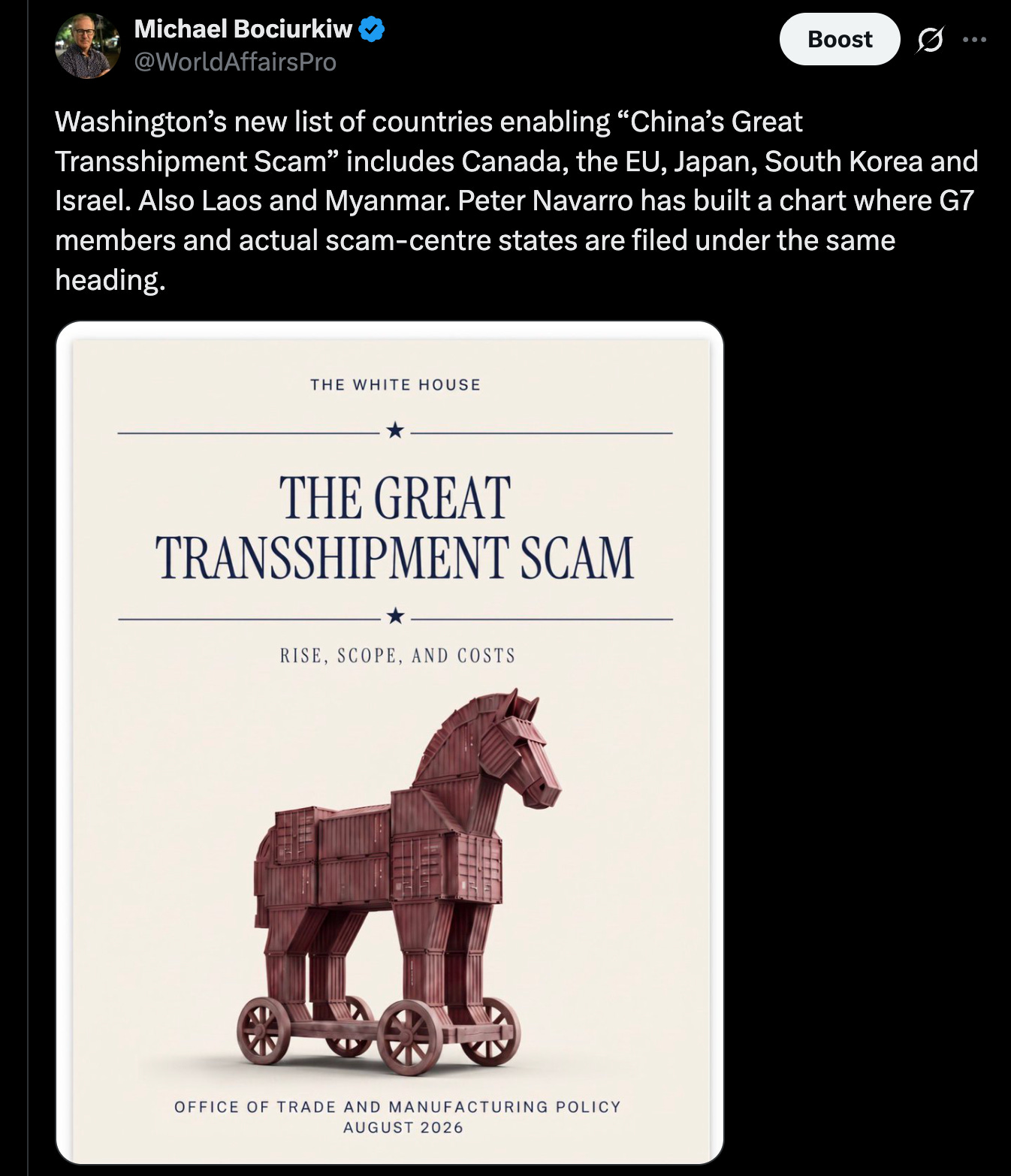
Washington Names 40+ Countries in "The Great Transshipment Scam"
This is not an analysis document. It is a pre-negotiation target list with a footnote apparatus. Peter Navarro said so out loud.
The White House released a 25-page report on 13 August accusing China and more than 40 countries of routing goods through third countries to disguise their origin before shipping to the United States. Produced by Navarro’s Office of Trade and Manufacturing Policy, it opens with an illustration of a Trojan horse built from shipping containers. The practice traces to the 2018 Section 301 tariffs, after which, the report says, exporters increasingly moved goods through jurisdictions where light assembly, repackaging or documentation changes could create the appearance of a different national origin.
Tier one — “Diversified Scale Leaders” — is Canada, the European Union, India, Israel, Japan, Mexico, South Korea and Taiwan. Tier two takes in Brazil, Indonesia, Malaysia, Thailand, Turkey and Vietnam. Panama, Colombia, Peru and several other Latin American states follow. Cooperation bought nothing: Panama cancelled CK Hutchison’s canal port contracts in January and Colombia imposed a 35% duty explicitly aimed at Chinese steel. Both are listed anyway.
The numbers are where it falls apart. The report values illegal transshipment at anywhere from $40 billion to $303 billion, a 7.5x spread across five estimates it concedes are not directly comparable, then runs all of them through the same loss table. From a $75 billion central case it derives roughly 450,000 displaced jobs, a $113–150 billion annual GDP reduction and $19–26 billion in lost federal revenue, while cautioning that these are model-based estimates. Model output, not a count.
What follows is enforcement: an AI system dubbed “Detective Border” to assist customs officers, a 40% levy on transshipped goods and criminal prosecution for wilful evasion. Navarro told reporters the issue would form part of the reciprocal trade negotiations. On India, whose Pune–Chennai belt the report sets against Cincinnati, Dayton and Columbus, he was blunter: “well on our radar.” All of it lands ahead of Xi Jinping’s expected September visit to the US.
The tell is in the report’s own opening section, which concedes that tariff differentials create the arbitrage opportunity. Washington built the incentive, is shocked to find it working, and has named Canada an accomplice for the offence of running a large economy with ports. When your risk taxonomy cannot distinguish Rotterdam from Sihanoukville, it isn’t a taxonomy. It’s a seating chart for a negotiation nobody has been invited to yet.
Turkish Foreign Minister Hakan Fidan says Ankara conveyed a proposal to Moscow and Kyiv for a mechanism to stop attacks on Black Sea shipping. Russia’s Deputy Foreign Minister Alexander Grushko says it doesn’t exist. Moscow has heard plenty of calls for moratoriums through various channels, he told reporters, but received nothing formalised. Fidan’s account was blunter than the diplomacy suggests. Speaking at Anadolu Agency, he said the conflict has spread across the whole Black Sea: early strikes hit military ports and naval vessels, now commercial shipping is hit without distinction, Turkish-flagged and Turkish-owned vessels included. Ukraine had already requested such a mechanism, he said; Türkiye passed it to the Russian side and is waiting. The darker material came in the same interview. Fidan warned the war is mutating from attrition into what he called a war of annihilation reaching civilian targets, and said parties rarely concede while they still believe they hold military options. Asked whether Russia might reach for its last available option, he said the subject had come up with his Russian counterparts, framed as something the public now demands, and that Western capitals have been told the same. It is worth noting that, one week earlier, Ankara’s other hand was visible. State Department notifications published in the Congressional Record on 6 August cover the transfer of 70 M39 ATACMS ballistic missiles and 12 M270 launchers from Turkish stocks to Ukraine, with shipment to begin once the statutory review period lapses. The package also includes thousands of DPICM cluster rockets and 47,000 203mm cluster shells. The M39’s roughly 165km reach puts Crimean airfields, depots and command nodes back inside Ukrainian range. Military Watch Magazine characterized the package as “one of the most significant transfers of U.S.-origin long-range strike equipment to Ukraine by a third country.” Read the sequence, not the headline. Ankara is proposing a moratorium on strikes while restocking one side’s deep-strike inventory, and publicly relaying a Russian nuclear hint while Moscow denies receiving the peace proposal Türkiye says it delivered. Neither of those is a contradiction in Turkish terms — the leverage has always come from being the only channel both sides still use, and channels are worth keeping only while both sides need them. Grushko’s denial is a cheap reminder of who grants that status. For anyone loading grain at Odesa, the operative fact is unchanged: no mechanism, no moratorium, and no agreement that one is even under discussion.
The Kennedy Center board on Thursday voted to again attach President Donald Trump’s name to the performing arts center, Rep. Joyce Beatty (D-Ohio) and two other people with knowledge of the vote said, its latest attempt to honor the president after a judge blocked an effort to rename the Kennedy Center after him in May. The board — which is mostly Trump loyalists after the president dismissed Democratic-appointed members on the historically bipartisan body — voted to “honor the President’s contribution with an inscribed recognition on the building,” with the new signage reading: “The John F. Kennedy Memorial Center for the Performing Arts, Restored and Renovated by President Donald J. Trump.” The board also voted Thursday to shutter the main building for two years, the culmination of Trump’s long-term effort to make sweeping changes to the performing arts institution. “This morning’s decision to close the Center and the surprise agenda item to put Donald Trump’s name back on the building was more of the same,” Beatty, an ex-officio board member, said in a statement that came after the initial publication of this report. “This latest development is a transparent effort to circumvent the Court’s ruling, and flies in the face of the statutes that Congress passed. I will continue to fight for this treasured national monument.” - POLITICO
The journals…