Iran said Tuesday it has not yet sent a delegation for new peace talks with the United States, as the temporary ceasefire which paused the Middle East war was set to expire. Iran and the US have accused each other of breaching the two-week truce that is set to end by Wednesday, as uncertainty grows over a push to stop the war from resuming. During initial talks in Pakistan earlier this month, the highest-level discussions between the foes since the founding of the Islamic Republic in 1979, analysts pointed to the seniority of the delegations as an indicator of a willingness to strike a deal. But those talks collapsed without an agreement, with Iran since closing the Strait of Hormuz again and US President Donald Trump announcing a blockade of Iranian ports. “So far, no delegation from Iran has departed for Islamabad, Pakistan; whether it is the main or subsidiary delegation; primary or secondary,” Iranian state TV said, dismissing reports suggesting otherwise. Trump has accused Iran of firing on ships in the crucial trade route it has choked, while Tehran says the US blockade and seizure of a ship violated the ceasefire deal. Iranian officials say they feel the Trump administration has not acted in good faith in negotiations and refused to back down from what it called excessive demands. Its parliament speaker said the country would not accept talks “under the shadow of threats” from the US leader and would “show new cards on the battlefield” if conflict resumed. The truce theoretically ends overnight Tuesday, though in comments to Bloomberg, Trump said the end was a day later, on Wednesday evening Washington time and it would be “highly unlikely” he would extend the truce. Trump told PBS News that Iran was “supposed to be there” at the talks in Pakistan. “We agreed to be there,” he said, warning that if the ceasefire expired “then lots of bombs start going off.” - Al Arabiya
The US Department of Defense announced that its military forces had boarded a sanctioned ship called the M/T Tifani without incident in South Asian waters on the night of April 20. “We will pursue global maritime enforcement efforts to disrupt illicit networks and interdict sanctioned vessels providing material support to Iran -- anywhere they operate,” the Pentagon statement said. “International waters are not a refuge for sanctioned vessels,” it added, saying the defense department “will continue to deny illicit actors and their vessels freedom of maneuver in the maritime domain.” Along with this statement, the US Department of Defense released images of military helicopters flying over an oil tanker and military helicopters landing onboard. This is the second ship the United States has seized and taken control of since imposing a naval blockade on Iran on April 19. The Islamic republic has called the naval blockade and ship seizure a “violation of the cease-fire.” - RFE/RL
Representatives of U.S. President Donald Trump’s “Board of Peace” have held talks with state-owned Dubai multinational DP World about managing supply chains and infrastructure projects in Gaza, the Financial Times said on Tuesday. Rehabilitation of Gaza, where two years of Israeli bombardment have destroyed four-fifths of buildings, has been projected by global institutions to cost around $70 billion. Citing three people familiar with the matter, the paper said the talks centred on prospects for a partnership between DP World and the Board of Peace to run logistics. These efforts would cover humanitarian aid and other goods entering Gaza, including warehousing, tracking systems and security, it added. Other ideas floated during the talks included a new port in either Gaza or on the nearby Egyptian coast built by the company based in the United Arab Emirates, which could also develop a free-trade zone in the war-shattered strip, the paper said. DP World and the White House did not immediately respond to Reuters’ requests for comment.
** DP World is primarily owned by the Government of Dubai through its holding company, Dubai World. As of 2020, it is a privately held entity and a subsidiary of the Ports, Customs & Free Zone Corporation (PCFC), which is controlled by the ruling royal family of Dubai.
Mexican President Claudia Sheinbaum has ordered an investigation into the role played by two US officials who reportedly worked for the CIA in a counter-narcotics operation in the northern state of Chihuahua. The two died alongside two Mexican officials when their car crashed on their way back from an operation to destroy illegal drug labs, Chihuahua officials said. Sheinbaum said that neither she nor senior members of the federal security team had been informed about any joint US-Mexican operations. The Mexican leader has been adamant that foreign officials can only operate on Mexican soil if given prior clearance at the federal level. Sheinbaum has come under pressure from her US counterpart, President Donald Trump, to do more to stem the flow of drugs from Mexico to the United States but she has insisted that Mexico’s “sovereignty” cannot be breached. On Monday, Sheinbaum said “we did not have knowledge of any direct work between Chihuahua state and personnel from the US embassy”. She also said the government needed “to understand the circumstances under which this was taking place, and then assess the legal implications”. According to a Chihuahua state official, the two US nationals and two members of the Chihuahua State Investigation Agency (AEI) died on Sunday morning when the car they were travelling in skidded off the road and fell into a ravine, where it exploded. On Tuesday, The Washington Post reported that the two US officials who died worked for the CIA as part of a significantly expanded role in battling narcotics trafficking in the Western Hemisphere. Their employment was later confirmed by other US media outlets, including CBS - BBC
Major Russian companies have been conscripted into a “witch-hunt” against users trying to circumvent online controls, researchers have said, as the Kremlin continues trying to cut its citizens off from the global internet. Banks and web platforms are collecting data on users of virtual private networks (VPN) tools, which obscure an individual’s real location and allow them to access sites blocked in Russia, according to an investigation by RKS global, an advocacy group for internet freedoms. Tens of millions of Russians use VPNs to access the global internet. This number grew dramatically at the outset of their country’s full-scale invasion of Ukraine, after the Kremlin introduced sweeping bans of platforms like Facebook and Instagram. Authorities are now taking far greater measures to track these users, who may be at risk of criminal penalties, the researchers said. The investigation analysed 30 popular Russian apps, including those run by T-Bank, Sberbank, the search engine site Yandex and the social media platform VKontakte. It found that 22 of these apps actively detected whether a user was on a VPN – or had one installed on their phone – and most of them retained that data in their servers, where it could be accessed by security services. “The level of intrusion into the device can be very high,” said RKS global. “Any Android app released by Russian companies for the Russian market may now be spying.” Mazay Banzaev, founder of Amnezia, an open-source VPN company, said: “It’s one thing if Russian IT companies were to ‘catch’ users the moment they visit a site with a VPN enabled. It is quite another when even a closed application continues scanning the phone for VPN usage.” For millions of Russians, this means that their options to interact with the rest of the world are narrowing – and growing increasingly fraught with risk. It is not formally illegal in Russia to use a VPN, and businesses and state agencies still rely on them. But activities around VPN use are increasingly criminalised. This year, Russian courts have begun to treat VPN use as an aggravating circumstance in prosecutions. Over the past year, the authorities have embarked on a gradual effort to throttle the global internet. This began with blackouts of mobile networks across large swathes of the country last year. These spread to Moscow and St Petersburg and Russians started to buy paper maps and pagers to get around and communicate - The Guardian
United Kingdom Prime Minister Keir Starmer has admitted he was wrong to appoint Peter Mandelson as ambassador to Washington, but rejected mounting calls to resign. Starmer told the UK Parliament on Monday that, while the appointment was a mistake, he would have withdrawn the decision had he known the Foreign Office had overruled security officials’ recommendations not to give the job to Mandelson, whose friendship with convicted sex offender Jeffrey Epstein was long known. The British leader again rejected calls for his resignation over the botched vetting process. Those calls have mounted as the issue has developed into a major scandal. The premier denied misleading parliament and placed the blame squarely on the shoulders of the Foreign Office, saying that it beggared belief that officials “saw fit to withhold this information from the most senior ministers in our system”. “That is not how the vast majority of people in this country expect politics, government or accountability to work,” Starmer said, adding that it was “frankly staggering” he had not been told about Mandelson’s failure to gain security clearance, to the sound of jeers from opposition lawmakers. “It doesn’t appear that he asked any questions at all. Why? Because he didn’t want to know,” Conservative Party leader Kemi Badenoch said. The fiasco has raised doubts about Starmer’s judgement, with the beleaguered prime minister claiming he only found out about the overruling of the vetting decision last week - Al Jazeera
Explainer
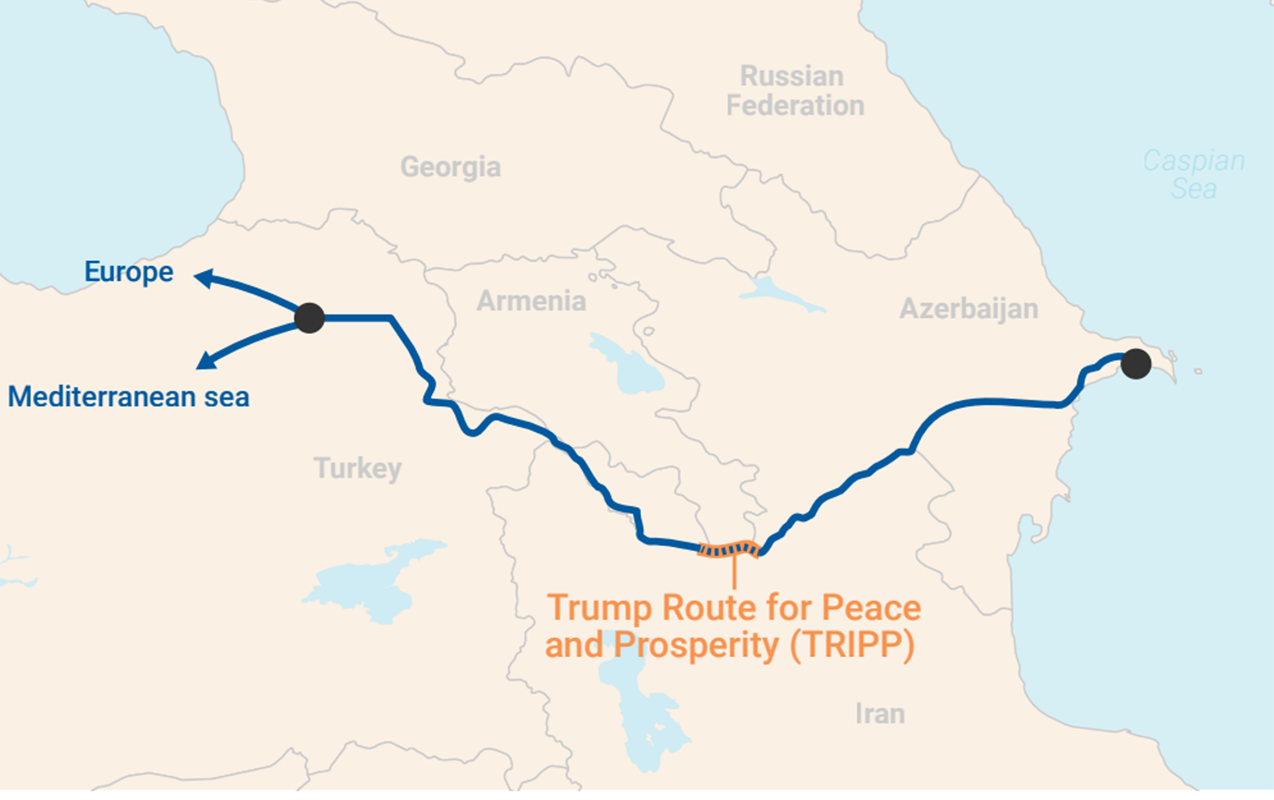
The “Trump Route for International Peace and Prosperity” (TRIPP), a 21st century version of a Panama-style “canal zone,” is a narrow strip of land that decides who moves energy, freight, and data between continents, and who gets paid for the privilege. And, vitally, a U.S.-backed counter to infrastructure being built by China. TRIPP is more than a photo-op or a vanity project. The South Caucasus, particularly since Russia’s full-scale invasion of Ukraine, has become an area of critical strategic value as a corridor between East and West and a new arena of superpower competition. Armenia and Azerbaijan have fought two wars over disputed Nagorno-Karabakh since the late-1980s, as the Soviet Union collapsed. It has been a brutal, society-shaping conflict, followed in 2023 by Azerbaijan’s rapid takeover of Nagorno-Karabakh and the flight of nearly the entire ethnic Armenian population. Russia, though formally cast as a mediator, spent years manipulating the conflict: arming both sides, managing ceasefires and preventing resolution in a familiar imperial tactic later perfected in Ukraine: manufacturing and freezing instability until it could be turned into full-scale war on Moscow’s terms. But Trump changed the narrative by brokering a peace that has continued to hold. In December, officials from both countries discussed “lasting peace” and a “joint future” at a summit in the Qatari capital Doha. Armenia and Azerbaijan are also deep in discussion about integrating their energy systems. And Washington is now trying to lock that peace into concrete: rails, roads, and fiber that physically re-route the region away from Russian and Iranian gatekeeping. The South Caucasus is to Russia what the Caribbean Basin and the Panama “backyard” once was to the United States: a strategic near-abroad where outside powers aren’t supposed to build permanent leverage. TRIPP, even if it exists just on paper for now, indirectly challenges the Chinese Belt and Road Initiative, a network of railways, ports, pipelines, and trade corridors aimed at boosting international trade under Beijing’s leadership. It enables the moving of goods while bypassing Russia and, where possible, Iran — an approach that became more urgent after 2022. And it undermines China, which has been busy paving routes to Iran. Both countries have been in intense contact with Central Asian countries and last summer inaugurated a railway route that connects China and Iran through Kazakhstan, Turkmenistan, and Uzbekistan. The simplest way to read TRIPP is as a 27-mile project with an outsized consequence: it reorders who controls the “land bridge” between Europe and Central Asia and it tells every capital nearby who Washington thinks matters. And China will have to prepare for an economic standoff in terrain it once assumed was ripe for Chinese dominance. Russia, meanwhile, finds itself on slippery ground, no longer the indispensable broker it once was in its immediate neighborhood. TRIPP also adds an unexpected edge to the Ukraine-shaped narrative of a Trump administration willing to accommodate Moscow at every turn, suggesting instead a relationship that is less uniform and more selectively disruptive than it first appears - Adapted from a story by Coda Media
The implementation of the TRIPP project will establish rail service between Iran and Armenia, Armenian Prime Minister Nikol Pashinyan announced at a press briefing recently. Responding to journalists’ questions regarding the situation in the Strait of Hormuz, he expressed confidence in a speedy resolution and, in this context, did not rule out accelerating the implementation of the TRIPP project. According to him, the TRIPP route envisages the creation of a Persian Gulf-Black Sea railway corridor, which is expected to benefit Iran, Armenia, Georgia, Azerbaijan, Turkey, and the United States. The Prime Minister emphasized that Armenia views cooperation with the Islamic Republic of Iran as a strategic direction, and the Armenian side intends to expand logistics chains and capabilities through Iranian territory. “The implementation of the TRIPP project is of great importance, as we will gain a railway connection with Iran, which will significantly simplify the import of goods into Armenia and export from the country,” Pashinyan said - Arka News Agency
The son of right-wing pundit Tucker Carlson has left Vice President JD Vance’s press team to set up his own political consulting firm amid escalating tensions between his father and President Trump. Buckley Carlson, a 20-something who had served as Vance’s deputy press secretary since the start of the second Trump administration, is joining a group of several White House alumni departing for the private sector. While such moves can be typical in presidential administrations, Buckley’s departure comes against the backdrop of a growing rift between Trump, 79, and Tucker, 56, once an avid backer. Trump wrote in a screed against Tucker earlier this month, “Flailing Fools like Tucker Carlson, who couldn’t even finish College, he was a broken man when he got fired from Fox, and he’s never been the same — Perhaps he should see a good psychiatrist!” Trump jabbed at Tucker again on Truth Social on Friday, linking to a story about CNN data guru Harry Enten suggesting the president was winning the feud in the public eye and writing, “Tucker is a Low IQ person – Always easy to beat, and highly overrated.” - NY Post
The journals….