🔥 World Briefing Hot Take
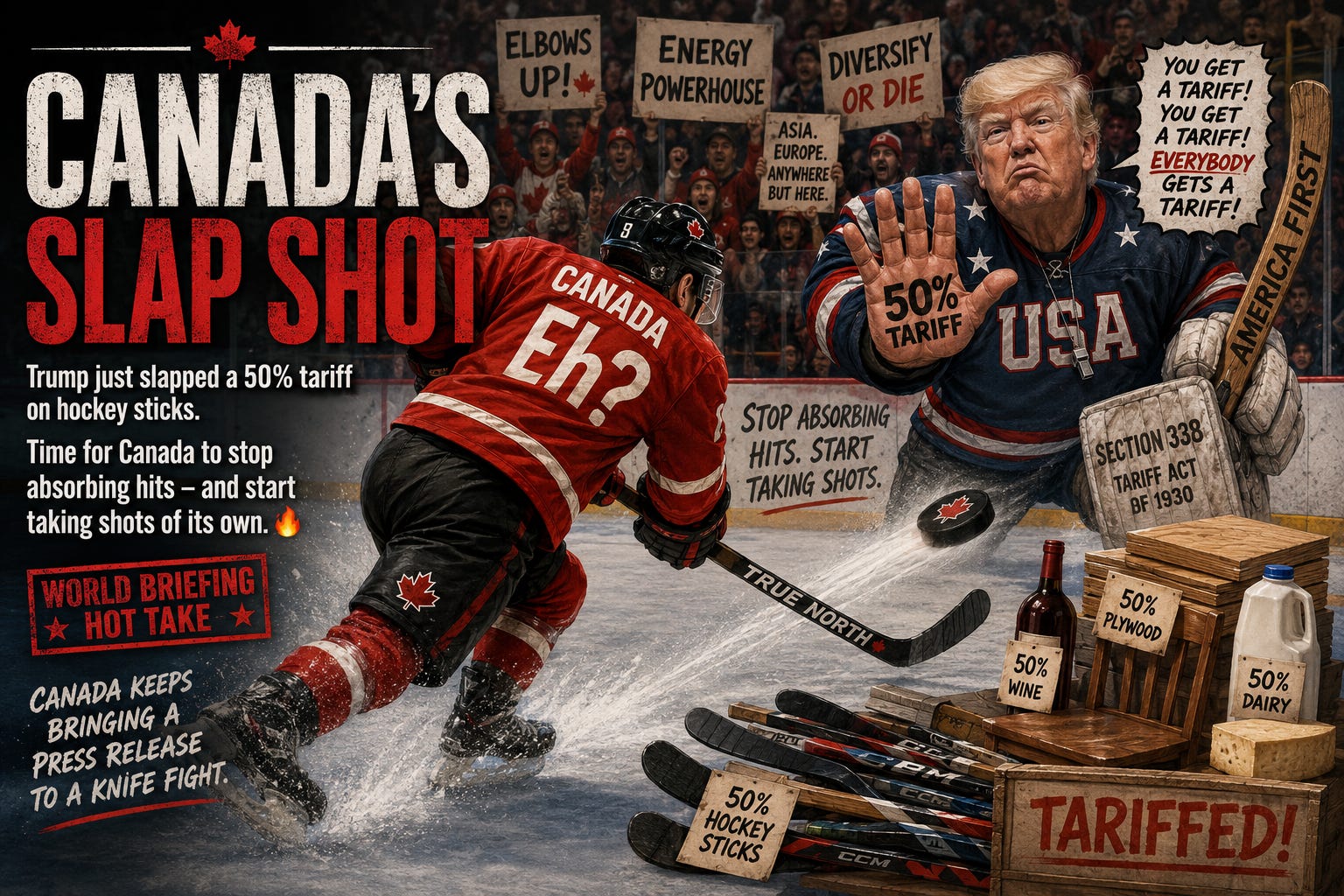
Canada keeps bringing a press release to a knife fight.
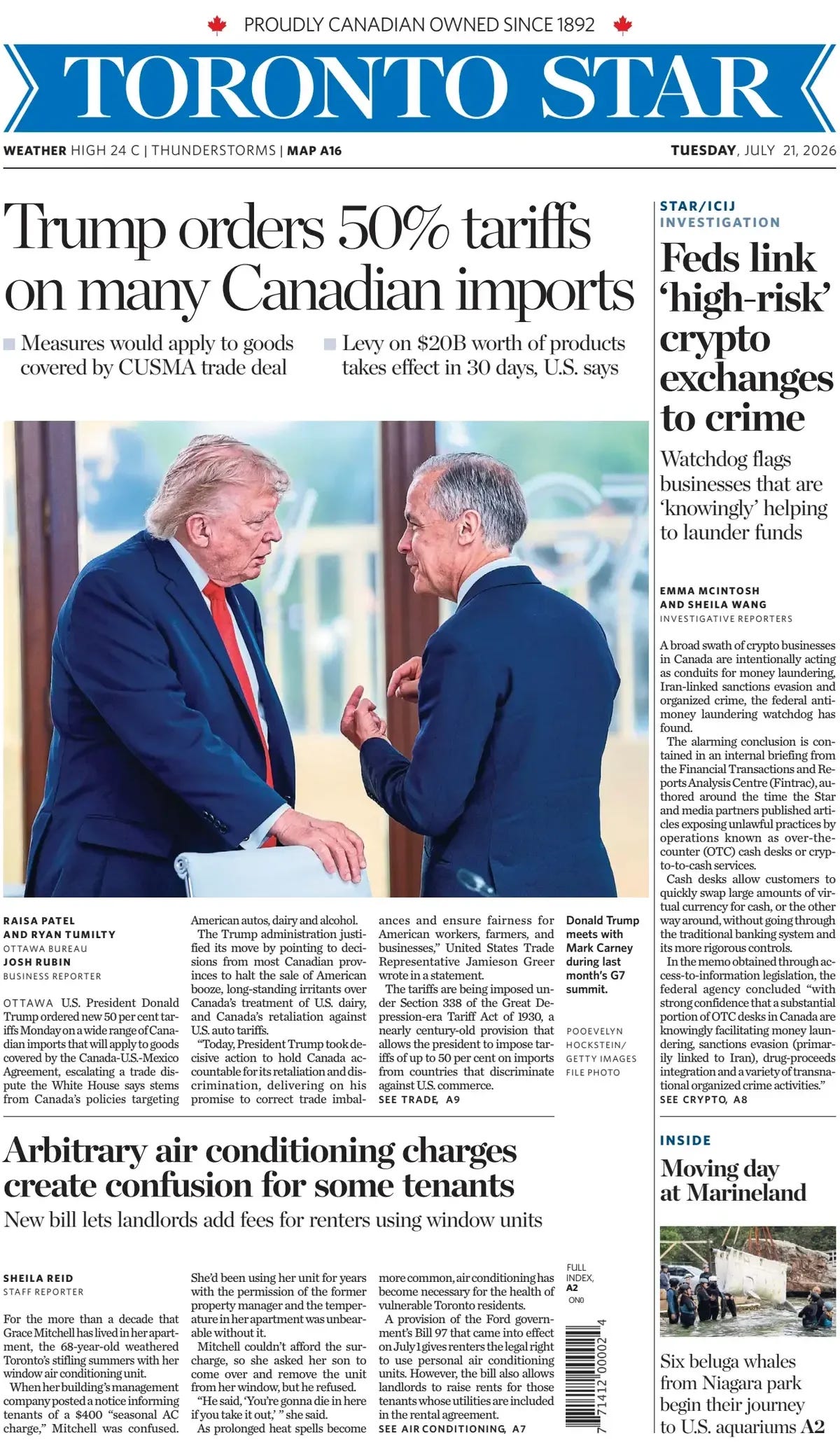
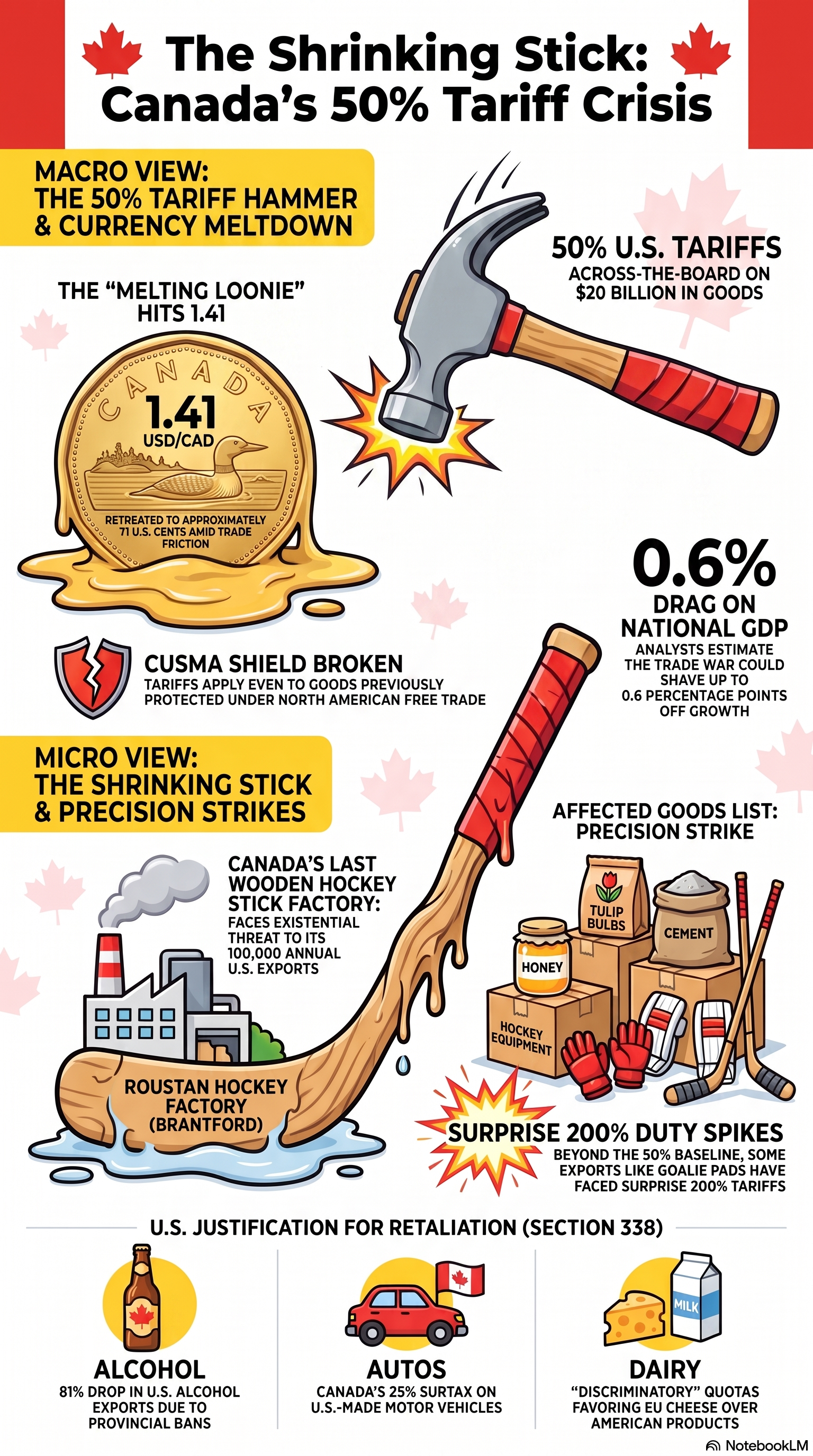
You can’t make this up: among the goods Donald Trump just hit with a 50 percent tariff - invoked under a dusty 1930 statute - are hockey sticks. Also wine, plywood, furniture, and sacred Canadian dairy. And unlike every previous salvo, these tariffs shred the USMCA fig leaf entirely: no exemptions, no carve-outs, no pretence that the trade agreement Trump himself signed in his first term still means anything.
Mark Carney’s response? Canada “stands ready to engage intensively.” With respect, Prime Minister: we’ve been engaging intensively for a year, and the lunch money keeps disappearing. Doug Ford - a man who’s been widely pilloried, and who has been compared, not unfairly, to Trump himself - nonetheless captured the national mood better than anyone in Ottawa when he arrived in Charlottetown talking about bullies and back heels. When the premier of Ontario sounds more like the voice of Canada than the prime minister, that’s a signal worth reading.
But here’s the thing about fighting back: anger is not a strategy. Leverage is.
Look south - further south. Mexico, facing the same bully, didn’t just retaliate; it pivoted. As reported recently in World Briefing, new Pacific-coast LNG terminals are now shipping Mexican gas to Asia, converting geographic vulnerability into market diversification. Look across the Pacific: Japan, watching the Iran war strangle the Strait of Hormuz, is ruthlessly re-engineering its energy dependencies in real time. Nobody in Tokyo is waiting to see if the old arrangements come back. And with European gas prices hitting four-month highs this week and Asian demand climbing into the summer heat, the world is practically begging for non-Gulf energy - a seller's market Canada was built for.
Canada, meanwhile, sits on the very cards Ford named - oil, gas, potash, electricity, critical minerals - and treats them like family heirlooms too precious to play. Kitimat is finally shipping LNG to Asia. TMX finally reaches tidewater. These shouldn’t be footnotes; they should be the centrepiece of a deliberate, loudly-announced strategy to make the American market optional rather than existential. That - not pulling bourbon off liquor store shelves in eight provinces while Alberta and Saskatchewan quietly restock it - is what “hitting back” actually looks like.
The wildfire-smoke tariff threat tells you everything about what Canada is dealing with: this is not a trade negotiation, it’s a protection racket with a grievance generator attached. You don’t appease that. You make yourself less available to it.
Elbows up, yes. But eyes up, too - on Asia, on Europe, on anywhere that isn’t a market run by a man who taxes hockey sticks. The puck, Prime Minister, is on your stick.
I'm tired of the bully trying to take our lunch money all the time. We always seem to be on our back heels. We need to be on the offence, not constantly on the defence with President Trump - Ontario Premier Doug Ford
News Briefs
Canadian Prime Minister Mark Carney spoke out Monday after the Trump administration announced a new 50 percent tariff on a range of exports from the U.S.’s northern neighbor. President Trump signed three orders in total, accusing the country of “discriminatory” trade policies. Carney slammed the new import taxes as “the latest … in a series of tariffs in direct violation” of the trade agreement between the U.S., Mexico and Canada, known as the United States-Mexico-Canada Agreement (USMCA). “This trade dispute has raised costs for families, particularly in the U.S.,” Carney said in a statement shared on the social platform X. “Canada stands ready to engage intensively to address outstanding issues with the U.S. to the mutual benefit of our citizens.” The Trump administration has already imposed tariffs on Canadian exports like steel and aluminum products, softwood timber and lumber. The new tariff policies will go into effect 30 days after signing and will be enforced under Section 338 of the Tariff Act of 1930, which permits up to 50 percent tariffs on imports from countries that discriminate against the U.S. The three policies signed by the president on Monday seek to target Canada’s alleged discrimination against three main U.S. American exports: automobiles, alcohol and dairy. Impacted exports include wine, hockey sticks, cement, furniture, paper, plywood, dairy products and more. The new policies differ from previous tariffs in that they apply to all goods, without exemption for Canadian goods covered under the USMCA. Carney said in his statement that Canada has drafted proposals to modernize the USMCA in the past 18 months in response to changes in the U.S.’s trade policies. “We stand ready to intensify those discussions in the coming weeks,” the prime minister wrote. Over the past year, Trump has placed economic and political pressure on Canada as part of his broader efforts to broker more advantageous trade policies for the U.S. The president’s suggestion to annex Canada as a “51st state” have provoked angry responses from the country’s citizens. Additionally, after wildfire smoke from Canada covered parts of the Northeast and Midwestern U.S., Trump threatened to impose new levies on the country. White House officials told reporters on a Monday call that the 50 percent tariffs are not related to the wildfires — adding that the president has provided options related to the handling of the smoke - The Hill
Ontario Premier Doug Ford - who has ironically been compared to Donald Trump - says he’s “losing patience” following U.S. President Donald Trump’s latest tariff hit and urged the federal government to “hit him back as hard as we can.” He added: “I’m tired of the bully trying to take our lunch money all the time. We always seem to be on our back heels. We need to be on the offence, not constantly on the defence with President Trump,” said Ford as he arrived in Charlottetown for three days of meetings with his provincial and territorial counterparts, CBC reported. “I’m losing patience … we can’t keep rolling over it. We can’t keep backing down. We have to go full tilt.” Ford resurrected his suggestion Canada cut off energy supplies to its southern neighbour. “We are an energy powerhouse and we could dismantle the U.S. if we wanted to,” said Ford. “The potash, the oil, we’re their number-one customer in the world, they need to feel the pain rather than us constantly feeling the pain.” His comments will likely cause a stir as he sits down with his counterparts for their annual summer meetings, which have been reoriented following Washington’s announcement that it will impose 50 per cent tariffs on a range of goods. The squeeze from Canada’s southern neighbour puts pressure on the premiers to respond. Already there’s division on what to do with the majority of provinces’ decision to stop selling American alcohol in retaliation to Trump’s previous tariffs on things like the auto sector, steel and aluminum. Only Alberta and Saskatchewan still offer U.S. booze. Separately, when asked whether provinces should put U.S. booze back on the shelves, in light of Trump’s persistent complaints, Carney said that’s up to premiers, CTV reported.
Trump said he is looking at separate tariffs to impose on Canada over wildfire smoke. “A lot of damage has been done. They’re not managing their forests properly,” the president said. Last week, Trump threatened to impose additional tariffs on Canada over wildfire smoke coming into the U.S. In a background briefing on Monday, a senior Trump administration official confirmed that the president has “asked for options” when it comes to wildfire-related tariffs and “options are being shared with him.” - CTV

Ukrainian President Volodymyr Zelensky has replaced Kyiv’s military chief, General Oleksandr Syrskyi, after days of widespread protests against the removal of the country’s popular defense minister, whose ousting revealed an unprecedented public split in the military over its strategy in the war against Russia. Mykhailo Drapatyi, who is the commander of Ukraine’s Joint Forces, will become Ukraine’s new commander-in-chief, Zelensky announced on Tuesday evening. Meanwhile, Zelensky offered Mykhailo Fedorov, whose removal as defense minister sparked this political storm, a “prominent position in government that would allow him to unify the technical component of our state and ensure its development.” Aged 35 years old, Fedorov carved out a reputation as pioneering innovative approaches to technology and recruitment but clashed with other members of Ukraine’s defense establishment. His six-month tenure as defense minister coincided with Ukraine’s recent success on the battlefield and so his removal, amid disagreements with Syrskyi, caused a backlash against the military chief - CNN
Russian and German officials met for secret talks in Azerbaijan earlier this month, Azerbaijani President Ilham Aliyev told reporters on Tuesday, though he did not detail what was discussed during the meeting. “Our territory was used for such a meeting without our knowledge… Flight data allows me to state that a secret meeting did take place in Baku,” Aliyev said during a joint press conference with German Chancellor Friedrich Merz. The chancellor said he was unaware of the meeting. According to the German tabloid Bild, Azerbaijan’s border services recorded former minister president of Brandenburg Matthias Platzeck and former chief of staff of the German chancellery Ronald Pofalla arriving in the South Caucasus country on July 12. Russia’s former prime minister and current Gazprom board chairman Viktor Zubkov and current presidential human rights chief Valery Fadeyev reportedly arrived in Azerbaijan shortly after. Kommersant reported that Aliyev confirmed their visit to the country - Moscow Times
The European Commission has confirmed the withdrawal of the €2 million grant earmarked for the La Biennale di Venezia Foundation, opening up a new front of tension between Brussels and one of Italy's most important cultural institutions. The decision, formalised on Tuesday by the European Education and Culture Executive Agency (Eacea) after a legal assessment and on the Commission’s recommendation, is linked to Russia’s controversial participation in the 2026 Art Biennale. According to the EU executive, cultural events supported with Union funds must promote and uphold democratic values, dialogue, diversity and freedom of expression, principles that ‘are not respected in today’s Russia’. This is the reasoning with which Brussels has justified cutting off the European contribution - Euronews
Vladimir Putin’s top TV propagandists are starting to betray signs of panic inside the Kremlin. They admit the war in Ukraine is spiraling out of control, and Putin can no longer protect the Russian people, but they are warning against bringing Putin down as it would spill “lots of blood.” Decorated state TV host Vladimir Solovyov, who used to relish the idea of destroying Ukraine’s energy infrastructure and freezing its citizens to death, is now warning Russians to prepare for Ukrainian strikes that might leave them without heating this winter. During the latest broadcast of Sunday Evening With Vladimir Solovyov, the host opened the program by trying to cheer people up. He asserted that "there is no panic," even though "things are difficult."Effectively conceding that Russia is unable to protect its border regions, Solovyov suggested relocating hundreds of thousands of people from Kursk, Bryansk, Belgorod, Crimea, and occupied parts of Donetsk, Luhansk, Zaporizhzhia, and Kherson to distant areas within Russia, like the Volga, Urals, and Far East - The Daily Beast
European natural gas prices shot to a four-month high as renewed violence around the Strait of Hormuz triggered concerns about the feasibility of transporting energy through the world’s most vital energy chokepoint. The benchmark European natural gas price — known as the Dutch TTF — briefly crossed €60 per megawatt-hour on Monday, the highest level since mid-March, and settled at €59 per megawatt-hour on Tuesday after the United States launched a tenth consecutive night of strikes against Iran. Tehran responded by targeting U.S. allies in the region and tankers in the Persian Gulf. Before a ceasefire was struck in June, gas prices had consistently stayed below €50 per megawatt-hour, with traders wary of placing big bets during a war that had become impossible to predict. Tuesday’s prices represent a 50 percent increase from the previous month. They also reflect concern that gas supplies will be further squeezed by the combination of depleted European reserves and high summer temperatures in Asia, which analysts expect will drive up demand for air conditioning - Politico
This year’s El Niño weather system, expected to be one of the strongest in decades, could cause a global economic shock that the world is unable to absorb given existing stress on supply chains, Deutsche Bank warned. The phenomenon causes temperature spikes every few years and shifts weather patterns, exacerbating global warming trends: The US can expect wetter conditions, and India weaker monsoons. Disruption to agriculture, hydropower, shipping, and even political stability makes it “a multi-channel supply shock,” DB economists said. Alongside the Iran war, El Niño will “push inflation higher … when it is already above target.” It also raises the risk of natural disasters: China is offering typhoon survival training in coastal cities ahead of El Niño’s arrival - Semafor
The journals…