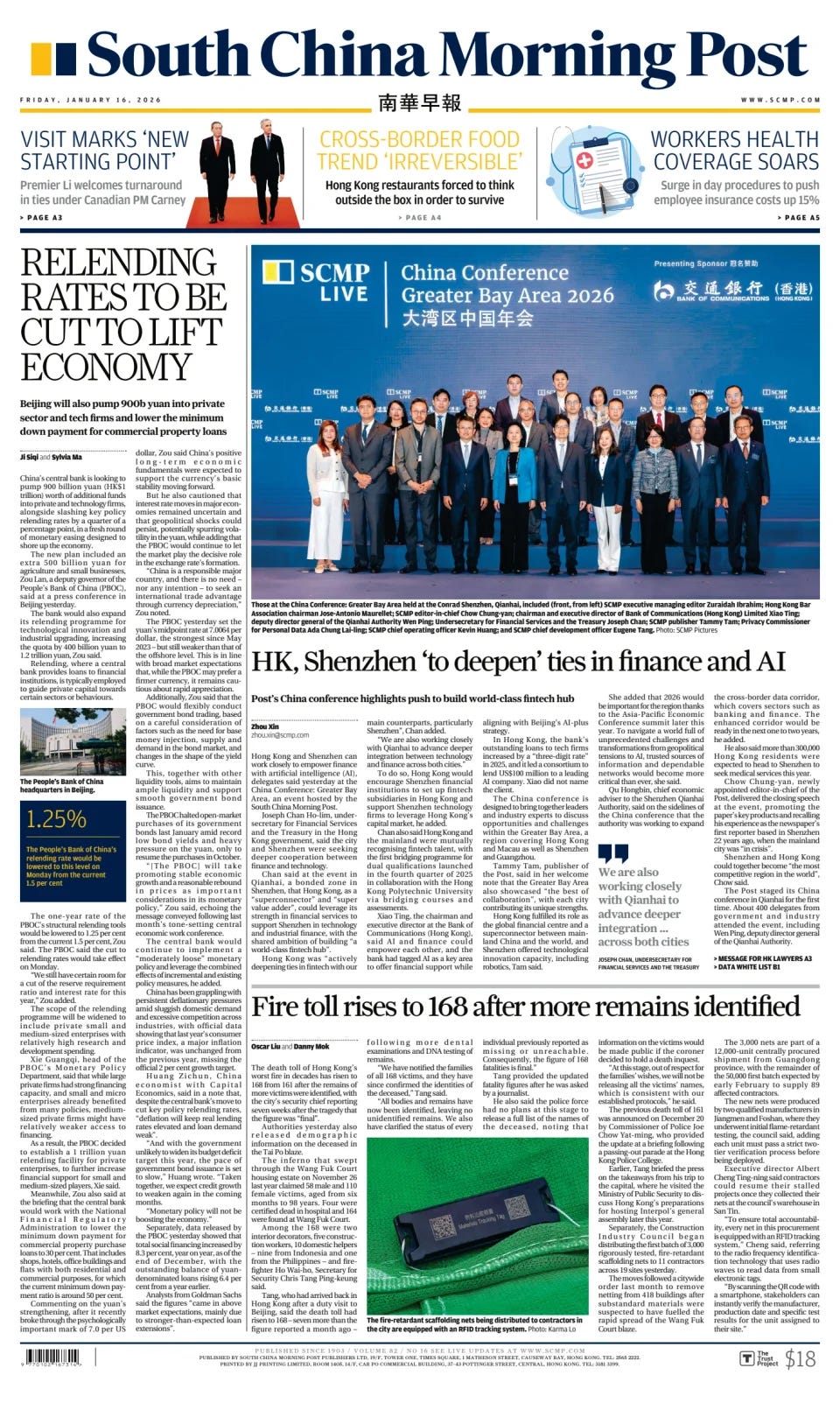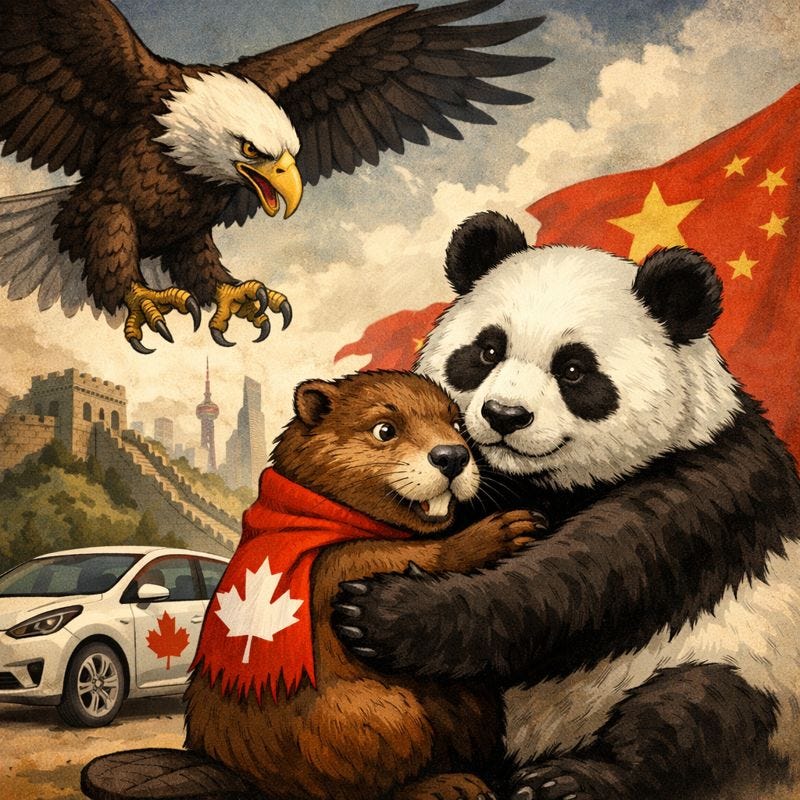
Prime Minister Mark Carney’s first trip to China - the first by a Canadian leader in nearly a decade - isn’t about symbolism. It’s about survival economics. Canada has finally internalized the risk of being tethered to the U.S. market while Washington leverages tariffs and tantrum diplomacy towards friends and foes alike. So Ottawa is doing what middle powers do in a fractured global economy: it’s diversifying, fast - shifting, as I’ve advocated, from a north–south dependency toward an east–west rebalancing, starting with the world’s biggest trading superpower. And the early deliverables are enough to generate a decent press release: China is expected to slash tariffs on Canadian canola oil from 85% to 15% by March 1, while Canada drops its tax on Chinese electric vehicles to the most-favoured-nation rate of 6.1%. This reset is being built invoice-by-invoice, not slogan-by-slogan.
What jumps out from Carney’s tone is the clinical, dry realism that one would expect from a former central banker. He’s essentially telling Canadians: we’re not going to “change” China, but we can work with China where interests overlap. He called the talks “realistic and respectful,” and even praised Beijing’s recent “predictability” - which, in today’s chaos, reads like a diplomatic compliment, a dig at the Trump White House and a strategic necessity rolled into one.
But this is not a starry-eyed thaw. It’s a managed relationship - with “red lines” and “guardrails”. Carney made a point of saying Canada doesn’t agree with Beijing on everything, flagging human rights and election interference as hard boundaries. (Indeed, as recently as 2025, the Canadian government said Beijing “is the most active state conducting foreign interference activities” in the country.
That matters because Canada isn’t walking into this blind. It’s walking in with scars - from the 2018 detention of Huawei CFO Meng Wanzhou to China’s retaliatory detention of the “two Michaels,” and from trade retaliation to allegations of interference (anyone remember claims that Beijing had established “Chinese police stations” in Canada to intimidate critics)?
As I have learned from more than a decade reporting in Asia, including China and Hong Kong - trust in Asia doesn’t reset with one summit or meeting - or handshake for that matter. It’s earned - or lost - over years.
And that’s where the beaver-and-panda metaphor lands: a tighter embrace can still come with scratches. More Chinese EVs and investment could help cushion the shock of U.S. uncertainty - but it also raises unavoidable questions about dependency, technology access, and espionage risk in an era where supply chains and data are strategic weapons. (I have seen first hand here in Europe how Chinese EVs have dominated that sector of auto sales).
Unsurprisingly, it’s already producing political blowback at home. Ontario Premier Doug Ford - guardian of Canada’s auto belt - has been warning against opening the door to cheaper Chinese vehicles, fearing it undercuts jobs and risks U.S. retaliation, given how integrated Ontario’s supply chain is with American firms and markets. “This was not thought out properly,” Ford told reporters. “It was a knee-jerk reaction, as far as I’m concerned, and this is going to be a big, big problem.”
In Washington, Carney’s China reset appears to be drawing mild immediate pushback. U.S. President Donald Trump had no apparent criticism for the prime minister: "If you can get a deal with China, you should do that.”
Bottom line: better Carney went than he didn’t. It was a calculated (or in Carney’s bank-speak, “calibrated”) move. This is the beginning of a phased reset - business first, guardrails up, values voiced more quietly but not abandoned. Yet Canadians should brace for short-term pain as the U.S. relationship remains unstable. Carney is betting that diversification buys resilience - and that Canada can do trade with China without being swallowed by it. The beaver is stepping closer to the panda. The trick now is not getting pinned.
Chinese leader Xi Jinping and Canadian PM Mark Carney have announced lower tariffs, signalling a reset in their countries’ relationship after a key meeting in Beijing. China is expected to lower levies on Canadian canola oil from 85% to 15% by 1 March, while Ottawa has agreed to tax Chinese electric vehicles at the most-favoured-nation rate, 6.1%, Carney told reporters. The deal is a breakthrough after years of strained ties and tit-for-tat levies. Xi hailed the “turnaround” in their relationship but it is also a win for Carney, the first Canadian leader to visit China in nearly a decade. He has been trying to diversify Canadian trade away from the US, his country’s biggest trading partner, following the uncertainty caused by Trump’s on-again-off-again tariffs. The deal could also see more Chinese investments in Canada, right on America’s doorstep. Carney himself seemed to allude to the fact that this was a result of Trump’s tariffs, which have now pushed one of the US’s key allies towards its biggest rival. He told reporters that Canada’s relationship with China had been more “predictable” in recent month and that he found talks with Beijing “realistic and respectful”. He also made clear Ottawa does not agree with Beijing on everything, adding that in his discussions with Xi he made clear Canada’s “red lines”, including human rights, concerns over election interference and the need for “guardrails”. Observers believe Carney’s visit could set an example for other countries across the world who are also feeling the pain from Washington’s tariffs. As the Chinese and Canadian delegations sat down in the Great Hall of the People on Friday, Xi said: “The healthy and stable development of China-Canada relations is conducive to world peace, stability, development, and prosperity.” - BBC
Iranian authorities are reportedly demanding money to return the bodies of some of the 2,435 killed in the last few weeks. In some cases, hospital staff have phoned relatives of the dead to give them an advance warning to collect the bodies before security forces can extort any funds. When the family of a construction worker killed in recent protests in Iran went to collect his body, they said authorities told them they would have to pay a billion tomans ($7,000; £5,200) to receive it. The family said they couldn’t afford the fee and left empty-handed. The average construction worker in Iran earns less than $100 a month. Theirs is just one of multiple stories the BBC has been told of.
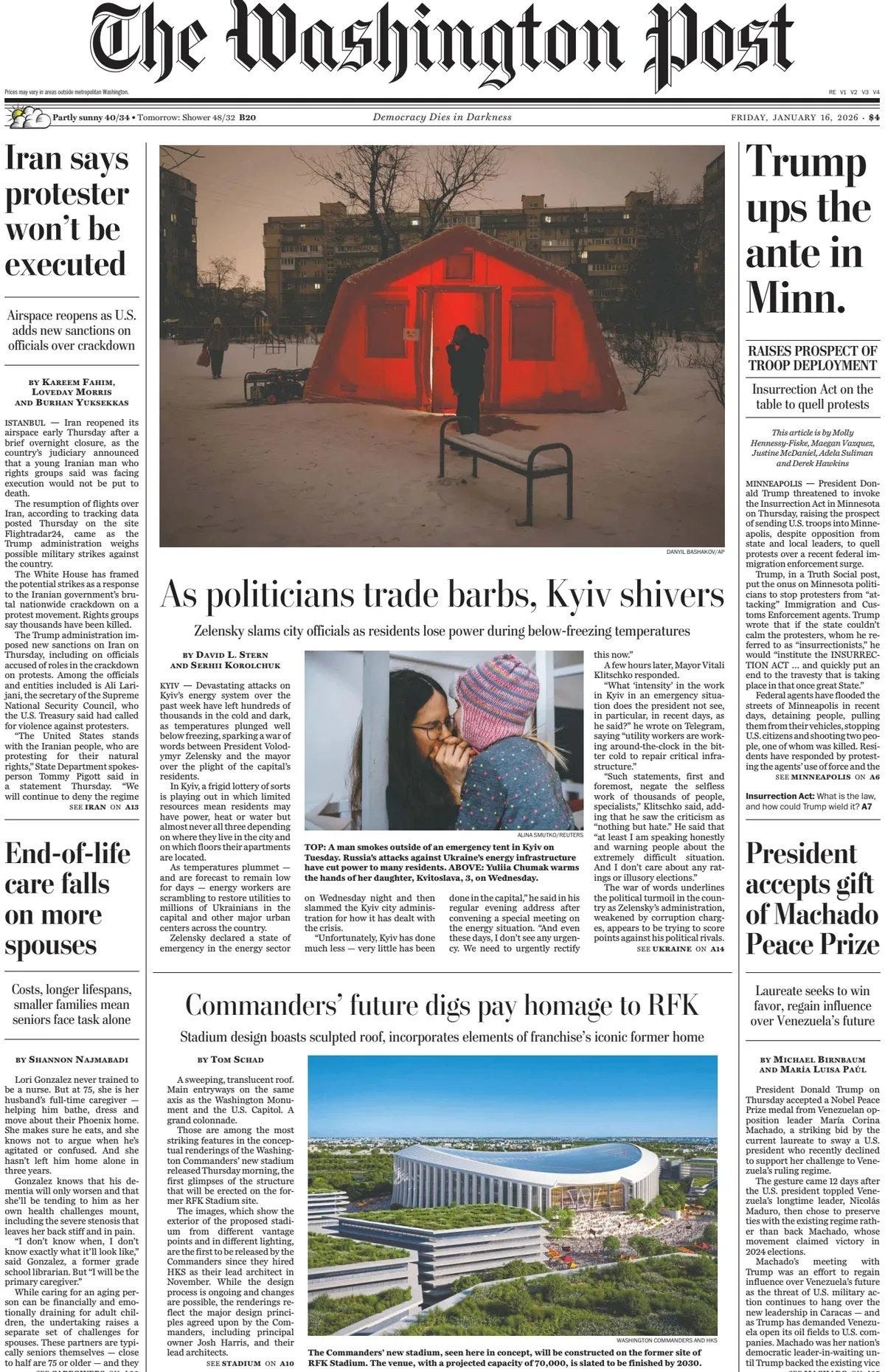
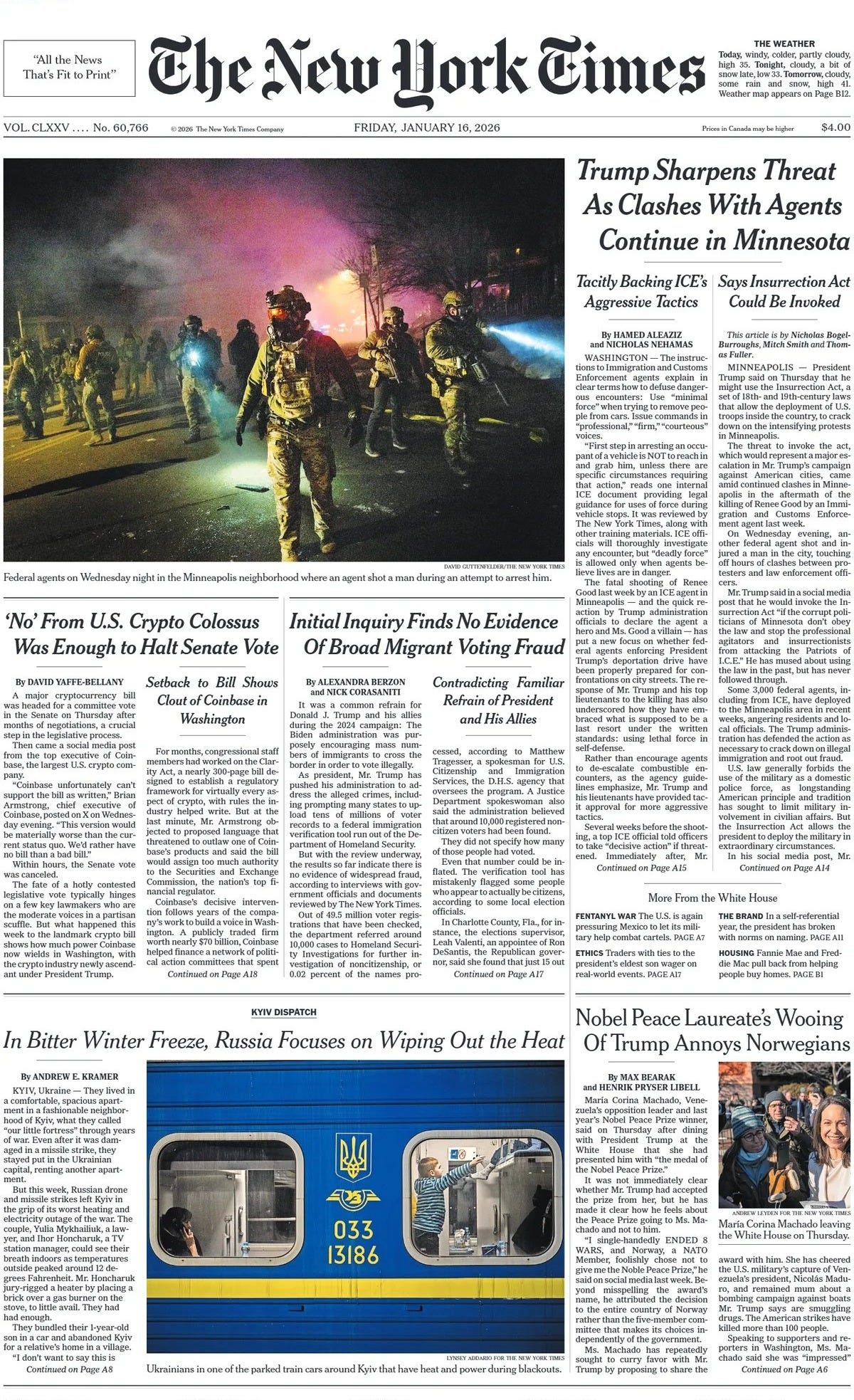
While temperatures plunge across Ukraine in a brutal cold snap - forcing countless residents to seek shelter in heating centres or with relatives farther afield - one thing that hasn’t cooled is the heated war of words between President Volodymyr Zelensky and big-city mayors and opposition figures. As The Washington Post and other outlets have reported, Zelensky declared a state of emergency in the energy sector on Wednesday night, then sharply criticized the Kyiv city administration for what he called a poor response to the crisis. “Kyiv, unfortunately, has done much less – very little has been done in the capital. And even these days I don’t see any intensity – we need to urgently fix all this now. There must be solutions,” the president emphasized in an evening video address, while praising efforts in the heavily bombed eastern city of Kharkiv. Kyiv Mayor Vitali Klitschko quickly fired back on Telegram: “What ‘intensity’ in the work in Kyiv in an emergency situation does the president not see, in particular, in recent days, as he said?” he asked, adding that “utility workers are working around-the-clock in the bitter cold to repair critical infrastructure….Such statements, first and foremost, negate the selfless work of thousands of people, specialists,” Klitschko said, calling Zelensky’s criticism “nothing but hate.” Klitschko insisted he was leveling with Ukrainians about the scale of the challenge. “At least I am speaking honestly and warning people about the extremely difficult situation. And I don’t care about any ratings or illusory elections.” In the wake of the latest strikes, Klitschko said around 6,000 buildings were left without heat. He also urged residents to leave the capital temporarily if they could (a striking reversal from early 2022, when Zelensky dismissed warnings of a full-scale Russian invasion and urged Ukrainians to stay put in order to avoid panic, even as many Western intelligence services warned the attack was imminent). Klitschko said his comments triggered a wave of online backlash. By yesterday, however, he reported the number of buildings without heat had fallen dramatically, to just 400.
Ukraine is facing a winter emergency — and the world needs to treat it like the crisis it is. In my live interview with CNN, we focused on the brutal cold snap now gripping Ukraine, combined with cascading power, heating, water, and lighting outages. Forecasters warn the freeze could stretch up to 10 days, with temperatures plunging closer to -20°C, pushing millions into survival mode.
▶️👇 Watch the clip below
The Ugandan military is fully deployed to the streets of Kampala, there is a total internet blackout and the permits of at least nine local human rights organisations have been suspended - all while Ugandans vote for who they want to see govern the country for the next five years. “This is supposed to be an election, but besides switching off the internet, our agents are being picked by security to ensure that the election happens in the dark,” says pop star opposition politician Bobby Wine. His National Unity Party says that 300 of their supporters and party officials have been detained in the weeks building up to this election as he runs against Uganda‘s long-time ruler President Yoweri Museveni for the second time. President Museveni denies long-time allegations of election rigging and told me that it is the opposition that rigs the election. “They try but they can’t overturn us. We are too popular,” he says. “Bobi Wine breaks the law, that is why. There are other people in opposition - you don’t find us having problems with them. But if you take each case, you find that he is breaking the law,” the president says. “He says I break the law, but I’m not arrested. Why am I not arrested and charged?” Wine replies. “If I break the law, the only law that I break is to stand and challenge a 40-year-old dictatorship.” - Sky News
**** Uganda’s Electoral Commission said on Friday that the Museveni had taken 76.25 percent of the vote, according to tallies from nearly half of all polling stations. The UN human rights office said last week that the election was being held in an environment of “widespread repression and intimidation.” - Al Jazeera
An almost brand new Air India passenger plane engine was badly damaged after it sucked up a storage container while taxiing to its gate. The Airbus A350 was scheduled to fly to New York City on Thursday but was forced to return to Delhi when Iran temporarily closed its airspace amid tensions with the U.S. With 240 passengers onboard, flight AI 101 touched down safely in heavy fog, but as it made its way across the apron, it sucked in a container through its right engine. No one was hurt, but the two-year-old plane’s engine suffered significant damage, the BBC reports. Footage published by The Times of India, taken from inside the plane through the fog, shows the engine stuffed with debris. The aircraft has been grounded, with India’s ministry of civil aviation saying the container fell “onto the taxiway intersection” after a wheel came loose on the trolley that was carrying it, the BBC reports. “However, the container which fell was left behind and it got ingested into the No. 2 engine of the aircraft,” Air India told the BBC.
The journals…..